
 By
By 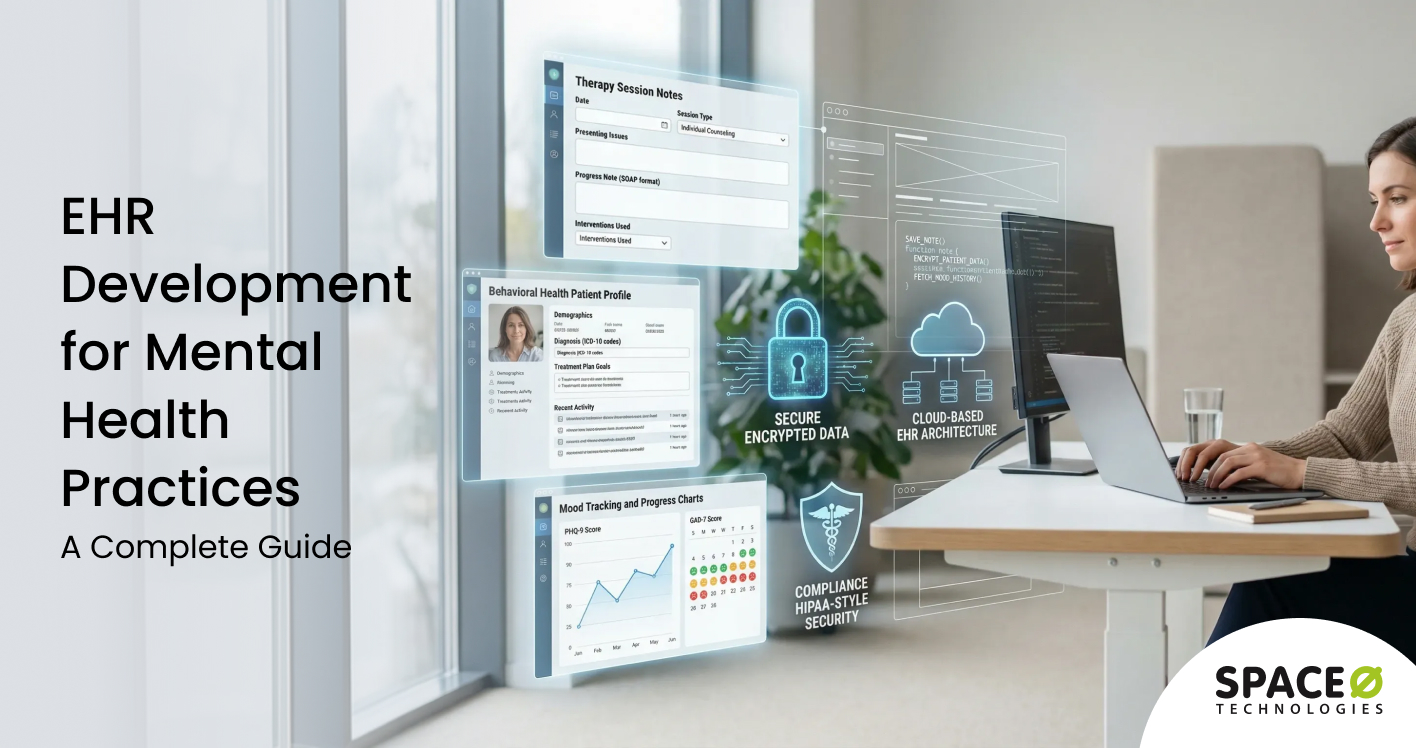
Contents
Mental health practices are increasingly adopting digital solutions to improve care delivery, streamline documentation, and enhance patient engagement.
According to Grand View Research, the U.S. behavioral health EHR market reached USD 316.95 million in 2025 and is expected to reach USD 518.98 million by 2030. This steady growth reflects the rising demand for specialized EHR systems tailored to the unique workflows of behavioral and mental health providers.
Unlike general healthcare settings, mental health practices require detailed therapy notes management, long-term treatment tracking, secure telehealth integration, and enhanced confidentiality controls. Generic EHR systems often fail to address these specific needs, leading to workflow inefficiencies and documentation challenges.
Developing a custom EHR system for mental health practices allows providers to build solutions aligned with therapy workflows, psychiatric evaluations, compliance requirements, and hybrid care models.
This blog covers everything you need to know about developing an EHR software for mental health practice. With 15+ years of experience as a leading EHR software development agency, we have shared insights on the benefits of EHR development for mental health clinics, essential features, the development process, key challenges, and cost considerations to help you make informed decisions.
What Is Mental Health Practice EHR Development?
Mental health practice EHR development is the process of building an electronic health record system specifically tailored to the workflows of behavioral health providers. Unlike generic EHR platforms, these systems are structured to support therapy sessions, psychiatric evaluations, treatment plans, progress notes, and long-term patient engagement.
A mental health EHR system goes beyond basic patient record management. It is built to handle detailed psychotherapy notes, DSM-based diagnostic documentation, medication management, e-prescriptions, group therapy records, outcome tracking, and secure telehealth sessions. Since mental health care often involves recurring visits and extended treatment plans, the system must allow structured yet flexible documentation while maintaining strict confidentiality controls.
Ultimately, mental health practice EHR development focuses on creating a secure, scalable, and workflow-aligned digital system that improves clinical efficiency, protects sensitive patient information, and supports high-quality behavioral healthcare delivery.
Benefits of Developing a Specialized EHR Solution for Mental Health Practices
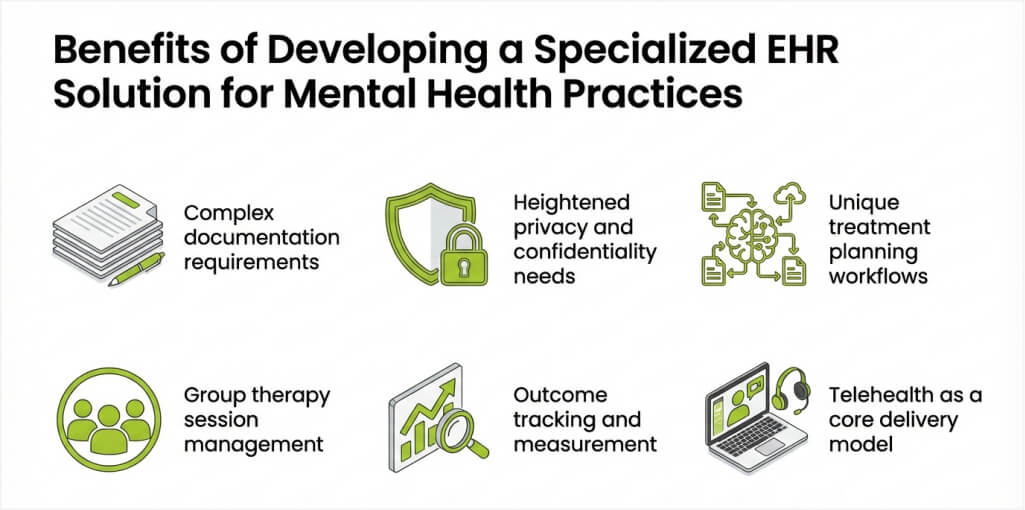
Standard EHR platforms serve hospitals and primary care clinics well. However, they fall short when applied to behavioral health environments. Mental health providers face distinct clinical, regulatory, and workflow demands. These differences require purpose-built digital solutions that generic systems cannot deliver.
Behavioral health documentation differs fundamentally from physical health records. Therapy sessions produce narrative notes rather than structured clinical data points. Treatment spans months or years instead of single visits or short episodes.
1. Complex documentation requirements
Mental health clinicians produce detailed narrative therapy notes during every session. Progress notes in behavioral health follow formats such as DAP, SOAP, or BIRP. Generic EHR templates designed for physical exams cannot accommodate these documentation styles. Specialized platforms offer therapy-specific templates that save time and improve accuracy.
2. Heightened privacy and confidentiality needs
Behavioral health records contain extraordinarily sensitive patient information. Substance use disorder records fall under 42 CFR Part 2, which adds protections beyond standard HIPAA rules. Therapy notes require separate storage with restricted access controls in most settings. A purpose-built system automatically enforces these layered privacy requirements.
3. Unique treatment planning workflows
Mental health treatment plans evolve continuously based on patient progress and response. Clinicians adjust goals, interventions, and timelines throughout the care journey. Standard platforms lack the flexibility to support this iterative planning process. Custom solutions let providers update and track treatment plans without cumbersome workarounds.
4. Group therapy session management
Many behavioral health practices offer group therapy as a core service. Providers must document attendance, individual responses, and session themes for multiple patients simultaneously. Generic record systems lack tools to handle group session billing and documentation. Specialized platforms streamline this process with built-in features for managing group therapy.
5. Outcome tracking and measurement
Mental health providers rely on standardized assessment tools to measure patient progress over time. Instruments like the PHQ-9, GAD-7, and CAGE questionnaires guide clinical decisions throughout treatment. General platforms rarely support these behavioral health assessment workflows natively. Custom systems embed outcome measurement directly into the clinical documentation process.
6. Telehealth as a core delivery model
Virtual care has become essential for delivering mental health services nationwide. Therapists conduct a significant portion of sessions through secure video platforms today. Standalone telehealth tools create disconnected workflows when they lack EHR integration. A purpose-built system seamlessly embeds virtual care directly into the clinical record.
These factors make specialized EHR development a strategic priority for behavioral health providers. Practices that rely on generic platforms sacrifice efficiency, compliance, and care quality daily. Investing in custom solutions addresses these gaps and positions providers for long-term success.
Build Compliant EHR Software Tailored to Mental Health Care Workflows
Work with experienced EHR developers who understand behavioral health workflows and compliance requirements.

Essential Features for a Mental Health EHR System
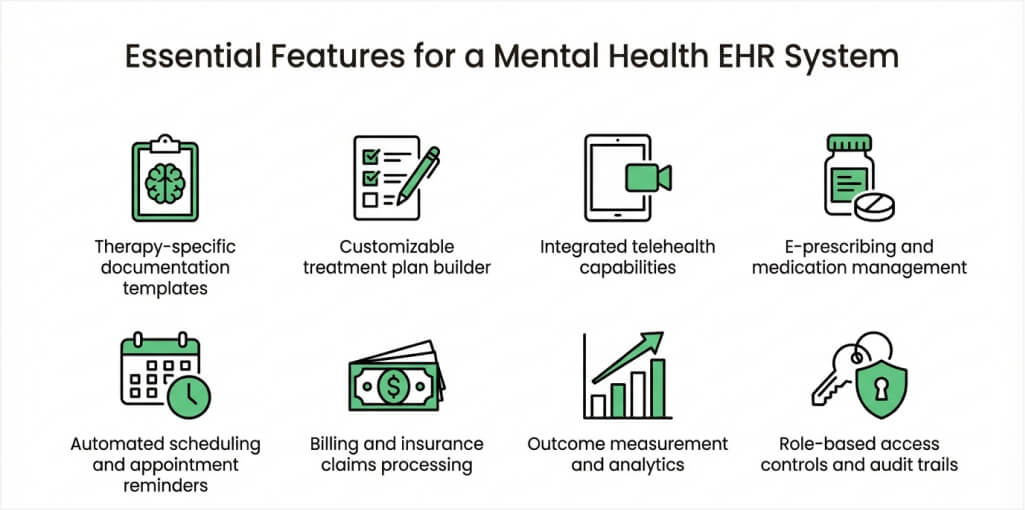
Building an EHR system for behavioral health requires careful feature selection from the start. Each capability must align with how mental health clinicians actually work with patients. The right feature set improves clinical efficiency while maintaining strict regulatory compliance. Missing even one critical function creates workflow bottlenecks that frustrate providers daily.
Below are the most important capabilities every mental health EHR platform must include. Prioritizing them during development ensures the final product delivers real clinical value.
1. Therapy-specific documentation templates
Behavioral health documentation follows distinct formats that differ from general medical notes. Templates should support DAP, SOAP, BIRP, and narrative progress note structures natively. Pre-built templates for intake assessments, psychiatric evaluations, and discharge summaries save valuable time. Clinicians complete documentation faster when templates align with their natural workflow.
2. Customizable treatment plan builder
Every patient’s mental health journey follows a unique path through care. The system must allow providers to create individualized treatment plans with flexible goals. Clinicians should track interventions, adjust timelines, and document progress within the same interface. Customizable plan builders eliminate the need for external documents or manual tracking spreadsheets.
3. Integrated telehealth capabilities
Virtual therapy sessions require seamless recording within the clinical documentation system. The platform should include secure video conferencing with automatic session logging features. Digital intake forms, consent management, and virtual waiting rooms enhance the remote care experience. Built-in telehealth eliminates the need for separate third-party video tools entirely.
4. E-prescribing and medication management
Psychiatrists and prescribing providers need direct electronic prescribing from within the patient chart. The system should automatically verify drug interactions, allergies, and dosage guidelines. Controlled substance prescribing must comply with EPCS requirements and state regulations consistently. Medication history tracking helps providers monitor adherence patterns across appointments.
5. Automated scheduling and appointment reminders
Mental health practices manage recurring weekly or biweekly appointments for ongoing clients. The scheduling module should support repeating sessions, waitlists, and provider availability management. Automated reminders via text, email, or phone significantly reduce no-show rates. Calendar integration helps both clinicians and patients stay organized throughout their care journey.
6. Billing and insurance claims processing
Revenue cycle management features should accurately handle mental health-specific CPT codes and modifiers. The system must support insurance eligibility verification during patient check-in workflows. Automated claim generation reduces billing errors and accelerates reimbursement cycles for providers. Superbill creation and payment tracking streamline the financial side of practice operations.
7. Outcome measurement and analytics
Clinical assessment tools must integrate directly into the patient documentation workflow. Providers need to administer, score, and track instruments such as the PHQ-9 and GAD-7 within the chart. Visual dashboards should clearly display outcome trends over time for individual patients. Practice-level analytics helps administrators measure program effectiveness and identify opportunities for improvement.
8. Role-based access controls and audit trails
Sensitive therapy notes require strict access restrictions beyond standard record security measures. The platform must support granular role-based permissions for every user type. Administrative staff should be able to access scheduling and billing without viewing clinical note content. Comprehensive audit trails log every access event for compliance reporting and security monitoring.
These features form the foundation of a functional behavioral health EHR platform. Development teams should validate each capability with actual clinicians before finalizing the product scope. A feature-rich platform only delivers value when it aligns with real clinical needs.
Step-by-Step Process for Mental Health EHR Development
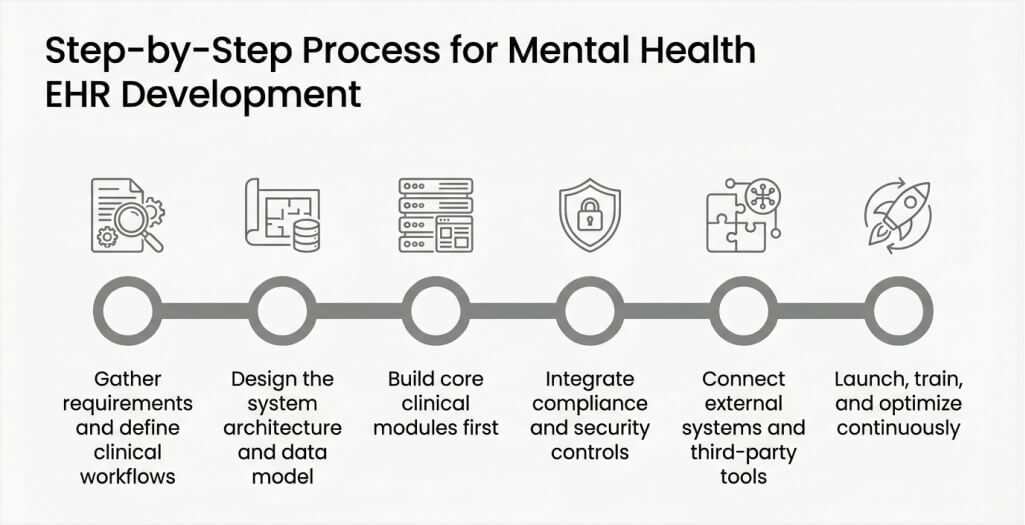
Building a custom EHR requires a structured approach to manage complexity and reduce risk. Each phase builds on the previous one to create a solid foundation for the final product. Skipping any stage often leads to costly rework and extended project timelines later. Following this process helps development teams deliver reliable solutions on schedule.
Step 1: Gather requirements and define clinical workflows
Start by documenting every workflow your mental health practice performs daily. Interview therapists, psychiatrists, administrative staff, and billing personnel for detailed input. Thoroughly map existing processes for intake, documentation, scheduling, billing, and reporting. This discovery phase reveals the specific features and integrations your platform needs.
Step 2: Design the system architecture and data model
Carefully choose your technology stack based on scalability, security, and compliance requirements. Define the database structure to accommodate therapy notes, treatment plans, and assessment data. Plan for cloud deployment with encryption, backup, and disaster recovery capabilities built in. Document architectural decisions so every team member understands the system’s technical foundation.
Step 3: Build core clinical modules first
Develop the essential documentation, scheduling, and patient management features before anything else. Focus on therapy note templates, treatment plan builders, and patient intake workflows initially. Each module should undergo clinical review to verify it matches real provider workflows. Building core features first lets clinicians test the system early in the development cycle.
Step 4: Integrate compliance and security controls
Implement HIPAA security safeguards, including encryption, access controls, and audit logging, throughout the system. Add 42 CFR Part 2 protections for substance use disorder records where applicable. Build role-based permissions that restrict therapy note access to authorized clinicians only. Conduct security testing at every integration point to identify vulnerabilities before launch.
Step 5: Connect external systems and third-party tools
Integrate the platform with labs, pharmacies, billing clearinghouses, and telehealth services. Use FHIR and HL7 standards to exchange data with other clinical applications. Build APIs that allow future connections without requiring major architectural changes later. Test every integration thoroughly in a sandbox environment before deploying to production.
Step 6: Launch, train, and optimize continuously
Deploy the platform with dedicated support available for immediate troubleshooting needs. Provide comprehensive training for every user role, including clinicians and administrative staff. Monitor system performance, error rates, and user feedback closely during the initial weeks. Establish ongoing maintenance routines to keep the platform secure and up to date.
Looking for a Reliable Mental Health EHR Development Partner?
Hire our healthcare technology experts who build compliant, user-friendly platforms. Strengthen your practice operations without the complexity of building in-house.
Compliance and Security Requirements for Mental Health EHR Development
Mental health EHR platforms face stricter compliance demands than general healthcare systems. Behavioral health data is highly sensitive and requires additional protective measures. Regulatory requirements span federal privacy laws, state regulations, and industry security standards. Failing to meet these obligations exposes practices to severe financial and legal consequences.
According to the IBM Cost of a Data Breach Report, the healthcare sector continues to face the steepest financial impact from data breaches, with the average cost per incident reaching approximately USD 10.93 million, significantly higher than other industries. The financial sector follows with average breach costs of around USD 5.9 million. In addition, healthcare data breaches tend to go undetected for longer periods, with a typical time to discovery of about 213 days, compared with 194 days across other sectors, increasing overall response and recovery costs.
1. HIPAA Privacy and Security Rule compliance
Every mental health EHR must meet HIPAA requirements for protecting patient health information. The Security Rule mandates administrative, physical, and technical safeguards for electronic records. Encryption, access controls, and workforce training form the baseline security framework, making HIPAA-compliant EHR development a foundational requirement rather than an afterthought. The proposed 2025 HIPAA Security Rule update will require encryption and multi-factor authentication.
2. 42 CFR Part 2 protections for substance use records
Substance use disorder treatment records require additional privacy protections under federal law. The February 2024 Final Rule harmonized Part 2 with HIPAA while maintaining core consent requirements. Providers now use a single consent for treatment, payment, and healthcare operations disclosures. Development teams must build consent management workflows that automatically enforce these regulations.
3. Psychotherapy notes separation
HIPAA provides special protections for psychotherapy notes created during counseling sessions. These notes must be stored separately from the general medical record within the system. Access requires explicit patient authorization beyond the standard treatment consent form. The platform must enforce this separation through technical controls rather than manual policies.
4. Data encryption at every layer
All patient information must be encrypted both during transmission and while stored in databases. AES-256 encryption provides the standard protection level for healthcare data at rest. TLS 1.2 or higher secures data flowing between system components and external services. Encryption key management practices must follow industry standards for rotation and storage.
5. Audit trail and access logging
The system must record every instance of data access, modification, or deletion comprehensively. Audit logs should automatically capture user identity, timestamp, action type, and affected records. These logs support compliance investigations and breach response activities when needed. Regular audit reviews help identify suspicious access patterns before they escalate into incidents.
6. Business Associate Agreements with vendors
Every third-party service that handles patient data must sign a Business Associate Agreement. This requirement applies equally to cloud hosting providers, payment processors, and integration partners. The agreement explicitly defines each party’s responsibilities for protecting patient information. Development teams must verify BAA coverage before connecting any external service to the platform.
These compliance requirements protect both patients and providers from serious consequences. Building security into the development process from day one saves high costs. Retrofitting compliance after launch substantially increases the risk of breaches.
Common Challenges in Mental Health EHR Development and How to Solve Them
Despite careful planning, behavioral health EHR projects encounter obstacles that can derail progress. Recognizing these challenges early enables teams to prepare proactive solutions. Below are the most frequent issues and proven strategies for addressing each one effectively.
Challenge 1: Adapting generic frameworks to behavioral health workflows
Most development frameworks and reference architectures target general medical record keeping. Mental health documentation patterns, session-based scheduling, and group therapy workflows require significant customization. Teams that start with generic templates often discover major gaps during clinical testing phases.
How to overcome this challenge
- Involve behavioral health clinicians in requirements gathering and design reviews from the project’s start.
- Build therapy-specific modules from scratch rather than forcing clinical workflows into generic templates.
- Conduct usability testing with actual therapists and counselors during every development sprint.
- Study existing behavioral health platforms to understand documentation patterns that providers already prefer.
Challenge 2: Meeting layered privacy and compliance requirements
Mental health records fall under multiple overlapping regulatory frameworks simultaneously. HIPAA, 42 CFR Part 2, state privacy laws, and psychotherapy note rules create a complex compliance landscape. Development teams without healthcare experience often significantly underestimate these requirements.
How to overcome this challenge
- Engage compliance consultants who specialize in behavioral health privacy regulations early.
- Build configurable consent management workflows that adapt to different state requirements.
- Implement automated compliance checks that continuously validate data handling against regulatory rules.
- Create a compliance matrix that clearly maps every feature to its applicable regulatory requirements.
Challenge 3: Ensuring clinician adoption and satisfaction
Mental health providers often resist new technology that disrupts their therapeutic relationship with patients. Clinicians consistently prioritize patient interaction over data entry during sessions. Systems that require excessive clicking or typing during appointments face strong pushback.
How to overcome this challenge
- Design interfaces that minimize documentation time with smart templates and auto-population features.
- Offer flexible documentation options, including voice-to-text and post-session note completion.
- Provide role-specific training that shows clinicians how the platform improves their daily work.
- Gather ongoing feedback and implement usability improvements based on real provider experiences.
Challenge 4: Managing integration with diverse external systems
Behavioral health practices regularly connect with labs, pharmacies, insurance payers, and referring providers. Each external system uses different data formats, protocols, and authentication methods. Building reliable connections across this fragmented landscape demands significant technical effort.
How to overcome this challenge
- Adopt FHIR and HL7 standards for all external data exchanges wherever possible.
- Build a modular integration layer that allows adding new connections without architectural changes.
- Test every integration thoroughly in sandbox environments before production deployment begins.
- Partner with experienced healthcare integration specialists who understand clinical data exchange standards.
These obstacles are manageable with the right expertise and planning approach. Teams that anticipate challenges build more resilient and successful platforms. Investing in proactive solutions prevents costly delays throughout the development lifecycle.
How Much Does It Cost to Build a Mental Health EHR?
The cost to develop an EHR system depends heavily on what you’re building, how advanced the features are, and the level of compliance required. A lightweight solution for a single-provider clinic will cost much less than a full-scale platform designed for multi-location healthcare organizations. Knowing what drives cost early makes it easier to plan a realistic budget and avoid surprises later.
Cost factors that influence your investment
- Feature scope and complexity: Advanced modules such as telehealth, e-prescribing, and analytics increase development costs in proportion.
- Compliance requirements: HIPAA security controls, 42 CFR Part 2 protections, and audit systems add to the total project budget.
- Integration needs: Connecting with external labs, pharmacies, and billing systems will require additional development and testing.
- Deployment model: Cloud-based platforms require ongoing hosting costs while on-premise solutions demand upfront infrastructure investment.
- Customization level: Highly tailored workflows and templates require more design and development time than standard configurations.
- Ongoing maintenance: Post-launch support, updates, and security patches represent a continuous operational expense for providers.
Typical mental health EHR development cost ranges
| Project Scope | Estimated Cost Range | Timeline |
|---|---|---|
| Basic platform for solo or small practices | $50,000 to $100,000 | 12 to 20 weeks |
| Mid-range platform with telehealth and billing integration | $100,000 to $250,000 | 20 to 36 weeks |
| Enterprise platform for multi-location behavioral health organizations | $250,000 to $500,000+ | 36 to 52 weeks |
| Legacy system migration with custom development | $150,000 to $350,000 | 24 to 40 weeks |
Community mental health centers often face high implementation and setup costs, even for basic platforms. At the same time, evolving HIPAA security and compliance expectations continue to increase the overall cost of maintaining secure healthcare systems. These regulatory pressures can be especially difficult for smaller behavioral health organizations with limited budgets. Working with experienced healthcare software development partners helps control spending while still meeting full compliance requirements.
Get a Customized Cost Estimate for Your EHR Project
Consult Space-O Technologies to receive a tailored estimate for developing a secure and scalable EHR system for your mental health practice.
Partner with Space-O Technologies for Mental Health EHR Development
EHR development for mental health practices requires specialized expertise in clinical workflows and compliance. The right platform eliminates documentation burdens and strengthens the therapeutic relationship between providers and patients. Purpose-built systems address the unique privacy, billing, and treatment planning needs of behavioral health settings. Success demands careful planning, deep domain knowledge, and a commitment to security at every level.
Space-O Technologies specializes in custom healthcare software development for providers of all sizes. Our experienced development teams bring deep expertise in HIPAA compliance, FHIR integration, and clinical workflow design. We help therapists, psychiatrists, and behavioral health organizations build platforms that fit their practice perfectly. From initial discovery through deployment and ongoing support, we consistently deliver reliable solutions.
Our healthcare tech team partners with your clinic to map everyday processes and identify what your staff actually needs from the system. We help you choose the right technical foundation, build scalable functionality, and deliver a dependable EHR that stays stable as your practice grows. To keep costs predictable and reduce long-term upkeep, hire EHR software developers with proven experience in compliant healthcare platforms.
Connect with our experts and start planning your next-generation EHR today and get a free consultation.
Frequently Asked Questions on Mental Health Practice EHR Development
1. Why do mental health practices need a specialized EHR system?
Mental health providers work with distinct documentation formats, treatment planning workflows, and privacy requirements. Generic EHR platforms designed for hospitals and primary care clinics cannot effectively accommodate these needs. Specialized systems support therapy notes, outcome tracking, group session management, and telehealth natively. Purpose-built platforms also enforce the heightened privacy protections that behavioral health records demand.
2. What compliance requirements apply to mental health EHR systems?
Mental health EHR platforms must comply with HIPAA Privacy and Security Rules for all patient data. Substance use disorder records require additional protections under 42 CFR Part 2 regulations. Psychotherapy notes need separate storage with restricted access controls within the system. State-level behavioral health privacy laws may impose further requirements depending on your practice location.
3. How long does it take to build a custom mental health EHR?
Development timelines depend directly on project scope, feature complexity, and integration requirements. Basic platforms for small practices typically take 12 to 20 weeks to complete. Mid-range systems with telehealth and billing integration require 20 to 36 weeks of development. Enterprise platforms for large behavioral health organizations may need 36 to 52 weeks or more.
4. How much does mental health EHR development cost?
Costs range from $50,000 for basic solo practice platforms to $500,000 or more for enterprise systems. Major cost drivers include feature scope, compliance requirements, and integration complexity. Cloud hosting, ongoing maintenance, and security updates add recurring operational expenses over time. Working with experienced partners helps manage budgets while maintaining high development quality.
5. Can a custom mental health EHR integrate with existing systems?
Yes, custom platforms can seamlessly connect with labs, pharmacies, billing clearinghouses, and telehealth tools. Development teams use FHIR and HL7 standards to enable reliable data exchange with external applications. API-based integration allows adding new connections without major architectural changes later. Thorough testing in sandbox environments ensures every connection functions correctly before going live.



 All our projects are secured by NDA




 4.8
4.8