
 By
By 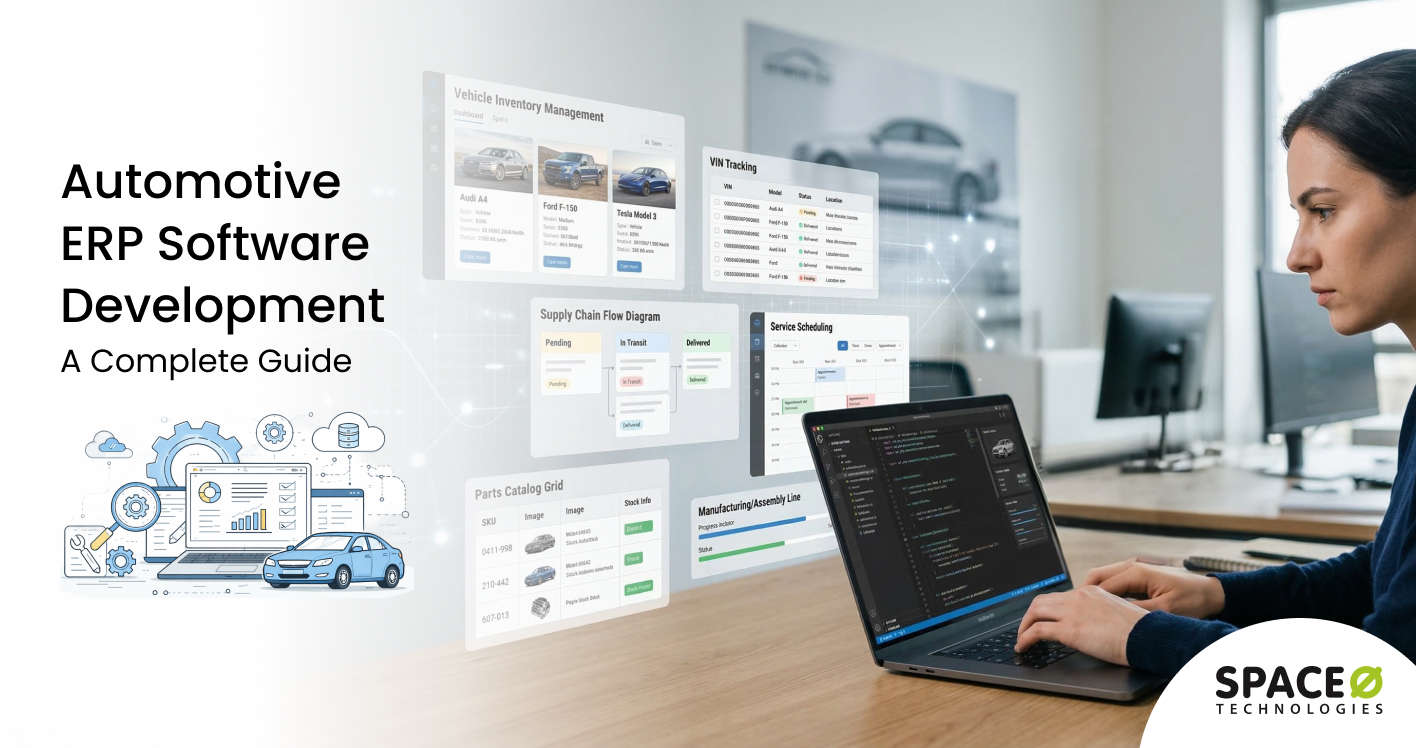
Contents
The automotive industry involves complex operations that span production planning, supply chain management, procurement, inventory control, and financial management. Automotive manufacturers, suppliers, and dealerships must coordinate multiple processes across departments while maintaining efficiency, accuracy, and compliance.
Managing these operations through disconnected systems can lead to delays, data silos, and operational inefficiencies. To address these challenges, many automotive businesses are adopting ERP (Enterprise Resource Planning) systems tailored to their operational needs.
The demand for ERP solutions continues to grow as organizations invest in technologies that improve visibility and streamline operations. According to Fortune Business Insights, the global ERP software market is projected to grow from $92.6 billion in 2025 to $281.58 billion by 2034, at a CAGR of 13%. This growth highlights the increasing reliance on ERP systems across industries, including automotive.
This comprehensive guide covers everything automotive businesses need to know about automotive ERP software development. Based on our experience as a trusted ERP development agency, we share insights on the business benefits of automotive ERP systems, key features, development process, cost considerations, and possible challenges with their solutions.
What Is Automotive ERP Software?
Automotive ERP software is a specialized enterprise resource planning system designed to manage the unique operations of businesses in the automotive sector. Unlike general-purpose ERP systems that serve broad business functions, automotive ERP addresses industry-specific workflows such as bill of materials (BOM) management across multiple vehicle models, VIN tracking, warranty administration, and parts catalog management.
This software serves as a centralized platform that connects every department in an automotive business. Production teams track manufacturing progress. Procurement teams manage supplier relationships. Service departments schedule repairs and assign technicians.
Finance teams handle invoicing, dealer commissions, and regulatory filings. All of this happens within a single integrated system. Businesses that need guidance in defining their ERP requirements often partner with an with ERP consulting agency to map their operational workflows before committing to development.
Who needs automotive ERP software?
Automotive ERP software is relevant to several types of businesses within the sector:
- OEMs and vehicle manufacturers managing complex assembly lines, multi-tier supplier networks, and quality control processes
- Auto dealerships handling vehicle inventory, sales pipelines, finance and insurance (F&I), and service operations
- Parts distributors and wholesalers are tracking thousands of SKUs across multiple warehouses
- Auto repair and service centers managing work orders, technician scheduling, and parts procurement
- EV companies and startups building operations from the ground up with modern, scalable systems
Automotive ERP vs general ERP: Feature-based comparison
| Feature | General ERP | Automotive ERP |
|---|---|---|
| Inventory management | Standard SKU tracking | VIN-level tracking, parts catalogs, and core management |
| Production planning | Generic BOM support | Multi-model BOM with engineering change management |
| Service management | Basic work orders | Bay scheduling, technician assignment, and warranty claims |
| Compliance | General tax and reporting | Emission standards, safety recalls, OEM requirements |
| Supply chain | Standard procurement | Multi-tier supplier management with JIT delivery |
| Financial management | Standard accounting | Dealer commissions, floor plan financing, F&I accounting |
Automotive ERP systems handle these specialized requirements that general platforms cannot address without extensive and costly customization. As a category of enterprise application, automotive ERP stands apart due to the depth of industry-specific functionality it must deliver.
Now that you understand what automotive ERP software is, let us explore why the automotive industry specifically needs custom ERP solutions.
Major Benefits of Automotive ERP Software Development
Investing in automotive ERP software delivers measurable improvements across your operations. Here are the key benefits.
1. Real-time visibility across operations
Automotive ERP provides a unified dashboard view of production, inventory, sales, and service data. Managers make faster decisions based on live information rather than outdated spreadsheets.
2. Streamlined supply chain management
Automated procurement workflows, supplier performance tracking, and JIT scheduling reduce lead times and prevent production delays. Your supply chain operates with fewer bottlenecks and lower carrying costs.
3. Improved regulatory compliance
Built-in compliance modules automate emissions tracking, safety recall management, and tax calculations. Your business stays audit-ready without dedicating staff to manual compliance documentation.
4. Reduced operational costs
By eliminating data silos and manual processes, automotive ERP reduces labor costs, minimizes inventory waste, and prevents costly errors in production and order fulfillment.
5. Better customer experience
Integrated CRM and service modules enable personalized interactions, faster service turnarounds, and proactive communication about recalls, maintenance schedules, and warranty coverage for vehicle owners.
6. Data-driven decision making
Advanced analytics transform raw operational data into actionable insights. Forecast demand accurately, identify underperforming areas, and allocate resources where they generate the highest returns.
7. Scalability for business growth
Custom automotive ERP systems scale with your business. Add new locations, onboard dealers, expand into EV service, or enter new markets without replacing your core platform. Choosing the best framework for ERP development from the start ensures your system handles this growth without requiring a complete rebuild.
These benefits compound over time as your team adopts the system and uses its full capabilities. This naturally leads us to explore the different types of automotive ERP solutions available.
Ready to Build a Custom Automotive ERP System for Your Business?
Space-O Technologies has delivered 300+ successful software projects, including enterprise software for complex industries. Get expert guidance for your automotive ERP project today.

Key Features of Automotive ERP Software
A well-built automotive ERP system includes modules that address every operational area of your business. Whether you plan to build software from scratch or customize an existing platform, here are the essential features your system should include.
1. Production and BOM management
Automotive production involves multi-level bills of materials that change frequently due to engineering updates, model variants, and supplier availability. Your ERP must support multi-model BOM structures, engineering change management, production scheduling with capacity planning, and work-in-progress tracking across assembly lines.
2. Supply chain and procurement
Managing hundreds of suppliers requires robust procurement tools. Your automotive ERP should include vendor rating and performance tracking, purchase order management with automated reordering, multi-tier supplier visibility with lead time tracking, and JIT delivery scheduling to minimize inventory holding costs.
3. Inventory and spare parts management
Automotive inventory management goes beyond standard SKU tracking. Your system needs VIN-level vehicle tracking, parts catalog management with cross-referencing, core management for remanufactured parts, obsolescence tracking to prevent dead stock, and barcode or RFID integration for warehouse operations.
4. Sales and dealer management
For dealerships and distribution networks, the ERP should handle vehicle sales pipelines with deal tracking, F&I (Finance and Insurance) management, dealer commission calculations, customer relationship management, and multi-location inventory visibility.
5. Service scheduling and bay management
Service departments generate significant revenue for automotive businesses. Your ERP must include technician scheduling and skill-based assignment, service bay utilization tracking, work order creation and progress monitoring, warranty claim management, and customer communication automation.
6. Financial management and accounting
Automotive financial operations have unique requirements. Your ERP should support floor plan financing and interest calculations, dealer rebate and incentive tracking, multi-entity consolidation for dealership groups, GST and tax compliance automation, and revenue recognition across vehicle sales, parts, and service.
7. Compliance and regulatory tracking
Regulatory compliance is non-negotiable in the automotive sector. Essential compliance features include emissions standard tracking by region, safety recall management with customer notification, OEM compliance documentation, audit trail and reporting, and environmental regulation monitoring.
8. Analytics and reporting dashboard
Data-driven decisions require comprehensive analytics. Your automotive ERP should provide real-time KPI dashboards for each department, inventory turnover and aging analysis, service department profitability reports, supplier performance scorecards, and sales forecasting with trend analysis.
These features form the foundation of a comprehensive automotive ERP system. Connecting these modules with your existing tools and third-party platforms requires expert ERP integration services to ensure seamless data flow across every department. With this feature overview in place, let us examine the specific benefits your business gains from automotive ERP software development.
Types of Automotive ERP Solutions
Before starting development, you need to decide which deployment model and development approach best fit your business. Here is a comparison of your options.
Cloud-based automotive ERP
Cloud-based automotive ERP systems are hosted on cloud infrastructure (AWS, Azure, or GCP) and accessed through web browsers. This model eliminates the need for on-premise servers and reduces upfront infrastructure costs.
Cloud deployment suits businesses that need remote access across multiple locations, want predictable subscription-based pricing, and prefer automatic updates without IT overhead.
1. On-premise automotive ERP
On-premise deployment gives you full control over your data and infrastructure. The system runs on your own servers within your facilities. This model is preferred by organizations with strict data residency requirements, businesses in regions with unreliable internet connectivity, and companies that need deep customization at the infrastructure level. However, on-premise solutions require a higher upfront investment and dedicated IT staff for maintenance.
2. Hybrid deployment
Hybrid ERP combines cloud and on-premise components. For example, you might keep sensitive financial data on-premises while running inventory management and service scheduling in the cloud. This approach offers flexibility but adds complexity in integration and data synchronization.
3. Custom-built vs. platform-based solutions
Beyond deployment models, you must decide between building from scratch or customizing an existing platform. The following table compares the three main approaches to automotive ERP development.
| Approach | Upfront Cost | Time to Deploy | Flexibility | Long-term Cost |
|---|---|---|---|---|
| Custom-built | $100,000–$400,000+ | 6–18 months | Full control | Lower maintenance over time |
| Platform-based (Odoo, SAP) | $40,000–$150,000 | 3–9 months | Limited by platform | License fees accumulate |
| Off-the-shelf (ready-made) | $10,000–$50,000/year | 1–3 months | Minimal customization | Subscription costs compound |
For businesses considering the platform approach, odoo development services offer a flexible open-source foundation that can be customized for automotive workflows at a lower cost than proprietary platforms like SAP or Oracle.
Understanding your deployment and development approach sets the stage for the actual build process. Let us now walk through the automotive ERP software development process step by step.
The Step-by-Step Automotive ERP Software Development Process
Building an automotive ERP system follows a structured methodology that ensures every module meets your operational requirements. Here is each phase of the development process.
1. Discovery and requirements analysis
This phase defines the scope, objectives, and functional requirements of your automotive ERP system. Your development team works closely with stakeholders from every department to document existing workflows, identify pain points, and establish the project vision that guides all subsequent development decisions.
Action items
- Conduct stakeholder interviews with operations, finance, service, and sales teams
- Map existing business processes and identify automation opportunities
- Define functional and non-functional requirements for each ERP module
- Create a project roadmap with milestones and deliverables
- Establish KPIs that the ERP system must improve
2. System architecture and design
The architecture phase translates your requirements into a technical blueprint that guides the entire development effort. Engineers select the technology stack, database structure, integration points, and security framework while designing a modular architecture that supports future expansion and third-party connectivity.
Action items
- Design microservices or a modular architecture for scalability
- Select the technology stack (backend, frontend, database, cloud platform)
- Create wireframes and UI/UX designs for each module
- Plan third-party integrations (DMS, OEM systems, payment gateways)
- Define role-based access control and data security protocols
3. Module development and integration
Development proceeds in iterative sprints, with each sprint delivering functional modules that stakeholders can review and test. The team builds core modules first, followed by department-specific features and cross-module integrations, ensuring continuous feedback loops between developers and business users throughout the process.
Action items
- Develop core modules: inventory, finance, HR, and procurement
- Build automotive-specific modules: BOM, VIN tracking, service scheduling
- Implement API integrations with existing systems and third-party tools
- Conduct code reviews and unit testing for each module
- Demo completed modules to stakeholders for feedback after each sprint
4. Testing and quality assurance
Thorough testing ensures your automotive ERP performs reliably under real-world conditions. QA teams validate every module, integration point, and user workflow across multiple scenarios before the system goes live, including stress testing under peak usage loads to confirm system stability.
Action items
- Execute functional testing for every module and feature
- Perform load testing to simulate peak usage scenarios
- Run integration testing across all connected systems
- Conduct user acceptance testing (UAT) with representatives from each department
- Validate data accuracy, security protocols, and compliance features
5. Deployment and data migration
Deployment involves migrating data from legacy systems, configuring the production environment, and transitioning your operations to the new ERP platform. This phase requires careful planning to minimize business disruption and ensure data integrity throughout the cutover period from old systems to the new platform.
Action items
- Cleanse and validate legacy data before migration
- Execute phased data migration with rollback procedures
- Configure production servers and cloud infrastructure
- Implement monitoring and alerting for system performance
- Run parallel operations during the transition period
6. Training and post-launch support
Post-deployment support ensures your team adopts the system effectively and that issues are resolved quickly. Training programs should be role-specific, covering only the modules and workflows each department uses, so employees gain hands-on confidence without information overload from irrelevant features.
Action items
- Deliver role-based training sessions for each department
- Create user documentation and video tutorials
- Establish a helpdesk for post-launch issue resolution
- Monitor system performance and user adoption metrics
- Plan ongoing updates, feature enhancements, and maintenance cycles
Understanding the software development process helps you set realistic expectations for timelines and deliverables. For automotive ERP projects, the average timeline ranges from 6 to 18 months, depending on scope and complexity.
With the development process covered, let us now address the common challenges you may face during automotive ERP development and how to overcome them.
Get Expert Support for Building Your Automotive ERP
Partner with Space-O Technologies to build an integrated automotive ERP solution. Our 140+ developers specialize in enterprise software that drives operational efficiency.
Challenges in Automotive ERP Development and How to Overcome Them
Automotive ERP development involves unique challenges that can derail projects if not addressed proactively. Without proper planning, execution, and stakeholder alignment, ERP implementations risk delays, budget overruns, and low user adoption. Here are the most common challenges and practical solutions.
1. Complex BOM management across vehicle models
Automotive manufacturers deal with multi-level BOMs that vary across vehicle models, trim levels, and regional variants. Engineering changes happen frequently, and a single BOM error can cascade across the entire production line, causing delays and quality issues.
How to overcome this challenge
- Implement version-controlled BOM structures with change history tracking
- Build automated validation rules that flag conflicts between BOM components
- Create visual BOM editors that make complex structures easier to manage
- Set up approval workflows for engineering change orders before they affect production
2. Legacy system data migration
Automotive businesses often run multiple disconnected systems accumulated over the years. These legacy systems contain data in inconsistent formats, obsolete codes, and undocumented custom fields. Migrating this data without corruption or loss is one of the biggest risks in ERP projects.
How to overcome this challenge
- Conduct a thorough data audit before migration begins
- Build automated data cleansing scripts to standardize formats and remove duplicates
- Execute migration in phases, starting with non-critical data for validation
- Maintain parallel systems during the transition period as a safety net
3. Supply chain integration complexity
Connecting your ERP with hundreds of suppliers, OEM systems, and logistics providers requires managing dozens of different data formats, APIs, and communication protocols. Integration failures lead to procurement delays and inventory mismatches.
How to overcome this challenge
- Use middleware or integration platforms to standardize data exchange
- Implement EDI (Electronic Data Interchange) for supplier communication
- Build real-time API connections for critical supply chain data flows
- Create fallback mechanisms for when third-party systems go offline
4. User adoption and change resistance
Employees who have worked with legacy systems for years often resist transitioning to a new ERP platform. Poor adoption rates undermine the entire investment. According to industry research, insufficient training is the leading cause of low user adoption in ERP projects.
How to overcome this challenge
- Involve end users in the design and testing phases from the start
- Deliver role-specific training programs rather than one-size-fits-all sessions
- Identify department champions who advocate for the new system
- Roll out the system in phases rather than a sudden “big bang” deployment
Engaging professional ERP implementation services that include structured change management programs significantly reduces adoption risk and accelerates time to value.
5. Cost overruns and scope creep
ERP projects frequently exceed initial budgets due to expanding requirements, underestimated integration complexity, and unplanned customization requests. Without strict scope management, costs can spiral beyond what the business anticipated.
How to overcome this challenge
- Define clear requirements and sign off on the scope before development starts
- Use Agile sprints with fixed deliverables to control scope incrementally
- Build contingency budgets (15%–20% of total project cost) for unforeseen needs
- Track costs against milestones and flag deviations early
These challenges are manageable with the right planning and development partner. Businesses evaluating whether to build in-house or outsource software development should weigh their internal expertise against these challenges when making the decision.
Now that we have covered the challenges, let us look at the cost side of automotive ERP software development.
How Much Does Automotive ERP Software Development Cost?
The cost of automotive ERP software development varies based on project scope, complexity, number of modules, integration requirements, and team location. For a comprehensive breakdown of these variables, refer to our detailed guide on ERP software development cost. Here is a realistic breakdown of what businesses should budget.
The following table outlines cost ranges by project scope.
| Project Scope | Modules Included | Team Size | Timeline | Estimated Cost |
|---|---|---|---|---|
| Small-scale ERP | 3–5 core modules | 5–8 developers | 4–8 months | $40,000–$100,000 |
| Mid-range ERP | 6–10 modules with integrations | 8–15 developers | 8–14 months | $100,000–$250,000 |
| Enterprise ERP | 10+ modules, full integration | 15–30 developers | 12–18+ months | $250,000–$400,000+ |
Small-scale ERP ($50,000–$100,000) suits single-location businesses like independent dealerships or auto repair chains that need core modules for inventory, finance, and service scheduling without complex third-party integrations.
Mid-range ERP ($100,000–$250,000) fits multi-location operations such as regional dealership groups or parts distributors that require cross-location inventory visibility, supplier integrations, and department-specific workflows with moderate customization.
Enterprise ERP ($250,000–$400,000+) serves large automotive manufacturers, OEMs, and national dealership networks that need full-scale integration across production, supply chain, dealer management, compliance, and financial operations with advanced analytics and AI capabilities.
Factors that affect automotive ERP development cost
Several factors influence the final cost of your project:
- Number of modules: Each additional module (inventory, service, finance, HR) adds development time and cost
- Integration complexity: Connecting with OEM systems, dealer management systems, and third-party logistics platforms increases integration effort
- Customization depth: Highly customized workflows, reports, and dashboards require more development hours
- Deployment model: Cloud deployment typically costs less upfront than on-premise, but subscription costs accumulate over time
- Team location: Hourly developer rates range from $25–$50 in India and Southeast Asia to $100–$250 in North America and Western Europe
Hidden costs to plan for
Beyond the initial development budget, plan for these ongoing expenses:
- Annual maintenance: 15%–20% of the initial development cost
- Training programs: $5,000–$20,000 depending on team size and complexity
- Infrastructure costs: Cloud hosting fees ranging from $500–$5,000 per month based on usage
- Future enhancements: Feature updates and new module additions as your business evolves
- Data migration: Legacy system migration can add 10%–15% to your project budget
Companies looking to scale their development teams quickly can hire erp developers to accelerate the build process without long-term recruitment overhead.
With costs clearly outlined, let us look ahead at the emerging trends that will shape automotive ERP software in the coming years.
Get a Free Cost Breakdown for Your ERP Development Project
Planning to build a custom ERP system? Share your requirements with our experts and get a tailored development quote for your project.
Future Trends in Automotive ERP Software Development
The automotive industry is evolving rapidly, and ERP systems must keep pace with emerging technologies and shifting market demands. Here are the trends shaping the next generation of automotive ERP software.
1. AI and machine learning integration
AI is transforming automotive ERP from a record-keeping system into a predictive intelligence platform. Machine learning algorithms analyze historical data to forecast demand, predict equipment failures before they occur, optimize production schedules, and automate quality control inspections.
For automotive businesses, AI-powered ERP enables predictive maintenance scheduling that reduces unplanned downtime, intelligent inventory reordering based on demand patterns, automated supplier risk assessment, and defect detection through computer vision on assembly lines.
2. IoT-enabled connected vehicle data
The rise of connected vehicles creates a new data stream that flows directly into ERP systems. IoT sensors embedded in vehicles report real-time diagnostics, maintenance needs, and usage patterns. Automotive ERP systems that ingest this data can trigger proactive service appointments, automate parts ordering based on predicted component wear, and provide dealers with vehicle health dashboards.
This integration connects the vehicle itself to your service and parts supply chain, creating a closed-loop system that improves both customer experience and operational efficiency.
3. Electric vehicle supply chain management
EV adoption is reshaping automotive supply chains. New ERP modules must manage battery sourcing and lifecycle tracking, charging station network management, EV-specific compliance and safety certifications, and battery recycling and end-of-life logistics.
Automotive ERP systems built today should include the flexibility to add EV-specific modules as this market segment grows.
4. Digital twins for manufacturing and inventory
Digital twin technology creates virtual replicas of physical manufacturing processes, warehouses, and supply chains. Automotive ERP systems that integrate digital twins enable simulation-based production planning, virtual testing of process changes before real-world implementation, predictive warehouse optimization, and scenario modeling for supply chain disruptions.
5. Blockchain for supply chain transparency
Blockchain technology offers automotive businesses an immutable record of every transaction in their supply chain. From raw material sourcing to final vehicle delivery, blockchain integration in ERP systems provides parts provenance and authenticity verification, automated smart contracts for supplier payments, tamper-proof compliance and audit records, and end-to-end visibility across multi-tier supply chains.
As an enterprise software development company with expertise in emerging technologies, Space-O Technologies helps automotive businesses build ERP systems that are ready for these future demands.
How Space-O Technologies Can Help You Build Your Automotive ERP
From disconnected spreadsheets to a unified platform that manages your entire automotive operation, the right ERP system changes how your business competes. This guide walked you through the features, process, costs, and challenges involved so you can approach your ERP project with clarity and confidence.
Space-O Technologies has spent 15+ years delivering 300+ custom software solutions for businesses across complex industries. With a 97% client retention rate, our team understands what it takes to build enterprise systems that companies rely on every day.
Our 140+ developers bring hands-on expertise in ERP architecture, module development, third-party integrations, and cloud deployment. Whether you need a focused system for a single dealership or a multi-location platform connecting production, service, and distribution, we build to your exact operational requirements.
Contact us today to schedule a free consultation where our ERP specialists will assess your current workflows, recommend the right module architecture, and provide a detailed project estimate tailored to your automotive business.
Frequently Asked Questions on Automotive ERP Software Development
How long does it take to develop an automotive ERP system?
Development timelines range from 4 to 18 months, depending on scope and complexity. A small-scale system with 3–5 core modules takes 4–8 months. Mid-range systems with integrations take 8–14 months. Enterprise-grade solutions with full integration suites can take 12–18 months or longer.
How much does automotive ERP software development cost?
Costs range from $40,000 for a basic system to $400,000 or more for an enterprise-grade solution. Key cost factors include the number of modules, integration complexity, customization depth, and development team location. Annual maintenance adds 15%–20% to the initial investment.
What modules are essential in an automotive ERP system?
The core modules include inventory and parts management, production and BOM management, service scheduling and bay management, supply chain and procurement, financial management and accounting, compliance and regulatory tracking, and CRM with sales management. Additional modules depend on your specific business type and operational needs.
Should I choose a custom ERP or an off-the-shelf for my automotive business?
Custom ERP is ideal if your business has unique workflows that off-the-shelf systems cannot support without heavy modification. Off-the-shelf solutions work for businesses with standard operations and limited budgets. Many automotive businesses opt for a hybrid approach, customizing an open-source platform like Odoo to balance flexibility with cost efficiency.
Can an automotive ERP integrate with existing dealer management systems?
Yes. A well-architected automotive ERP integrates with existing DMS platforms, OEM portals, payment gateways, and third-party logistics systems through APIs, EDI, or middleware. Integration planning should be part of the discovery phase to ensure compatibility and data synchronization across all systems.
What technologies are used for automotive ERP software development?
Common technology stacks include Python or Java for backend development, React or Angular for frontend interfaces, PostgreSQL or MySQL for databases, and AWS, Azure, or GCP for cloud deployment. Frameworks like Odoo (Python-based) and ERPNext are popular open-source foundations for automotive ERP systems.



 All our projects are secured by NDA




 4.8
4.8