
 By
Contents
- Ask every vendor to answer the same sections in the same order to compare bids.
- Require written confirmation that you own fine-tuned weights, user data, and code at project end.
- Ask every vendor whether their models may train on your data, and get the answer in writing.
- Request data preparation as a separate line item, because it often hides inside one total price.
Key Takeaways
An AI app development RFP (request for proposal) template makes vendors answer the same questions. Space-O Technologies built this one around four pillars: objectives, architecture, data, and evaluation. Founders, CTOs, and enterprise leaders can use it to compare every bid fairly.
A generic software RFP forces vendors to guess at AI details. They guess at model choice, data condition, and who keeps the fine-tuned weights. Our AI development services team has built software since 2010 and wrote this template.
Below, each of the nine sections gets what-to-write bullets and a fill-in example. Pair it with our free application development templates when you plan the wider project. Swap the sample values for your own details, and your RFP is ready to send.
Generic Software RFPs Leave AI Proposals Impossible to Compare
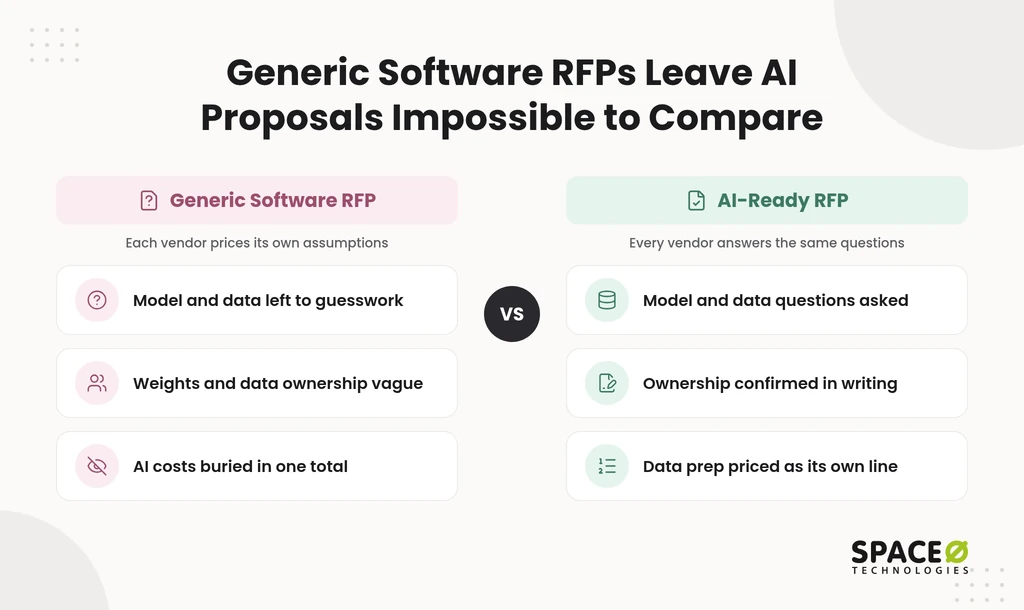
A generic software RFP gets you AI bids that answer different questions. Most RFP templates cover generic software projects. They rarely ask about models, data, or who owns AI outputs.
Questions about models and data
When the RFP skips model and data questions, each vendor prices its own assumptions. One bid may assume a proprietary model and clean data. Another may assume open-source hosting and months of data cleanup. Neither is wrong, but you cannot compare them.
Ownership of weights and data stays vague
Unclear ownership terms leave fine-tuned weights and user data in a gray zone. If the RFP never asks, the contract rarely settles it. You find out who owns the model only when you try to switch vendors.
Budgets hide the AI-specific line items
A single total price hides the costs that make AI projects different. Data preparation and ongoing maintenance often disappear into one number. The nine sections below are designed to bring those costs into view.
9 Sections That Make Your AI App RFP Vendor-Ready
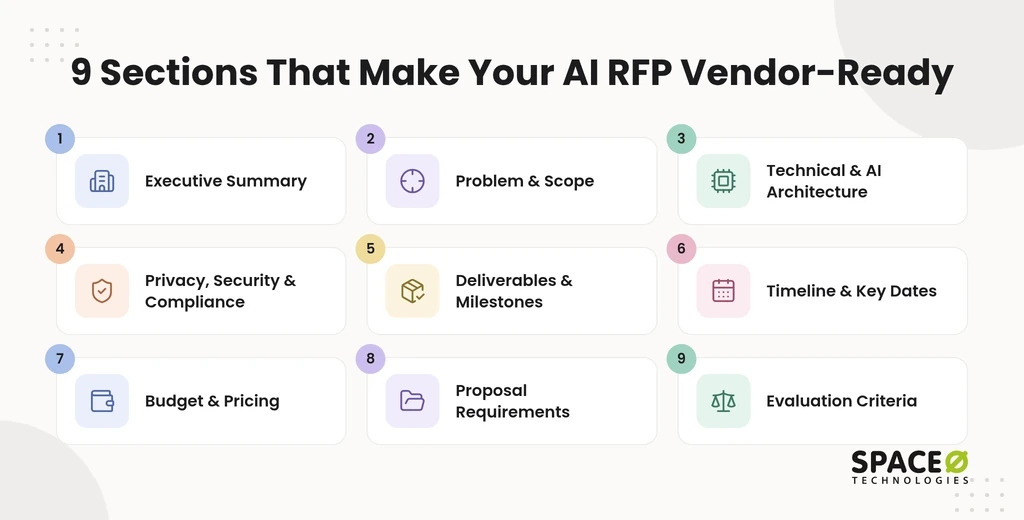
This template uses nine numbered sections, in the order vendors expect to read them. Each section lists what to write and gives one fill-in example. Copy the headings as they are and replace each field with your project details.
1. Executive summary and company overview
The executive summary tells AI vendors who you are and what result the AI app must deliver. Keep it short enough to read in two minutes.
- Company profile: your industry, size, and the systems the app must work with.
- Core objective: the business outcome, stated as one measurable sentence.
- Primary users: who will use the AI app and how often.
- Decision owner: the person who signs off on vendor selection.
Example objective: “Northwind Retail wants an AI assistant that cuts customer response time from 24 hours to 2 hours.”
2. Problem statement and scope of work
The scope section names the problem and draws a firm line between in-scope and out-of-scope features. That line is what keeps quotes comparable.
- Problem statement: the manual work, cost, or delay you want removed.
- In-scope (MVP): the features your minimum viable product must ship with.
- Out-of-scope: the features you are parking for a later phase.
- Success measure: the metric that proves the MVP works.
Example: “In scope: document upload and AI summaries. Out of scope: multilingual support, planned for phase two.”
3. Technical requirements and AI architecture
The technical section is where an AI RFP differs most from a generic software RFP. It tells vendors what kind of AI you need and where it must run.
- AI capability: large language models (LLMs), Computer Vision, natural language processing (NLP), or predictive models.
- Model approach: proprietary models from OpenAI or Anthropic, or open-source models such as Llama and Mistral.
- Data sources and readiness: where the data lives, its format and volume, and how clean it is.
- Hosting: Amazon Web Services (AWS), Google Cloud Platform (GCP), Microsoft Azure, on-premises, or serverless.
- Stack preferences: the languages and databases your team already supports.
- Application layer: Python, FastAPI, and React.js.
- Vector database: Pinecone, Milvus, or pgvector.
If your team has already chosen GPT models, vendors should show experience with AI app development using OpenAI.
4. Data privacy, security, and compliance
The security section settles who owns the AI outputs and how your data stays protected. Ask each vendor to answer every line in writing.
- Data ownership: your company owns the fine-tuned weights, user data, and code.
- Training policy: the vendor states whether its models may train on your data.
- Encryption: data stays encrypted at rest and in transit.
- Health data: HIPAA (Health Insurance Portability and Accountability Act) safeguards apply to any patient information.
- Privacy and audit: ask for audit evidence, plus GDPR (General Data Protection Regulation) compliance if you serve EU users.
Example clause: “Northwind Retail retains ownership of all fine-tuned model weights, user data, and source code.”
How Space-O Technologies handles this: we sign a non-disclosure agreement (NDA) before every project. All source code, data, and intellectual property (IP) transfer to you at completion. Ask every vendor to put its data training policy in writing.
5. Deliverables and project milestones
The deliverables section lists what you receive at each milestone, so progress stays measurable. Tie each milestone to something you can test or review.
- Discovery output: the requirements, architecture plan, and data assessment.
- MVP release: a working app with the agreed-upon in-scope features.
- Handover package: the source code, documentation, and deployment notes.
- Post-launch SLA: the service level agreement (SLA) response times for fixes and support.
Example: “Milestone 2: MVP release to 50 pilot users by Day 90.”
6. Timeline and key dates
The timeline section gives every vendor the same dates to respond against. The sample days below count from the day you issue the RFP. Replace each with a calendar date before you send it.
RFP issued: Day 1
Vendor questions due: Day 7
Proposal submission deadline: Day 21
Vendor demos: Day 35
Selection announced: Day 42
Project kickoff: Day 56
7. Budget and pricing structure
The budget field can stay optional or open-ended, but the pricing request should be specific. How you ask for pricing decides whether bids can be compared.
- Budget: give a range, or mark the budget as open-ended.
- Pricing by phase: request separate quotes for Discovery, Development, Testing, and Maintenance.
- Engagement model: request Time-and-Materials vs. Fixed-Price, or both for comparison.
- Payment terms: request milestone-based payments tied to deliverables.
Example field: “Budget range: $50,000 to $120,000, or open-ended.”
Section 7 should drag two AI costs into the open: data preparation and upkeep. According to our AI development cost guide, data preparation takes a large share of the total budget. Maintenance then adds a yearly cost on top of the original build.
Use phase benchmarks to sanity-check each bid line. The same guide breaks a typical AI build into six phases. A bid that prices one phase far outside its usual range deserves a follow-up question.
| Development phase | Estimated range |
|---|---|
| Discovery and planning | $5,000-$25,000 |
| Data collection and preparation | $15,000-$150,000 |
| Model development and training | $30,000-$200,000 |
| Software engineering and integration | $25,000-$120,000 |
| Testing, QA, and compliance | $10,000-$50,000 |
| Deployment and go-live | $5,000-$30,000 |
A focused AI proof of concept runs $15,000 to $40,000 over 4 to 8 weeks, per the same guide. Our MVP development services start at $15,000 for a basic MVP, and feature-rich builds reach $50,000 or more. Even so, your RFP should require data preparation and first-year maintenance to be quoted on their own lines.
Our team can respond under four engagement models: Dedicated Team, Time & Material, Fixed Cost, or Staff Augmentation. State which one your RFP prefers.
Get Phased Pricing for Your AI RFP
Send us your completed RFP and our AI engineers will return phased pricing for discovery, development, testing, and maintenance. Data preparation is shown as its own line.

8. Vendor proposal requirements
The proposal requirements section tells vendors exactly what evidence to submit. A fixed list stops polished pitches from replacing proof.
- Case studies: AI projects similar to yours in scope and industry.
- Team resumes: the AI engineer, data scientist, and project manager (PM) assigned to you.
- Proposed approach: the architecture, model choice, and delivery plan.
- References: 2-3 clients you can contact directly.
Example: “Attach resumes for every named team member, including the lead AI engineer and years on AI projects.”
For follow-up interviews, use our list of questions to ask an AI agent development company.
9. Evaluation criteria
The evaluation section tells vendors how you will score them, so they answer what matters to you. Publish the weights so bids focus on your priorities.
- Technical expertise: proven AI and machine learning delivery.
- Business understanding: a clear grasp of your business objective.
- Architecture and security: a credible architecture and security plan.
- Cost and timeline: cost-effectiveness and a realistic timeline.
- Post-launch support: a defined maintenance and support model.
Example field: “Technical expertise: 30 of 100 points.”
Our guide on how to evaluate AI development companies explains each criterion in more detail.
Vendor questions that expose weak AI proposals
Five questions separate vendors who have shipped AI from those who have only demoed it. Add them to your RFP or use them in vendor demos.
| Comparison axis | What to ask | What a strong answer includes |
|---|---|---|
| IP ownership | Who owns fine-tuned weights, user data, and code at completion? | A full transfer to you, written into the contract. |
| Training on your data | Can your models train on our data? | A written no-training policy and PII masking. |
| Engagement model | Which pricing models can you offer for this scope? | More than one option, with pricing broken out by phase. |
| Post-launch maintenance | What does year-one maintenance cost and include? | A figure tied to the build cost, plus monitoring and an SLA. |
| Data preparation | How will you assess and price data readiness? | A separate line item, set after a data review. |
With the template filled in, the next step is getting it to the right vendors in the right order.
Prepare and Send Your AI App RFP in Four Steps
Four steps take your AI app RFP from a rough idea to scored proposals. Each step builds on the one before it.
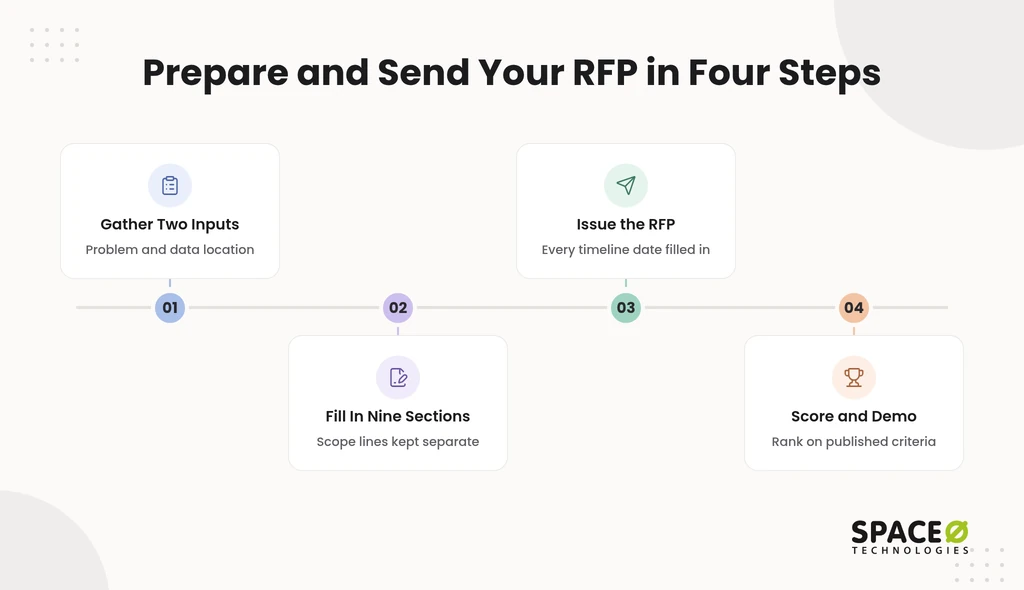
- Gather two inputs first: the problem you want solved and where your data lives.
- Fill in the nine sections, keeping in-scope and out-of-scope features separate.
- Issue the RFP with every date in the timeline filled in.
- Score responses against your published criteria and invite the top vendors to demo.
A clear process gets you stronger bids. The vendor’s track record is what tells you whether they can deliver on them.
Delivery Record Behind Every Proposal We Submit
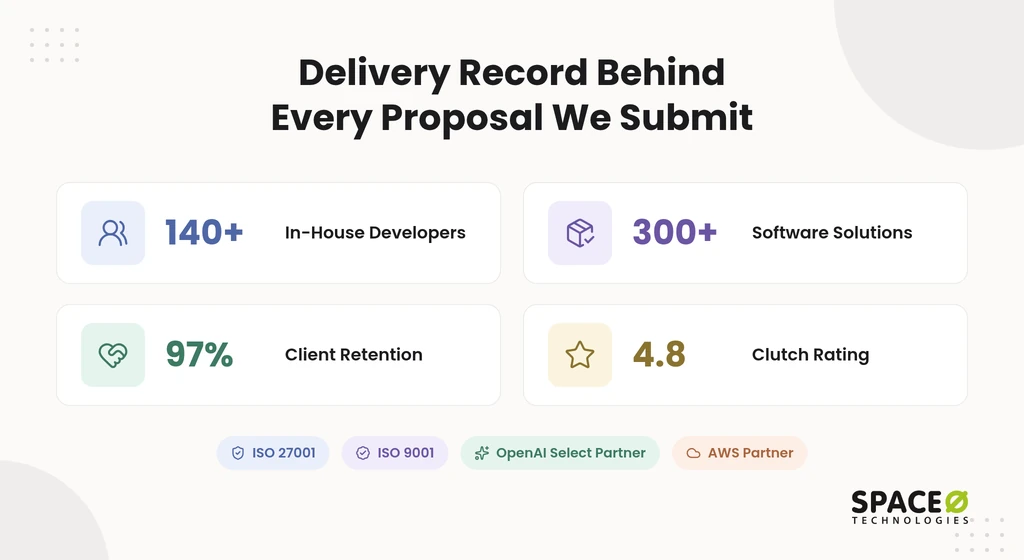
Space-O Technologies backs each RFP response with production work, not a slide deck. The figures below come from our published company data.
Production AI built by an in-house team
Our RFP responses draw on a team of 140+ in-house developers. That team holds ISO 27001 and ISO 9001 certifications, plus OpenAI Select Partner and AWS Partner status.
Delivery record and client retention
We have delivered 300+ software solutions and report 97% client retention. Space-O Technologies holds a 4.8 overall rating on Clutch.
Products that scaled after launch
Glovo, an on-demand delivery app built by our team, now has 50M+ downloads. It is one of our unicorn projects, alongside MrSool and FTcash.
Why Space-O Technologies Fits AI Projects Headed for Production
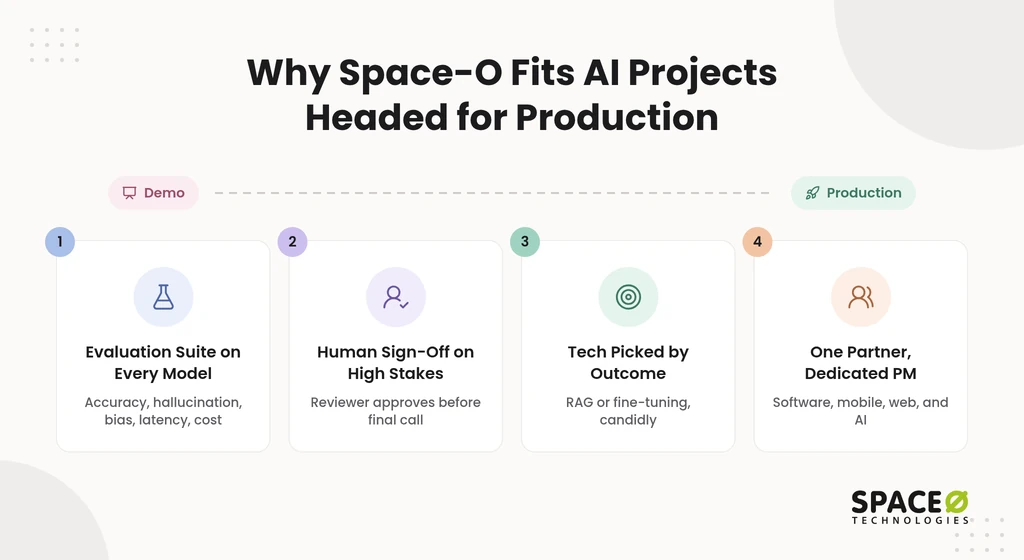
Many AI projects stall between demo and production, so we build the controls in from the start. Each of the four practices below answers a common reason AI pilots fail.
Every model ships with an evaluation suite
Your evaluation criteria should ask vendors how they prove quality. Our answer is a test suite on every production model. It measures accuracy, hallucination rate, bias, latency, and cost, and monitoring continues after go-live.
People approve high-stakes decisions
When an output could sway a finance or healthcare decision, we tighten accuracy testing and add human sign-off. Automation still carries the volume. A qualified reviewer approves the results before they shape any final call.
Technology chosen by business outcome
Picking a model before the goal burns budget, which is why Section 3 lets vendors justify their choice. We work back from your outcome to the most cost-effective technology. That includes a candid call on retrieval-augmented generation (RAG) or fine-tuning.
One partner with a dedicated project manager
Juggling several vendors slows AI projects and blurs accountability. We cover software, mobile, web, and AI work under one team. A dedicated PM keeps you informed at every milestone.
Turn Your Finished RFP Into a Scoped AI Build
A finished RFP only pays off when a vendor answers every section in full. Our response covers phased pricing, team roles, and a security plan. Share your problem and where your data lives, and we’ll help tailor your technical requirements. Talk to our AI app development team.
Frequently Asked Questions
Who should write an RFP for an AI app?
The founder, CTO, or enterprise leader running the AI project typically writes the RFP. Whoever drafts it, one named decision owner should sign off on vendor selection, as Section 1 sets out. Giving every vendor the same inputs keeps bids comparable.
What ongoing costs should I expect after my AI app launches?
Budget for more than the annual maintenance share, because infrastructure and API usage fees add to the total. Ask vendors to show first-year maintenance and run costs as separate lines so none of these hide inside one figure.
What compliance requirements should I ask an AI vendor to confirm in writing?
Ask vendors to confirm encryption, security controls, and their data training policy in writing. Add HIPAA only if you handle patient information. Add GDPR only if you serve EU users.
How do I evaluate AI RFP responses effectively?
Score each bid against the Section 9 weights you published before issuing the RFP. Take only the top scorers to demos. Use the vendor questions table there to test IP ownership, data training, and maintenance costs.
How do I price an AI project when I don’t know how clean my data is?
Request phased quotes with Discovery as the first phase, since it produces the requirements, architecture plan, and data assessment. Ask the vendor to price data preparation as its own line item, set after a data review. This avoids locking in a fixed price built on an assumption about your data.
How is an AI app RFP different from a standard software RFP?
An AI app RFP adds questions on models, data readiness, and ownership. It asks who owns fine-tuned weights, user data, and code, and whether the vendor’s models may train on your data. It also asks for data preparation and maintenance as separate line items, so bids stay comparable.
Should my RFP name a proprietary or an open-source AI model?
State your preferred approach in the technical section, but let vendors explain their choice. Options include proprietary models from OpenAI or Anthropic, or open-source models such as Llama and Mistral. Ask each vendor to give its model choice, architecture, and delivery plan in its proposed approach. That stops bids resting on different hidden assumptions.



 All our projects are secured by NDA




 4.8


