
 By
Contents
- AI agent orchestration coordinates specialized agents, business systems, data, and human approvers as one governed workflow.
- Match the pattern to the workflow: routing for ticket triage, writer-critic for regulated output.
- Place human approval gates on high-risk actions, set by confidence and policy thresholds.
- Budget annual maintenance as a recurring line, since models, tools, and protocols keep changing.
Key Takeaways
AI agent orchestration for enterprise coordinates specialized agents, systems, and human approvers as one workflow. It assigns tasks, hands off context, and enforces governance across multi-step work. As an AI agent development company, we build it inside your existing systems.
Most enterprises already run a few agents that work well alone. Then a task crosses systems, progress resets, and approvals drift into email. The first design decision is single-agent vs multi-agent architecture.
This guide covers the core functions, components, patterns, and platforms. It shows where humans approve at each step. It also sets out how we deliver orchestration.
Single Agents Stall When Enterprise Work Crosses Systems
A single agent cannot reliably handle complex, multi-step enterprise workflows on its own. One model juggling intake, policy checks, system updates, and approvals loses context and compounds its errors. That is why many AI agents fail in production. Specialized agents that split the work usually handle each step better than one generalist. Gartner predicts 40% of enterprise apps will include task-specific agents by 2026, up from under 5%.
Context resets at every handoff
Without shared state, each agent starts from zero. A request that passes from intake to review to fulfillment loses its history at each step. Teams then re-enter data, and customers repeat themselves.
Agent sprawl outruns governance
Agents multiply faster than access rules, audit trails, and owners can keep up. Each new agent brings its own credentials and its own tool access. Within a few quarters, nobody can say which agent changed a record or why. Deloitte predicts agentic AI pilots will rise from 25% to 50% of gen AI companies in 2027.
High-risk actions go out unreviewed
An agent that can act can also act wrongly at scale. A wrong credit decision, contract clause, or clinical letter costs far more than a slow one. A PwC survey of 300 executives found only 20% trust AI agents with financial transactions. These costs share one cause: missing coordination, which an orchestration layer supplies.
Governed Orchestration Built Into Your Existing Stack
We build the orchestration layer inside the ERP, CRM, ServiceNow, and API estate you already run. Enterprise resource planning (ERP) and customer relationship management (CRM) systems hold the records your agents need. Our job is to make agents work across them as one accountable system.
Five core functions every orchestrated workflow needs
Every orchestrated workflow depends on five functions working together. Remove one, and the system either stalls or acts without control.
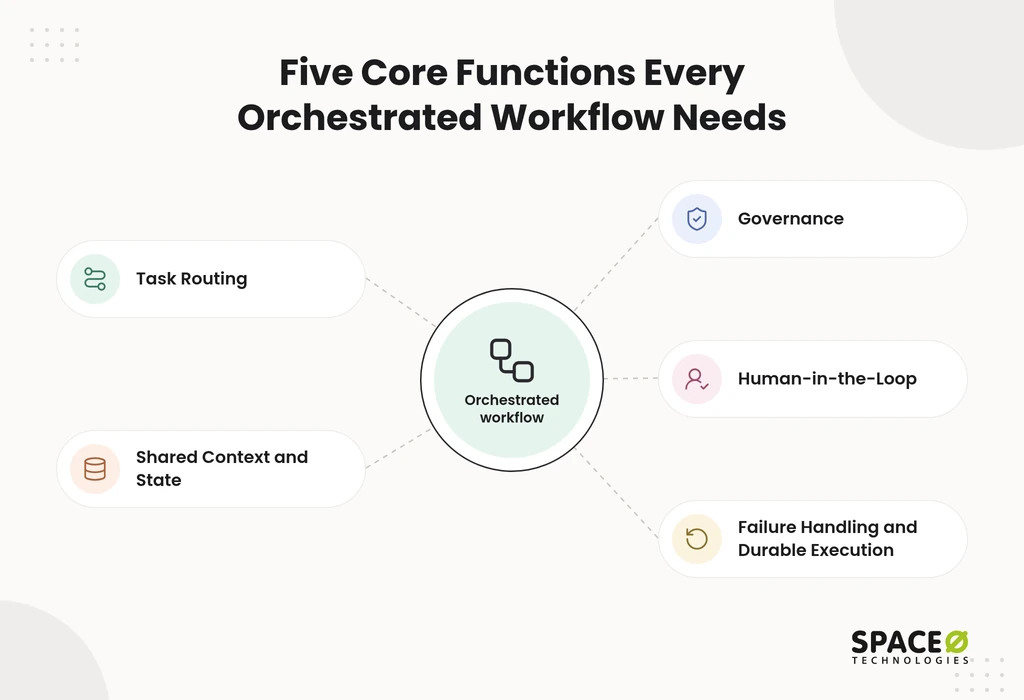
- Task routing: The orchestrator sends each step to the best-suited specialist agent instead of one agent attempting everything.
- Shared context and state: Context carries across every handoff, so progress never resets between agents.
- Governance: Access control, audit, and policy enforcement apply to every action an agent takes.
- Human-in-the-loop: Approval and escalation gates stop high-risk actions until a qualified person signs off.
- Failure handling and durable execution: Retries and checkpoints let a long-running job resume from its last completed step.
Four components form the orchestration architecture
Every orchestrated system is built from four components: agents, an orchestrator, shared state and memory, and tools.
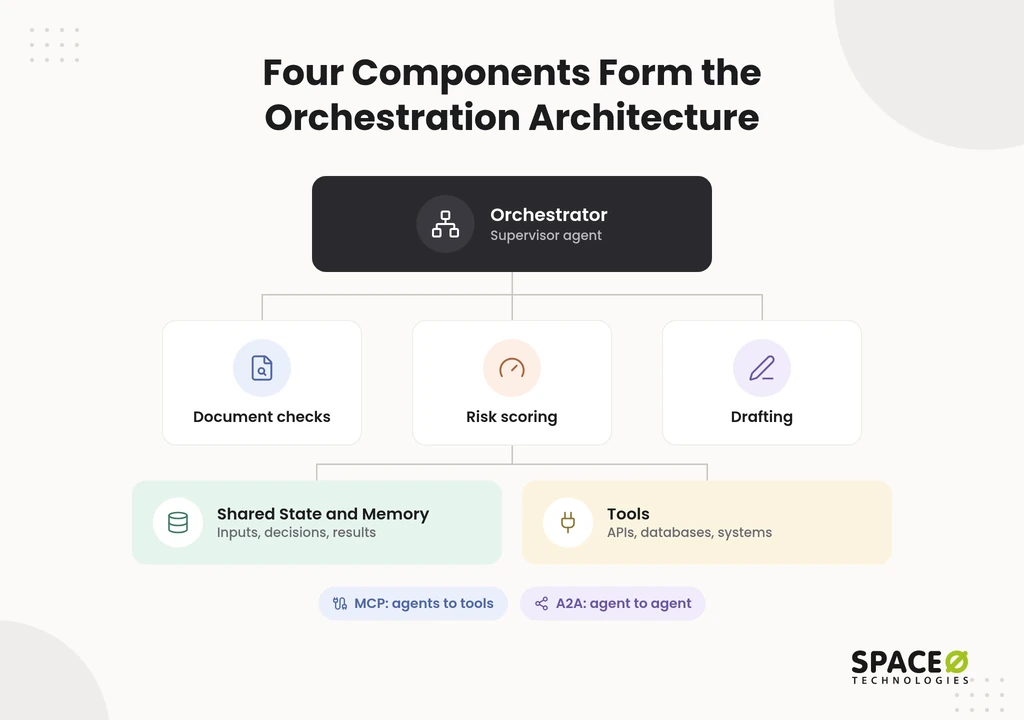
- Specialized agents: Each agent owns one narrow job, such as document checks, risk scoring, or drafting.
- Orchestrator (supervisor agent): The orchestrator plans the work, assigns tasks, tracks progress, and assembles the final result.
- Shared state and memory: A common record holds inputs, decisions, and intermediate results that every agent can read.
- Tools: Tools are the APIs, databases, and business systems agents call to read data and take action.
Two open protocols connect these parts. MCP (Model Context Protocol) gives agents a standard way to reach tools and data sources. The agent-to-agent (A2A) protocol lets agents built by different teams or vendors pass tasks and results to each other.
Five orchestration patterns and the workflows they suit
Five patterns cover most enterprise workflows, and each suits a different shape of work.
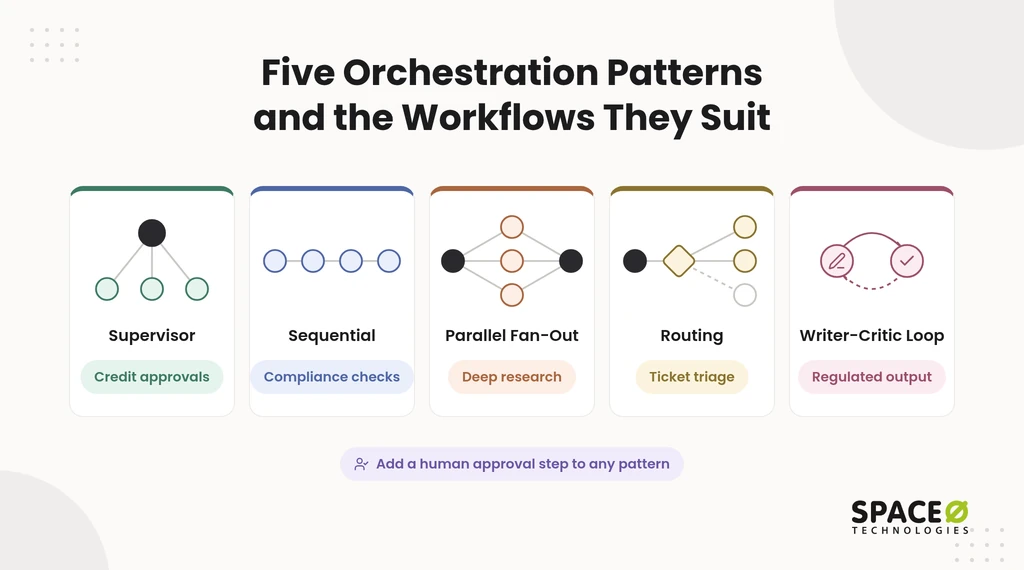
- Supervisor (orchestrator-workers): A supervisor agent splits a request into tasks, assigns each to a worker agent, and assembles the results. Best for renewals and credit approvals.
- Sequential (prompt chaining): Each agent completes one stage and passes its output to the next in a fixed order. Best for compliance checks and contract generation.
- Parallel fan-out: Several agents work on separate slices of a request at once, and the orchestrator merges their findings. Best for deep research and pulling metrics from siloed systems.
- Routing (adaptive routing): A router classifies each incoming request and sends it to the specialist best suited to handle it. Best for support ticket triage.
- Writer-critic loop: One agent drafts, a second checks the draft against rules and sources, and the loop repeats until it passes. Best for high-precision or regulated output.
Human-in-the-loop also works as a pattern. It adds a required approval step to any of the five.
The right pattern for each business workflow, and where humans stay in the loop
Each pattern puts its human checkpoint in a different place, so choose the pattern and the checkpoint together. The table shows how each pattern runs in common enterprise systems and where a person approves.
| Pattern | Example in your systems | Where the human review checkpoint sits |
|---|---|---|
| Supervisor | Credit-line increases: a supervisor assigns statement, policy, and risk agents over core banking APIs. | A credit officer approves every decision before it posts to the customer account. |
| Sequential | Vendor onboarding: agents collect documents, check procurement policy, then draft the supplier agreement. | A procurement lead approves the final agreement before signature. |
| Parallel fan-out | Account health brief: agents read CRM, billing, and usage data, then merge findings. | An analyst reviews the merged brief only when sources conflict. |
| Routing | Email triage: a router sends each message to a billing, order, or returns agent. | Low-confidence classifications and complaints go to a human queue. |
| Writer-critic | Prior authorization letters: a writer drafts, and a critic checks payer criteria. | In HIPAA-regulated work, a clinician signs the letter before submission. |
Match Each Workflow to the Right Pattern
Share one workflow and the systems it touches. Our AI agent architects will recommend a pattern, map the human review checkpoints, and outline the build scope.

Integration into ERP, CRM, ServiceNow, and your APIs
Orchestration is not simple integration or fixed robotic process automation (RPA). Integration moves data between systems, and RPA replays the same steps every time. Orchestration decides which agent acts next based on context, then hands off with the full state attached.
We connect agents to your records through application programming interfaces (APIs) and MCP servers. ServiceNow, ERP, and CRM connections are part of our enterprise software development work. Where a step never varies, we keep deterministic code or existing RPA and reserve agents for judgment calls.
Governance and human review designed in from day one
Every agent gets its own identity, scoped permissions, and an audit trail before it touches production.
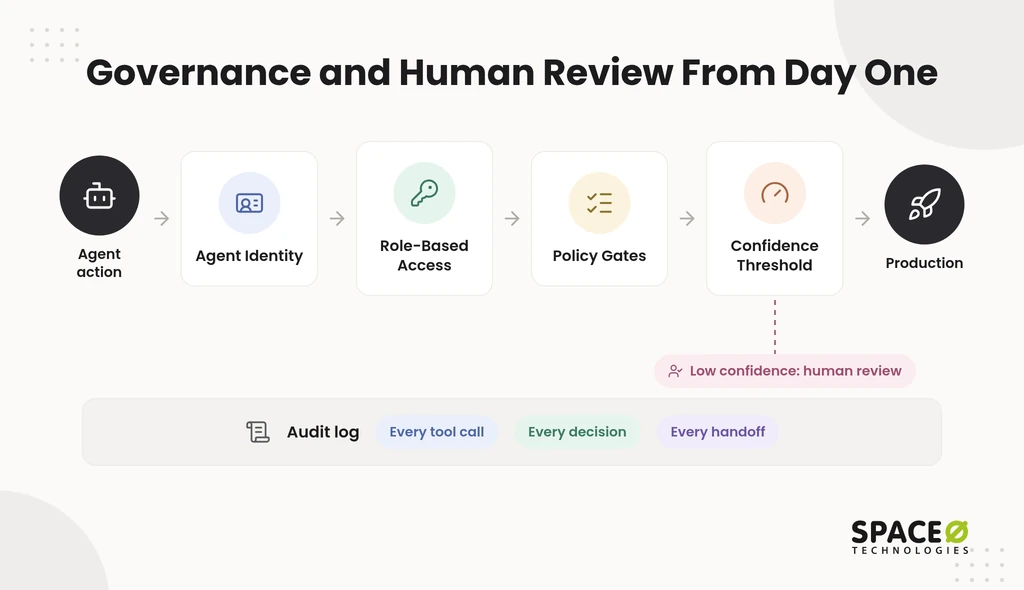
- Role-based access control (RBAC): Each agent reaches only the systems and fields its role requires.
- Audit logs: Every tool call, decision, and handoff is recorded with the agent and the time.
- Policy gates: Business rules block actions that break limits, such as payment thresholds or contract terms.
- Agent identity: Each agent runs on its own credentials, so actions trace back to one accountable agent.
- Confidence thresholds: An agent escalates to a person when its confidence drops below an agreed level.
Responsible AI is our default. We do not train models on client data, and we mask personally identifiable information (PII). Every production model gets an evaluation suite for accuracy, hallucination rate, bias, latency, and cost, plus continuous monitoring. Human review checkpoints are enabled by default for lending, clinical, and other high-stakes decisions. Our guide to AI agent security best practices covers access and deployment controls in depth.
In lending, the agent only drafts an approve-or-decline recommendation with its reasoning. A human underwriter signs off on every case above the exposure threshold.
Platforms and frameworks in the orchestration market
No platform appears in every enterprise shortlist, so compare them by what adoption requires. The table describes each option neutrally. Pricing varies by plan and usage and is not compared here. These options run on large language models (LLMs), and our LLM development services cover that model layer.
| Platform or framework | Type | Orchestration focus | What adopting it requires |
|---|---|---|---|
| AWS Bedrock AgentCore | Managed cloud service | Runtime, memory, identity, and tool access for agents on AWS. | An AWS estate and cloud engineers to configure and operate it. |
| LangGraph | Open-source framework | Graph-based state, cyclic workflows, and persistence. | Engineers to build, host, monitor, and upgrade the graphs. |
| CrewAI | Open-source framework | Role-based agents running sequential or hierarchical processes. | Engineers to define roles, host the runtime, and add governance. |
| Microsoft AutoGen and Semantic Kernel | Open-source frameworks | Multi-agent conversations and agent orchestration libraries. | Engineers to host, secure, and maintain the code. |
| Microsoft Copilot Studio | Low-code platform | Agents built for the Microsoft 365 environment. | A Microsoft tenant, admin setup, and the matching licenses. |
| Salesforce Agentforce | Platform | Agents working on Salesforce data and workflows. | A Salesforce estate, admin configuration, and Salesforce licensing. |
| Gemini Enterprise Agent Platform | Platform | Agent building and management on Google Cloud. | A Google Cloud estate and admin setup. |
| Kore.ai | Platform | Enterprise agents for conversational and process automation. | A vendor license and platform configuration. |
| Mastra | Open-source framework | TypeScript agents and workflows. | TypeScript engineers to host and maintain it. |
| ServiceNow | Platform | Agents inside ServiceNow IT and service workflows. | A ServiceNow instance and platform administrators. |
| Temporal, Prefect, and Astronomer | Workflow and durable execution engines | Retries, state, and resumable long-running jobs. | Engineers to model workflows and run the engine or managed service. |
| UiPath and Appian | Automation platforms | RPA and process automation alongside agents. | Existing licenses and an automation team to configure them. |
For open-source options in more depth, our comparison of AI agent frameworks covers them one by one.
Buy a platform, assemble a framework, or build custom
The right path depends on where your data lives, how you review decisions, and who must own the code.
| Axis | Buy a platform | Assemble an open-source framework | Custom build with a partner |
|---|---|---|---|
| Fit to your stack | Requires core data and workflows to sit in the vendor’s ecosystem. | Fits any system, but your team writes and maintains every connector. | Built around the systems and APIs you already run. |
| Human review design | Uses the approval features the platform provides. | You design and build every gate yourself. | Gates are designed per decision at agreed risk thresholds. |
| Code and IP ownership | You own configurations, and the runtime stays with the vendor. | You own your code, and the framework stays open source. | Source code, data, and IP transfer to you at completion. |
| NDA and engagement flexibility | Vendor plan terms apply. | No vendor contract, but you carry all engineering. | NDA before work starts, with a choice of engagement model. |
With the architecture chosen, delivery follows a fixed sequence.
How We Deliver Orchestration in Six Steps
We deliver orchestration one workflow at a time, with review gates live before any agent acts in production.
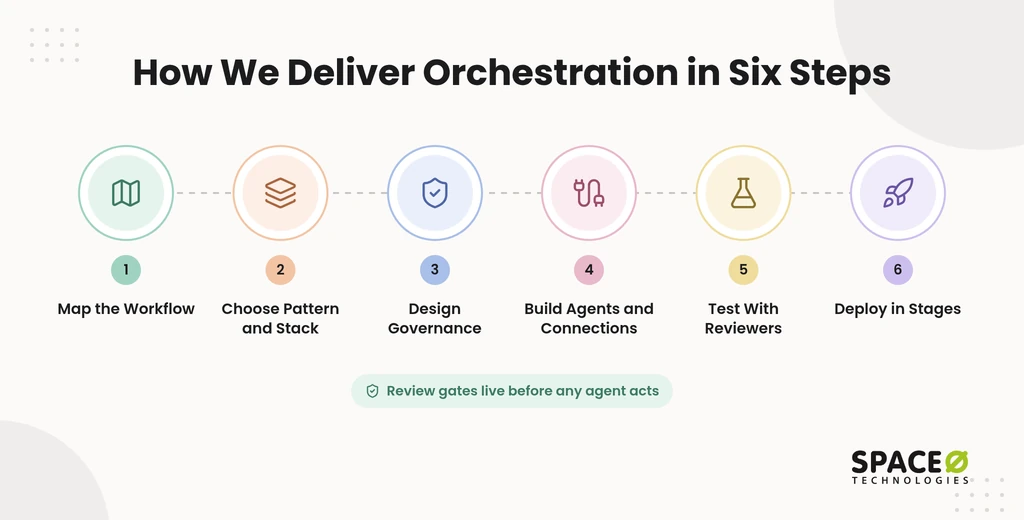
- Map the workflow: We document each step, system, data source, and decision, and flag which actions carry risk.
- Choose the pattern and stack: We match the workflow to a pattern, then pick a platform, framework, or custom build.
- Design governance: We set agent identities, RBAC scopes, policy gates, audit logging, and human approval points.
- Build agents and connections: We build the specialist agents, shared state, and tool connections through APIs and MCP.
- Test with reviewers in place: We run evaluations against real cases while human reviewers check every gated action.
- Deploy in stages: We release to a limited scope first, widen it as results hold, and monitor continuously.
Timelines depend on workflow count, connected systems, and review gates. A free, expert-reviewed estimate sets scope and schedule for your case.
Annual maintenance keeps orchestrated agents accurate
An orchestrated system needs funded upkeep every year, not just a launch budget. Annual maintenance for an AI build typically costs 15% to 25% of the original development cost every year. That range comes from our AI development cost research. Maintenance funds monitoring, model drift correction, tool and protocol changes, and governance reviews. Infrastructure, API usage, and large language model (LLM) tokens add to the total as separate run costs.
The table below applies that rate to two hypothetical builds. The budgets are illustrative, not quotes.
| Illustrative build | Hypothetical build cost | Yearly maintenance estimate |
|---|---|---|
| Single agent | $40,000 | $6,000-$10,000 |
| Multi-agent system | $160,000 | $24,000-$40,000 |
The multi-agent system’s upkeep runs four times higher because its build cost is four times higher. Monthly operating cost covers LLM tokens, cloud infrastructure, vector databases, and monitoring for any deployment. That cost runs from about $500 for a simple agent to over $10,000 for enterprise deployments.
The steps and costs only matter if the team behind them has delivered at scale before.
Delivery Record Behind Every Orchestration Build
Our orchestration work rests on a long delivery record across AI development services and audited security practices.
- Clients served: Space-O Technologies has served 1,200+ clients.
- Solutions delivered: Our teams have developed 300+ software solutions.
- Team: We employ 140+ in-house developers.
- AI in production: For agent work, 30+ AI engineers run 50+ AI systems live.
- Retention: We report 97% client retention.
- Scale: Glovo, an on-demand delivery app we built, secured $1.2 billion in funding and passed 30 million downloads.
- Compliance: Our compliance posture covers ISO 27001 alignment and HIPAA-ready frameworks for healthcare AI engagements.
- Regulated delivery: We delivered a custom system for a medical devices company that significantly improved its data protection and compliance processes.
That record supports the specific reasons enterprises bring orchestration work to us.
Why Enterprises Choose Space-O Technologies for Orchestration
We build orchestration into your existing systems, with review designed for high-stakes decisions and full ownership at handover.
- Built into your stack: We connect AI agents directly to the ERP, CRM, ServiceNow, and APIs your business already runs. You keep your current systems, so there is no need to move to a new platform.
- One partner across systems: The same team covers software, AI, ERP, CRM development, and ServiceNow work.
- Protected from day one: We sign a non-disclosure agreement (NDA) before starting any project.
- Full ownership: All source code, data, and IP built during a project transfer to you at completion.
- Flexible engagement: Choose from Dedicated Team, Time & Material, Fixed Cost, or Staff Augmentation.
- Local presence: Our offices are in Mesa (Arizona, USA), Brampton (Ontario, Canada), and Ahmedabad (India).
Start With One Workflow and the Systems It Touches
The fastest way to prove orchestration is one well-chosen workflow with clear review points. Tell us the process, the systems involved, and the decisions that need a human. You get a recommended pattern, a review plan, and a free, expert-reviewed estimate. Talk to an AI agent architect about your workflow and systems.
Frequently Asked Questions
What is the Google enterprise agent platform?
Gemini Enterprise Agent Platform is a platform for building and managing agents on Google Cloud. Adopting it requires a Google Cloud estate and admin setup. Pricing varies by plan and usage.
What is the best AI agent orchestrator?
No single orchestrator is best for every enterprise, because no platform appears in every shortlist. Fit depends on adoption needs (cloud estate, engineers, licenses) and data location, review design, and code ownership.
What is the best AI tool for enterprise operations?
The best tool fits where your operational data lives: ServiceNow for IT workflows, Agentforce for Salesforce data. Microsoft tenants suit Microsoft 365; where no platform fits your ERP, CRM, and API mix, build custom.
How does an AI agent run?
An orchestrator plans the steps, assigns specialist agents, and pauses for human approval wherever policy requires it.
How do I decide which steps in a workflow get an agent and which stay deterministic code?
Give an agent the steps that need judgment, such as classifying a request, scoring risk, or drafting text. Keep deterministic code or existing RPA for steps that never vary. Then flag which actions carry risk, because those need a human approval gate, whichever way the step is built.
How much does AI agent orchestration for enterprise cost?
On Space-O Technologies’ published ranges, a multi-agent system costs $150,000 to $500,000 to build. Annual maintenance typically costs 15% to 25% of the original development cost every year, and infrastructure, API, and LLM token costs come on top.
How long does it take to implement AI agent orchestration?
Timelines depend on scope. Simple AI solutions typically take 2 to 3 months, while enterprise systems may take 6 to 12 months. A multi-agent system typically takes 16 to 28 weeks to build.



 All our projects are secured by NDA




 4.8


