
 By

Contents
- Choose fixed price only when AI scope, data, and accuracy targets are already well defined.
- Time and Materials suits experimental AI work such as RAG pipelines, fine-tuning, and hallucination-rate testing.
- A fixed-price discovery phase followed by T&M development balances budget control with room to iterate.
- Price data preparation first, since it typically takes 20% to 30% of an AI build budget.
Key Takeaways
An AI app quote can shift once real data arrives. That is why fixed price vs. time and material for AI app development matters. Pick fixed price for a defined scope and Time and Materials (T&M) for experimental work.
Some vendors pad a fixed quote with a risk margin. Others bill open-ended hours until accuracy targets land. Space-O Technologies has built AI software since 2010 and offers both engagement models.
This guide compares both models and frames each pro and con for AI work. It also covers the hybrid route, cost drivers, and a short diagnostic. For hands-on help, our team delivers AI development services.
Fixed Price vs Time and Materials: Direct Comparison for AI Projects
Fixed price gives up flexibility to gain budget certainty, and T&M gives up budget certainty to gain flexibility. The table shows where that trade-off appears in an AI build. Use it to spot which column matches your project today, or compare wider ML development pricing models.
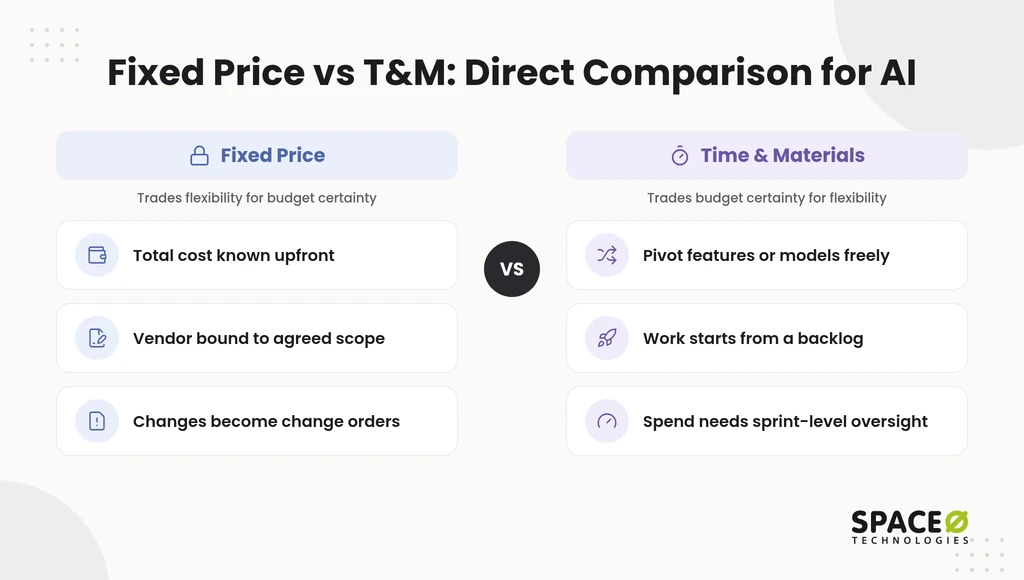
| Criterion | Fixed Price | Time and Materials (T&M) |
|---|---|---|
| Suits | Well-defined scope with known, usable data | Experimental, iterative AI work |
| Scope clarity needed | High, agreed before work starts | Low to moderate, refined sprint by sprint |
| Budget certainty | High, with one agreed price | Lower, because cost tracks actual effort |
| Changes to scope, large language models (LLMs), or application programming interfaces (APIs) | Handled as formal change orders, often costly | Absorbed into the next sprint |
| Payment structure | Agreed price for agreed deliverables | Actual hours plus cloud compute and model API usage |
| Speed to start | Slower, because the specification comes first | Faster, because work starts from a backlog |
| Client management effort | Lower during the build | Higher: progress, code quality, and sprint velocity |
| Code and IP ownership | Set by the contract, so confirm transfer at completion | Set by the contract, so confirm transfer at completion |
The table points to one pattern. The less you know about your data and accuracy targets, the more the right column wins. The next two sections explain why.
Fixed Price for AI App Development
Under fixed price, you and the vendor agree on one price for one defined scope before work begins. It works when features, data sources, and acceptance criteria are clear on day one, as in standard fixed-cost software development.
AI projects add pressures that standard software rarely faces, and the cons below cover them.
Pros of fixed price
Fixed price gives you budget safety and one clearly accountable vendor.
- Budget safety: You know the total cost before the build starts, which simplifies internal approvals.
- Clear accountability: The vendor is bound by contract to deliver the agreed scope for the agreed price.
These benefits hold only while the scope stays put. AI work rarely lets it stay put.
Cons of fixed price for AI work
Fixed price fits most AI work poorly because AI development is inherently experimental.
- Experimental work: Training models, tuning prompts, handling unstructured data, and testing accuracy rarely follow a fixed plan.
- Rigid scope: A scope change or a switch to another LLM becomes a slow, expensive change order.
- Hidden risk margins: Vendors inflate fixed quotes to cover technical unknowns, so you may pay for risks that never happen.
Fixed price protects the budget by freezing the plan. AI rarely rewards a frozen plan, and T&M is built for that problem.
Time and Materials (T&M) for AI App Development
Under Time and Materials, you pay for the actual hours worked. You also pay direct resource costs, such as cloud compute and model API usage. The model expects scope to change as you learn, and it bills for that learning openly.
Pros of time and materials
T&M lets you change course as the AI work shows you what works.
- Agility: You can pivot features, switch foundation models, or retrain workflows without renegotiating the contract.
- Faster start: Work begins without a long specification negotiation, so experiments run sooner.
- Fit for iterative AI research: Retrieval-augmented generation (RAG) pipelines, fine-tuning, and hallucination-rate evaluation all need room to test and adjust.
Cons of time and materials
T&M lowers budget predictability and requires more of your management time.
- Budget unpredictability: Costs can keep rising until the model reaches its accuracy threshold.
- Management load: You need to track progress, code quality, and sprint velocity to keep spend tied to results.
Unchecked T&M spend is a common path to AI software development budget overruns. If neither column feels safe, the hybrid model is designed for that position.
The Hybrid Alternative: Fixed-Price Discovery Plus T&M Development
The hybrid model fixes the price of a short discovery phase and then moves development to T&M. Discovery is bounded, predictable work, so a fixed price fits it well. Its outputs turn vague unknowns into a plan you can estimate.
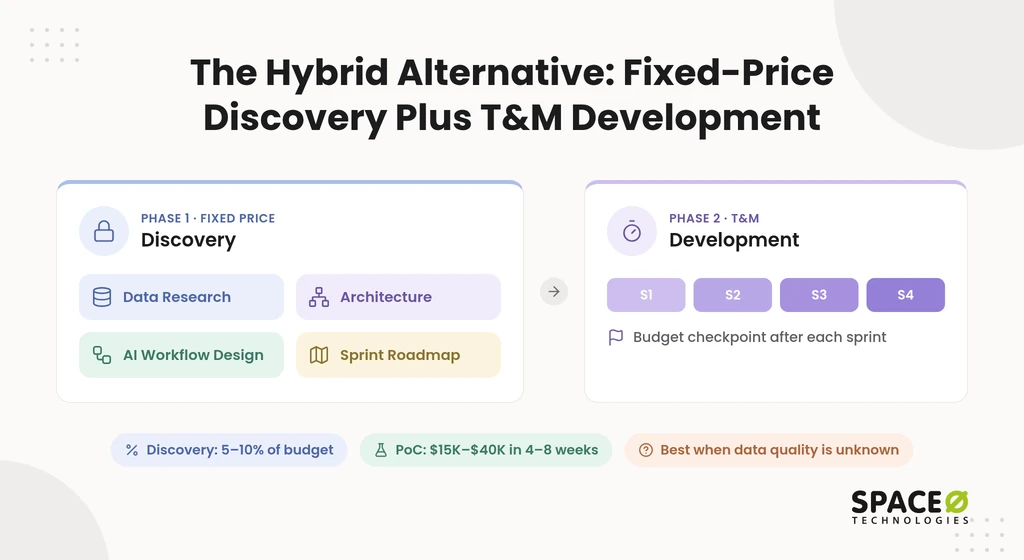
A discovery phase typically produces four outputs:
- Data research that checks whether your data can support the use case.
- An architecture that sets the model, hosting, and integration approach.
- An AI workflow design that maps where the model acts and where people review.
- A roadmap that sequences development into sprints with budget checkpoints.
Discovery is also the smallest line in an AI budget. Space-O Technologies’ AI development cost guide puts discovery and planning at 5% to 10% of the budget. That is about $5,000 to $25,000. A focused proof of concept runs $15,000 to $40,000 over 4 to 8 weeks, per the same guide.
Hybrid engagements fit best when your AI project’s data quality and achievable accuracy are still unknown. Discovery is one of the most practical ways to reduce risk in AI development before larger spend begins. The next question is what makes AI estimates uncertain in the first place.
How AI Cost Drivers Shift the Fixed Price vs T&M Decision
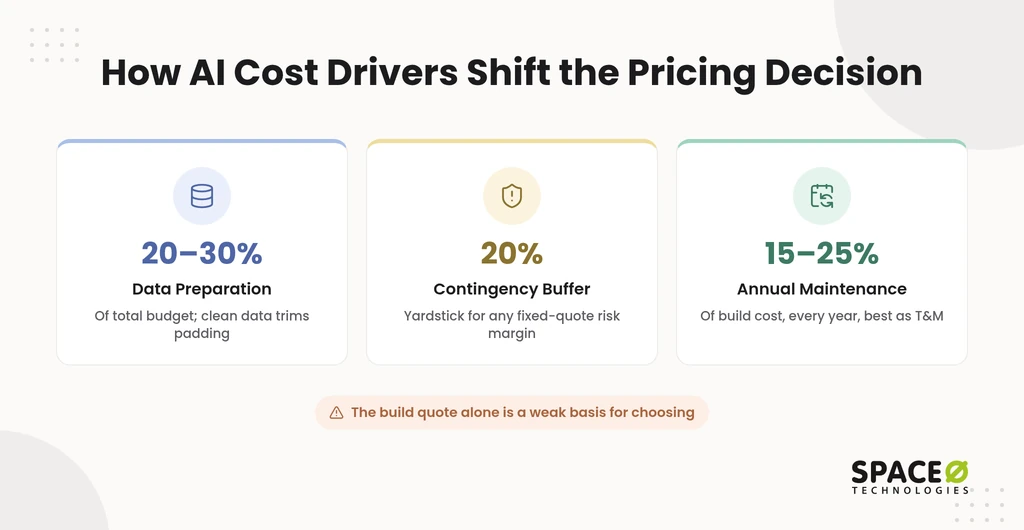
AI cost drivers decide how much uncertainty a fixed quote has to absorb. The comparison above treats risk in general terms. Three figures from the same cost guide make it concrete for AI builds.
Data preparation decides whether a fixed quote is realistic
Data collection and preparation typically take 20%-30% of the total project budget, according to Space-O Technologies’ AI development cost guide. Data quality is often unclear until engineers inspect it, and fixed price handles that kind of uncertainty badly.
- Clean data: If your data is labeled and accessible, a fixed quote can price data work with less padding.
- Messy data: If your data is scattered, book AI consulting services for a data review, then use discovery or T&M.
A contingency buffer shows what a risk margin should cost
The same guide recommends a 20% contingency buffer on every AI project to absorb scope changes, data issues, and infrastructure spikes. Use that figure as a yardstick. If a fixed quote looks padded well beyond it, ask the vendor what risks the margin covers. On T&M, hold the buffer in your own budget instead of paying it upfront.
Annual maintenance sits outside the build price
Annual maintenance for an AI build typically costs 15%-25% of the original development cost every year. Plan post-launch work as ongoing T&M, or hire AI developers monthly, since retraining and model updates rarely fit fixed scopes.
Together, these figures show that the build quote alone is a weak basis for choosing a model. The diagnostic below turns them into a decision.
Which Model Fits Your AI App Project?
Answer five questions to see which model fits your AI build. Each question tests requirement clarity or budget flexibility, the two factors the decision rests on.
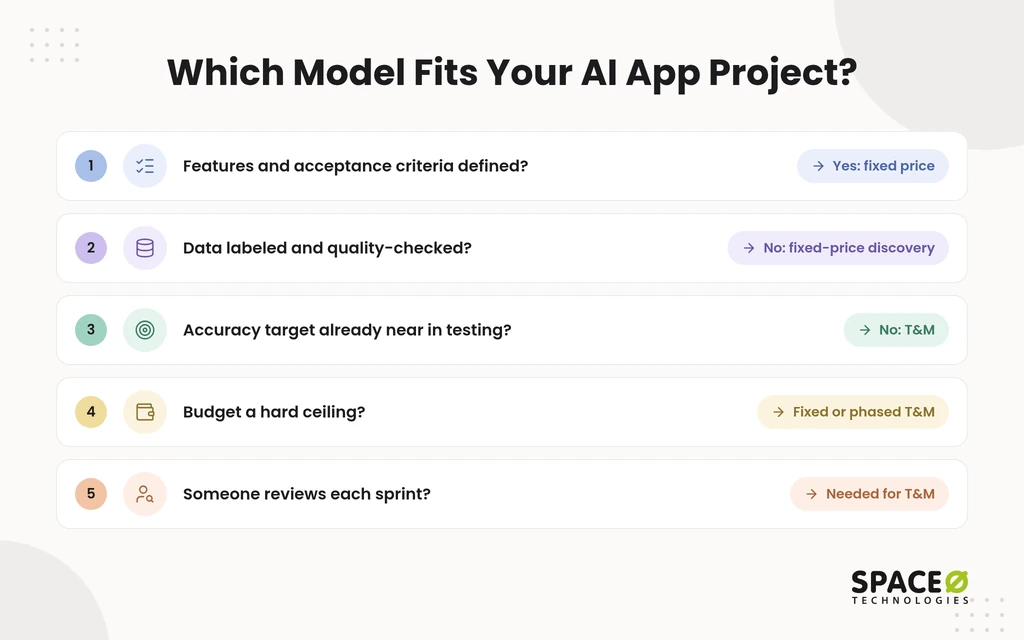
- Can you list the features, inputs, outputs, and acceptance criteria today? If yes, fixed price is viable.
- Is your data labeled, accessible, and checked for quality? If not, start with fixed-price discovery.
- Do you have a measurable accuracy target the model has already approached in testing? If not, T&M suits the work.
- Is your budget a hard ceiling or a range? A hard ceiling points to fixed price or tightly phased T&M.
- Can someone on your side review sprint velocity and code quality each sprint? T&M needs that oversight.
A scoped AI minimum viable product (MVP) with clear features is the strongest case for fixed cost. For founders, that keeps the first release predictable before raising the next round. A basic MVP with Space-O Technologies starts from $15,000. A feature-rich MVP can reach $50,000 or more, per our MVP development services page.
How Space-O Technologies Structures AI Engagements
Space-O Technologies matches the engagement model to your scope instead of forcing one contract on every AI project. We offer four engagement models, and each suits a different stage of AI work.
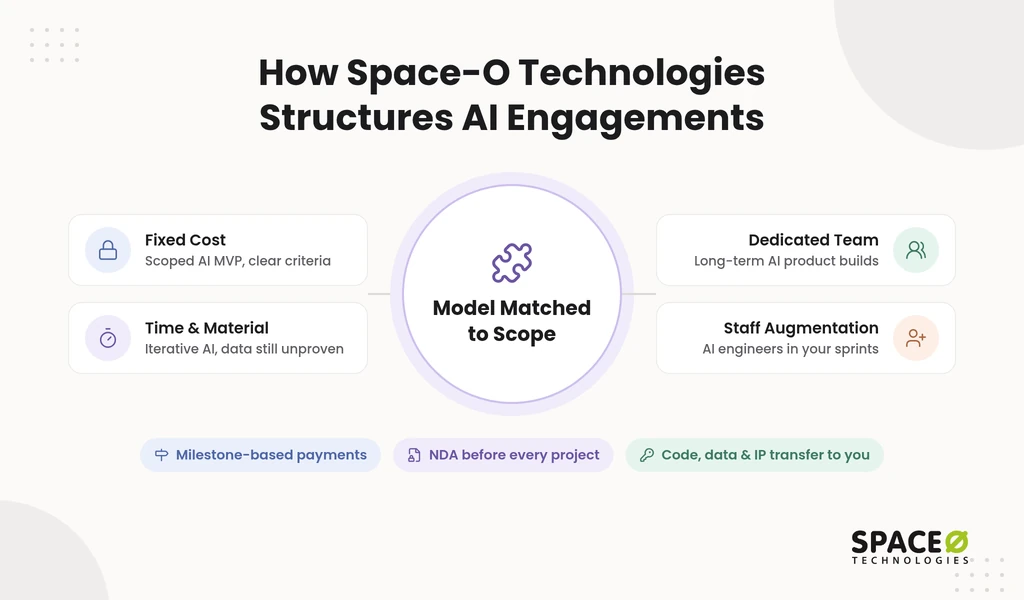
- Fixed Cost: Suits a scoped AI MVP with clear features, inputs, and acceptance criteria.
- Time & Material: Suits iterative AI work where data and accuracy are still being proven.
- Dedicated Team: Suits long-term AI product builds that need a stable team across many releases.
- Staff Augmentation: Suits CTOs who need vetted AI engineers inside their own sprints.
Fixed-cost payments are milestone-based and tied to deliverables, so you pay as each deliverable lands. We sign a non-disclosure agreement (NDA) before every project starts. All source code, data, and intellectual property (IP) transfer to you at completion.
Every model we put into production runs inside an evaluation suite. The suite covers accuracy, hallucination rate, bias checks, latency, and cost, with continuous monitoring in place. Automation handles the volume, but a qualified person approves any output before it influences a final decision.
Space-O Technologies has served 1,200+ clients since 2010 and reports 97% client retention. Request a free AI app development estimate to match your scope to a model.
Turn Your AI Idea Into a Scoped Plan
Share your use case and data sources with our AI team. You get a free, expert-reviewed estimate and a clear view of the right engagement model.

Frequently Asked Questions
When should a time and materials contract be used?
Use time and materials when the work is experimental, or requirements will change as you learn. Choose it when no accuracy target is proven, and your budget is a range, not a hard ceiling. Someone on your side must review sprint velocity and code quality, since T&M depends on that oversight. If your data is not yet labeled or checked for quality, start with a fixed-price discovery phase first.
Is fixed price the right choice for a founder building an AI MVP?
It can be, if the MVP is tightly scoped with clear features, inputs, outputs, and acceptance criteria. A scoped AI MVP is the strongest case for fixed cost. It keeps the first release predictable before the next funding round. If your data is messy or accuracy targets are unproven, start with a fixed-price discovery phase instead.
Who on our team needs to manage a time and materials AI engagement?
You need at least one person on your side who can review progress, code quality, and sprint velocity every sprint. T&M shifts oversight to the client, and without that reviewer, spend can drift away from results.
What is the difference between fixed price and time and material for AI app development?
Fixed price sets one agreed cost for a defined scope. Time and material bills the actual hours worked, plus cloud compute and model API usage. Fixed price gives budget certainty. T&M gives room to change course as the AI work shows what works.
Which pricing model is cheaper for AI app development?
Neither is always cheaper. Fixed quotes often carry a risk margin for technical unknowns, so you may pay for risks that never happen. T&M costs can keep rising until the model reaches its accuracy threshold. The cheaper model is the one that matches how well your scope and data are defined.
Why is fixed price risky for AI projects?
Fixed price is risky because AI development is experimental. Training models, tuning prompts, and handling unstructured data rarely follow a fixed plan. A scope change or a switch to a different LLM becomes a slow and costly change order.
What is a hybrid contract for AI app development?
A hybrid contract fixes the price of a short discovery phase and then moves development to T&M. Discovery produces data research, an architecture, an AI workflow design, and a roadmap. It fits best when data quality and achievable accuracy are still unknown.



 All our projects are secured by NDA




 4.8


