
 By

Contents
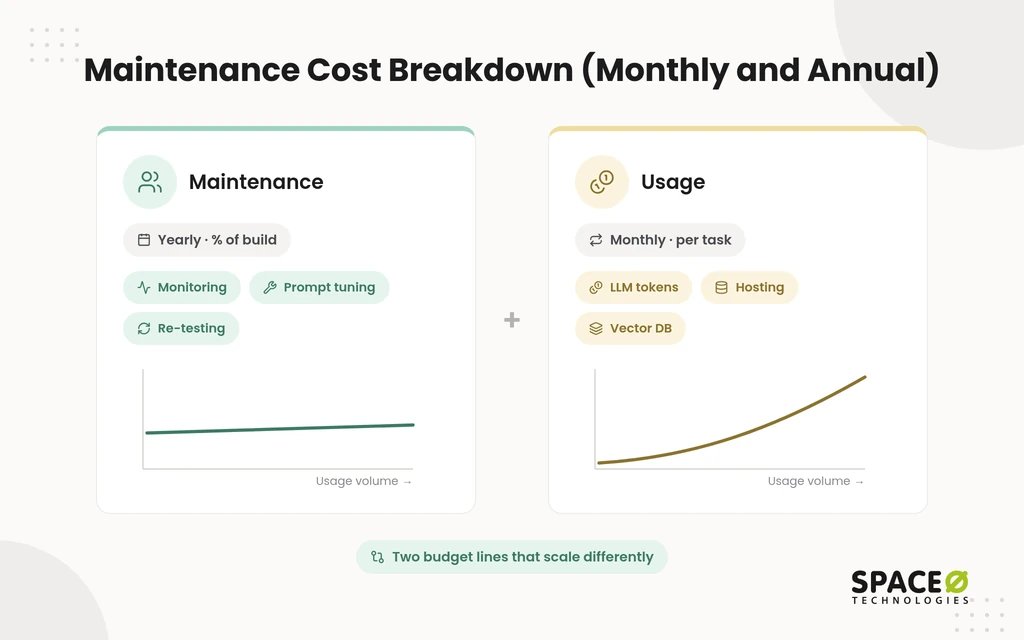
- Budget maintenance and usage as two lines, because people time and token fees scale differently.
- Size token budgets at P90 usage per completed task, not per prompt, to avoid a 10x to 12x underestimate.
- Cap loop iterations, cache static prompts, and route simple steps to smaller models before scaling volume.
- Over three years, usage can outweigh the build price, so review token spend every month.
Key Takeaways
AI agent maintenance cost after launch surprises most teams that only budgeted for the build. Maintenance usually costs 15% to 25% of your AI development cost each year. A separate monthly bill for large language model (LLM) tokens sits on top of that budget.
Maintenance pays for people’s time, such as monitoring, prompt tuning, and re-testing. Token and infrastructure fees grow with volume, reasoning steps, and context length. Many guides blend the two lines, which hides your real running cost.
This guide prices each line and adds them together in worked examples. It also shows how agent loops drive the token bill. If you are still scoping a build, explore our AI agent development services.
Maintenance Cost Breakdown (Monthly and Annual)
Post-launch spend has two parts: a monthly operating bill and an annual maintenance budget. Finance teams need both numbers to plan, yet most quotes show only one. The ranges below come from published cost guides.
Monthly operating costs
Monthly operating costs start with tokens and infrastructure, then add monitoring, tuning, and security. Each line below is a typical published estimate.
- API fees: $500 to $3,000 a month per 10,000 conversations.
- Token and API usage: $500-$5,000+ per month, scaling with volume, reasoning steps, and context length.
- Infrastructure and memory: $200-$2,000+ per month for hosting and vector databases.
- Monitoring and observability: $200-$1,000 per month for dashboards, alerts, and logs.
- Prompt tuning: about 10-20 hours a month, or $1,000-$2,500.
- Security upkeep: $500-$2,000 per month for patches and access reviews.
All-in production estimates are higher, and they differ by source. Enterprise operational spend runs about $3,200-$13,000 per month, covering tokens, vector database hosting, monitoring, prompt tuning, and security. Other estimates reach $4,200-$18,000 per month for usage, cloud infrastructure, monitoring, and maintenance, so the ceiling sits $5,000 higher.
A wider band of about $500 to $20,000+ a month appears for AI product maintenance. A narrower one lists ongoing maintenance at $500 to $5,000 per month, covering monitoring, retraining, API costs, and security patches. These estimates draw scope differently, so check what each range includes before you compare quotes.
Annual maintenance budget
Annual maintenance runs 15% to 25% of the original AI development cost, the band most guides repeat. Teams use it as a starting benchmark for eval review, prompt iteration, incident response, and re-validation after model updates.
The percentage pays for people time, not tokens. Keep it on its own budget line, and the usage bill stays visible.
What Drives Post-Launch Costs
Six drivers decide whether upkeep lands at the low or high end of the range. This recurring spend is sometimes called the agent’s “maintenance tax,” and it never reaches zero. Each driver below names the mechanism behind it.
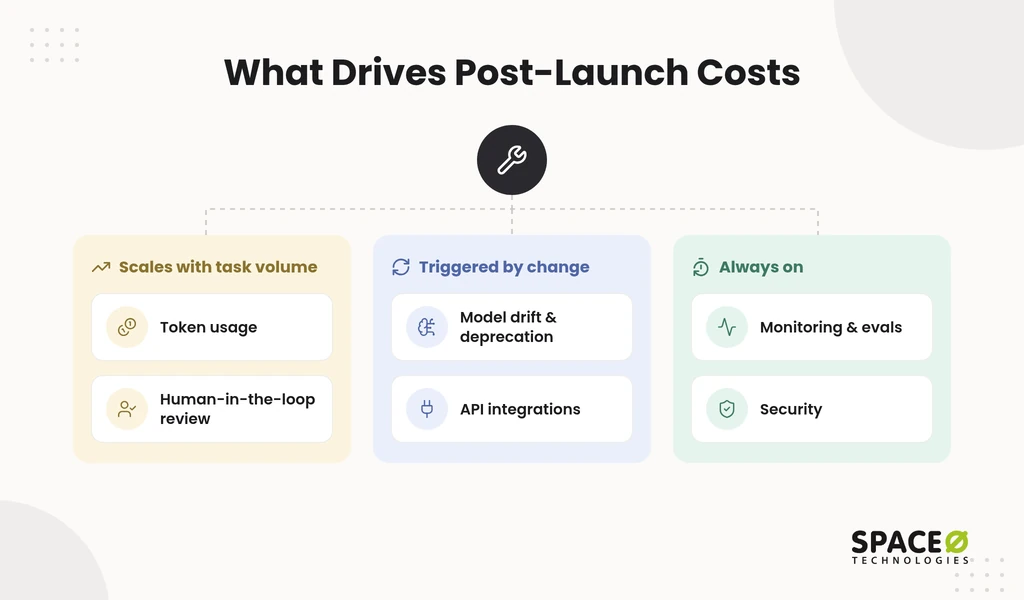
- Token usage: spend grows with task volume, loop depth, and context length, as the token budget section explains.
- Model drift and deprecation: provider updates shift outputs, and model retirements force re-testing or migration.
- Monitoring and evals: production agents need constant checks on quality and cost. Every model we put into production sits inside an evaluation suite covering accuracy, hallucination rate, bias checks, latency, and cost, with continuous monitoring in place.
- Human-in-the-loop review: high-stakes outputs in finance or healthcare need stricter accuracy testing and often human review. In our builds, automation handles the volume, but a qualified human approves before any output influences a final decision.
- API integrations: each connected tool or system can change its interface, which breaks calls and forces re-tests.
- Security: access controls, patching, and data-handling reviews recur for as long as the agent runs.
Of these six, token usage is the one that scales with every task. It deserves its own budget method.
AI Agent Running Costs and LLM Token Budget
AI agent running costs and LLM token budget planning start from one fact: an agent runs a loop, not a single call. Leaders who budget per prompt underestimate the bill, because each task triggers several model calls. The sections below cover the loop, token types, monthly ranges, the budget formula, and the controls.
Why do agent loops multiply the token bill?
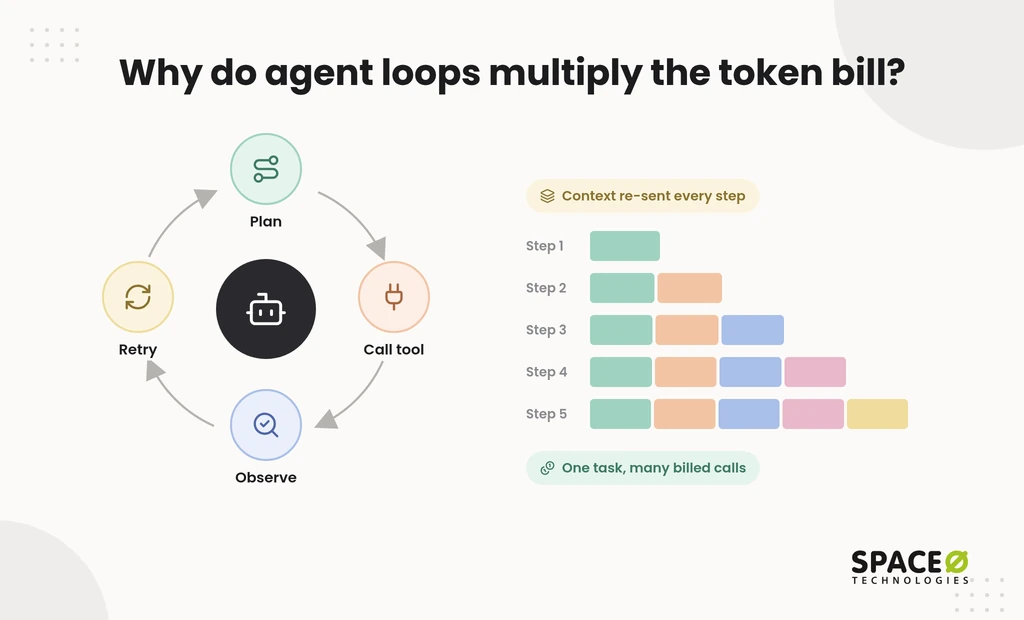
Agents plan, call a tool, observe the result, and retry, and each step re-sends a growing context window. Anthropic reports that agents use about 4x the tokens of chat, and multi-agent systems about 15x. Intercode.com notes that token use can grow quadratically when prompts are not pruned.
Costs also swing from one run to the next. A Stanford paper, summarized in a LinkedIn post on hidden agent costs, found that identical tasks can vary widely in cost. The same post reports up to 1,000x for coding agents.
That variance is why averages mislead. The budget has to cover the long runs, not just the typical one.
How are input, output, cached, and reasoning tokens billed?
Providers meter input and output tokens separately and price them at different rates. Keito.ai advises tracking input, output, and reasoning tokens as separate lines. It reports that output tokens cost three to five times more than input tokens. Cached input is billed at a discount, covered under the controls below.
Reasoning tokens add the biggest multiplier, but sources disagree on its size. Keito.ai puts it at five to twenty times, and other sources cite 10-30x. Treat the multiplier as a range that depends on the model and the task.
Sources also split on how much of the total spend tokens represent. Keito.ai says token billing covers only a fraction of actual AI spend, while Inkeep puts tokens at a very small share at high request volumes. Architecture decides which figure fits your agent.
What does a production agent cost to run each month?
Intercode.com prices monthly run cost by architecture, from $1,000 for RAG agents to $25,000+ for multi-agent systems. Retrieval-augmented generation (RAG) agents look up your documents before answering. The ladder, as published:
- RAG knowledge agent: $1,000-$4,500 per month.
- Multi-step workflow agent: $2,500-$8,000 per month.
- Multi-agent orchestration system: $6,000-$25,000+ per month.
Each step up adds more calls per task and more context per call. The formula below shows how to size your own number.
Which controls keep the token budget in check?
Model routing, prompt caching, and iteration caps do most of the work, and deterministic code handles the rest. Each control below targets a different multiplier in the formula.
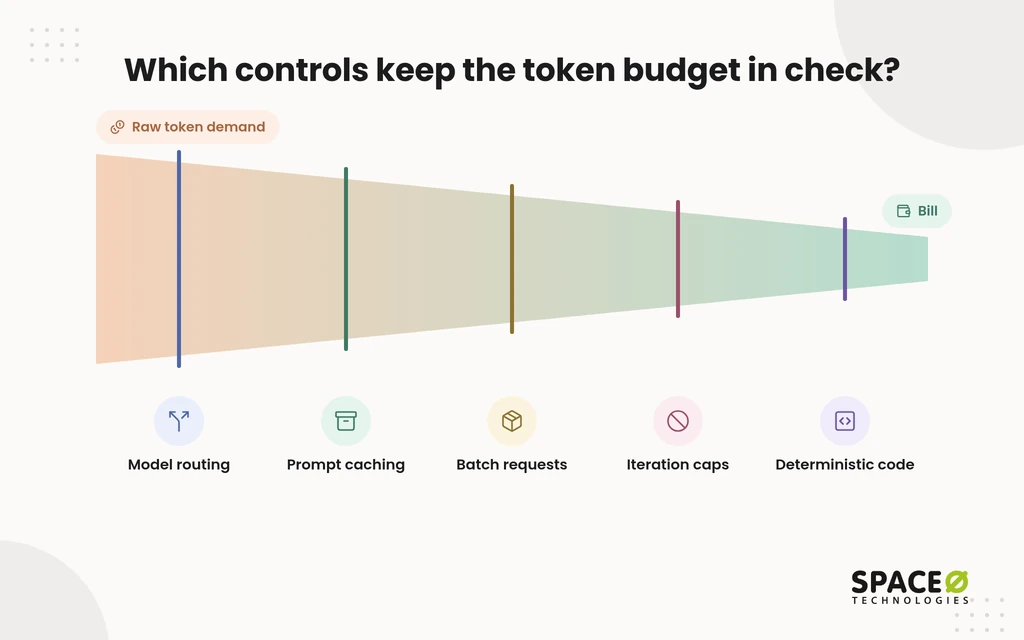
- Model routing: send simple steps to smaller models, which Inkeep reports can cut costs.
- Prompt caching: reuse static system prompts and documents; seoprofy.com reports cached input can cost far less.
- Batch requests: queue work that can wait; seoprofy.com reports eligible batches get a discount.
- Iteration caps: set a hard step limit per run so a stuck loop cannot drain the budget.
- Deterministic code: move steps that never change into plain code, so no model call is needed.
Controls cut the usage line, but the maintenance line remains. The next section adds the two together.
Maintenance and Run Cost Reconciled: Worked Examples and Three-Year Total Cost of Ownership
Maintenance and usage are separate lines; you need both to see the real bill. Most published answers quote one or blend them. The examples below are our arithmetic on the ranges already cited, not quotes.
What does a $100,000 build cost to keep running?
A $100,000 build needs $15,000-$25,000 a year for maintenance, about $1,250-$2,083 a month, plus usage.
| Line | Low case | High case |
|---|---|---|
| Maintenance (15% / 25% of build) | $1,250/month | $2,083/month |
| LLM tokens | $500/month | $5,000+/month |
| Infrastructure | $200/month | $2,000+/month |
| Monthly total | $1,950 | $9,083+ |
| Annual total | $23,400 | $109,000+ |
What does a $30,000 build cost per month after launch?
At 15-25%, a $30,000 build needs $4,500-$7,500 a year, or about $375-$625 a month, before usage.
What is the three-year total cost of ownership for an MVP-sized agent?
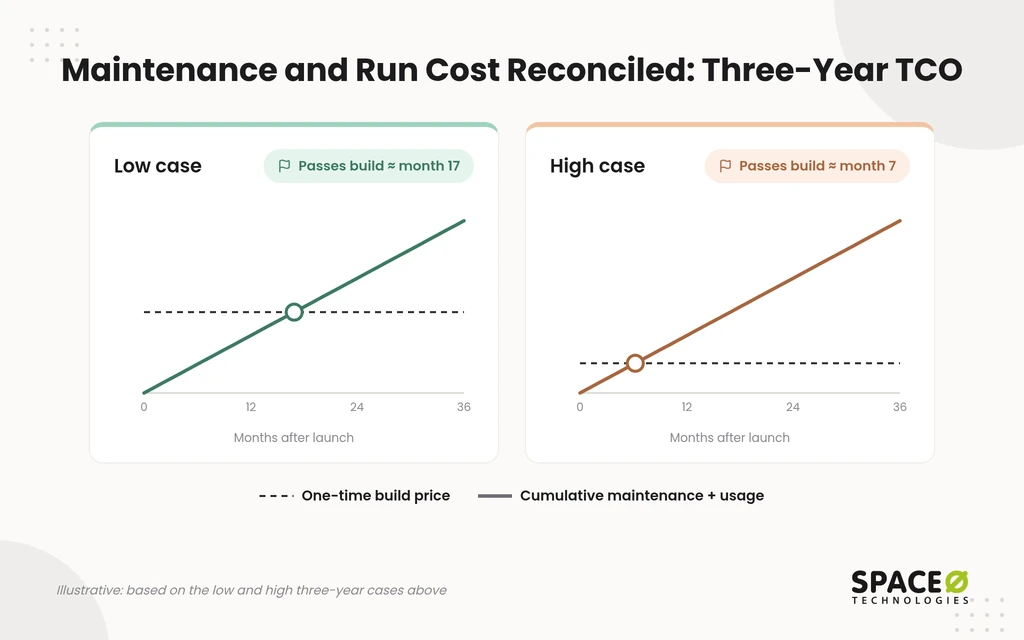
Over three years, usage can outweigh the build price itself. This model starts from the Space-O Technologies minimum viable product (MVP) range: per our MVP development services, a basic MVP can start at $15,000, while more feature-rich MVPs can go up to $50,000 or more, with milestone-based payments.
| Line | Low case | High case |
|---|---|---|
| Build (one-time) | $15,000 | $50,000+ |
| Maintenance, 3 years (15% / 25% of build) | $6,750 | $37,500+ |
| Usage, 36 months ($700 / $7,000 a month) | $25,200 | $252,000+ |
| Three-year total | $46,950 | $339,500+ |
The low case totals $46,950 and the high case $339,500+. Usage is about 54% of the low case and 74% of the high case. In both cases the token budget matters more than the build price.
Space-O Technologies production benchmark: infrastructure, API usage, and maintenance add to the total, and maintenance alone typically costs 15% to 25% of the build every year.
Your agent’s architecture sets where you land. The tier ranges show that link below.
Maintenance Cost by Agent Type
Monthly upkeep scales with agent type, from $500-$2,000 for simple agents to $8,000-$20,000+ for multi-agent systems, per azilen.com. More tools, retrieval, and hand-offs mean more calls and more to re-test. Figures are published estimates, dated per the pricing note.
| Agent type | Monthly cost | What drives it |
|---|---|---|
| Simple FAQ or rule-based agent | $500-$2,000 | Few calls, short context |
| LLM task agent | $2,000-$6,000 | Multi-step tasks and tool calls |
| RAG knowledge agent | $3,000-$9,000 | Vector database, retrieval, document refresh |
| Multi-agent system | $8,000-$20,000+ | Agent hand-offs and nested loops |
Who Maintains the Agent After Launch?
You have four options: an internal team, a retainer with the builder, Space-O Technologies, or a managed product. The right owner depends on your team’s depth and the agent’s volume. Each option carries a different cost profile and risk.
| Option | What it requires | Cost profile | Trade-off |
|---|---|---|---|
| Internal team | Engineers skilled in LLM operations on staff | Lowest long-term cost once staffed | Fragile when one person is out |
| Retainer with the builder | A monthly agreement with the original team | Predictable monthly fee | Coverage depends on the retainer’s scope |
| Space-O Technologies | One of four engagement models | Set by the model you choose | An external team needs onboarding to your workflows |
| Managed per-seat or per-resolution product | A subscription priced per seat or per resolution | Can total less at low volume | Fees grow with volume; the vendor controls routing and token settings |
Space-O Technologies maintains agents under Dedicated Team, Time & Material, Fixed Cost, or Staff Augmentation models. We sign a non-disclosure agreement (NDA) before every project. All source code, data, and intellectual property (IP) transfer to you at completion. With a custom build, your team keeps control of the token budget and model routing.
We have served 1,200+ clients since 2010 and report 97% client retention. Our 140+ in-house developers cover build and upkeep, and you can hire AI agent developers to join your own team.
Tell Us About Your Agent and Monthly Volume
Tell us your agent type and monthly interactions. We will map your maintenance and run budget line by line in a free, expert-reviewed estimate.

Frequently Asked Questions
How much would it cost to run 5 AI agents?
No cited guide publishes a five-agent figure, so this is arithmetic that assumes costs scale linearly. Using azilen.com’s monthly ranges, five simple agents cost the least, while five LLM task agents cost more. Five RAG knowledge agents cost more still than five LLM task agents on those same ranges. Five multi-agent systems come to about $40,000-$100,000+.
How much will it cost to develop a custom AI agent in 2026?
Space-O Technologies puts AI development cost at $25,000 to $500,000+ in 2026. A proof of concept costs $15,000 to $40,000 over 4 to 8 weeks, as of July 2026. MVP pricing is set out in the three-year TCO section above, so it is not repeated here. Enterprise platforms with custom models, deep integrations, and compliance controls go beyond $500,000 in cost. Treat the build quote as the smaller long-run number: as the three-year TCO shows, maintenance and usage can together outweigh it.
Can I build my own AI for free?
You can avoid a vendor build fee, but you cannot avoid the usage bill itself. The token and infrastructure ranges in the monthly operating costs section apply to whoever builds the agent. The real cost of going it alone is staffing. In the ownership table, an internal team only becomes the cheapest option once LLM operations engineers are on staff, and it stays fragile if that depends on one person.
What information do I need to get an accurate AI agent maintenance estimate?
Share the agent type (simple, RAG, workflow, or multi-agent), monthly interactions, integrations, and compliance scope. If you can supply only one figure, make it monthly volume, since usage moves with every task.



 All our projects are secured by NDA




 4.8


