
 By
Contents
- Agentic workflow automation uses AI agents that plan, act, and adapt toward a business goal.
- Hybrid designs pair rule-based bots with agents, so you pay for reasoning only where judgment is needed.
- Approval gates, least-privilege access, and audit trails keep production agents safe and reviewable.
- Budget for run costs and yearly maintenance, which typically adds 15% to 25% of build cost.
Key Takeaways
Agentic workflow automation services put AI agents in charge of multi-step business processes. These agents plan goals, call tools, and decide each next step. Human review stays in place for high-stakes actions.
Rule-based bots break when a screen layout or a data field changes. Agents adapt to those changes and handle free-text emails, scanned forms, and odd requests. Most teams pair both and gain the benefits of agentic workflow automation.
Space-O Technologies builds them into your CRM, ERP, and ServiceNow systems. Our AI agent development company team scopes, builds, and maintains them. This guide covers patterns, use cases, costs, and the controls that keep agents safe.
What Is Agentic Workflow Automation?
Agentic workflow automation lets AI agents choose and run each next step of a business process.
AI adoption is already broad: McKinsey found that 88% of organizations use AI in at least one business function. The remaining cost sits in exceptions such as free-text emails, scanned forms, and requests that fit no template.
An agent takes a goal and breaks it into subtasks. It then works through a perceive-reason-act loop, a pattern behind current agentic AI trends. It reads unstructured data, adapts to unexpected inputs, and checks each result before moving on.
- Goal-driven: The agent receives an outcome to reach, not a script to replay step by step.
- Subtasks: A large language model (LLM) splits the goal into ordered steps and picks a tool for each one.
- Real-time decisions: The agent chooses its next action from live data, not from a hard-coded branch.
- Self-correction: A failed step triggers a retry or a revised plan instead of a silent stop.
- Large action models (LAMs): These models are trained to take actions inside software, and some platforms pair them with LLMs.
- Model Context Protocol (MCP): MCP is an open standard that lets agents reach tools and data through one consistent interface.
- A2A (agent-to-agent) protocols: These protocols let agents built on different systems pass work to each other.
Agentic Workflows vs. Traditional Automation
Traditional automation follows fixed rules, while agentic workflows reason toward a goal and adapt when inputs change.
Robotic process automation (RPA) works well until a screen layout or a field changes. Then the bot stops, and someone rewrites the script. Agents plan, use tools, and absorb that variation. Computer-based AI agents can even operate legacy screens.
The trade-off is real, though. Rule-based steps run faster and cost less per run. That is why most modern systems blend both.
| Aspects | Traditional Automation (RPA, Scripts) | Agentic Workflows | Hybrid (How Space-O Technologies Designs) |
|---|---|---|---|
| How it decides | Hard-coded rules and conditions | LLM reasoning toward a goal | Deterministic orchestration executes, and bounded agents reason at decision points |
| Inputs it handles | Structured, predictable data | Unstructured text, documents, and exceptions | Code handles structured steps, and agents handle unstructured ones |
| When something changes | Breaks on changed screens or fields | Re-plans or escalates to a person | Agents absorb variation while code keeps the core path stable |
| Speed and cost per run | Fastest and lowest cost | Slower, because every model call adds cost | Model calls happen only where judgment is needed |
| Oversight | Exception queues | Human-in-the-loop approval gates and audit trails | Approval gates on high-risk actions, with logs on every step |
| Typical fit | Stable, high-volume tasks | Variable, judgment-heavy tasks | Most production workflows |
Core Components of an Agentic Workflow
Every production agentic workflow rests on five components that work together.
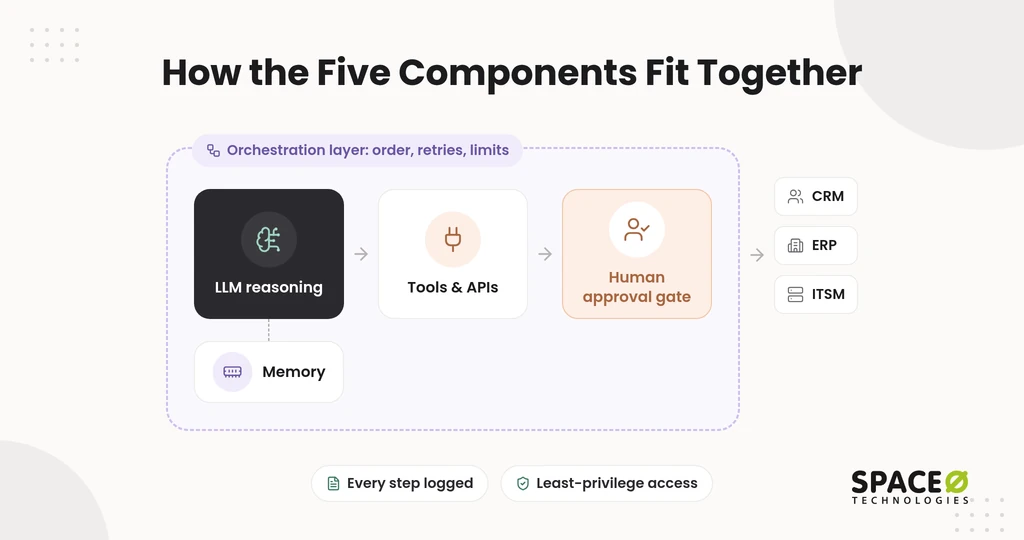
Remove any one of them, and the workflow either cannot act or cannot be trusted. We design all five from the first sprint.
- LLM reasoning layer: The model interprets the goal, plans subtasks, and picks the next action. Weak grounding causes AI agent hallucinating.
- Tools and APIs: These connections let agents read and write in your business systems. Examples include CRM (customer relationship management), ERP (enterprise resource planning), and ITSM (IT service management) platforms.
- Memory or shared state: Stored context lets agents keep case history and hand work to each other without losing detail.
- Orchestration layer: This layer sequences agents, handles retries and errors, and enforces safety boundaries across the workflow.
- Human-in-the-loop (HITL) controls: Approval gates, human review, and escalation paths sit in front of high-risk actions.
Common Design Patterns
Four design patterns cover most agentic workflows, and many systems combine two or more of them.
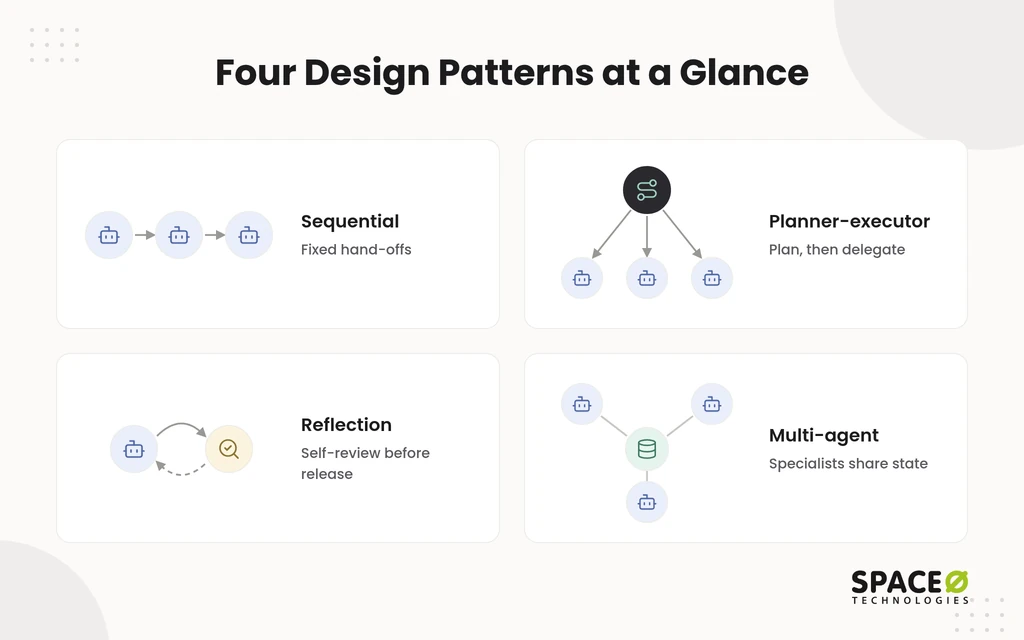
The pattern sets your cost, your speed, and how easily you can test the system. We choose the simplest pattern that meets the goal and prove it first through an AI agent proof of concept.
- Sequential: Agents run in a fixed order, and each agent passes its output to the next step.
- Planner-executor: One agent plans the subtasks, and separate executors carry out each step with narrow permissions.
- Reflection and self-critique: An agent reviews its own output against criteria and retries before anything is released.
- Multi-agent collaboration: Specialist agents share state, and multi-agent orchestration coordinates their hand-offs and conflicts.
What Our Services Cover
Our services cover six areas, from process redesign through long-term maintenance.
Many teams buy a model and then discover the real work is integration and control. We scope all six areas together, so nothing important lands in a later phase.
- Workflow assessment and redesign: We map the process, remove dead steps, and mark where agents add value. This work often starts with AI consulting services.
- Agent design and guardrails: We define each agent’s goal, tools, permissions, and escalation rules before any code is written.
- Systems and API integration: We connect agents to your CRM, ERP, and legacy systems through secure API integration services.
- Multi-agent orchestration: We build the coordination layer that sequences agents, retries failures, and logs every action.
- Testing and evaluation: We test for accuracy, hallucination, bias, latency, and cost before release.
- Monitoring and maintenance: We track live performance, update models and tools, and adjust guardrails as your process changes.
Common Enterprise Use Cases
The strongest enterprise use cases share one trait: high volume mixed with frequent exceptions.
These are the workflows where rule-based bots generate the most manual rework. Each line below shows the chain of actions an agent typically runs.
- IT service desk: Classify the ticket, check the ITSM record, run approved fixes, and update the ticket. Agents work inside your instance through our ServiceNow integration services.
- Customer support: Read the complaint, gauge its tone, pull the case history, and draft a reply for an agent to approve.
- Finance and insurance: Extract invoice or claim data, match it to ERP records, flag mismatches, and route approvals.
- HR: Collect onboarding documents, create system accounts, schedule training, and answer policy questions.
- Supply chain: Monitor orders, spot delays, re-plan shipments, and notify suppliers of the changes.
Platform or Custom Build?
Buyers choose between enterprise automation platforms and custom development firms, and each path asks something different of your team.
The table describes each option by what adopting it requires. Pricing changes often, so we print no vendor figures here.
| Option | What It Is | What Adopting It Requires | Pricing |
|---|---|---|---|
| UiPath | Enterprise automation platform that runs AI agents with RPA bots inside an orchestration layer | Platform licenses, trained administrators, and workflows built within its connectors | No figure listed here; check the vendor’s current pricing page |
| Automation Anywhere | Agentic AI platform for multi-step, multi-system processes | Platform licenses, administrators, and processes shaped to its automation model | No figure listed here; check the vendor’s current pricing page |
| Microsoft Copilot Studio / Power Automate | Microsoft’s agent and workflow tools within the Power Platform | A Microsoft environment, plan-based licensing, and admins to manage connectors and data policies | No figure listed here; check the vendor’s current pricing page |
| ServiceNow AI Agents | Agents that run inside the ServiceNow platform | An existing ServiceNow instance, the right plan tier, and administrators to configure agents | No figure listed here; check the vendor’s current pricing page |
| IBM watsonx Orchestrate | IBM’s agent orchestration product for enterprise tasks | An IBM subscription, integration setup, and administrators to govern access | No figure listed here; check the vendor’s current pricing page |
| n8n, CrewAI, LangGraph | Workflow and agent frameworks that developers assemble in code or visual flows | Engineers to build, host, secure, and monitor agents, plus governance you design yourself | No figure listed here; check each project’s current pricing or license page |
| Custom build (Space-O Technologies) | Agents designed around your process, systems, and data | A defined scope, system access, and a named owner on your side | Scoped ranges appear in the cost section below |
A custom build can also sit on top of one of these platforms. In that case, the platform becomes the runtime and the build supplies the logic. Teams without engineers can hire AI developers for that layer.
Agentic Process Automation for Enterprises: How APA Runs Beside RPA
Agentic process automation (APA) runs agents inside an orchestration layer, next to your RPA bots, APIs, documents, and people.
Enterprises rarely start from zero. Most already run bots, integrations, and approval chains. APA does not replace that estate. It adds a reasoning layer where rules fall short, as an agentic AI transformation roadmap would sequence it.
- Perceive: The agent reads the incoming request, document, or system event, including unstructured data.
- Reason: The agent plans subtasks and decides which bot, API, or person handles each one.
- Act: RPA bots and APIs execute the deterministic steps, and the agent handles the judgment calls.
- Verify: The agent checks the result against business rules and sends high-risk actions to a human for approval.
- Record: The system logs every decision and action in an audit trail for compliance review.
For APA, success means a finished task backed by evidence and an audit trail. A fluent reply on its own does not count.
Agentic Workflow Automation Development Company: Space-O Technologies
Space-O Technologies is an agentic workflow automation development company that builds goal-driven AI agents for enterprise systems.
Space-O Technologies has built custom software since 2010 and has served 1,200+ clients. Our approach suits US teams that need agents wired into an existing ERP, CRM, and ServiceNow stack. It also suits teams that want built-in human review and fixed-cost scoping. One partner covers software, AI, ERP, CRM, and ServiceNow, so you manage one vendor.
- Human review by default: We enable human review checkpoints for lending, clinical, and other high-stakes decisions.
- Responsible AI: We never train models on client data, mask personally identifiable information (PII), and test for hallucination and bias.
- Ownership: We sign an NDA before every project. All source code, data, and IP transfer to you at completion.
- Engagement models: You can choose a Dedicated Team, Time & Material, Fixed Cost, or Staff Augmentation model.
- Client retention: Space-O Technologies reports 97% client retention.
- Locations: We have offices in Mesa (Arizona, USA), Brampton (Ontario, Canada), and Ahmedabad (India).
What should you look for in a development partner?
Look for proof of production work and controls you can inspect, not demo polish.
- Production track record: The partner shows live agents with monitoring and answers every question to ask an AI agent development company.
- Human-review design: The partner documents where people approve actions and what triggers an escalation.
- Process redesign first: The partner maps and simplifies the workflow before writing agent logic.
- Code and IP ownership: You own the code, prompts, and data at handover, in writing.
- Engagement flexibility: The partner offers fixed-cost pilots as well as ongoing team models.
Do you need a custom build partner or an off-the-shelf platform?
The answer depends on what your team can staff and what you need to own.
A platform asks you to fit the process to its connectors, licenses, and admin model. A custom build asks for a clear scope and a partner you trust with system access. Some teams run both, with a custom layer on a licensed runtime.
How We Deliver Agentic Workflows
We deliver in six stages, with a review checkpoint and a risk gate at each one.
Projects slip when integration and testing get squeezed at the end. Our sequence moves that work forward.
- Assess and redesign the workflow: We map the current process, cut dead steps, and agree on success measures.
- Design agents and guardrails: We set goals, tools, permissions, and approval gates for each agent.
- Integrate systems and APIs: We connect your CRM, ERP, ServiceNow, and legacy systems with least-privilege access.
- Test and validate: We run evaluation sets for accuracy, hallucination, bias, latency, and cost.
- Deploy and monitor: We release in stages, with dashboards and alerts on live behavior.
- Maintain: We update models, tools, and guardrails as your systems and rules change.
Want A Clear Plan For One Workflow?
Our engineers map your process, systems, and approval points to give you a clear plan. We then scope a pilot that you can fund before you commit to a larger budget. Share your workflow today.

Governance, Security, and Implementation Challenges
Governance, security, and integration complexity cause most agentic projects to slow down, so we plan them first.
What makes agentic workflows hard to implement?
The hard part is trust at scale, not the model itself.
- Governance: Teams must decide who owns each agent, who approves changes, and how decisions get audited.
- Security and compliance: Agents touch live systems, so access, logging, and data handling must meet your policies.
- Integration complexity: Legacy systems and inconsistent data slow tool connections more than model work does.
- Output reliability: An LLM can produce confident errors, so outputs need checks before they trigger transactions.
- Run-cost drift: Token use grows with volume, so cost needs budgets and monitoring from launch.
Which controls keep agents safe in production?
Production agents need grounding, evaluation, human approval, and a complete audit trail.
We run every production model inside an evaluation suite that covers accuracy, hallucination rate, bias, latency, and cost. Continuous monitoring watches live behavior. Automation handles the volume, and a qualified human approves before any output influences a final decision.
- Approval gates: Teams set AI agent guardrails so people approve payments, account changes, and other high-risk actions.
- Audit trails and observability: Every agent step, tool call, and decision gets logged for review.
- Data protection: We apply no training on client data, PII masking, and least-privilege access.
- Compliance posture: Our posture covers ISO 27001 alignment and HIPAA-ready frameworks for healthcare AI.
What Does It Cost to Build and Run an Agentic Workflow?
Build cost depends on scope, integrations, and compliance needs, and run costs continue after launch.
Budgets often cover the build and forget the bill that follows. The ranges below come from our AI development cost guidance. Your scoped estimate replaces them.
| Tier | Typical Range (2026) |
|---|---|
| Proof of concept or basic MVP | From about $15,000 |
| Feature-rich MVP | Up to $50,000+ |
| Custom AI development, overall | $25,000-$500,000+ |
| Enterprise AI platform with deep integrations and compliance | Beyond $500,000 |
- Recurring costs: Your budget also needs cloud infrastructure and LLM or API usage fees.
- Annual maintenance: Maintenance typically costs 15% to 25% of the original build cost every year.
- Data preparation: Data work can take 25% to 40% of the total project budget.
- Payment structure: MVP-scale pilots use milestone-based payments tied to deliverables.
- Pilot path: Many teams start with one workflow scoped as a fixed-cost pilot.
- Free estimate: Ask our team for a free, expert-reviewed estimate based on your scoped workflow.
We do not quote hourly rates. Every estimate is a scoped range tied to your process and systems.
Scope Your First Agentic Workflow
Three answers let us scope your project accurately.
- Process or department: Which workflow costs the most manual effort? See how to pick the first use case for an AI agent.
- Systems and tool stack: Which CRM, ERP, ITSM, or legacy systems should the agents read from and write to?
- Build path: Do you prefer a no-code platform, a custom build, or a custom layer on a platform?
Frequently Asked Questions
Does Power Automate have agentic AI?
Yes. Microsoft offers agent and workflow tools within the Power Platform, under the names Copilot Studio and Power Automate. Using them requires a Microsoft environment, plan-based licensing, and administrators to manage connectors and data policies. For plan figures, check Microsoft’s current pricing page.
How do I add human approval gates and audit trails to an AI agent?
Place approval gates in front of high-risk actions such as payments and account changes. Define in advance what triggers an escalation to a person. Log every agent step, tool call, and decision so reviewers can audit the full chain. For lending or clinical decisions, require a qualified human to approve before any output influences a final decision.
What system access and data controls do AI agents need in a CRM, ERP, or ServiceNow environment?
Agents should run with least-privilege access, and executor agents should have narrow permissions limited to their own step. Mask personally identifiable information (PII) and keep client data out of model training. Log every tool call. Make sure access, logging, and data handling meet your own policies, because agents touch live systems.
What is the difference between agentic workflow automation and RPA?
RPA follows fixed rules and stops when a screen or field changes. Agentic workflow automation uses AI agents that reason toward a goal and adapt to changed inputs. Most production systems combine both.
How much do agentic workflow automation services cost?
A proof of concept starts at about $15,000. Custom AI development overall typically runs from $25,000 to $500,000+, and enterprise platforms with deep integrations go beyond $500,000. Your scoped estimate replaces these ranges.
Which processes should you automate first with AI agents?
Start with high-volume processes with frequent exceptions, such as IT service desk tickets and customer support cases. Invoice and claim matching, HR onboarding, and supply chain monitoring are also strong first candidates.
Can agentic workflows run alongside existing RPA bots?
Yes. Agentic process automation runs agents in an orchestration layer next to your bots, APIs, and people. Bots handle the deterministic steps, and agents handle the judgment calls.
Will AI agents replace human workers?
No. Agents handle routine steps, and people approve high-risk actions. Human review, escalation paths, and audit trails keep accountable staff in control of final decisions.



 All our projects are secured by NDA




 4.8


