
 By
Contents
- AI agents complete multi-step tasks across your tools, while chatbots only answer questions inside one chat.
- Start with support triage, lead follow-up, or invoice matching, because each repeats the same steps daily.
- Check agent features in software you already pay for before commissioning a custom build.
- Keep a person approving anything the agent publishes, sends, or spends.
Key Takeaways
Small and medium-sized enterprises lose hours every week to repeated tasks that span several systems. Examples include moving a lead from email into the CRM or matching invoices to purchase orders. AI agent development for SMEs (also called SMBs) targets that work. Done well, an agent handles routine steps while your staff keeps control.
The hard part is knowing where to start. Custom AI agent development means building software that completes multi-step work across your CRM and email. Unlike a chatbot or fixed script, an agent picks the next step toward a goal. You still must choose which workflow to automate and whether software you already pay for is enough. You also need to decide how your team will approve anything the agent publishes, sends, or spends.
Space-O Technologies has built AI-powered custom software since 2010 for 1,200+ clients. This guide covers use cases, build-versus-buy choices, safeguards, and costs, including the AI development cost of keeping an agent running. You will leave with a clear first pilot to scope.
How Is an AI Agent Different From a Chatbot or RPA?
An AI agent chooses the next step toward a goal, while a chatbot answers questions and RPA repeats fixed steps. Most SMEs already run some automation. The useful question is what an agent adds on top.
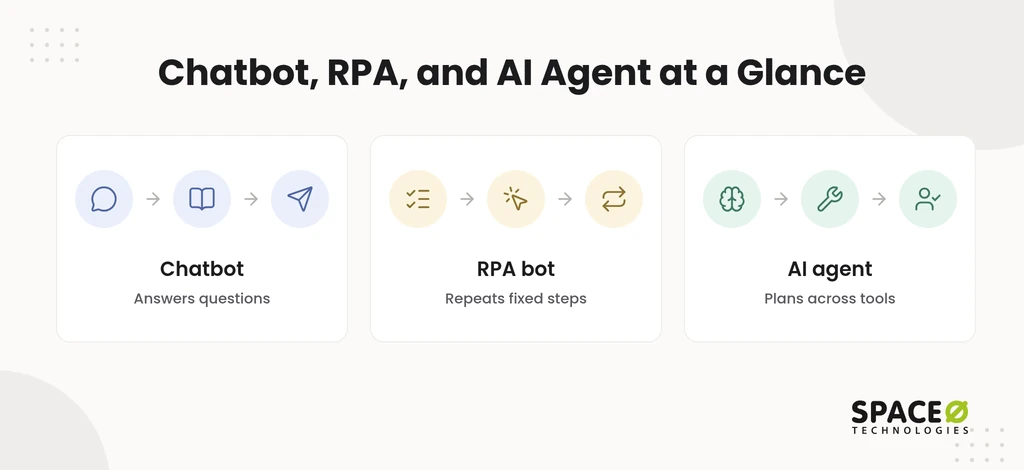
- Chatbots: A chatbot, the kind built through AI chatbot development, answers questions inside one conversation. It rarely updates records or finishes a task across several systems.
- RPA (robotic process automation): An RPA bot repeats the same fixed, rule-based clicks every time. It suits stable processes that never change shape.
- AI agents: An AI agent reads context, picks the right tool, and carries a task through several systems. It pauses for approval wherever you set a checkpoint.
In short, pick a chatbot for simple questions and RPA for fixed routines. Choose an agent when a task needs judgment across several tools. Many SMEs combine all three, with the agent coordinating the work.
What Are SMEs, and How Do They Define Size?
SMEs are independent businesses whose employees, revenue, or assets fall below limits that separate them from large corporations. Owners often ask whether their company qualifies. The answer depends on which public body draws the line.
- EU employee thresholds: The European Commission defines an SME as fewer than 250 employees. A small business has fewer than 50, and a micro business fewer than 10.
- US employee thresholds: In the US, a small business commonly means fewer than 500 employees. The U.S. Small Business Administration (SBA) sets industry caps up to 1,500.
- Economic weight: The World Bank reports that SMEs make up most businesses and a large share of employment worldwide.
- Common challenges: SMEs face tighter financing, uneven cash flow, and more vulnerability to shocks than large corporations.
- Local examples: A restaurant needs online orders and reservations in one system. A dental office needs appointment reminders and patient intake. A retail shop needs store inventory matched to online sales.
The term MSME means the same thing, with micro businesses counted as a separate tier.
Match your headcount to the right body’s definition before you plan. Size limits differ by region, so confirm yours. Then scope an agent that fits your team and budget.
Which AI Agents for SMB Workflow Automation Pay Off First?
AI agents for SMB workflow automation pay off first in customer support, sales follow-up, and back-office work. Each of these areas repeats the same steps across the same tools every day. Operations and internal knowledge come next.
- Customer support triage: The agent reads Zendesk or email tickets and answers routine questions from your documentation. It routes complex cases to staff.
- Lead qualification and follow-up: The agent scores new leads in HubSpot or Salesforce and drafts a follow-up email. It then books a call on your calendar.
- Invoice processing: The agent pulls invoice fields and matches them to purchase orders. It works in QuickBooks or connects to your enterprise resource planning (ERP) system through ERP integration. It flags any mismatch for review.
- Order and inventory updates: For Shopify stores, the agent checks stock and updates order status. It posts exceptions to a Slack channel.
- Internal knowledge answers: With retrieval-augmented generation (RAG), the agent answers staff questions from Notion, Google Docs, or Confluence. It cites the source page with each answer.
Start with the area where your team repeats the most steps. One well-chosen workflow gives you a fast, measurable first result. Expand to the next area once it runs reliably.
Should You Use Built-In AI, a No-Code Platform, or a Custom Agent?
Check the agent features in software you already pay for first, then compare no-code platforms with a custom build. Your CRM or helpdesk may already include agent features. Audit those before you buy more software. Weigh the trade-offs of custom AI development vs. off-the-shelf options early.
Suite vendors offer agents inside their own products, such as Microsoft Copilot Studio, Salesforce Agentforce, and HubSpot Breeze. Zapier Agents, Make, n8n, and Meta Muse offer ready-made agents or visual workflow builders.
| Decision factor | Agent features in software you already pay for | No-code platform | Custom build with Space-O Technologies |
|---|---|---|---|
| Fit to your workflow | Follows the vendor’s built-in workflow inside one product | Fits simple, linear automations across common apps | Built around your exact steps, rules, and exceptions |
| Integration depth with CRM and ERP | Deep inside the host product, limited outside it | Depends on the platform’s prebuilt connectors | Custom application programming interface (API) integration with CRM, ERP, and legacy systems |
| Human-review checkpoints | Set through the vendor’s approval settings | Added as manual steps inside each workflow | Placed at every high-stakes action you define |
| Code and IP ownership | The vendor owns the software; you configure it | Workflows run on the platform’s infrastructure | All source code, data, and IP transfer to you at completion |
| Engagement model | Your existing subscription; higher plan tiers may gate agent features | Self-serve subscription with usage tiers | Dedicated Team, Time & Material, Fixed Cost, or Staff Augmentation |
| Who maintains it | The software vendor | An administrator on your team | Space-O Technologies or your in-house team |
- Agent features in existing software: Best for workflows that start and finish inside one product, such as ticket replies in a helpdesk.
- No-code platforms: Best for simple linear automations between common apps, with a team member assigned to administer them.
- Custom build with Space-O Technologies: Best for SMEs whose workflows span a CRM, ERP, or legacy systems that off-the-shelf connectors don’t cover.
Start with the software you already own, and move to custom only when workflows cross systems. Compare cost, integration depth, and ownership before you commit. The right choice depends on your workflow, not on the vendor.
When do custom AI agents for small and mid-sized businesses make sense?
Custom AI agents for small and mid-sized businesses make sense when work crosses systems that off-the-shelf agents cannot reach. They suit SMEs that have outgrown spreadsheets and off-the-shelf agents.
We build each custom AI agent around your workflow. We connect it through API integration services and, where needed, custom CRM development. To compare partners first, browse reviewed AI development companies on GoodFirms.
- Ownership: We sign an NDA before every project. All source code, data, and IP transfer to you at completion.
- Compliance: Our compliance posture covers ISO 27001 alignment and HIPAA-ready frameworks for healthcare AI engagements.
- Evaluation: Every model we put into production runs inside an evaluation suite. The suite covers accuracy, hallucination rate, bias checks, latency, and cost, with continuous monitoring.
If your workflows span several systems, a custom agent is worth scoping. Settle ownership, compliance, and evaluation before the build begins. Ask any partner to show how they cover all three.
Which frameworks and models power a custom agent?
A custom agent combines an orchestration framework, a language model, and connectors to your business tools. The right mix depends on the task, not on the newest release.
- Frameworks: We build on LangChain, CrewAI, OpenAI Agents SDK, or Claude Agent SDK. Model Context Protocol (MCP) gives them tool access.
- Models: We match the model to the job. We compare Claude, GPT, and Gemini on accuracy, speed, and cost for your task.
- Grounding: RAG ties the agent’s answers to your own documents and records. Our generative AI integration services keep the stack small, focused, and easier to test.
Choose frameworks and models for your task, then test them on real cases. A focused stack is easier to maintain and cheaper to run. Ask your partner to explain every choice in plain terms.
Ready to Map Your First Pilot?
Send us your CRM, helpdesk, and ERP details. We will outline one pilot workflow with approval points, build costs, and a running cost range for your team. Book Scoping Call

How Does an SME Agent Project Run?
An SME agent project runs in five steps, from a tool audit to a measured pilot. Starting narrow keeps both risk and budget small.
- Audit what you own. List the agent features already included in your CRM, helpdesk, and accounting plans.
- Pick one workflow. Choose one repetitive task your team does more than a couple of times a week.
- Prepare data and connections. Clean the records the agent will read. Then connect each system through its API.
- Set approval points. Mark which actions need a person’s sign-off before the agent goes live.
- Run a pilot. A proof of concept, scoped like an MVP development project, commonly takes 4 to 8 weeks. Measure results on real work, then expand to the next workflow.
Keep the first project narrow and measure it on real work. Approval points and clean data matter more than speed. Expand only after the pilot proves its value.
What Does a Custom AI Agent Cost to Build and Keep Running?
A custom AI agent costs a build fee up front, then maintenance, hosting, and model usage every year. Most published price ranges cover the build and skip the running cost. This table shows both.
| Cost line | First year | Ongoing |
|---|---|---|
| Agent features in software you already pay for | Included in, or added to, your current plan; check vendor pricing | Per-user or per-month subscription set by the vendor |
| Custom agent build | Depends on scope, workflows, and integrations; request the free, expert-reviewed estimate | Covered by the maintenance, hosting, and usage rows |
| Space-O Technologies MVP development pricing (MVP pricing, not an agent-specific quote) | Depends on feature scope. Payments are milestone-based. | Covered by the maintenance row |
| Ongoing maintenance | Not applicable in the build year | 15% to 25% of the original build cost per year, per our AI development cost breakdown |
| Cloud infrastructure and monitoring | Set up during the build | Recurring hosting and monitoring fees |
| Inference and token usage | Grows with testing and pilot volume | Billed per model call, so cost scales with tasks completed; see LLM integration project cost |
Request a free, expert-reviewed estimate to get build and running costs for your workflow.
How Do You Keep a Human in the Loop?
Keep a human in the loop by requiring approval before the agent publishes, sends messages, or spends money. Customer-facing, financial, and irreversible actions should always reach a person first.
- Approval gates: The agent drafts the reply, payment, or post. A staff member approves it before it goes out.
- Limited permissions: Grant read access broadly and write access only to the fields each task needs.
- Testing before launch: Run the agent against real cases and score each output before it touches live customers.
- Audit log: Record every action, tool call, and approval, so your team can trace any outcome.
- Visible handoff: Customers and staff can see when the agent passes a case to a person.
Automation handles the volume. A qualified person approves before any output shapes a final decision.
Why Do AI Agents Fail in Production?
Many agent failures come from integration plumbing, messy data, and unchecked costs rather than from the model. These problems rarely show up in a short trial. Plan for them before launch. McKinsey’s State of AI research shows most organizations use AI, yet few have scaled it.
- Missing error handling: An agent without retry and fallback logic stalls when one connected tool times out.
- Dropped webhooks: Webhooks need retries and duplicate checks. Without them, events are lost or processed twice.
- Poor data hygiene: Duplicate CRM records and outdated documents lead the agent to wrong answers.
- Wrong model for the job: A large model on a simple task adds cost and latency without adding accuracy.
- Unchecked token spend: Inference cost grows with every call. Set budgets and alerts per workflow.
- Agent washing: Some products sold as agents are rebadged chatbots. Ask whether the product can complete a multi-step task across systems.
Most of these failures are preventable with planning before launch. Build in error handling, clean data, and spending limits from day one. Test against real cases to catch the rest.
Frequently Asked Questions
What is AI agent development for SMEs?
AI agent development for SMEs builds software that completes multi-step tasks across a company’s existing tools. The agent reads context, picks the next step, and acts through connected systems. Staff approves anything it publishes, sends, or spends.
How much does it cost to build an AI agent for a small business?
The build cost of a custom AI agent depends on your workflow, tools, and scope, so request our free, expert-reviewed estimate. Maintenance adds 15% to 25% of the build cost each year, plus hosting and model usage.
Which workflows should an SME automate first with an AI agent?
Start with customer support triage, lead qualification, or invoice processing. Each repeats the same steps across the same tools every day. Pick one workflow, pilot it, and expand after you measure results.
Should an SME build a custom AI agent or use a no-code platform?
Use a no-code platform or built-in agent features when the workflow stays inside common apps. Choose a custom build when work crosses a CRM, ERP, or legacy systems that connectors cannot reach. A custom build also transfers all source code and IP to you.
How long does an AI agent pilot take?
A proof of concept commonly takes 4 to 8 weeks. Timing depends on how clean your data is and how many systems the agent touches. Run the pilot on one workflow with real cases.
How do you keep a human in the loop with an AI agent?
Require staff approval before the agent publishes, sends messages, or spends money. Limit write permissions to the fields each task needs. Keep an audit log of every action, tool call, and approval.
What data should I have ready before building a custom AI agent?
Have clean, current records for the one workflow you pilot, plus API access to each connected system. Remove duplicate CRM records and retire outdated documents. Name an owner for every data source the agent reads.
What does a first AI agent rollout look like for a small business?
Start with one repetitive workflow, check the software you already pay for, and pilot with human approval. Audit existing agent features, prepare the data, and set approval points. Then run a pilot of 4 to 8 weeks and expand after you measure results.



 All our projects are secured by NDA




 4.8


