
 By
Contents
- A2A is an open standard that lets AI agents from different vendors work together.
- Use MCP to connect an agent to tools and data; use A2A to connect agents.
- A2A reuses HTTPS, JSON-RPC 2.0, OAuth 2.0, and your existing API gateways for security.
- Most rollout effort goes into integration, identity, and governance, not the protocol itself.
Key Takeaways
The agent-to-agent protocol (A2A) is an open standard for artificial intelligence (AI) agents. It lets agents discover, authenticate, and collaborate across vendors and frameworks. Google introduced it, and the Linux Foundation now governs it.
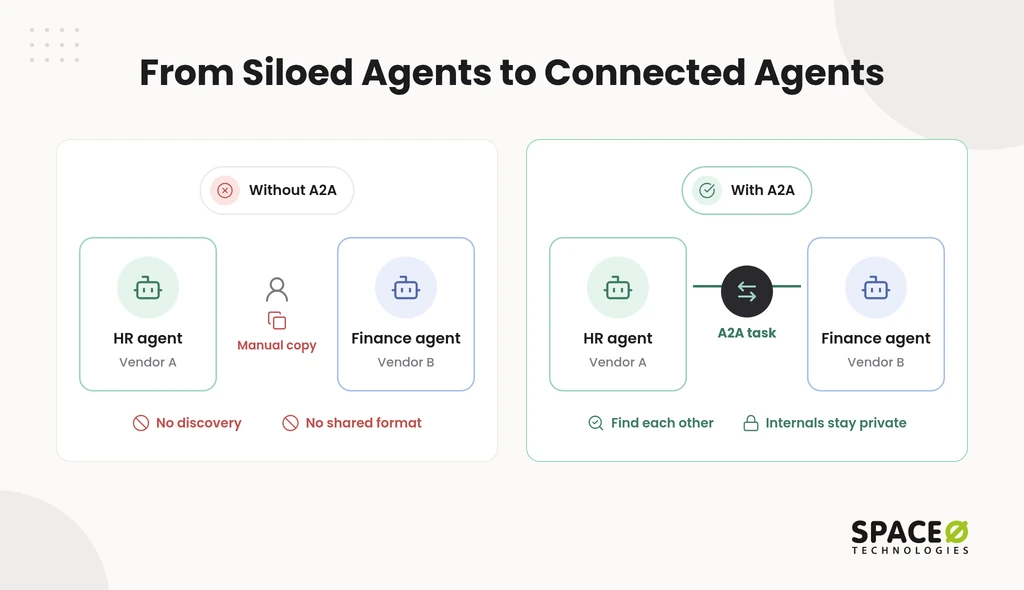
Many enterprises now run agents from several platforms. Each one works well alone but cannot talk to the others. Teams then rely on manual copying or custom API integration.
A2A coordinates work between agents, while the Model Context Protocol (MCP) connects agents to tools. This guide explains how it works and where it fits in your stack. It also covers the AI agent development work that turns the protocol into production.
What Is A2A, and What Does It Give an Enterprise?
A2A gives agents from different vendors one shared way to find each other and hand off work. Many enterprises now run agents from several platforms. Each one works well alone, but it cannot talk to the others. People end up copying results between systems by hand.
A2A solves this at the protocol level. The core enterprise value comes from four properties:
- Vendor neutrality: Agents built on AI agent frameworks work together through one standard. Examples include Google Agent Development Kit (ADK), LangGraph, and BeeAI.
- Opaque collaboration: Agents share context and artifacts without exposing their memory, prompts, or internal logic.
- Discovery and authentication: Each agent publishes what it can do and how callers must prove their identity.
- Asynchronous work: Tasks can run for seconds or for hours, which suits real business processes.
Opaque collaboration matters most when agents cross company lines. A partner’s agent can serve your request without seeing your agent’s proprietary instructions.
A2A vs. MCP: What Is the Difference?
MCP connects one agent to data and tools, while A2A coordinates tasks across multiple agents. Teams often treat the two as rivals and stall while they pick one. In practice, most multi-agent systems need both.
| Axis | Model Context Protocol (MCP) | Agent2Agent (A2A) |
|---|---|---|
| Connects to | Data sources, tools, and application programming interfaces (APIs) | Other autonomous agents, including other vendors’ agents |
| Coordinates | One agent’s access to the resources it needs | Task delegation and multi-agent workflows |
| Example | An agent queries a customer database before it answers | A human resources (HR) agent delegates a payroll check to a finance agent |
| Enterprise use | Grounding an agent in company systems | Running a process that spans departments or vendors |
A simple rule applies. Use MCP when an agent needs a resource. Use A2A when an agent needs another agent.
How Does A2A Work? The Key Components
A2A uses a client-server model in which a client agent sends tasks to a remote agent over standard web protocols. Architects often worry that a new protocol means new infrastructure. A2A avoids that by reusing transport your security team already knows.
What is the client-server model in A2A?
A client agent starts a request, and a remote agent server receives it and completes it. The client finds the right remote agent, sends the task, and tracks the result. The remote agent does the work with its own tools and logic. The two sides can be built on different frameworks. One agent can act as a client in one workflow and as a server in another.
What is an A2A Agent Card?
An Agent Card is a JavaScript Object Notation (JSON) metadata file that describes an agent to potential callers. It sits at a well-known Uniform Resource Identifier (URI), so client agents know where to look. The card lists the agent’s identity, endpoints, capabilities, and authentication requirements. For enterprise teams, each Agent Card works like an entry in a service catalog.
Which transport technologies does A2A use?
A2A runs on Hypertext Transfer Protocol Secure (HTTPS), JSON-RPC 2.0, and Server-Sent Events (SSE). Each one does a specific job:
- HTTPS: Encrypts traffic between agents on the same transport layer as your existing web services.
- JSON-RPC 2.0: Structures every request and response in a predictable remote procedure call format.
- Server-Sent Events: Stream progress updates from the remote agent while a long task runs.
What are the A2A task lifecycle states?
A2A tracks every task through defined states, so both agents always know where the work stands. A short-running task may finish in a single exchange. A long-running task, such as a multi-step approval, moves through states over time. The core states include:
- Submitted: The remote agent has received the task.
- Working: The remote agent is processing the task.
- Completed: The task has finished, and the results are available.
- Failed: The task could not finish, and the client must handle the outcome.
How Does A2A Handle Enterprise Security and Governance?
A2A relies on standard authentication, least-privilege access, and your existing API gateways rather than a new security model. Security leaders usually ask one question first. Can an outside agent reach data it should not see? A2A answers with controls your team already runs:
- Authentication: Agents present OAuth 2.0 or OpenID Connect (OIDC) bearer tokens, or API keys, as each Agent Card specifies.
- Least-privilege scopes: Permissions map to specific agent skills, so a caller reaches only what its task requires.
- API gateway routing: A2A traffic passes through API gateways for rate limiting, analytics, logging, and traffic control.
- Data minimization: Agents exchange only the data a task needs. This aligns with the General Data Protection Regulation (GDPR) and the California Consumer Privacy Act (CCPA). It also supports HIPAA-compliant handling under the Health Insurance Portability and Accountability Act.
The protocol supplies the controls. Your compliance still depends on how each agent stores, logs, and retains data.
From Protocol to Production: Connecting Agents Across Your CRM, ERP, ServiceNow, and Internal APIs
The protocol is the easy part; connecting agents to your existing systems is most of the work. Most enterprise data lives in customer relationship management (CRM) systems, enterprise resource planning (ERP) systems, and ServiceNow. Many of these systems were never built to talk to agents. A2A defines how agents speak to each other. It does not connect your systems for you.
Which enterprise workflows should you connect with A2A first?
Start with one workflow that already crosses two departments or two vendors. Two patterns fit well:
- HR-to-Finance handoffs: An HR agent passes onboarding or payroll checks to a finance agent.
- Multi-vendor supply chain: Your agent coordinates order and status updates with supplier or logistics agents.
Use this decision rule. Pick a workflow with a clear owner, a defined handoff, and an outcome you already measure. Leave high-risk decisions for a later phase, after your controls are proven.
What integration work sits around the A2A protocol?
Most of an A2A rollout is integration, identity, and governance work around the agents. Plan for these work streams early, because they set the scope behind your AI agent development cost:
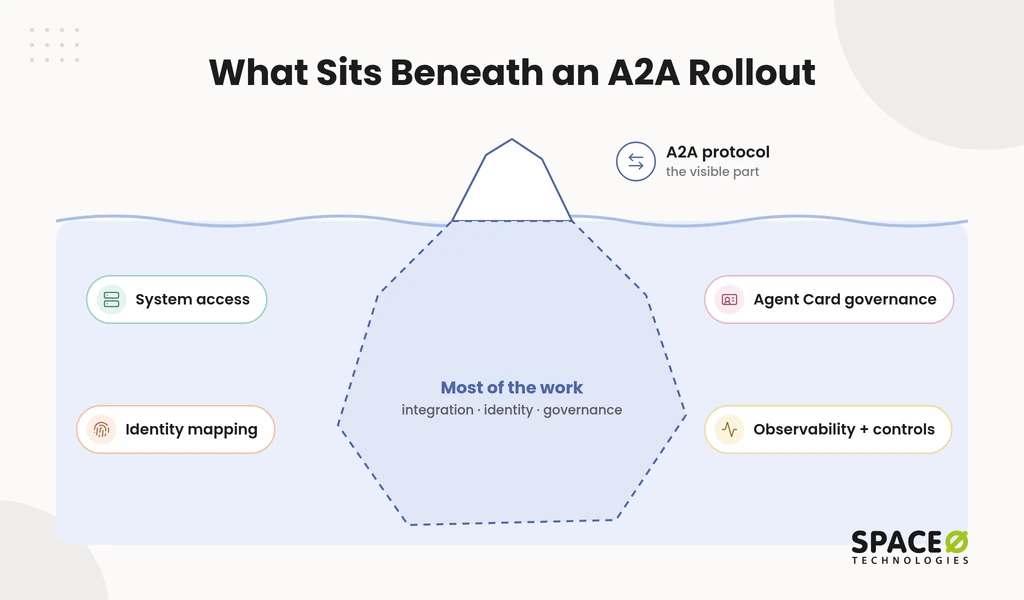
- System access: Expose CRM, ERP, and legacy data through secure API integration where no clean interface exists.
- ServiceNow connection: Let agents open, update, and route tickets through a governed ServiceNow integration.
- Platform modernization: Some older platforms need enterprise software development work before an agent can safely call them.
- Identity mapping: Tie agent tokens to your existing identity provider and role structure.
- Agent Card governance: Decide who publishes cards, who reviews capabilities, and who retires agents.
- Observability: Feed gateway logs into monitoring, so every cross-agent call is traceable.
- Production controls: Ground agents in company data, evaluate their outputs before release, and have people approve consequential decisions.
Ready to Plan Your First Cross-Agent Workflow?
Our team can scope the system access, identity mapping, and governance work around your first agent workflow. You will know the effort before you start.

Working With Space-O Technologies on Agent Integration
Space-O Technologies builds AI agents and the system integrations they depend on. Many leaders do not want one vendor for the agent and another for the connections. Space-O Technologies has built AI-powered custom software since 2010. It has served 1,200+ clients and reports that most of them stay with it.
Your team works with 140+ in-house developers who have delivered 300+ software solutions. We sign a non-disclosure agreement (NDA) before every project. All source code, data, and intellectual property (IP) transfer to you at completion.
We run 50+ AI systems in production. We are SOC 2 certified and ISO 27001-aligned. We mask PII before any third-party model sees it.
You can engage us in four ways: Dedicated Team, Time & Material, Fixed Cost, or Staff Augmentation. If you already have agent engineers, Staff Augmentation lets you hire AI agent developers into your existing sprints. If you need the full build, our team can take the agent from design to production. We work from offices in Mesa (Arizona, USA), Brampton (Ontario, Canada), and Ahmedabad (India).
Frequently Asked Questions
Do enterprises running AI agents on several platforms need A2A?
Yes. Many enterprises now run AI agents from several platforms. Each agent works well alone but often cannot talk to the others. The result is that people copy results between systems by hand, which is the gap A2A is meant to close.
Why is a standardized protocol like A2A necessary for building enterprise AI solutions?
A2A gives agents built on different frameworks, such as Google ADK, LangGraph, or BeeAI, one common standard. They use it to discover each other, authenticate, and collaborate. It also lets agents work together without exposing their memory, prompts, or internal logic.
What does the A2A agent-to-agent protocol enable?
A2A enables agents from different vendors and frameworks to discover each other and prove their identity. They can then delegate tasks through one open standard. It supports asynchronous work, so tasks can run for seconds or hours. Agents can collaborate by sharing context and artifacts without revealing their internal logic.
What is the difference between A2A and MCP?
MCP connects one agent to data, tools, and APIs. A2A coordinates tasks across multiple agents, including other vendors’ agents. Most multi-agent systems need both.
How does A2A handle enterprise security?
A2A relies on standard authentication, least-privilege access, and your existing API gateways. Agents present OAuth 2.0 or OpenID Connect bearer tokens, or API keys, as each Agent Card specifies. Permissions map to specific agent skills. Your compliance still depends on how each agent stores, logs, and retains data.
What is an A2A Agent Card?
An Agent Card is a JSON metadata file that describes an agent to potential callers. It sits at a well-known URI. It lists the agent’s identity, endpoints, capabilities, and authentication requirements.
Which technologies does A2A use?
A2A runs on HTTPS, JSON-RPC 2.0, and Server-Sent Events. HTTPS encrypts traffic between agents. JSON-RPC 2.0 structures each request and response. Server-Sent Events stream progress updates while a long task runs.
Which enterprise workflow should we connect with A2A first?
Start with one workflow that already crosses two departments or two vendors. Pick one with a clear owner, a defined handoff, and an outcome you already measure. Examples are HR-to-Finance handoffs and multi-vendor supply chain updates. Leave high-risk decisions for a later phase.



 All our projects are secured by NDA




 4.8


