
 By
Contents
- Ask each vendor what the agent may do alone and which actions need human approval.
- Test architecture, data security, and evaluation with evidence such as a live agent or a test plan.
- Request written terms for code, IP, data use, and running costs before you sign.
- Start with a scoped pilot, and budget 15%-25% of build cost yearly for upkeep.
Key Takeaways
The right questions to ask an AI agent development company test governance, integration, and reliability. Press each vendor on five areas: autonomy, architecture, data security, evaluation, and lifecycle cost. A credible vendor answers each with a live agent, a test plan, or a contract clause.
A polished demo rarely shows how an agent is governed. According to Deloitte’s January 2026 survey, only 21% of companies planning agentic AI deployments report a mature agent governance model.
Space-O Technologies is an AI agent development company that has served 1,200+ clients since 2010. Each group below pairs the questions with a sample strong answer and a red flag.
1. What Should You Ask About Autonomy and Human-in-the-Loop Governance?
Ask first what the agent may do on its own and what needs a human sign-off. An agent that acts can issue refunds, change records, or message customers. A wrong action is much harder to undo than a wrong answer.
Will the agent recommend actions or execute them?
Ask whether the agent only suggests next steps or carries them out inside your systems. The answer sets your risk level, testing depth, and approval design. Many teams start with recommendations and then grant execution rights one task at a time.
A good answer sounds like this: “The agent drafts the action, your staff approves it, and autonomy grows once accuracy holds.”
Which actions need human approval before they run?
Ask the vendor to list every irreversible action and the approval checkpoint in front of it. Payments, deletions, contract changes, and outbound customer messages usually belong on that list. Human-in-the-loop control should be a configured rule, not a verbal promise.
A good answer sounds like this: “Payments, deletions, and outbound messages pause for approval, and here is the screen your reviewer uses.”
Can the agent start with read-only access?
Ask whether the first release runs behind read-only guardrails before it gets write access. In read-only mode the agent can pull data, summarize, and suggest, while your systems stay untouched. Read-only mode gives your team a safe window to judge quality on real work.
A good answer sounds like this: “The first phase is read-only, and write permissions open per tool after review.”
2. How Should You Question the Agent’s Architecture, Models, and Differentiation?
Ask how the agent is built, because architecture decides whether it survives real work. Many vendors demo a polished chat window. Underneath, some run a single prompt with little control over planning, memory, or failure.
Which models, frameworks, and cloud will the agent run on?
Ask the vendor to name the models, the orchestration framework, and the hosting cloud. Expect specifics such as LangChain or LlamaIndex for orchestration and retrieval. For hosting, expect a named platform such as Amazon Web Services (AWS) or Microsoft Azure. Then ask why each was chosen for your use case.
A good answer ties every choice to your data, your budget, and your compliance needs.
Is this custom orchestration or a thin API wrapper?
Ask what the vendor built beyond a call to a large language model (LLM) API. A thin wrapper sends your prompt to a model and returns text. Custom orchestration adds tool routing, state, permissions, and logging around the model.
A good answer sounds like this: “Here is our orchestration layer, and here is what the model does not control.”
How does the agent handle memory and multi-step planning?
Ask how the agent keeps context and breaks a goal into ordered steps. Real tasks span several tools and many steps, not a single reply. Ask what the agent stores, for how long, and who can see it.
A good answer explains short-term task memory, long-term retrieval, and how each plan is checked before it runs.
What stops the agent from looping on a task?
Ask how the agent detects a repeated step and recovers from it. Loops burn tokens and can repeat actions inside your systems. Expect step limits, timeouts, and a hand-off to a person when progress stalls.
A good answer sounds like this: “The agent stops after a set number of failed attempts. Then it escalates with a full trace.”
3. What Should You Ask About Data Integration and Security?
Ask how the agent reaches your data and how that data stays protected. An agent is only as useful as the systems it can reach. Every connection it gets is also a new path into your business.
How will the agent connect to our CRM, helpdesk, and APIs?
Ask which systems the vendor has integrated before and how access is scoped. Name your actual stack, such as Salesforce for customer relationship management (CRM) and your helpdesk tool. Ask whether integrations use official application programming interfaces (APIs) with least-privilege credentials.
A good answer includes an integration map and a plan for rate limits and API version changes. If your tools do not share data yet, API integration services often come before the agent.
Is our data ready for an agent, and who prepares it?
Ask the vendor to assess data readiness before quoting the build. Agents fail on stale, duplicated, or scattered records. Ask who cleans, labels, and maintains the sources the agent reads.
A good answer names the gaps the vendor found and who closes each one. A short engagement with AI consulting services is one way to run that assessment first.
Which security controls and certifications apply?
Ask for encryption details, role-based access control (RBAC), and audit evidence. Data should be encrypted in transit and at rest. RBAC should limit what the agent and each user can see. Ask for security audit reports or alignment documents for recognized standards, and have the team confirm which certifications the vendor holds.
ISO 27001 is the International Organization for Standardization’s information security standard. Request the documents themselves, not logos. For reference, Space-O Technologies signs a non-disclosure agreement (NDA) before starting every project.
Will our data be used to train public models?
Ask for a written commitment that your data never trains public or shared models. Check the model provider’s terms as well as the vendor’s terms. Ask how personally identifiable information (PII) is masked before it reaches a model.
A good answer points to a contract clause and the provider setting that enforces it.
How do you defend against prompt injection?
Ask how the agent handles instructions hidden in emails, documents, or web pages. Prompt injection tricks an agent into ignoring its rules or leaking data. Defenses include input filtering, tool permission limits, and separating instructions from retrieved content.
A good answer sounds like this: “Here are the attacks we test. Here is what happened when we ran them.”
4. How Should You Test Reliability, Evaluation, and Error Handling?
Ask how the vendor proves the agent works and what happens when it does not. A demo shows the happy path. Production brings odd inputs, slow systems, and edge cases the demo never touched.
What happens when the agent fails?
Ask for a breakdown of known failure modes and the response to each one. Common failure types are wrong answers, wrong actions, timeouts, and refusals. Each needs a defined fallback, such as retry, escalate, or stop.
A good answer comes with logs or traces that show how a past failure was caught and fixed.
How does the agent behave when a tool or API goes down?
Ask what the agent does when a connected system is slow, offline, or returning errors. The agent should not guess, invent data, or retry forever. Expect graceful degradation, clear messages to users, and alerts to your team.
A good answer sounds like this: “The agent pauses the task, tells the user, and queues the work for retry.”
How will you test the agent before launch?
Ask for an offline evaluation set and a sandbox that mirrors your systems. Offline evals score the agent against real past cases before it touches live data. A sandbox lets the agent run actions without real consequences.
A good answer shares the test set size, the scoring method, and a pass threshold you agree on together.
Should we start with a pilot or proof of concept?
Ask whether the vendor will run a scoped pilot or proof of concept (PoC) before the full build. A PoC on one workflow shows real performance before you fund everything. Agree on success criteria before the PoC starts.
A good answer defines the workflow, the duration, and the go or no-go decision in writing.
Which KPIs will prove the agent is working?
Ask the vendor to commit to measurable key performance indicators (KPIs) from day one. Four KPIs cover quality, speed, and spend:
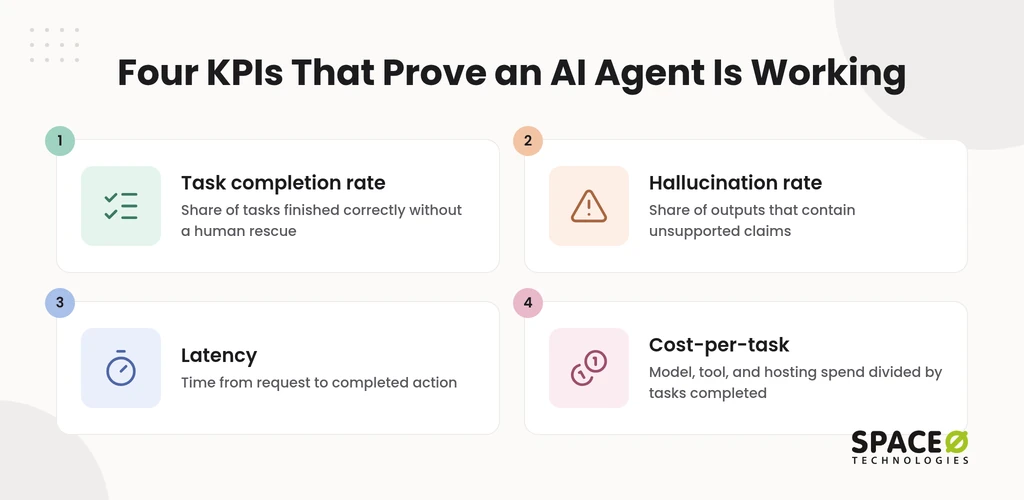
- Task completion rate: the share of tasks finished correctly without a human rescue.
- Hallucination rate: the share of outputs that contain unsupported claims.
- Latency: the time from request to completed action.
- Cost-per-task: model, tool, and hosting spend divided by tasks completed.
A good answer includes a baseline, a target, and a dashboard your team can access.
5. What Should You Ask About Lifecycle, Ownership, and Cost?
Ask who owns the result and what it will cost to keep running. The build price is only the start. Ownership terms, usage costs, and support decide what the agent really costs you.
Who owns the code, prompts, and intellectual property?
Ask for written terms that transfer code, prompts, data, and intellectual property (IP) to you. Without those terms, switching vendors can mean starting over. Check for licensed components the vendor keeps after handover.
As one example, Space-O Technologies transfers all source code, data, and IP to the client at project completion.
How will token and hosting costs scale with usage?
Ask for a cost model that shows spend at your current volume and at ten times that volume. LLM costs grow with tokens per task, tool calls, and retries. Cloud hosting adds compute and storage on top.
Hosting is scoped per project, so ask for per-task figures at your own volume. Our AI agent development cost guide explains each cost driver.
According to McKinsey’s August 2026 survey, about 20% of respondents say AI-related operating costs have limited their AI use.
A good answer breaks cost into per-task units and names the levers that bring it down.
What do post-launch support and drift monitoring include?
Before signing, ask how the vendor will spot drift and what its support plan includes. Quality slips over time as your data, your users’ behavior, or the underlying model versions shift. Budget for it: yearly upkeep on an AI build usually runs 15%-25% of what development cost, for every year the agent stays live.
Ask your vendor what is included in that figure. Coverage may include monitoring, model updates, re-testing, or new integrations.
Can we talk to a client whose agent has run in production for 6+ months?
Ask for a reference whose agent has been live in production for at least six months. Six months is long enough for drift, edge cases, and support response to show up. Ask that client what broke, how fast it was fixed, and what it costs now.
A good answer is a phone call with a real client, not a logo slide.
How does Space-O Technologies answer these questions?
Space-O Technologies answers this checklist with terms you can verify in writing. Since 2010, Space-O Technologies has built AI-powered custom software for 1,200+ clients through its AI development services, with 140+ in-house developers. Engagement runs as a Dedicated Team, on Time & Material, at Fixed Cost, or through Staff Augmentation.
Space-O Technologies signs an NDA before every project. All source code, data, and IP transfer to you at project completion. A scoped pilot shows real performance before you fund the full build.
You can also hire AI agent developers to work inside your own team.
Get a Scoped Plan for Your First Agent
Share your workflow, systems, and approval rules. Our engineers will map autonomy limits, integrations, and a pilot scope for your first agent.

Which Question and Red Flag Matter Most in Each Group?
Use this table to run a fast first call with any vendor. The table pairs one high-signal question with the answer that should worry you.
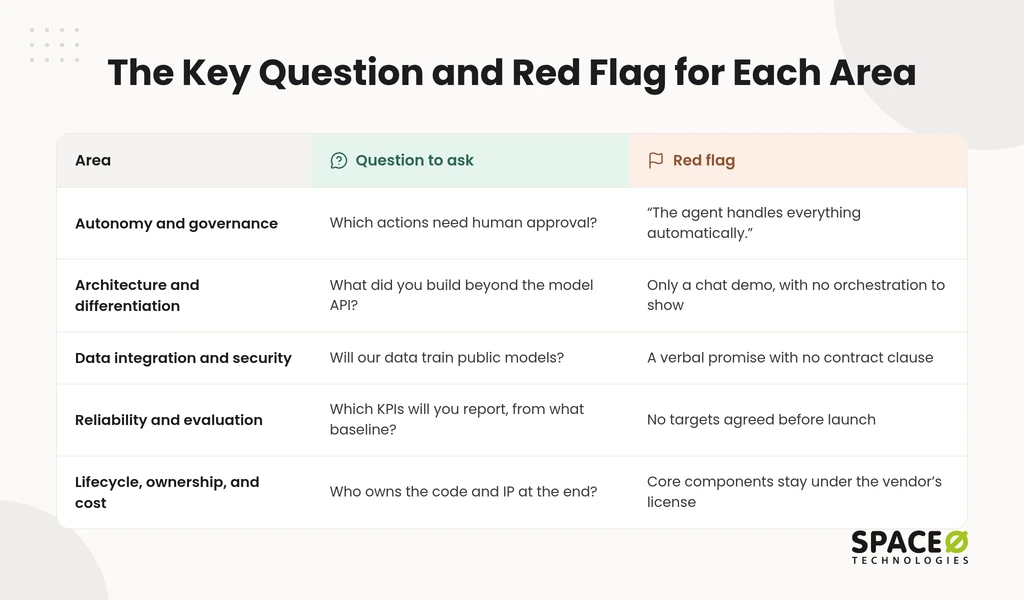
| Group | Question to ask | Red flag |
|---|---|---|
| 1. Autonomy & governance | Which actions need human approval? | “The agent handles everything automatically.” |
| 2. Architecture & differentiation | What did you build beyond the model API? | Only a chat demo, with no orchestration to show. |
| 3. Data integration & security | Will our data train public models? | A verbal promise with no contract clause. |
| 4. Reliability & evaluation | Which KPIs will you report, from what baseline? | No targets agreed before launch. |
| 5. Lifecycle, ownership & cost | Who owns the code and IP at the end? | Core components stay under the vendor’s license. |
Frequently Asked Questions
How much does AI agent development cost?
AI builds in 2026 typically span $25,000-$500,000 or more, and scope decides where you land. A basic MVP starts from $15,000, while a feature-rich MVP runs to $50,000 or more. Hosting, API calls, and upkeep sit on top of the build price.
Is an AI agent realistic if our customer data is scattered across tools that don’t talk to each other?
Yes, but plan to do the data work first. Stale, duplicated, or scattered records cause agents to fail, so integration or cleanup usually comes before the build. Ask the vendor to assess data readiness before quoting and to name who fixes each gap.
Do finance and healthcare buyers need to vet AI agent vendors differently?
Yes, because a wrong output carries higher stakes in finance and healthcare. Vendors should apply tighter accuracy testing and a human reviewer. Ask where the review step sits in the workflow and how accuracy gets verified before go-live.
How do you prevent hallucinations even when the correct context is retrieved?
Do not assume retrieval solves hallucinations; ask the vendor to track hallucination rate as a KPI. Set a baseline and a target, graded against source documents. Grounding, evaluation, and human review are the controls to look for.
What signals should make an agent ask for human intervention?
An agent should escalate when progress stalls or when a decision crosses a defined risk threshold. After a set number of failed attempts, the agent should stop and escalate with a full trace. Above the threshold, such as a lending exposure limit, a human signs off before the action runs.
Who owns the code and IP in an AI agent project?
You should own the code, data, and IP once the project completes. Space-O Technologies transfers all source code, data, and IP to the client at completion. Get these terms in writing before you sign.



 All our projects are secured by NDA




 4.8


