
 By
Contents
- Most businesses need a production ML engineer backed by MLOps, not a research hire.
- Pick your hiring route by constraint: direct hire for ownership, a partner for speed.
- Budget base salary and total compensation separately, and compare offers on one basis.
- Screen for models a candidate has shipped and maintained, not notebook work.
- Lock down code ownership, data handling, and monitoring in writing before outsiders get access.
Key Takeaways
Hiring a machine learning (ML) engineer starts with three decisions. Define the role, choose a hiring model, and set a budget. Do these before you post a job or call a vendor.
Most businesses need a production ML engineer, not a research hire. Screen candidates for shipped models and MLOps (Machine Learning Operations) experience. Notebook work alone rarely survives real users.
This guide covers roles, hiring routes, costs, screening, and risk controls. Space-O Technologies offers dedicated ML teams, staff augmentation, and fixed-scope builds. If you want ML capacity without a hiring cycle, see our hire ML developers service.
1. Which ML role does your business actually need?
Most businesses need a production ML engineer backed by MLOps, not a research hire. A wrong job title wastes a full hiring cycle. The five roles below solve different business problems. Pick the one that matches your bottleneck. For the basics, see our guide to machine learning development.
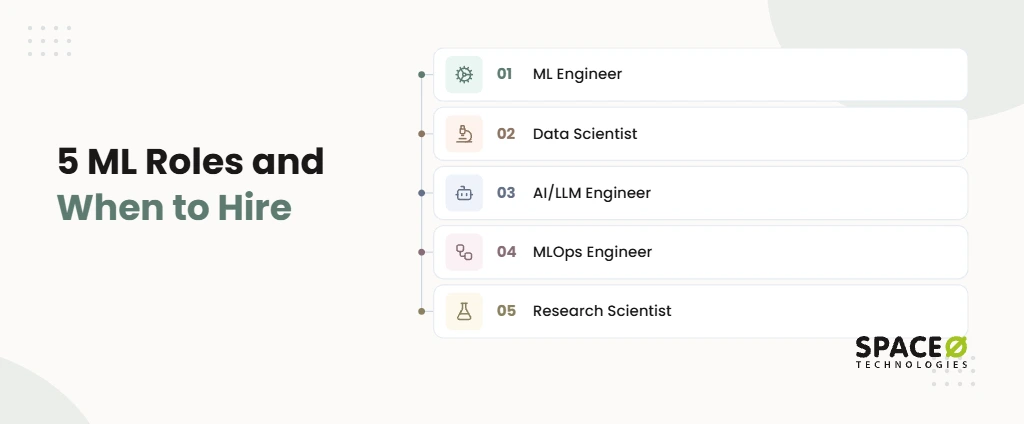
- ML Engineer: Builds, deploys, and maintains models in production. Hire one when a model must run inside your product or workflow.
- Data Scientist: Analyzes data, runs experiments, and finds patterns. Hire one when you need answers before you need software.
- AI/LLM Engineer (Applied AI): Builds large language model (LLM) features, including retrieval-augmented generation (RAG). Hire one when you are adding AI chat, search, or summaries.
- MLOps Engineer: Runs deployment pipelines, monitoring, and retraining. Hire one when your models exist but degrade or break after launch.
- Research Scientist: Invents new algorithms and publishes research. This role is rarely needed outside AI labs.
Most businesses need production ML plus MLOps coverage. Few need one “unicorn” who does all five jobs.
2. Full-time, freelance, staffing firm, or development partner?
Businesses choose between direct full-time hiring, freelance or contract talent, and a third-party firm. Each route solves a different constraint: budget, speed, or ownership of the outcome. The right one depends on how long you need ML capacity and who will run the model after launch.
- Direct full-time hire: Best for businesses with a long ML roadmap and the budget for a six-figure salary plus equity.
- Freelance or contract networks: Best for short, well-defined tasks with an in-house lead who can review the work.
- Specialized recruiters: Best for companies hiring permanently that want help finding and pre-screening candidates.
- Dedicated team or staff augmentation: Best for CTOs who need vetted engineers inside their own sprints without a full hiring cycle.
- Production ML delivery partner: Best for businesses that need a model built, deployed, and monitored end-to-end, not just a seat filled.
Contract-to-hire sits between the first two routes. It lets you test fit on real work before a permanent offer. If you are weighing locations, read our comparison of onshore vs offshore AI development.
| Route | Best for | Who manages delivery | Who supports the model after launch |
|---|---|---|---|
| Direct full-time hire | Long-term ML roadmap | Your team | Your team |
| Freelance or contract | Short, defined tasks | Your team | Your team, after the contract ends |
| Specialized recruiter | Permanent hiring help | Your team, after placement | Your team |
| Dedicated team/staff augmentation | Adding capacity fast | Your team, with partner support | Shared, by agreement |
| Production ML delivery partner | End-to-end outcomes | The partner, with a dedicated project manager (PM) | The partner, under a support plan |
How long does each route take to staff?
A direct ML hire usually takes weeks to a full quarter. Senior ML searches often take two to three months, and some run longer. Our vetted engineers join your sprints and tools within days, because we handle vetting, onboarding, and replacements.
Which routes does Space-O Technologies cover?
Space-O Technologies covers the dedicated team, staff augmentation, and production ML delivery routes. You choose from our engagement models: dedicated team, time and material, fixed cost, or staff augmentation. Every engagement includes a dedicated PM and daily updates, so you always see progress.
What backs a Space-O Technologies ML team?
Our ML teams draw on a production AI track record built since 2010.
- Team: 140+ in-house developers, including 30+ AI engineers.
- Production AI: 50+ AI systems live in production.
- Partnerships: OpenAI Select Partner, AWS Partner, and Claude Certified Architects.
- Client ratings: 4.8 Clutch ratings for quality, schedule, cost, and willingness to refer.
Want a team plan sized to your ML project? Get a free, expert-reviewed estimate from our ML team.
3. How much does it cost to hire an ML engineer in the US?
Experienced full-time ML engineers in the US earn six-figure base salaries, often with equity on top. Budget surprises usually come from comparing base salary with total compensation. Keep the two apart when you compare offers.
- Base vs total compensation: Base is salary only. Total compensation adds bonus, benefits, and equity. Compare offers on the same basis.
- Freelance or contract: Usually billed hourly or by milestone. Rates vary widely by seniority and specialty.
- Dedicated team or delivery partner: Priced by scope and team size, not by salary band. Size a partner-led build with our AI development cost calculator.
Space-O Technologies bills dedicated developers monthly. Full-time is 160 hours a month, and part-time is 80 hours. The minimum commitment is one month.
4. How to screen ML engineers for production experience
Screen for models a candidate has shipped and maintained, not notebook or theory work. Many strong résumés describe experiments that never reached users. These five checks separate production engineers from prototype builders.
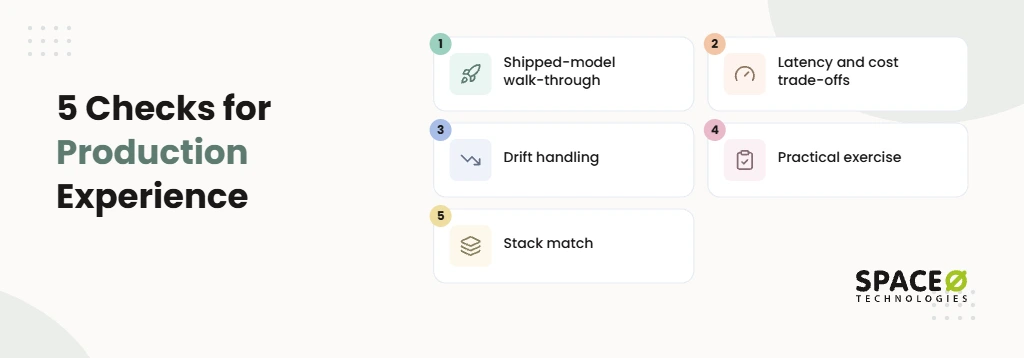
- Shipped-model walk-through: Ask the candidate to walk through one model they deployed and kept running.
- Latency and cost trade-offs: Ask how they balanced response time, accuracy, and cloud spend in production.
- Drift handling: Ask what they did when model accuracy dropped after launch.
- Practical exercise: Use a short, realistic task tied to your data instead of a theory quiz.
- Stack match: Check Python, PyTorch or TensorFlow, scikit-learn, Docker, Kubernetes, MLflow, and AWS SageMaker, Google Vertex AI, or Azure ML.
5. Is your business ready to hire an ML engineer?
Your business is ready when it has accessible data, a defined problem, and a first deliverable. Without these, even a strong ML engineer spends months on groundwork. Check four points before you post a role or sign a contract.
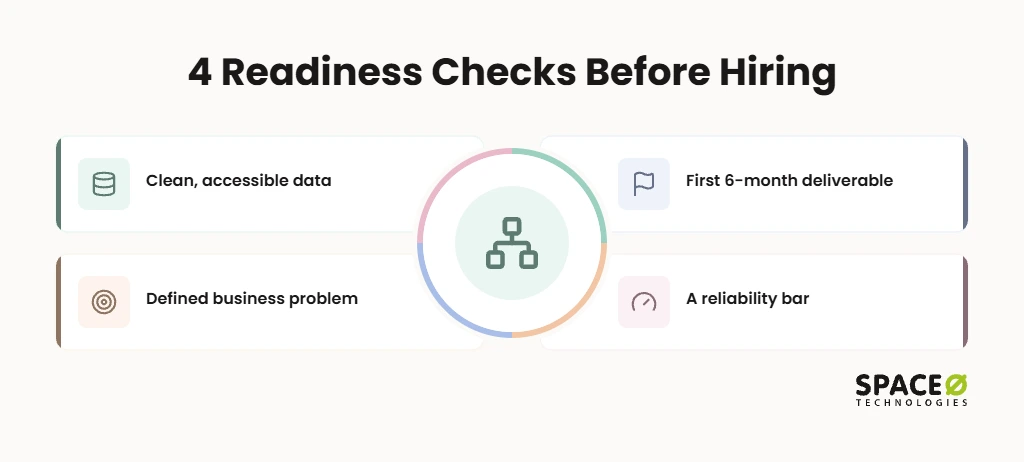
- Clean, accessible data: Your data is collected, labeled where needed, and reachable by engineers.
- A defined business problem: You can name the decision or task the model will improve.
- A first 6-month deliverable: You know what “shipped” looks like by month six.
- A reliability bar: You have set a service-level agreement (SLA) for uptime, accuracy, or response time.
If any point is unclear, start with AI consulting before you build. We begin with your business goal and pick the most cost-effective technology to reach it.
Not Sure Your Business Is Ready for ML?
Share your goal and data with our ML team. We will review your readiness, name the right role, and outline a first deliverable.

6. What to lock down before an outside team touches your models and data
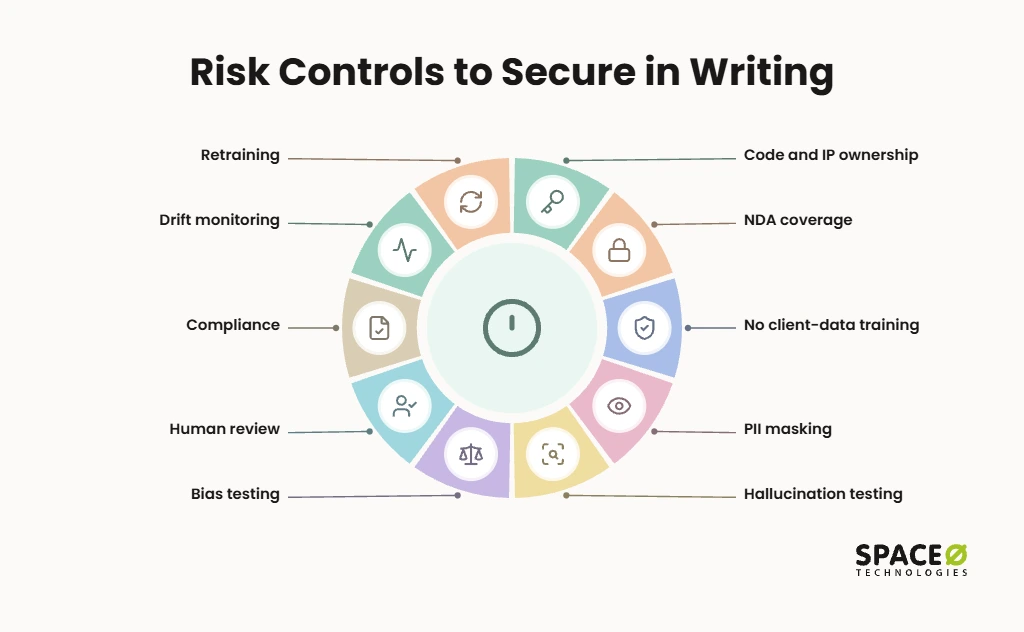
Before any outside team accesses your models or data, secure ownership, data handling, testing, and post-launch support in writing. Most hiring advice stops at the offer letter or the contract rate. Your real risk starts when an outside engineer gets access to customer data and production systems. Hiring guides on this topic already flag safety, privacy, model governance, and ongoing monitoring costs. Here is the checklist we apply by default.
Who owns the code, models, and IP?
You should own all code, model artifacts, and intellectual property (IP) from day one.
- Full code and IP ownership: Your contract assigns every repository, model weight, and pipeline to you.
- NDA-protected work: A nondisclosure agreement (NDA) covers every engineer before access is granted.
Space-O Technologies’ published terms transfer all source code, data, and IP to you at project completion. Nothing is retained, reused, or shared after handover.
How is your data handled?
Your data should train only your models and never leave agreed environments.
- No training on client data: We never use your data to train models for anyone else.
- PII masking: We mask personally identifiable information (PII) before it reaches development or test environments.
Our model provider contracts prohibit training on client inputs and outputs. PII is masked before it reaches any third-party model. Data residency options cover the US, EU, and India.
How are model quality and risk tested?
Production AI needs grounding, evaluation, and human review before it reaches customers.
- Hallucination testing: We test LLM outputs against grounded source data before release.
- Bias testing: We evaluate model outputs across user groups before launch.
- Human review: People approve high-stakes decisions such as lending or clinical outcomes.
Which compliance controls apply?
Your partner’s security controls should match your industry’s obligations.
- Privacy and health data: GDPR (General Data Protection Regulation) compliant and HIPAA-ready for health data.
- Security certifications: ISO 27001 and ISO 9001 certified, with ISTQB-certified QA.
Who pays to keep the model accurate after launch?
Drift monitoring and retraining belong in your total cost from the start. Models lose accuracy as real-world data shifts. A plan with no monitoring budget fails months after launch.
- Drift monitoring: Alerts fire when accuracy or input data shifts past agreed thresholds.
- Retraining: Scheduled and triggered retraining is scoped in the support plan.
Space-O Technologies re-evaluates models after every meaningful provider upgrade. Yearly maintenance runs 15% to 25% of the original build cost, as our AI development cost guide explains.
Before you hire, decide
Three decisions shape every ML hire. Settle them before you talk to candidates or vendors.
- Business problem: Which decision or task should the model improve first?
- Data readiness: Is the data clean, accessible, and approved for use?
- Ownership model: Will a full-time hire run the model, or will a partner deliver and support it?
Frequently Asked Questions
What does a machine learning engineer do?
A machine learning engineer builds, deploys, and maintains models in production. They are the right hire when a model must run inside your product or workflow. The focus is on models that ship and stay running, not prototypes.
What skills should a machine learning engineer have?
A production-ready ML engineer should know Python, PyTorch or TensorFlow, and scikit-learn. They should also know Docker, Kubernetes, and MLflow. Add one managed platform: AWS SageMaker, Google Vertex AI, or Azure ML. Weight shipped models above notebook-only work.
What is the difference between a data scientist and a machine learning engineer?
A data scientist analyzes data and runs experiments, while an ML engineer puts models into production. Choose a data scientist when you need answers before software. Choose an ML engineer when a model must run inside your product.
Should I start with contract-to-hire or hire a full-time ML engineer directly?
Start with contract-to-hire if you want to test fit; hire full-time directly if your roadmap is long. Contract-to-hire lets you test fit on real work before a permanent offer. Direct hiring suits a long ML roadmap and a six-figure salary budget with equity.
What should I put in a job brief before hiring an ML engineer?
Name the business decision the model should improve and what a shipped first deliverable looks like by month six. Add a reliability bar, such as a service-level agreement covering uptime, accuracy, or response time.
How do I know when I need an MLOps engineer instead of another ML engineer?
You need an MLOps engineer when your models exist but degrade or break after launch. They handle deployment pipelines, monitoring, and retraining. If the model still has to be built, an ML engineer is the better fit.



 All our projects are secured by NDA




 4.8


