
 By
Contents
- AI governance and compliance consulting turns laws and standards into owned policies, tested controls, and audit evidence.
- Most US companies answer to the NIST AI RMF, ISO/IEC 42001, and the EU AI Act.
- Add controls at discovery, pilot, pre-production, and live, not after launch.
- Pair an engineering partner with an independent auditor for built-in controls and certification evidence.
Key Takeaways
AI governance and compliance consulting helps organizations run AI safely and within the law. It covers policies, risk checks, technical controls, and human oversight. Frameworks like the EU AI Act, ISO/IEC 42001, and NIST AI RMF set the bar.
AI tools spread across teams faster than anyone can track them. Policies exist on paper, but deployed models often ignore them. That gap is where audit findings and legal exposure start.
This guide explains what the work includes and which frameworks apply. It also maps controls to each AI build stage. Space-O Technologies, an AI engineering partner since 2010, offers AI consulting services for governed AI.
Where Space-O Technologies fits in AI governance
Space-O Technologies builds governance controls into the AI systems we ship before launch. The usual problem is a gap between policy and practice. The policy exists, but the deployed model was never built to follow it. We close that gap from the engineering side through our AI development services.
- Production track record: 50+ AI systems in production, built by 30+ AI engineers.
- Partner status: OpenAI Select Partner, AWS Partner, and Claude Certified Architects on the team.
- Responsible AI by default: No training on client data. We use PII (personally identifiable information) masking, hallucination and bias testing, and human review for high-stakes decisions.
- Security posture: ISO 27001 alignment, GDPR compliant, and HIPAA-ready delivery.
- Delivery capacity: 1,200+ clients since 2010, 97% client retention, and 140+ in-house developers.
We do not provide legal advice or certify AI systems. Independent auditors and certification bodies do that. We build the systems and the evidence they review.
What AI governance and compliance consulting includes
AI governance and compliance consulting covers five core services, from risk classification to audit-ready oversight. The business problem behind them is simple. AI tools spread across teams faster than anyone tracks them, and nobody owns the risk.
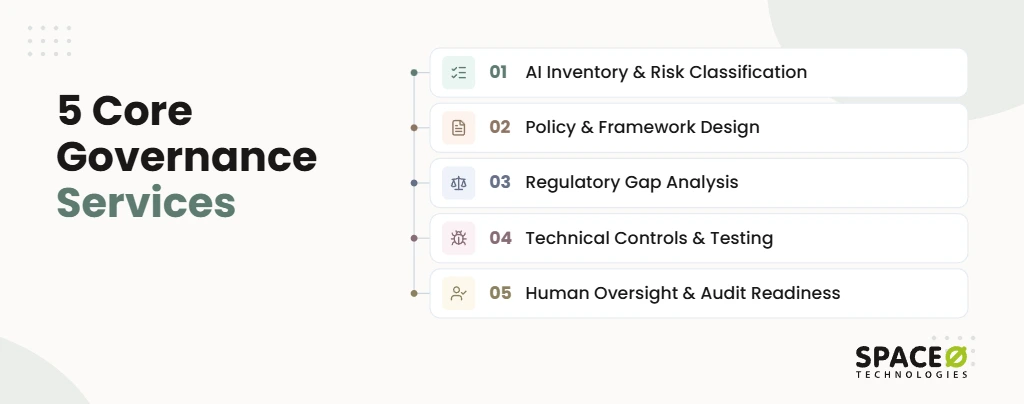
- AI Inventory & Risk Classification: Catalog every model, prompt, agent, and vendor tool, including shadow AI. Then assign each system an EU AI Act tier: unacceptable, high, limited, or minimal.
- Policy & Framework Design: Draft acceptable-use policies, a governance charter, and RACI (Responsible, Accountable, Consulted, Informed) matrices. These name who owns each AI decision.
- Regulatory Gap Analysis: Compare current practice against the EU AI Act and GDPR (General Data Protection Regulation). Then check CCPA/CPRA (California Consumer Privacy Act/California Privacy Rights Act) and HIPAA (Health Insurance Portability and Accountability Act).
- Technical Controls & Testing: Test for bias, hallucinations, and data leakage. Add red-teaming and prompt-injection defense, following AI agent security best practices. Once models go live, add drift monitoring.
- Human Oversight & Audit Readiness: Set up HITL (human-in-the-loop) review gates, audit trails, and model cards.
AI governance vs. AI compliance: what’s the difference?
AI compliance meets fixed legal duties. AI governance is the operating model that keeps you compliant as models change.
- AI Compliance: Meeting legal duties under the EU AI Act, GDPR, and HIPAA through documentation and assessments.
- AI Governance: The ownership, HITL workflows, and real-time controls that keep compliance sustainable as data and models shift.
A compliance check proves a system passed on audit day. Governance keeps it passing after the next model update. PwC frames responsible AI as practices that unlock value while managing risk.
Which frameworks will your AI be measured against?
Most US companies answer to the NIST AI RMF, ISO/IEC 42001, and the EU AI Act. State and sector laws add more.
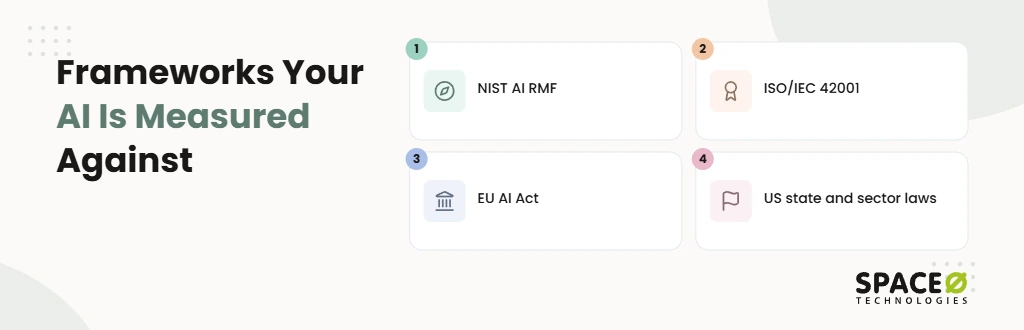
- NIST AI Risk Management Framework (AI RMF): A US framework organized around four functions: Govern, Map, Measure, and Manage.
- ISO/IEC 42001: The international standard for an AI Management System (AIMS). Independent certification bodies audit organizations against it.
- EU AI Act: Sorts AI systems into risk tiers and reaches US companies with EU customers. Fines can be substantial, scaling with a percentage of global annual revenue.
- US state and sector laws: CCPA/CPRA covers California consumer data, and HIPAA covers health data. GLBA (Gramm-Leach-Bliley Act) and SOX (Sarbanes-Oxley Act) cover financial firms, and NYC Local Law 144 covers hiring tools.
Governance controls by AI build stage
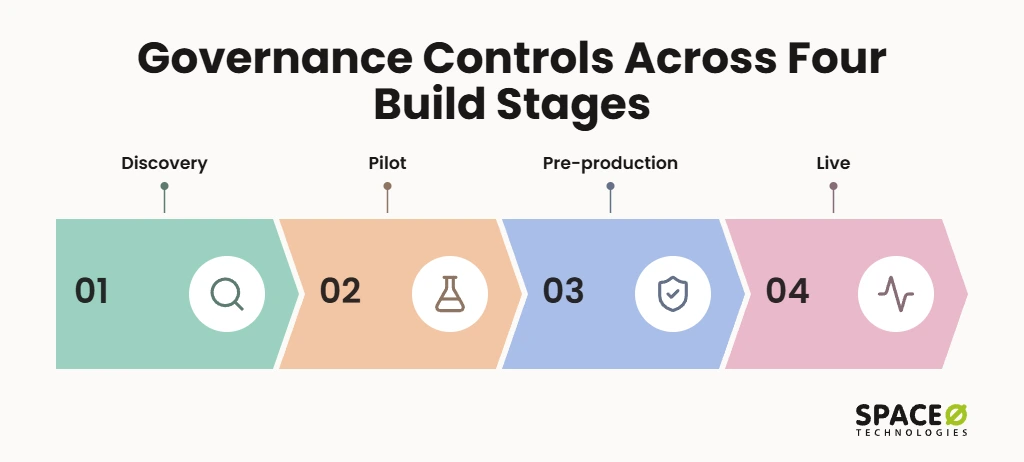
Governance controls belong at four build stages: discovery, pilot, pre-production, and live. Most teams add controls after launch, when every fix means rework. Our guide to scaling AI proof of concept to full product covers the move to production. This table shows where each control fits and what proof it leaves behind.
| Build stage | Control implemented | NIST AI RMF function | EU AI Act / ISO/IEC 42001 relevance | Artifact produced |
|---|---|---|---|---|
| Discovery | AI inventory, use-case risk classification, named owners in a RACI matrix | Govern, Map | Sets the EU AI Act risk tier and the ISO/IEC 42001 AIMS scope | AI inventory and risk register |
| Pilot | Bias, hallucination, and data-leakage testing on real workflows | Measure | Evidence for bias and accuracy claims before wider rollout | Bias and hallucination test report |
| Pre-production | Red-teaming, prompt-injection defense, PII masking, HITL review gates | Measure, Manage | Human oversight and record-keeping evidence that auditors review | HITL escalation path and audit log design |
| Live | Drift monitoring, scheduled re-testing, incident review | Manage | Ongoing monitoring under the AIMS and the EU AI Act risk tier | Audit trail and monitoring evidence pack |
Space-O Technologies’ published practice covers the pre-production and live stages:
- Evaluation: Every production model runs through an evaluation suite covering accuracy, hallucination rate, bias, latency, and cost.
- Red-teaming: New releases are red-teamed, and outputs that fail validation are rejected.
- Human review: Low-confidence outputs route to a qualified person for review.
- Re-evaluation: Models are re-evaluated after every meaningful provider upgrade.
- Architecture review: The choice between RAG and fine-tuning is reviewed quarterly.
What types of AI governance partners are there?
AI governance partners fall into five types, and they differ most on whether they build the AI system. The buying risk is choosing a partner whose work ends where your production risk begins.
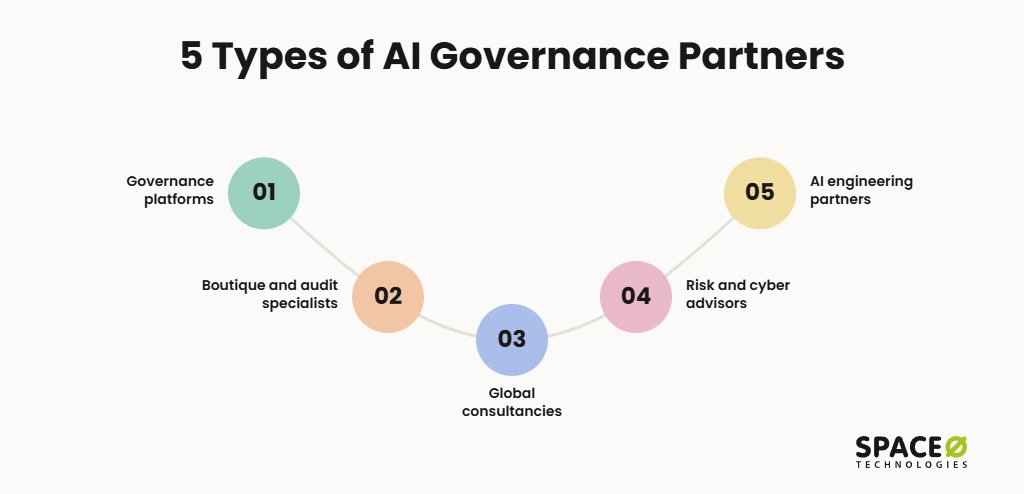
| Partner type | Best for | Builds the AI system | Implements controls in code | Maintains the system after launch | Engagement models |
|---|---|---|---|---|---|
| Governance platforms | Inventorying and monitoring AI across many teams | No | Monitoring and policy workflows inside the platform; your engineers connect each system | Maintains the platform, not your models | Software license |
| Boutique and audit specialists | Independent third-party model audits | No | Tests and assesses controls; your team implements fixes | No | Scoped audit or assessment |
| Global consultancies | Enterprise-wide digital transformations and heavy regulatory integration | Varies by engagement | Usually designs frameworks; build work often needs separate engineering teams | Varies by engagement | Multi-phase programs |
| Risk and cyber advisors | Linking AI risk to security and GRC (Governance, Risk, and Compliance) programs | No | Security and risk assessments; implementation sits with your team | No | Advisory or assessment engagements |
| AI engineering partners | Organizations that need governance controls built into the AI systems being developed, not added after launch | Yes | Yes, as part of the build | Yes | Fixed cost, time and material, dedicated team, or staff augmentation |
Space-O Technologies works as an AI engineering partner. Our guide on AI consulting vs AI development services explains the difference. Many organizations pair one with an independent auditor for certification.
Need AI That Stands Up To Any Audit?
Tell us about your first AI system and its risk exposure. We will map the controls, evidence, and build stages you need, then send a scoped plan.

How does AI governance work in regulated industries?
Regulated industries add sector rules on top of general AI law, so controls must match the sector. Space-O Technologies serves many industries. These three carry the heaviest oversight.
1. Healthcare AI governance
Healthcare AI must protect patient data under HIPAA, and some clinical software also faces FDA requirements. Your team needs HIPAA-compliant data handling before any model touches patient records. Our healthcare software development services deliver HIPAA-ready systems with encryption at rest and in transit. Human review checkpoints are on by default for clinical decisions.
2. Financial services and lending AI governance
Financial AI must fit GLBA privacy rules and SOX controls over financial reporting. In lending, a biased model creates legal exposure, not just a bad metric. That makes bias testing a release requirement. Human review is on by default for lending decisions in the systems we build.
3. Hiring and HR AI governance
AI used in hiring in New York City falls under NYC Local Law 144. Employers there need bias evaluation evidence for automated hiring tools. Because of this, testing and documentation for these tools should start at discovery, not at launch.
What does an AI governance engagement cost?
Cost depends on how many AI systems are in scope and whether controls are built or only assessed. We give scoped ranges, not hourly rates. Every project starts with a free, expert-reviewed estimate.
Our guide to the cost to build AI software shows what drives scope. Request the free, expert-reviewed estimate for a figure fitted to your systems.
Frequently Asked Questions
Do GRC platforms provide AI governance?
Partly. Governance platforms inventory and monitor AI across many teams, with monitoring and policy workflows inside the platform. They do not build your AI systems or implement controls in code, so your engineers still connect each system. The platform vendor maintains the platform, not your models.
Should I hire an AI engineering partner or an independent auditor?
Choose an engineering partner if you need governance controls built into the AI system, such as bias testing, PII masking, and human review gates. Choose an independent auditor if you need a third-party assessment or certification evidence. Many organizations pair the two, because auditors test and assess controls while an engineering partner builds the systems and the evidence the auditor reviews.
What should be included in an AI risk assessment?
An AI risk assessment should start from an inventory of AI systems and classify each by risk, covering bias, privacy, and security exposure. For EU AI Act purposes, each system is assigned a tier: unacceptable, high, limited, or minimal. Testing for bias, hallucinations, and data leakage supplies the evidence behind the ratings.
How do I classify an AI system under the EU AI Act?
First, catalog the system in your AI inventory, then assign an EU AI Act tier. Tiers run unacceptable, high, limited, or minimal, and that tier sets your ISO/IEC 42001 management system scope.
How do I keep an AI system compliant after a model update?
Keep an AI system compliant after a model update with drift monitoring, scheduled re-testing, and incident review. A compliance check proves only audit-day status; governance with clear ownership and real-time controls keeps systems passing.
How much does AI governance consulting cost?
Cost depends on how many AI systems are in scope and whether controls are built or only assessed. We give scoped ranges, not hourly rates. Every Space-O Technologies project starts with a free, expert-reviewed estimate.



 All our projects are secured by NDA




 4.8


