
 By
Contents
- Shortlist by partner type first: custom builder, enterprise transformation firm, staff augmentation, or cloud platform.
- Ask for a walkthrough of a live production system, not a demo, before comparing prices.
- Data preparation can take a large share of an AI budget, so check data readiness early.
- Put code, data, and intellectual property ownership, plus human review of high-stakes outputs in contracts.
Key Takeaways
Which AI software development company is best in 2026-27 depends on your project. No single firm fits every need, so the partner type matters first. Independent 2026-27 roundups repeat LeewayHertz, Accenture, and BairesDev for different jobs.
Choosing the wrong partner type can stall a rollout before it reaches users. A strategy firm will not ship your minimum viable product (MVP). Our guide on how to choose an AI development partner covers the selection steps.
Space-O Technologies tests its own AI development services against the same checks. As a custom engineering firm, we have built AI into web, mobile, and SaaS software since 2010. This list covers custom, enterprise, staffing, and platform firms, with prices in US dollars.
How We Built This Shortlist
We grouped firms by partner type and tested each one against the same five buyer checks. Entries are grouped by the types of AI software development services they deliver. We do not rank them, because no single firm fits every project. Most also appear in independent 2026-27 roundups, including AWS Builder Center, the Forbes AI 50, and Reddit’s r/ArtificialInteligence threads.
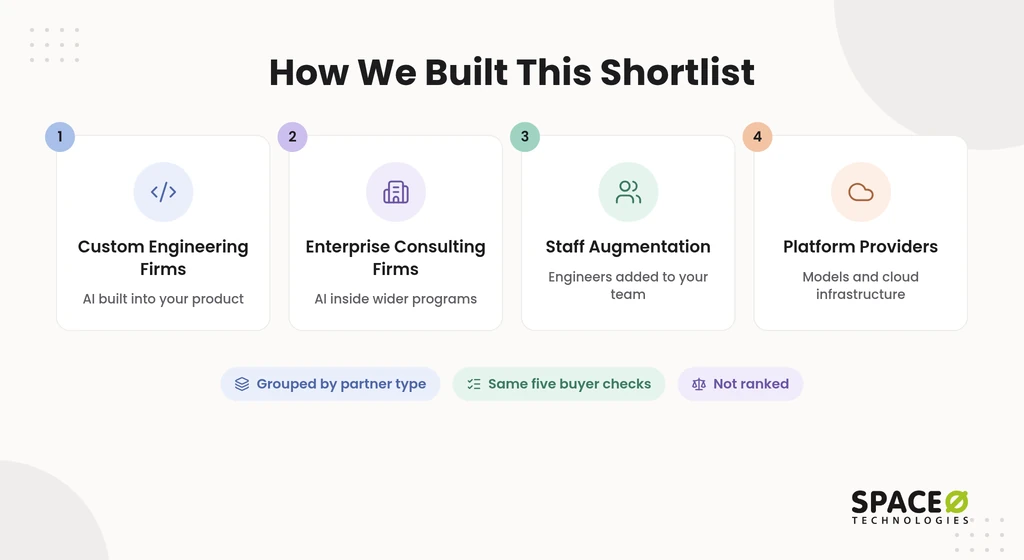
Space-O Technologies applies the same checks to itself, and its client reviews are public on Clutch. Every client also gets a dedicated project manager (PM) with daily updates. The five checks appear in the evaluation section after the lists.
Custom AI and Software Product Engineering Firms
Custom engineering firms build generative AI, large language model (LLM), and AI agent features into your own software. This group fits teams that need AI shaped around their own product, data, and workflows. Each entry lists capabilities, facts, and what adopting the firm requires.
1. Space-O Technologies
Known for AI built into shipped web, mobile, SaaS, and custom business software.
Grounding, evaluation, and human review apply to every system, with people approving consequential decisions. Defaults include no training on client data, masking of personally identifiable information (PII), and hallucination and bias testing.
| Area | Details |
|---|---|
| Capabilities | Generative AI development; LLM integration; retrieval-augmented generation (RAG); AI agents; computer vision; machine learning (ML). |
| Facts | 1,200+ clients; 140+ in-house developers; 97% client retention; OpenAI Select Partner and AWS Partner, with Claude Certified Architects on staff; built Glovo, which passed 50M+ downloads. |
| What adopting it requires | Look elsewhere if you want a foundation model or cloud platform instead of a build partner. |
2. LeewayHertz
Known for enterprise-scale generative AI and custom LLM applications.
It offers AI engineering and consulting for startups, scale-ups, and enterprise organizations. It suits teams that want AI built around their own internal systems.
| Area | Details |
|---|---|
| Capabilities | Generative AI platforms; AI agents; LLM integration for enterprise environments. |
| Facts | Engagement model: custom enterprise builds. |
| What adopting it requires | Integration access to your internal systems; internal owners who run the platform after rollout. |
3. Markovate
Known for scalable AI-driven products, generative AI MVPs, and proof-of-concept (PoC) builds.
It suits teams that want to test an idea first and then move it toward a product. Scope and success criteria matter most here.
| Area | Details |
|---|---|
| Capabilities | Generative AI MVPs; PoCs moved toward product. |
| Facts | Engagement model: MVP and PoC projects. |
| What adopting it requires | A bounded PoC or MVP scope; agreed success criteria; an owner for scale-up afterward. |
4. GeekyAnts
Known for end-to-end AI product engineering, including RAG systems, LLM integrations, and AI agents.
Its work covers the path from product build to production deployment. It suits teams with a defined product scope.
| Area | Details |
|---|---|
| Capabilities | AI agents; RAG systems and LLM integrations; machine learning and MLOps; automation; production deployment. |
| Facts | Describes itself as an AI-powered digital product engineering company. |
| What adopting it requires | A defined product scope; an internal owner for the roadmap after launch. |
5. Diffco
Known for AI-native software development.
Its approach designs custom software around AI features from the start. It suits teams with clear product requirements.
| Area | Details |
|---|---|
| Capabilities | Custom software designed around AI features from the start. |
| Facts | Roundups that name GeekyAnts often name Diffco alongside it. |
| What adopting it requires | Clear product requirements; an internal owner for the AI roadmap. |
Takeaway: check that each custom firm can show live systems before you compare scope.
Need AI Built Into Your Own Product?
Our AI engineers review your product, data, and workflows, then recommend RAG, fine-tuning, or agents. You get a scoped plan with evaluation and human review built in.

Enterprise AI Transformation and Consulting Firms
Enterprise firms suit AI that sits inside a wider transformation program spanning many teams. These programs need executive sponsors, formal governance, and program-level budgets. Our guide to enterprise AI software development covers that buying path in depth.
6. Accenture
Known for large, multi-business transformation programs.
Its AI work sits inside broader change to data platforms, cloud estates, operating models, workforce processes, and governance.
| Area | Details |
|---|---|
| Capabilities | AI Refinery; data platforms; cloud estates; operating model change. |
| Facts | Engagement model: multi-business transformation programs. |
| What adopting it requires | Executive sponsorship; a program-level budget; owners across data, cloud, and workforce teams. |
7. Cognizant
Known for secure, responsible AI and enterprise modernization.
It suits enterprises that want to modernize established systems with governance in place.
| Area | Details |
|---|---|
| Capabilities | Responsible AI practices; modernization of established enterprise systems. |
| Facts | Engagement model: enterprise modernization programs. |
| What adopting it requires | A defined modernization scope; governance owners on your side. |
8. IBM
Known for hybrid infrastructure, governance, regulated workloads, and integration with established enterprise systems.
It pairs consulting with platform tooling. It suits organizations that need governance and explainability around their AI.
| Area | Details |
|---|---|
| Capabilities | IBM Consulting; IBM watsonx; AI governance; explainability tooling. |
| Facts | Engagement model: consulting combined with platform tooling. |
| What adopting it requires | Fitting your AI governance process to its platform tooling. |
9. EPAM Systems
Known for large-scale enterprise engineering and AI programs.
It suits large organizations running multi-team programs that include AI delivery.
| Area | Details |
|---|---|
| Capabilities | Multi-team engineering programs; AI delivery at enterprise scale. |
| Facts | Engagement model: enterprise programs. |
| What adopting it requires | A program-level budget; formal governance; a scope large enough for several teams. |
10. Slalom
A Seattle-based firm known for enterprise AI strategy and legacy-system integration.
Its programs are consulting-led. It suits organizations that want a strategy phase before build work begins.
| Area | Details |
|---|---|
| Capabilities | AI strategy; roadmap work; integration with existing enterprise systems. |
| Facts | Engagement model: consulting-led programs. |
| What adopting it requires | Executive sponsorship; a strategy phase before build work begins. |
11. ScienceSoft
Known for managed AI delivery in healthcare, finance, and government.
ScienceSoft publishes no prices and sells by quote.
| Area | Details |
|---|---|
| Capabilities | Managed AI projects for regulated, compliance-heavy sectors. |
| Facts | Engagement model: managed delivery; publishes no prices and sells by quote. |
| What adopting it requires | A quote-based scoping stage; compliance requirements gathered before the estimate. |
Takeaway: enterprise programs reward preparation, so line up sponsors and governance before the first call.
Staff Augmentation and Nearshore AI Capacity
Dedicated Team, Time & Material, Fixed Cost, and Staff Augmentation firms add engineers to your team. In these engagement models, your team keeps product ownership while the added engineers work alongside it. This model fits companies that already run their own product process. Our comparison of an AI development company vs. staff augmentation explains the split.
12. BairesDev
Known for nearshore Latin American talent at scale.
Its model supplies engineers to your team. It suits companies that already run their own product process.
| Area | Details |
|---|---|
| Capabilities | Nearshore engineers, including AI and software developers; engineers supplied to client teams. |
| Facts | Engagement model: nearshore staffing. |
| What adopting it requires | Your team owning discovery and product design; your team owning project management around the supplied engineers. |
13. Azumo
Known for nearshore, production-oriented AI engineering and workflow automation.
Its engineers work inside your sprints. It suits teams with a lead who can direct them.
| Area | Details |
|---|---|
| Capabilities | LLM fine-tuning; computer vision; machine learning operations (MLOps). |
| Facts | Engagement models: nearshore Dedicated Team, Time & Material, Fixed Cost, and Staff Augmentation. |
| What adopting it requires | A lead who assigns work and reviews output; someone to run stand-ups inside your sprints. |
14. Uvik Software
Known as a Python-first firm that embeds senior AI engineers into US product teams.
Its engineers join your team rather than own the product. It suits teams with their own product leadership.
| Area | Details |
|---|---|
| Capabilities | Engineers skilled in PyTorch; engineers skilled in TensorFlow; RAG pipelines. |
| Facts | Engagement models: embedded engineers, Dedicated Team, Time & Material, Fixed Cost, and Staff Augmentation. |
| What adopting it requires | Your own product leadership to set the architecture; sprint planning and review of model work by your team. |
Takeaway: added capacity only speeds delivery when someone in-house directs the work.
AI Platform and Model Providers
Platform providers supply the models and cloud infrastructure that custom AI runs on, not the finished product. Most build partners on this list work on top of these platforms. Our guide to generative AI platform vs custom AI development explains when each fits.
1. Microsoft Azure AI
Known for cloud AI services, GitHub Copilot, and its ties to OpenAI.
It suits teams that already have engineers to build on Azure.
| Area | Details |
|---|---|
| Capabilities | Comprehensive developer toolkits; AI services on Azure. |
| Facts | A cloud platform rather than a build partner. |
| What adopting it requires | Engineers who build and integrate applications on Azure. |
2. Google Cloud AI and DeepMind
Known for scalable enterprise AI services and foundation-model research.
It suits teams with the engineering capacity to turn cloud services into product features.
| Area | Details |
|---|---|
| Capabilities | Cloud AI services; foundation models. |
| Facts | A cloud platform rather than a build partner. |
| What adopting it requires | Engineering capacity to turn Google Cloud services into product features. |
3. AWS
Known for Amazon Bedrock for model access and Amazon SageMaker for building ML models.
It suits teams that can design, deploy, and monitor their own workloads.
| Area | Details |
|---|---|
| Capabilities | Model access; model training; managed ML infrastructure. |
| Facts | A cloud platform rather than a build partner. |
| What adopting it requires | In-house or partner engineers who design, deploy, and monitor workloads. |
4. OpenAI and Anthropic
Known as foundation-model providers and the largest companies on the Forbes AI 50.
They supply models, not finished applications. Teams add grounding, evaluation, and integration work on top.
| Area | Details |
|---|---|
| Capabilities | Foundation models; enterprise APIs. |
| Facts | They provide models rather than finished applications. |
| What adopting it requires | Grounding work; evaluation work; integration work before the models serve your users reliably. |
5. C3 AI
Known for turnkey enterprise AI applications, including supply-chain optimization.
It suits organizations whose workflows fit prebuilt applications.
| Area | Details |
|---|---|
| Capabilities | Packaged enterprise AI applications. |
| Facts | Engagement model: turnkey applications. |
| What adopting it requires | Fitting your workflows to its prebuilt applications. |
6. H2O.ai
Known for agentic AI and open-source machine learning.
It suits teams with in-house data science or ML engineering staff.
| Area | Details |
|---|---|
| Capabilities | Agentic AI tooling; open-source ML frameworks. |
| Facts | Engagement model: software and platform. |
| What adopting it requires | In-house data science or ML engineering staff to configure, run, and extend the models. |
Also mentioned: Databricks, DataRobot, NVIDIA, and Fireworks AI.
Takeaway: a platform still needs engineers, so budget for a build team alongside it.
AI Inside the Business Software You Already Run
Most roundups separate builders, integrators, and staffing firms, but many AI projects need all three. Your AI feature often has to read a customer relationship management (CRM) system. It may also write to an enterprise resource planning (ERP) system. When one vendor owns the software, and another owns the AI, nobody owns the result.
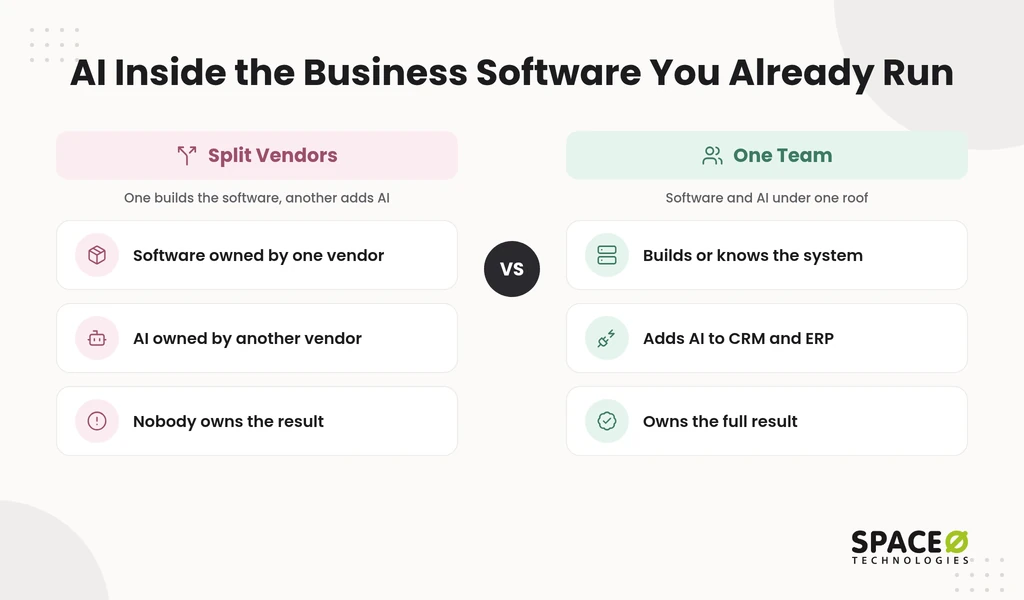
Space-O Technologies covers software, mobile, web, SaaS, ERP, and ServiceNow work, plus AI integration with CRM software, under one team. Many of its production AI systems run inside an existing client system. Published projects show the pattern:
- eComChat: AI search added to an existing e-commerce store, which eliminated zero-result searches.
- GPT Vix: Video interview workflow automation for a US recruiting agency, built with ChatGPT and Whisper.
- One8: A cloud-based transportation management system (TMS) that replaced a Saudi transport company’s paper and Excel process.
- ReadGenie: An optical character recognition (OCR) and GPT-3.5 iOS app that passed 525 downloads in its first week.
Takeaway: If your AI must live inside an existing system, shortlist partners who also build that system.
How to Evaluate an AI Development Partner
Verify live production systems before you compare prices. Many buyers fund AI pilots that never reach real users. When you evaluate AI development companies, run five checks on every firm you shortlist:
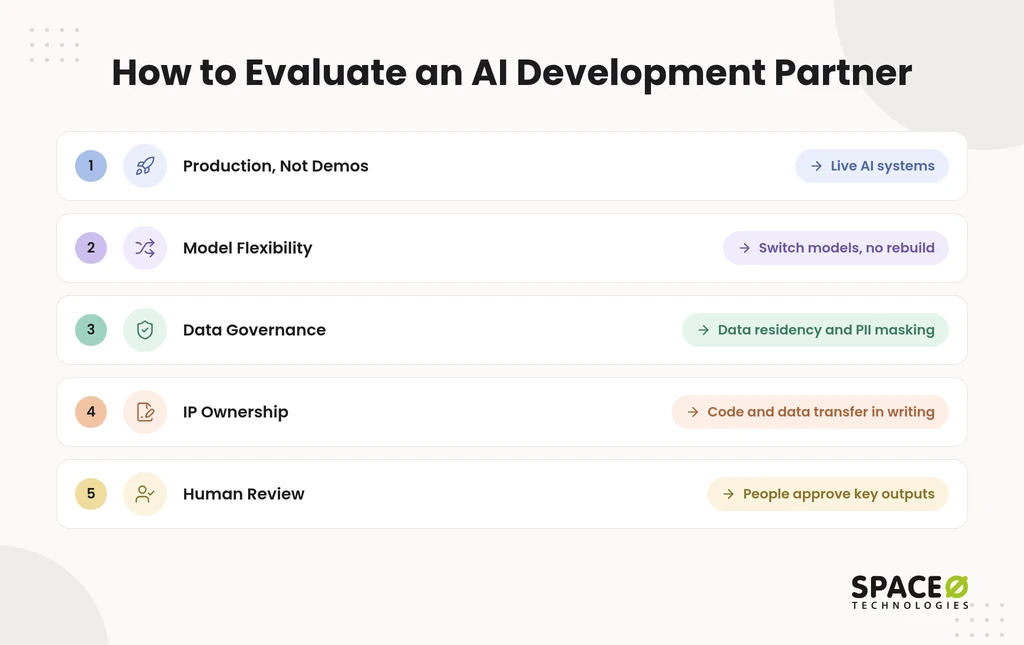
- Production, not demos: Ask how many AI systems are live and who approves high-stakes outputs.
- Model flexibility: Ask whether the design can switch models without a product rebuild.
- Data governance: Ask where your data resides, whether it trains any model, and how PII is masked.
- Intellectual property (IP) ownership: Confirm in writing that source code, data, and IP transfer to you.
- Human review: Ask which outputs a person approves before they reach customers or decisions.
A firm that fails any of these five checks is selling a prototype, not production AI. The gap between a working prototype and a system running in production is what drives cost.
What Does AI Software Development Cost in 2026-27?
AI software development costs vary widely, depending on the use case, technical complexity, data requirements, integrations, and security needs. Many buyers budget for the model and forget integration, testing, and monitoring. In most projects, data work, integrations, and production engineering cost more than the model itself.
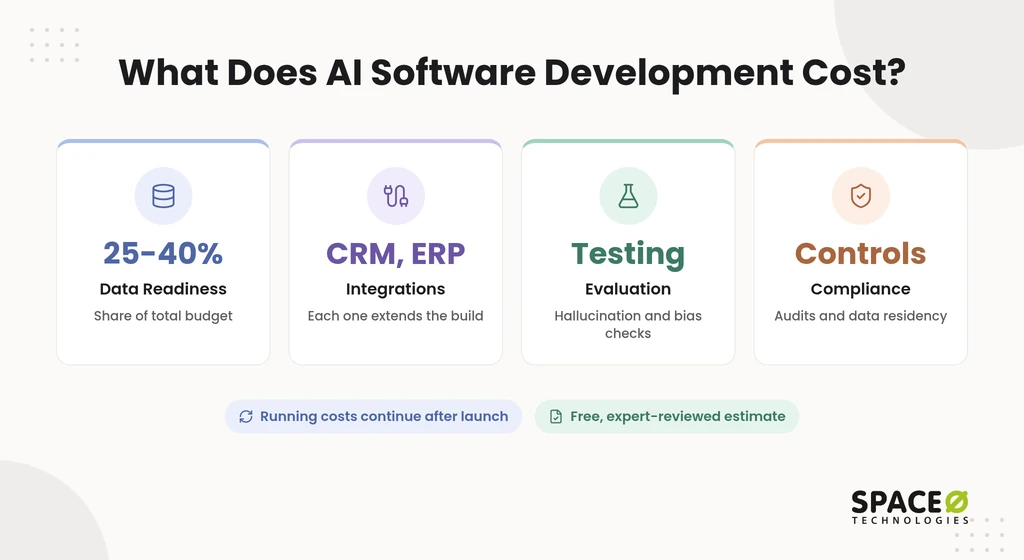
For outside benchmarks, NextGen Coding Company separates US prototype costs from first production feature costs. It puts first production features at $80,000-$400,000. Four drivers explain the spread:
- Data readiness: Data preparation can consume 25% to 40% of the total project budget, making it the largest single cost driver.
- Integrations: Every connected CRM, ERP, or payment system extends the build.
- Evaluation: Hallucination and bias testing protects users but adds time.
- Compliance: Regulated data adds controls, audits, and data residency choices.
Running costs continue after launch. Annual maintenance typically costs a meaningful share of the original development cost every year. Data infrastructure, retraining cycles, and audits add further yearly costs, so budget for them from the start.
Space-O Technologies does not quote hourly rates. Instead, we scope each project in a free, expert-reviewed estimate, so you see the range before you commit.
How to Narrow Your Shortlist
Answer three questions first: what you are building, your budget and timeline, and your compliance needs. Then match the partner type below, and check your budget against the cost to build AI software for businesses. Finally, compare firms within that type.
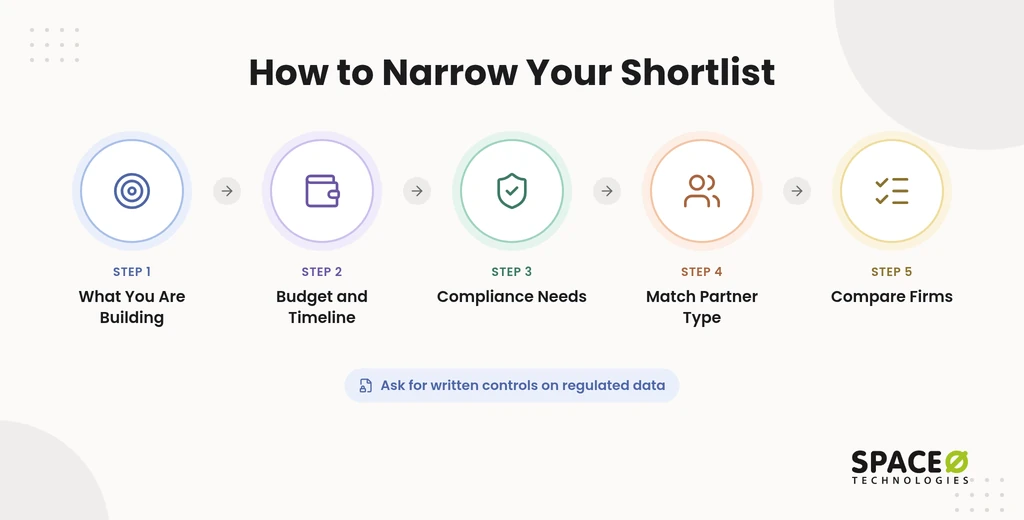
| Your project goal | Partner type to shortlist | Engagement model that usually fits | Question to ask before signing | Typical budget at Space-O Technologies (USD) | Typical timeline |
|---|---|---|---|---|---|
| Launch an MVP with AI features | Custom product and AI build partner | Fixed cost or time and material | How many of your AI products reached live users? Who owns the code from day one? | $20,000-$40,000to start | 4-16 weeks |
| Add AI to an existing product | Custom AI partner with integration depth | Time and material or dedicated team | Will you ground the model in our data with RAG, or fine-tune it, and why? | Quoted per feature after scoping | Varies with integration depth |
| Automate internal workflows | Custom software and AI agent development partner | Fixed cost per workflow, then time and material | Which decisions stay with a human reviewer? | Quoted per workflow | Varies with workflow scope |
| Modernize a legacy system | Engineering partner with legacy modernization work | Dedicated team | How will you migrate data without downtime? | Quoted per legacy integration | Varies with system complexity |
| Scale an in-house team | Staff augmentation or embedded engineers | Staff augmentation | How fast can engineers join our sprints, and who handles replacements? | Monthly billing per developer | Matched quickly |
| Run a project on regulated data | Partner with documented compliance controls | Dedicated team or fixed cost | Are you HIPAA-ready, and where will our data reside? | Quoted after compliance review | Varies with compliance scope |
Budget and timeline cells come from Space-O Technologies’ published cost guides and hiring terms. Healthcare, finance, and government data carry legal duties, so ask for written controls rather than verbal assurances.
Turn Your Shortlist Into a Scoped AI Plan
Share your project type, budget range, and compliance needs. Our team maps the right engagement model and sends a free, expert-reviewed estimate with timeline and team plan.
Frequently Asked Questions
What are the top 5 AI software companies?
Compare Space-O Technologies, LeewayHertz, Markovate, Accenture, BairesDev, and Microsoft Azure AI, one or two per partner type. These are grouped by what they deliver, not ranked, because no single firm fits every project. Swap in Cognizant, Azumo, Google Cloud AI, or AWS if your project type points there.
Do I need a custom AI build partner or a platform provider like Azure, AWS, or OpenAI?
It depends on whether you have engineers to build on a platform. Azure AI, Google Cloud AI, AWS, OpenAI, and Anthropic supply models and infrastructure. Custom partners build AI into your own software on top of them. Every platform still needs engineers to integrate, ground, evaluate, and monitor the results. Without that capacity, you will usually need a build partner as well as a platform.
How much does it cost to hire an AI software development company in 2026-27?
Cost depends on use case, complexity, data, integrations, and security needs. Space-O Technologies scopes each project in a free, expert-reviewed estimate rather than quoting hourly rates. Maintenance typically costs a meaningful share of the original build cost every year.
Do AI development companies charge hourly, fixed, or by quote?
It varies by partner type. Some firms publish no prices and sell by quote, such as ScienceSoft. Others scope each project in a free estimate instead of quoting hourly rates. Staff augmentation is typically billed monthly, with 160 hours per full-time developer in one published set of terms. Ask every shortlisted firm which model it uses before you compare totals.
Who owns the code and data when an AI company builds my software?
You should own all source code, data, and intellectual property (IP) at handover. Your contract should say so in writing. Do not rely on verbal assurances. Also confirm where your data resides, whether it trains any model, and how personally identifiable information (PII) is masked.
What do I need in place before engaging an AI software development partner?
Have clean, accessible data, a bounded scope, and an internal owner for the rollout. Data readiness shortens the build. You also need integration access to the internal systems the AI will touch, such as a CRM, ERP, or payment system.
How do I check that an AI development company ships production AI?
Ask how many AI systems are live in production and who approves high-stakes outputs. Request a walkthrough of a shipped system, not a prototype. Ask how they ground models, test for errors, and keep people in review.
Which engagement model works best for an AI project?
Fixed cost suits a bounded MVP; time and material or a dedicated team suits evolving scope. Staff augmentation fits when you already have product leadership in-house. Space-O Technologies offers four models: Dedicated Team, Time & Material, Fixed Cost, and Staff Augmentation.



 All our projects are secured by NDA




 4.8


