
 By
By 
Contents
Children are not small adults. Their medical needs, growth patterns, and treatment protocols differ significantly from those of adult patients. Yet most electronic health record platforms treat pediatric care as an afterthought. Generic systems often lack the specialized tools that pediatricians rely on every day.
Pediatric EHR development addresses this gap by creating health record platforms built for child-specific care. According to Precedence Research, the global pediatric EHR software market reached $40.42 billion in 2024 and is projected to grow to $82.15 billion by 2034. This rapid growth underscores the urgent need for specialized digital tools for young patients in healthcare.
However, building a pediatric EHR system comes with unique technical challenges. Many pediatricians still use platforms that lack essential child-specific functionality, and some systems don’t even include basic pediatric features. The right EHR development partner can close these gaps and transform how clinicians care for children.
This guide covers everything you need to know about building pediatric EHR platforms. You will explore essential features, development steps, and compliance requirements specific to child healthcare. Whether you run a children’s hospital or a pediatric clinic, this resource helps you plan confidently.
What Is Pediatric EHR Development?
Pediatric EHR development is the process of building electronic health record systems specifically for children’s healthcare. These platforms capture clinical data unique to young patients across every stage of growth. They support immunization tracking, developmental milestones, and age-based dosing calculations. The goal is to provide pediatricians with digital tools that align with their specialized workflows.
Standard EHR platforms primarily focus on adult patients and care models. Pediatric systems must handle rapidly changing vital sign ranges as children grow. They also need to track parental consent, guardianship records, and family medical histories. These differences make child-focused platforms fundamentally distinct from general-purpose solutions.
A well-built pediatric EHR improves outcomes for patients, families, and care teams alike. Clinicians access growth charts, vaccination schedules, and developmental assessments in one place. Hospitals and clinics benefit from streamlined workflows that significantly reduce documentation errors.
Why Pediatric EHR Systems Differ from Adult-Focused Platforms
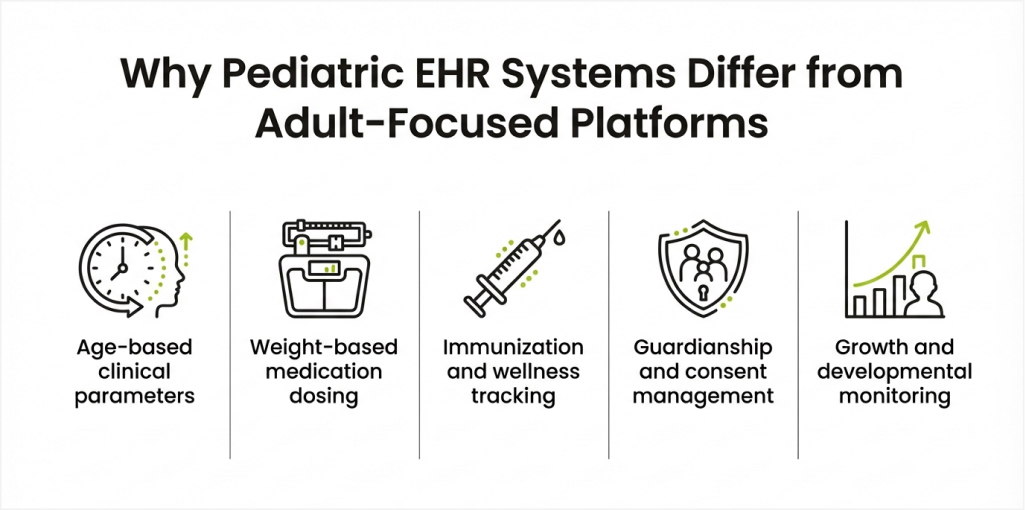
Children’s healthcare operates under entirely different clinical rules from adult medicine. A platform designed for adults cannot effectively accommodate these dynamic requirements. Below are the critical differences that drive the need for specialized pediatric solutions.
1. Age-based clinical parameters
Children’s vital signs, lab values, and growth metrics shift with every developmental stage. A normal heart rate for an infant differs dramatically from that of a teenager. Pediatric platforms must automatically adjust reference ranges based on the patient’s current age. Static adult benchmarks lead to missed diagnoses and incorrect clinical assessments.
2. Weight-based medication dosing
Prescribing for children requires precise weight-based dosage calculations to ensure safety. Adult systems typically use fixed dosing that does not account for a child’s body mass. Pediatric platforms calculate doses automatically and flag potential overdose risks instantly. This feature alone prevents thousands of medication errors in children’s healthcare annually.
3. Immunization and wellness tracking
Childhood vaccination schedules follow strict timelines set by national health authorities. Pediatric EHR systems must track every immunization dose and alert providers about upcoming ones. They also consistently monitor well-child visit schedules and developmental screening milestones. Adult-focused platforms rarely include these tracking capabilities as core features.
4. Guardianship and consent management
Minors cannot legally consent to medical treatment in most clinical settings. Pediatric platforms must record guardian information, custody arrangements, and consent authorizations. These records often change as family situations evolve over months and years. Accurate consent tracking effectively protects both the patient and the healthcare provider.
5. Growth and developmental monitoring
Tracking height, weight, and head circumference over time reveals critical health trends. Pediatric systems plot these measurements on standardized growth charts automatically after each visit. They also incorporate developmental milestone assessments for motor, language, and social skills. These longitudinal tracking tools have no equivalent in standard adult health records.
These differences make it clear that pediatric care demands purpose-built technology solutions. Investing in specialized development ensures clinicians have the right tools for every young patient.
Need a Custom Pediatric EHR System for Your Practice?
Access experienced healthcare technology specialists who understand child-specific clinical workflows. Build secure, compliant platforms tailored to pediatric care delivery today.

Key Features Every Pediatric EHR System Needs
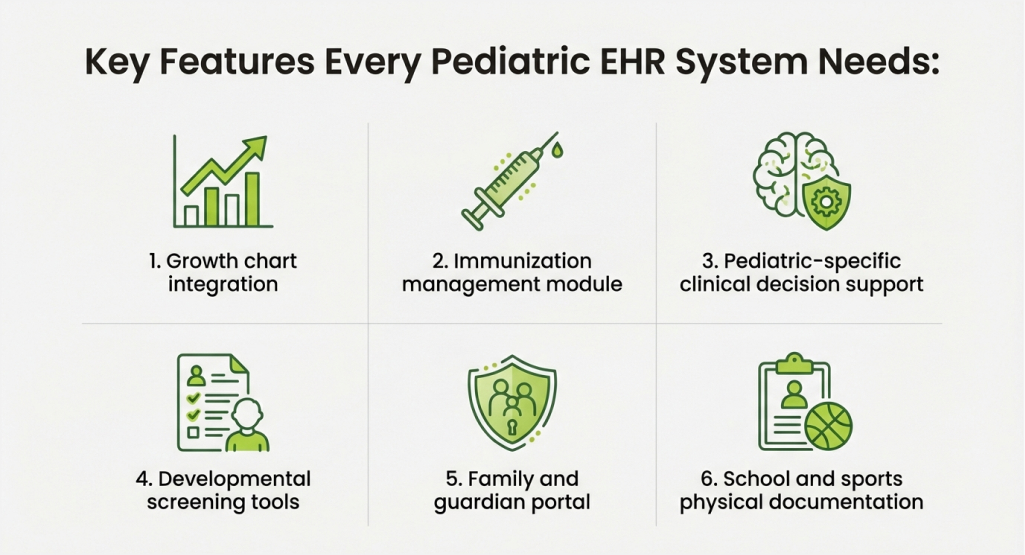
Building an effective EHR platform for pediatrics requires incorporating specific clinical and technical capabilities. Selecting the right functionality directly impacts clinical outcomes and provider satisfaction. Below are the essential components every pediatric EHR solution must include.
1. Growth chart integration
- Embed WHO and CDC growth charts directly into the patient record interface.
- Plot height, weight, BMI, and head circumference automatically at each visit.
- Display percentile rankings and trend lines for easy visual interpretation.
- Generate alerts when measurements fall outside normal growth parameters.
2. Immunization management module
- Track all vaccine doses against the recommended national immunization schedules accurately.
- Send automated reminders to families about upcoming or overdue vaccinations.
- Generate immunization compliance reports for schools and regulatory agencies.
- Support multiple vaccine schedule protocols for different age groups seamlessly.
3. Pediatric-specific clinical decision support
- Provide age-adjusted drug interaction and allergy checking at the point of care.
- Deliver evidence-based treatment recommendations tailored to pediatric conditions specifically.
- Alert clinicians to weight-based dosing errors before prescriptions are processed.
- Incorporate pediatric clinical guidelines from AAP and other recognized authorities.
4. Developmental screening tools
- Include standardized screening questionnaires for autism, speech, and motor delays.
- Record milestone achievements and flag missed developmental targets automatically.
- Track screening results over time to identify emerging developmental patterns.
- Share screening outcomes directly with specialists and early intervention programs.
5. Family and guardian portal
- Allow parents to securely view visit summaries, lab results, and upcoming appointments.
- Support multiple guardian accounts with different access permissions per patient.
- Enable secure messaging between families and the pediatric care team.
- Provide educational resources on childhood conditions and preventive care.
6. School and sports physical documentation
- Generate standardized forms for school enrollment and athletic participation needs.
- Pre-populate forms with current immunization records and medical history data.
- Store completed forms digitally for easy retrieval and sharing with institutions.
These features form the foundation of a clinically effective pediatric health record system. Providers should evaluate each capability based on their patient population and practice size.
Step-by-Step Pediatric EHR Development Process
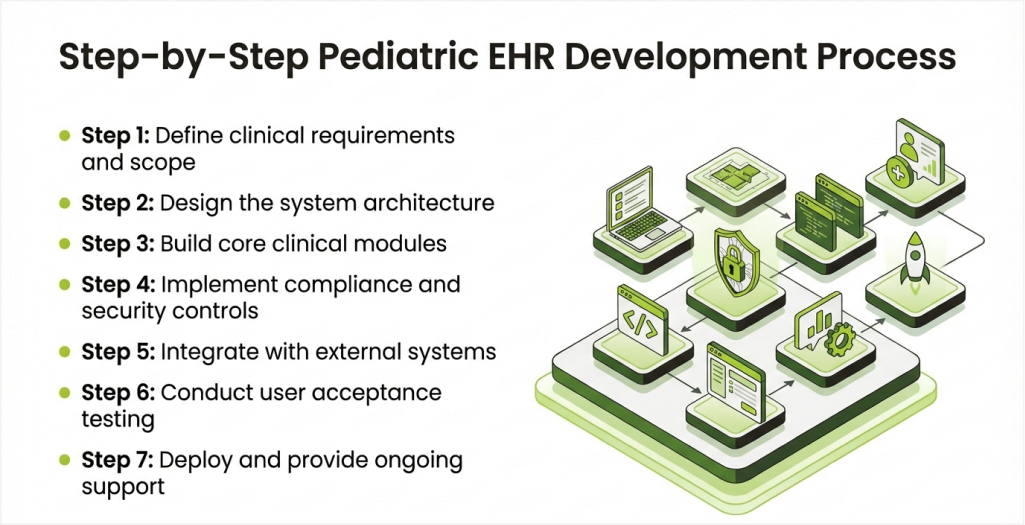
A structured approach keeps your project aligned with clinical needs and compliance standards—especially when starting with MVP development for EHR software to validate core features early. Following these steps reduces risk and consistently produces a higher-quality end product, while skipping them often leads to costly rework and extended timelines.
Step 1: Define clinical requirements and scope
Begin by documenting the specific pediatric workflows your platform must support daily. Interview pediatricians, nurses, and administrative staff about their current pain points. Identify which features deliver the highest clinical value for your target users. This assessment creates a clear roadmap for the entire development journey ahead.
Step 2: Design the system architecture
Choose your technology stack, deployment model, and data architecture based on project goals. Cloud-based platforms offer scalability and lower upfront infrastructure costs for most practices. Document all architectural decisions to guide the development team consistently throughout the project.
Step 3: Build core clinical modules
Develop the foundational modules, including patient demographics, charting, and ordering systems, first. Integrate growth chart engines, immunization trackers, and developmental screening tools early on. Build weight-based dosing calculators that integrate pediatric drug reference databases to support prescribing safety. Test each module thoroughly before moving to the next component in the queue.
Step 4: Implement compliance and security controls
Embed HIPAA security safeguards into every layer of the application architecture proactively. Build role-based access controls that address both guardian access and adolescent privacy needs. Encrypt all patient information both during transmission and while at rest.
Step 5: Integrate with external systems
Connect your platform with laboratories, pharmacies, imaging centers, and billing applications. Use FHIR and HL7 standards to ensure broad compatibility with external clinical systems. Test every EHR integration thoroughly in sandbox environments before production deployment begins. Verify that pediatric-specific data fields transfer accurately across all connected platforms.
Step 6: Conduct user acceptance testing
Invite pediatric clinicians to comprehensively test the platform using realistic patient scenarios. Gather feedback on usability, workflow efficiency, and clinical accuracy from every tester involved. Repeat testing cycles until the platform meets all defined acceptance criteria successfully.
Step 7: Deploy and provide ongoing support
Launch the platform with dedicated support staff available for immediate assistance and guidance. Monitor system performance, error rates, and user satisfaction closely during the initial weeks. Establish long-term maintenance routines to keep the platform reliable and up to date.
A disciplined process protects your investment and delivers a platform clinicians trust. Follow each step to build a pediatric EHR that performs reliably for years to come. Alternatively, you can hire an ERP software development team to manage complex development workflows and ensure a smooth, efficient implementation.
Ready to Start Your Pediatric EHR Development Project?
Our healthcare software experts can create a detailed roadmap tailored to your pediatric clinic’s workflows and compliance requirements.
Core Challenges in Pediatric EHR Development
Building child-focused health record platforms involves obstacles that general EHR projects rarely encounter, making collaboration with the best EHR development companies essential for successful implementation. Below are the most common challenges and practical strategies for addressing each.
Challenge 1: Managing complex and dynamic clinical data
Pediatric data changes as children grow and develop. Vital sign ranges, medication dosages, and lab reference values vary by age bracket. Systems must dynamically adjust clinical parameters without requiring staff to manually reconfigure them. Failing to account for this complexity results in inaccurate alerts and poor clinical guidance.
How to overcome this challenge
- Build age-aware logic engines that automatically adjust all clinical parameters by patient age.
- Implement real-time recalculation engines for weight-based dosing and vital sign ranges.
- Test extensively on patient data spanning newborns through adolescents to assess accuracy.
Challenge 2: Ensuring regulatory compliance for minors
Healthcare regulations impose additional requirements when treating patients under eighteen. HIPAA rules governing access to data about minor patients differ from standard adult privacy provisions. State laws on adolescent consent and confidentiality vary significantly across different jurisdictions. Development teams must navigate these layered compliance requirements carefully throughout the process.
How to overcome this challenge
- Consult pediatric healthcare compliance experts during the initial planning phase.
- Build granular access controls that support both guardian and adolescent privacy rules.
- Create configurable consent workflows that automatically adapt to different state regulations.
- Conduct regular compliance audits specific to pediatric data handling requirements.
Challenge 3: Achieving interoperability with existing systems
Pediatric platforms must exchange data with hospitals, labs, pharmacies, and specialist offices. Many external systems use adult-centric data models that ignore child-specific fields completely. Mapping pediatric data elements to standard exchange formats requires careful planning throughout. Poor interoperability isolates pediatric records from the broader care ecosystem entirely.
How to overcome this challenge
- Adopt FHIR standards with pediatric-specific resource extensions for clinical data exchange.
- Build flexible data mapping tools that translate child-specific fields into standard formats.
- Test connectivity with major EHR vendors that serve hospitals and specialist practices.
Challenge 4: Reducing clinician documentation burden
Pediatric visits often require extensive documentation for growth tracking and screenings. Providers spend significant time entering data rather than engaging directly with young patients. Complex documentation workflows contribute to burnout among pediatric clinicians across practices. Systems must balance thoroughness with efficiency for daily clinical use.
How to overcome this challenge
- Design smart templates that auto-populate fields with previous-visit data.
- Create streamlined workflows that reduce clicks during routine well-child visits.
- Gather regular feedback from pediatricians to identify and eliminate workflow bottlenecks.
Successfully navigating these challenges is key to delivering a functional and efficient pediatric EHR system. Comparable to the nuances highlighted in EHR systems for mental health, each healthcare domain introduces unique operational and compliance requirements. A proactive development approach helps mitigate risks and improve system adoption.
Facing Technical Challenges in Pediatric EHR Development?
Our experienced teams deliver reliable, compliant pediatric health record systems on time and within budget. Leverage our proven processes and clinical expertise to move your project forward.
Compliance and Security Requirements for Pediatric EHR Platforms
Pediatric health record systems must meet strict regulatory standards to protect young patients. Security failures in children’s healthcare carry severe legal and ethical consequences for providers. Below are the critical compliance areas every pediatric EHR platform must address properly.
HIPAA compliance for pediatric data
HIPAA-compliant EHR development governs how healthcare organizations securely handle protected health information. Pediatric records introduce additional complexity due to parental access and minor consent requirements. Systems must support granular access controls that accurately reflect guardianship and custody arrangements.
COPPA considerations for patient portals
The Children’s Online Privacy Protection Act applies when platforms collect data from minors online. Patient portals that allow children to interact directly must comply strictly with COPPA requirements. Parental consent mechanisms and data minimization principles become essential design elements. Development teams must evaluate COPPA applicability early in the project planning phase.
State-specific adolescent privacy laws
Many states grant adolescents the right to consent to sensitive healthcare services independently. These services often include mental health, reproductive care, and substance abuse treatment programs. Pediatric platforms must restrict parental access to specific record categories in accordance with state law. Configurable privacy rules allow a single platform to support practices across multiple jurisdictions seamlessly.
Data encryption and access control standards
All patient data must be encrypted with AES-256 during transmission and storage. Role-based access controls must limit data visibility to authorized clinical personnel only. Multi-factor authentication adds a critical security layer for all system users. Regular vulnerability assessments proactively identify and address potential security weaknesses.
Audit trail and breach notification capabilities
Every data access event must generate a detailed log entry for compliance reporting purposes. Audit trails help organizations detect unauthorized access and respond to incidents quickly. Breach notification workflows must comply with federal and state reporting timelines precisely. Automated alerting systems flag suspicious access patterns before they escalate into full breaches.
Addressing these compliance and security requirements lays the foundation for a resilient pediatric EHR system. As seen in other specialized implementations, such as EHR development for dental clinics, aligning technology with domain-specific regulations is essential. Strong safeguards ensure both legal protection and long-term system reliability.
How Much Does Pediatric EHR Development Cost?
EHR software development costs for pediatric care vary based on project scope, feature complexity, and compliance requirements. Understanding these cost factors helps organizations budget accurately for their initiatives.
Cost factors that influence your investment
- Feature complexity: Advanced modules such as clinical decision support and AI diagnostics increase development costs.
- Compliance requirements: HIPAA, COPPA, and state-specific regulations add security development costs.
- Integration scope: Connecting with labs, pharmacies, and billing systems adds testing and development time.
- Deployment model: Cloud-based platforms require ongoing hosting costs, while on-premises solutions require infrastructure investment.
- Customization level: Highly tailored workflows for specialty pediatric practices increase design and development effort.
- Ongoing maintenance: Post-launch support, updates, and regulatory compliance monitoring add to total ownership cost.
Typical pediatric EHR development cost ranges
| Project Scope | Estimated Cost Range | Timeline |
|---|---|---|
| Basic pediatric EHR (core features) | $50,000 to $150,000 | 12 to 20 weeks |
| Mid-range platform (multiple modules) | $150,000 to $350,000 | 20 to 36 weeks |
| Enterprise pediatric EHR system | $350,000 to $750,000+ | 36 to 60 weeks |
| Legacy EHR system modernization | $200,000 to $500,000 | 24 to 48 weeks |
Organizations should view pediatric EHR development as a long-term investment in care quality, requiring careful planning, the right technology stack, and domain expertise. To manage complexity and ensure efficient execution, many providers choose to outsource EHR system development to experienced partners who can control costs while maintaining high implementation standards.
Want an Accurate Pediatric EHR Development Cost Estimate?
Get a transparent quote based on your required features, integrations, and scalability goals.
Best Practices for Building a Pediatric EHR System
Following proven strategies increases the likelihood of delivering a successful pediatric platform. These guidelines come from real implementations across children’s hospitals and pediatric clinics. Each recommendation addresses a specific risk that can derail projects without proper attention.
1. Involve pediatricians from day one
Actively engage practicing clinicians during the requirements-gathering and interface-design phases. Their clinical insights ensure that the platform accurately supports real-world pediatric workflows. Clinician involvement increases adoption rates and significantly reduces post-launch change requests. Excluding end users from planning creates platforms that nobody wants to use daily.
2. Design for every age group
Build interfaces and logic that handle patients from premature newborns through eighteen-year-olds. Ensure clinical parameters adjust dynamically across all developmental stages. Gaps in age coverage create safety risks for specific patient populations.
3. Prioritize usability over complexity
Keep interfaces clean and workflows intuitive for time-pressed pediatric clinicians consistently. Use smart defaults and auto-population features to significantly accelerate data entry. Complex interfaces increase documentation time and contribute to provider burnout across practices.
4. Build compliance into the architecture
Embed HIPAA and COPPA safeguards into the platform foundation rather than adding them later. Retrofitting compliance features after development costs significantly more than building them initially. Security must be a design principle, not an afterthought in any healthcare platform.
5. Plan for scalability and future growth
Design your architecture to accommodate new features, users, and integrations seamlessly over time. Cloud-based EHR systems for small medical practices scale more efficiently than traditional on-premise deployments for growing practices. Modular designs allow organizations to add capabilities without rebuilding core components entirely.
6. Test with real clinical scenarios
Rigorously validate the platform using authentic pediatric patient data and workflow simulations. Include edge cases like premature infants, complex chronic conditions, and adolescent privacy scenarios. Thorough validation before launch prevents patient safety incidents in production environments.
These practices help organizations build reliable, secure, and clinically effective pediatric platforms. A disciplined approach delivers lasting value from every development dollar invested.
Why Choose Space-O Technologies as Your Pediatric EHR Development Partner
Building a pediatric EHR system is essential for practices that want to deliver focused, child-specific digital care. A well-designed platform simplifies clinical documentation and empowers providers to make better-informed decisions for their young patients. Getting it right requires a blend of clinical insight, engineering capability, and strict regulatory compliance throughout the development process.
Space-O Technologies is an experienced healthcare software development company delivering tailored healthcare platforms for organizations of all sizes. Our development teams hold deep proficiency in FHIR, HL7, and HIPAA-compliant architecture design. We support children’s hospitals, pediatric practices, and healthtech startups in creating systems that clinicians depend on in their daily routines. From discovery and planning through launch and continuous support, we maintain a strong track record of reliable delivery.
Our healthcare technology professionals collaborate closely with your clinical staff to understand pediatric care workflows in depth, while ensuring seamless EHR integration across your systems. We define the optimal architecture, engineer scalable solutions, and deliver platforms that perform reliably in demanding clinical environments.
If you are ready to develop a pediatric EHR system tailored to your practice, it’s time to hire EHR software developers who understand healthcare complexities. Consult our experts today and let Space-O Technologies help you build a secure, compliant, and future-ready pediatric EHR solution.
FAQs About Pediatric EHR Development
1. What is pediatric EHR development?
Pediatric EHR development is the process of building electronic health record platforms for children’s healthcare. These systems include specialized features like growth charts, immunization tracking, and age-based dosing. Purpose-built pediatric platforms improve patient safety and care quality for young patients.
2. How is a pediatric EHR different from a standard EHR?
Pediatric systems handle dynamic clinical parameters that change with each developmental stage. They include growth monitoring, vaccination tracking, and guardian consent management features. Standard platforms use static adult reference ranges and lack child-specific clinical tools entirely.
3. How long does pediatric EHR development take?
Timelines depend on project scope, feature complexity, and integration requirements significantly. Basic platforms may take 12 to 20 weeks to complete full development and testing. Enterprise systems for large children’s hospitals typically take 36 to 60 weeks to implement. Thorough planning during early phases helps prevent costly delays throughout the project.
4. How much does it cost to build a pediatric EHR system?
Costs range from $50,000 for basic platforms to $750,000 or more for enterprise solutions. Major cost drivers include feature complexity, compliance requirements, and integration scope. Working with experienced partners helps control spending while maintaining high-quality standards.
5. What compliance standards apply to pediatric EHR systems?
Pediatric platforms must comply with HIPAA regulations governing the handling of protected health information. COPPA applies when patient portals collect data from children under 13. State-specific laws also govern adolescent consent and confidentiality for sensitive services. Platforms must also meet certification requirements for encryption, access control, and audit trails.



 All our projects are secured by NDA




 4.8
4.8