
 By
By 
Contents
The adoption of electronic health record systems continues to accelerate as healthcare organizations prioritize digital transformation and interoperability. According to Grand View Research, the global EHR market was valued at $33.43 billion in 2024 and is projected to grow to $43.36 billion by 2030. This growth reflects the increasing demand for connected healthcare ecosystems that enable secure, real-time access to patient information across multiple systems.
However, implementing an EHR system alone is not enough. Healthcare providers rely on various platforms such as laboratory systems, billing software, telehealth solutions, pharmacy applications, and patient portals. Without proper integration, these systems operate in silos, leading to fragmented data, inefficiencies, and potential clinical risks.
EHR integration ensures seamless communication between systems through standards such as HL7, FHIR, and API-based connectivity. It plays a critical role in improving care coordination, reducing administrative workload, enhancing patient outcomes, and maintaining regulatory compliance.
In this blog, we will explore what EHR integration is, how it works, common integration methods, benefits, challenges, and key cost considerations. We have also shared practical insights drawn from 15+ years of experience as an expert EHR integration partner to help you make informed decisions about your interoperability strategy.
What is EHR Integration?
EHR integration connects electronic health record platforms with other healthcare software and systems. This process enables seamless data sharing between hospitals, clinics, labs, and pharmacies. Clinicians gain unified access to patient information across multiple care settings. The goal is to eliminate manual data entry and reduce errors in clinical workflows.
Modern EHR system integration relies on standardized protocols like HL7 and FHIR. These standards define how different applications exchange clinical data securely and consistently. Connectivity can happen through APIs, middleware engines, or direct database connections. Each approach serves different use cases based on complexity and security requirements.
A well-integrated EHR ecosystem benefits every stakeholder in the care continuum. Physicians access complete patient histories without switching between multiple platforms. Nurses update records once, and the information flows automatically to all connected applications. Patients experience better care coordination and fewer repeated tests or procedures.
Why EHR Integration is Essential for Healthcare Providers
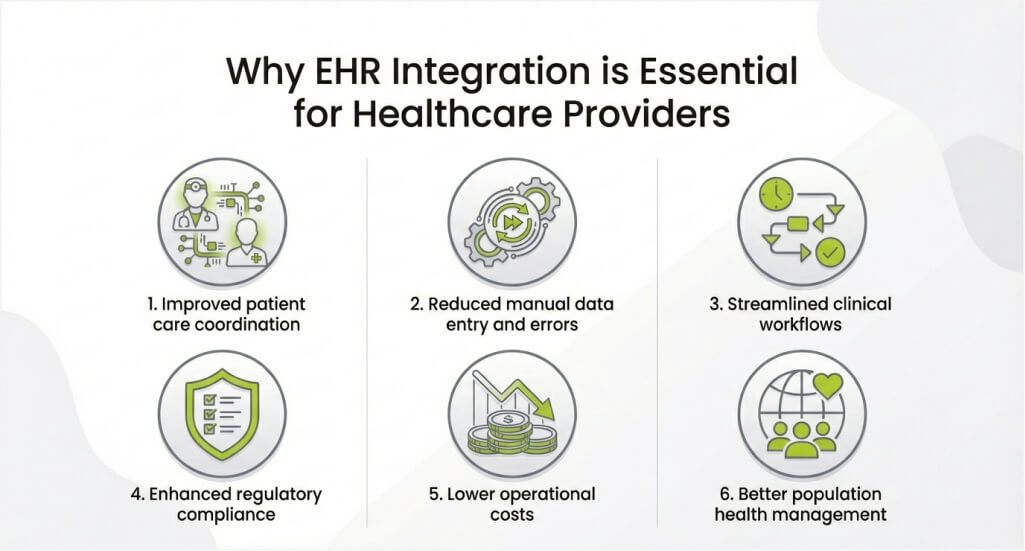
Connecting health record systems delivers measurable improvements across clinical and administrative operations. Facilities that invest in integration reduce costs, improve outcomes, and enhance patient satisfaction. These advantages extend far beyond simple data sharing between departments, making EHR development for small practices a strategic investment rather than just a technical upgrade. Below are the most impactful benefits providers experience after successful implementations.
1. Improved patient care coordination
Integrated platforms give providers a complete view of each patient’s medical history. Specialists, primary care doctors, and nurses all access the same updated information. This shared visibility reduces diagnostic errors and prevents conflicting treatment plans. Care teams make faster, more informed decisions at every stage of treatment.
2. Reduced manual data entry and errors
Clinical staff spend hours entering the same data into multiple disconnected systems. Integration automates data flow between platforms and eliminates repetitive manual input entirely. Fewer manual entries mean fewer transcription mistakes in patient records overall. Team members redirect their time toward direct patient care instead of paperwork.
3. Streamlined clinical workflows
Connected applications accelerate routine tasks like ordering lab tests or filling prescriptions. Automated alerts notify clinicians about critical results, allergies, or drug interactions instantly. Approval processes move faster when relevant information flows between systems without delay. Providers handle higher patient volumes without sacrificing quality or safety standards.
4. Enhanced regulatory compliance
Federal mandates require healthcare organizations to share data through certified technologies. The 21st Century Cures Act mandates FHIR-based APIs for patient data access. Integrated EHR environments help providers meet these interoperability regulations more easily. Compliance with standards like USCDI also reduces the risk of costly penalties.
5. Lower operational costs
Data silos force facilities to maintain separate systems with overlapping functionality. Integration consolidates these tools and significantly reduces software licensing and maintenance expenses. Automated workflows decrease the need for additional administrative staff across departments. Hospitals and clinics save thousands annually by eliminating redundant operational processes.
6. Better population health management
Aggregated patient data from multiple sources enables powerful analytics and reporting. Public health teams identify disease trends, risk factors, and treatment outcomes more accurately. Predictive models help organizations allocate resources before health crises escalate further. Population-level insights drive preventive care strategies that improve community wellness outcomes.
These benefits create a strong business case for healthcare providers at every scale. Facilities that delay integration risk falling behind competitors—especially those already working with experienced EHR development companies to deliver connected care. The key lies in choosing the right approach and standards tailored to your specific needs.
Need Expert EHR Integration Support?
Access experienced healthcare integration specialists who understand FHIR, HL7, and clinical workflows. Build secure, compliant connections between your critical systems today.

Types of EHR Integration Approaches
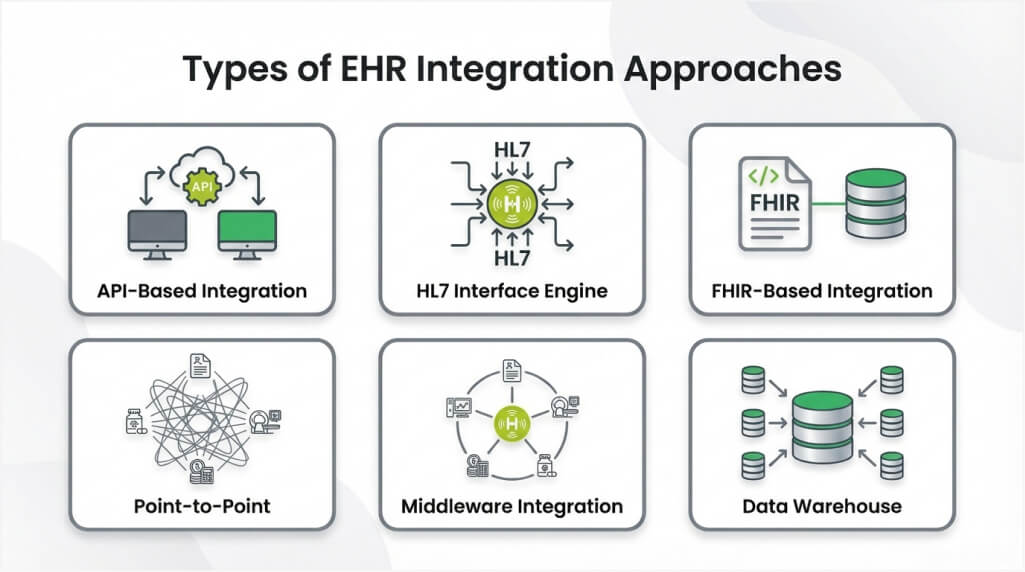
Healthcare organizations choose from several connectivity methods based on their goals and infrastructure. Each approach offers distinct advantages for different technical environments and budgets. Selecting the right method directly impacts implementation speed, cost, and long-term scalability.
The wrong approach can lead to performance bottlenecks, security gaps, and excessive maintenance overhead. Different stages of your integration journey often require different technical strategies. Many successful providers combine multiple methods to address their complete connectivity needs.
| Integration Type | Best For | Complexity | Data Flow |
|---|---|---|---|
| API-Based Integration | Modern cloud systems need real-time data exchange | Medium | Bidirectional |
| HL7 Interface Engine | Legacy systems using traditional messaging standards | High | Bidirectional |
| FHIR-Based Integration | Standards-compliant apps and patient-facing portals | Medium | Bidirectional |
| Point-to-Point | Connecting two specific systems directly | Low | Unidirectional or bidirectional |
| Middleware Integration | Complex environments with multiple disparate systems | High | Bidirectional |
| Data Warehouse | Analytics, reporting, and population health insights | Medium | Unidirectional (inbound) |
API-based integration uses application programming interfaces to exchange data between platforms. Modern cloud EHR solutions rely heavily on RESTful APIs for real-time connectivity. This approach works best for organizations running newer software architectures. It offers flexibility and speed that traditional methods cannot match.
HL7 interface engines process standardized messages between clinical applications and hospital systems. Many legacy platforms still depend on HL7 v2 messaging for lab results and admissions data. This method requires dedicated middleware to correctly translate and route messages. Despite its complexity, it remains essential for connecting older infrastructure.
FHIR-based integration is the modern standard mandated by federal regulations. FHIR uses RESTful APIs and structured data resources to enable flexible, scalable connections. Adoption in outpatient settings climbed from 49% in 2021 to 64% in 2024. Around 73% of digital health companies already use standards-based EHR APIs.
Point-to-point connections link two applications directly without middleware or intermediary layers. This approach suits simple use cases but becomes unmanageable as the number of systems grows. Maintenance burden increases exponentially with each new connection added to the network.
Middleware platforms act as central hubs that manage data flow between multiple applications. They handle message transformation, routing, error handling, and protocol translation automatically. This architecture scales well for large health systems with diverse technology portfolios.
Data warehouse integration pulls clinical information into centralized repositories for analysis. This method effectively supports population health management and regulatory reporting requirements. Organizations use warehoused data for research, quality improvement, and strategic planning.
Key Standards and Protocols for EHR System Integration
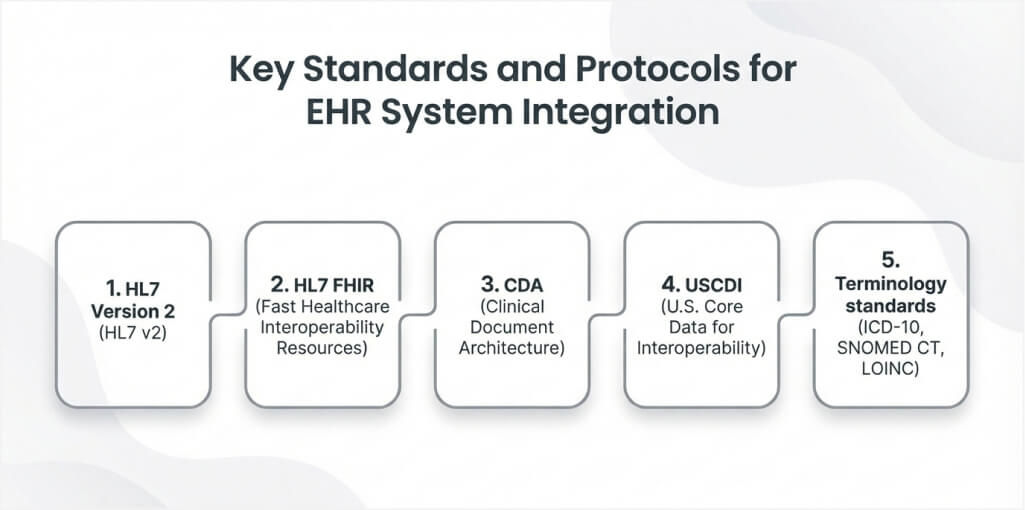
Successful integration depends on adopting recognized healthcare data exchange standards. These protocols ensure that different applications interpret clinical information consistently and accurately. Understanding each standard helps providers select the right tools for their connectivity projects.
1. HL7 Version 2 (HL7 v2)
HL7 v2 remains the most widely deployed messaging standard in healthcare today. Hospitals primarily use it to send lab results, admission notifications, and discharge summaries. The standard uses pipe-delimited text messages that flow through interface engines. Despite its age, HL7 v2 supports thousands of active clinical connections worldwide.
2. HL7 FHIR (Fast Healthcare Interoperability Resources)
FHIR is the modern, API-first standard built for web-based healthcare applications. It uses RESTful APIs and JSON or XML data formats for flexible exchanges. The 21st Century Cures Act mandates FHIR-based APIs for certified EHR technology. Companies that connect with multiple EHR platforms have a 75% FHIR adoption rate today.
3. CDA (Clinical Document Architecture)
CDA defines the structure and format for exchanging clinical documents electronically. Continuity of Care Documents and discharge summaries commonly use this XML-based standard. Providers share CDA documents through health information exchanges across regions. This standard complements FHIR by effectively supporting document-level data sharing.
4. USCDI (U.S. Core Data for Interoperability)
USCDI defines the minimum dataset required for nationwide health data exchange. Currently at version 3, it specifies the data elements every certified system must support. ONC updates USCDI regularly to expand the scope of interoperable data categories. Medical facilities must align their connectivity strategies with USCDI requirements for compliance.
5. Terminology standards (ICD-10, SNOMED CT, LOINC)
Clinical terminology standards ensure consistent coding across all connected platforms. ICD-10 classifies diagnoses and procedures for billing and reporting purposes. SNOMED CT provides comprehensive clinical terminology for medical documentation and exchange. LOINC standardizes codes for laboratory tests and clinical observations across systems.
Choosing the right combination of standards depends on your existing infrastructure. Most organizations implement FHIR for new connections while maintaining HL7 v2 for legacy platforms. A thoughtful standards strategy reduces rework and ensures long-term interoperability across your environment.
Simplify Your EHR Integration Journey With Our Experts
Our healthcare software experts handle architecture design, interoperability standards, API development, and compliance implementation for seamless EHR connectivity.
Common EHR Integration Challenges and How to Overcome Them
Despite thorough planning, EHR integration projects can encounter obstacles that extend timelines and increase costs. Anticipating these challenges enables proactive solutions rather than reactive crisis management. Below are the most frequent issues and proven strategies for addressing them.
Challenge 1: Data silos across departments and facilities
Clinical data often sits trapped inside individual systems with no path to other platforms. Departments operate independent software that stores patient information in incompatible formats. Merging these isolated datasets requires careful mapping and standardization efforts. Nearly 47% of clinicians report difficulty finding important patient data from outside their facility.
How to overcome this challenge
- Conduct a full audit of all existing systems and their data formats before beginning integration work.
- Implement a centralized integration engine that acts as a hub for all clinical data exchanges.
- Establish data governance policies that clearly define ownership, quality standards, and access rules.
- Prioritize high-value connections, such as linking labs to the primary health record platform.
Challenge 2: Legacy system compatibility issues
Many hospitals still run older platforms that predate modern connectivity standards entirely. These systems lack API support and use proprietary data formats exclusively. Replacing them entirely requires massive capital investment that most facilities cannot justify immediately.
How to overcome this challenge
- Deploy middleware solutions that translate legacy formats into modern standards like FHIR automatically.
- Use HL7 v2 interface engines to gradually bridge older systems with newer applications.
- Plan phased migration strategies that modernize components without disrupting active clinical operations.
- Partner with integration specialists who have experience reliably connecting outdated healthcare platforms.
Challenge 3: Data security and HIPAA compliance risks
Every connection point creates a potential vulnerability for protected health information access. Unauthorized access to data during transmission can quickly trigger severe regulatory penalties. According to an IBM report, the healthcare industry recorded the highest average breach cost, reaching USD 10.93 million.
How to overcome this challenge
- Consistently encrypt all data in transit and at rest using AES-256.
- Implement role-based access controls that limit data visibility to authorized personnel only.
- Conduct regular security audits and penetration testing of all integration endpoints.
- Establish audit trails that log every data access event for compliance reporting purposes.
- Sign Business Associate Agreements with all third-party vendors that directly handle patient information.
Challenge 4: Workflow disruptions during implementation
New integrations often significantly change how staff interact with their daily clinical tools. Resistance from clinicians and administrative teams can undermine adoption rates across the facility. Poorly timed rollouts during peak patient volumes create dangerous workflow interruptions for everyone.
How to overcome this challenge
- Involve clinical staff in planning sessions to thoroughly understand their daily workflow requirements.
- Schedule go-live dates during periods of lower patient volume to minimize operational disruption.
- Provide comprehensive training programs before, during, and after the integration launch period.
- Assign dedicated support staff to handle questions and issues during the transition phase.
Challenge 5: Maintaining data quality and consistency
Duplicate records, incomplete entries, and inconsistent formats plague many healthcare databases today. Integration amplifies these quality problems by rapidly spreading bad data across connected platforms. Poor data quality undermines the clinical value of even the most advanced connections.
How to overcome this challenge
- Implement master patient index systems to automatically identify and merge duplicate records.
- Define data validation rules that reject incomplete or improperly formatted entries at input.
- Establish regular data cleansing processes that run automatically on a weekly.
- Assign data stewards to continuously monitor quality across all integrated systems.
These obstacles are serious but not insurmountable with the right preparation. Providers who proactively address them build more resilient and effective connected environments. Investing in proper planning saves significant time and money throughout the integration lifecycle.
Overcome Complex EHR Integration Challenges
Legacy systems and interoperability barriers can delay progress. Space-O Technologies delivers reliable EHR integration solutions backed by 15+ years of healthcare development experience.
EHR Integration Use Cases Across Healthcare
Healthcare organizations connect their EHR platforms with diverse clinical and administrative systems. Each connection serves a specific purpose that improves care delivery or operational efficiency. Understanding these use cases helps providers strategically prioritize their integration roadmap. Below are the most common and high-value connectivity scenarios in practice today.
1. Laboratory system integration
Lab EHR connections seamlessly automate the flow of test orders and results between platforms. Physicians place orders directly from the health record without manually switching applications. Results return electronically and populate the patient chart within minutes of completion. This connection reduces turnaround times and eliminates manual result transcription errors entirely.
2. Pharmacy and e-prescribing integration
Linking EHR platforms to pharmacy systems enables the instant transmission of electronic prescriptions. Prescribers verify drug interactions, allergies, and insurance coverage before sending orders forward. Pharmacies receive prescriptions digitally, reducing phone calls and handwritten errors significantly. Patients benefit from faster medication fulfillment and improved overall safety checks.
3. Telehealth platform integration
Virtual care solutions connect with EHR systems to maintain continuity of clinical documentation, which is especially critical in EHR development for mental health. Clinicians can access patient histories during video consultations without manually opening separate applications. Visit notes, diagnoses, and care plans automatically flow back into the health record. This connection supports the growing demand for remote patient care services nationwide.
4. Billing and revenue cycle management integration
Financial systems pull clinical data from the EHR to generate accurate insurance claims. Automated coding suggestions reduce claim denials and accelerate reimbursement cycles for providers. Insurance eligibility checks happen in real time during patient registration workflows. Facilities capture more revenue by consistently reducing billing errors and missed charges.
5. Medical imaging and PACS integration
Radiology information flows seamlessly between imaging systems and the electronic health record. Physicians view X-rays, MRIs, and CT scans directly within the patient chart interface. Integrated imaging reduces the need for physical media and manual report transfers. Diagnostic accuracy improves when clinicians access images alongside a complete clinical context.
6. Health information exchange (HIE) integration
HIE connections enable effective data sharing across separate healthcare organizations and regions. Hospitals routinely exchange patient records with external providers during transfers and referrals. Emergency departments access critical medical histories for patients arriving from other facilities. This connectivity supports care coordination for individuals who regularly see multiple providers.
These use cases demonstrate the breadth of opportunities that EHR connectivity creates. Providers should evaluate which connections deliver the highest clinical and financial value first. A phased approach ensures each integration receives proper attention and thorough testing.
Step-by-Step EHR Integration Process
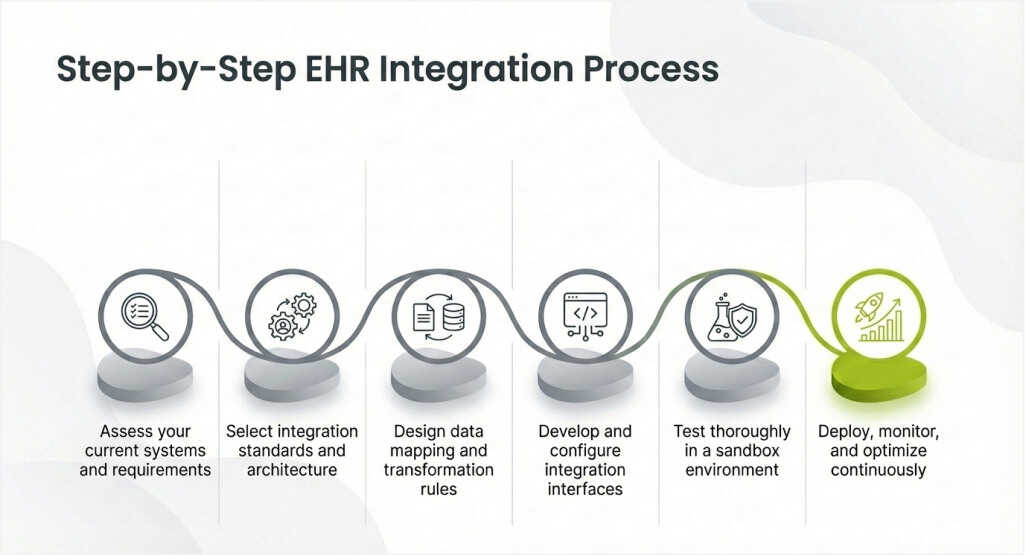
A structured process ensures your connectivity project stays on track and within budget. Following these steps reduces risk and increases the likelihood of a successful outcome. Each phase builds on the previous one to create a solid foundation for integration. Skipping any step often leads to costly rework and extended timelines later.
Step 1: Assess your current systems and requirements
Begin by documenting every software platform your organization currently operates daily. Identify which systems need to exchange data and clearly define specific connectivity objectives. Map existing workflows to understand how information flows between departments today. This assessment reveals gaps, redundancies, and priority connections for your project roadmap.
Step 2: Select integration standards and architecture
Choose the protocols and technical approach that best suit your environment specifically. Newer systems typically support FHIR APIs, while older platforms may require HL7 v2 engines. Carefully decide between point-to-point connections, middleware solutions, and hybrid architectures. Document your architecture decisions to guide the development team throughout the implementation process.
Step 3: Design data mapping and transformation rules
Define how data elements from one system translate to fields in another platform. Clinical terminologies, code sets, and data formats must align across all connected applications. Build transformation rules that automatically convert incompatible formats into standardized structures. Validate your mappings with clinical stakeholders to ensure accuracy and completeness throughout.
Step 4: Develop and configure integration interfaces
Build the technical connections using your selected standards, APIs, and middleware tools. Configure message routing, error handling, and retry logic to ensure reliable, consistent data delivery. Implement security measures, including encryption, authentication, and access controls at every endpoint. Follow development best practices to create maintainable and scalable integration code.
Step 5: Test thoroughly in a sandbox environment
Execute comprehensive testing before deploying integrations directly into your production environment. Verify data accuracy, message delivery, error handling, and system performance under load conditions. Involve clinical users in acceptance testing to validate that workflows function as expected. Document all test results and resolve identified issues before moving to the next phase.
Step 6: Deploy, monitor, and optimize continuously
Launch your integrations with dedicated support staff available for immediate troubleshooting needs. Monitor data flows, error rates, and system performance closely during the initial weeks. Gather feedback from end users and adjust configurations based on real-world usage patterns. Establish ongoing monitoring and maintenance routines to keep connections running reliably over the long term.
A disciplined process prevents costly mistakes and scope creep during integration projects. Providers that skip steps often face rework that doubles their original timeline estimate. Invest in each phase to build a robust, lasting connected healthcare ecosystem.
Need Help Planning Your EHR Integration Project?
Work with Space-O Technologies to design a clear integration roadmap tailored to your clinical environment. Discuss your requirements with our experts and move forward with confidence.
How Much Does EHR Integration Cost?
EHR integration costs vary based on project scope, complexity, and organizational size significantly. Simple connections between two modern systems cost far less than enterprise-wide deployments. Understanding these cost factors of EHR development and integration helps providers budget accurately for their connectivity initiatives.
Cost factors that influence your investment
- Number of systems connected: Each additional platform adds development, testing, and maintenance expenses.
- Integration complexity: Real-time bidirectional connections cost more than simple one-way data feeds.
- Legacy EHR software modernization: Older platforms often require custom middleware, which significantly increases development time.
- Compliance requirements: HIPAA security controls, audit trails, and encryption add to the total project budget.
- Data migration scope: Moving historical records between systems requires careful planning and validation work.
- Vendor API availability: Proprietary systems without open APIs require custom development for connectivity.
Typical EHR integration cost ranges
| Project Scope | Estimated Cost Range | Timeline |
| Single system connection | $25,000 to $75,000 | 4 to 8 weeks |
| Multi-system integration (3 to 5 platforms) | $75,000 to $250,000 | 8 to 20 weeks |
| Enterprise-wide integration program | $250,000 to $500,000+ | 20 to 52 weeks |
| Legacy system modernization with integration | $150,000 to $400,000 | 12 to 36 weeks |
Organizations that follow structured integration models achieve full ROI within three years. According to Grand View Research, the global healthcare interoperability solutions market was valued at USD 3.4 billion in 2023 and is forecast to reach USD 8.57 billion by 2030. These figures highlight the accelerating investment in connected healthcare infrastructure globally.
Best Practices for Successful EHR Integration
Following proven strategies dramatically increases your chances of delivering a smooth integration. These guidelines come from successful implementations across hospitals, clinics, and health systems. Apply them from the start to avoid common mistakes and wasted resources. Each practice addresses a specific risk that can derail projects without proper attention.
1. Start with a clear integration strategy
Define your objectives, scope, and success criteria before any official development begins. Document which systems you need to connect and what data must flow between them. Align your integration roadmap with broader organizational goals and regulatory deadlines. A clear plan prevents scope creep and keeps stakeholders aligned throughout the project.
2. Prioritize standards-based integrations
Choose FHIR and HL7 standards over proprietary connectors whenever possible for flexibility. Standards-based connections are easier to maintain, upgrade, and extend over time consistently. They also satisfy federal mandates for interoperability and patient data access requirements. Proprietary solutions create vendor lock-in, limiting future flexibility and technology choices.
3. Build security into every layer
Protect patient information at every stage of the data exchange process diligently. Encrypt transmissions, validate user identities, and restrict access based on clinical roles. Conduct regular vulnerability assessments on all integration endpoints and middleware components. Security cannot be an afterthought when handling protected health information across systems.
4. Involve clinical stakeholders early
Proactively engage physicians, nurses, and administrative staff during the planning phase. Their input ensures integrations align with real clinical workflows and daily needs. Clinician buy-in reduces resistance during deployment and substantially improves adoption rates. Excluding end users from planning leads to connections that nobody wants to use.
5. Test extensively before going live
Validate every data exchange scenario in a sandbox before production deployment begins. Include edge cases, error conditions, and high-volume simulations in your testing plan. Involve actual users in acceptance testing to catch workflow issues early on. Untested integrations create patient safety risks that no provider can afford to overlook.
6. Plan for ongoing maintenance from day one
Integrations require continuous monitoring, updates, and occasional troubleshooting after launch consistently. Proactively assign dedicated resources to manage and maintain all active connections over time. Build alerting systems that automatically detect failures and data quality issues. Neglected connections degrade over time and can unexpectedly break during system updates.
7. Document everything thoroughly
Create detailed documentation for every integration, including data mappings and configurations, completely. Record architectural decisions, troubleshooting procedures, and contact information for support teams. Updated documentation ensures that new team members can quickly understand and manage connections. Poor documentation traps critical knowledge inside individual team members’ heads permanently.
These practices help organizations successfully build reliable, secure, and scalable connected environments. To achieve this effectively, many providers choose to develop an EHR software platform tailored to their integration and workflow needs. Skipping any of these steps increases the risk of costly failures and extended delays, while a disciplined approach delivers lasting value from every integration investment you make.
Partner with Space-O Technologies for Expert EHR Integration Services
EHR integration is a critical step toward delivering connected, efficient, and patient-centered care. The right connectivity strategy eliminates data silos and strengthens clinical workflows across your facility. Standards such as FHIR and HL7 enable seamless data exchange for providers of all sizes. Success requires careful planning, technical expertise, and a commitment to security at every level.
Space-O Technologies specializes in custom EHR development for healthcare organizations of all sizes. Our experienced development teams bring deep expertise in FHIR, HL7, and API-based connectivity. We help hospitals, clinics, and healthtech companies securely and compliantly connect their systems. From initial assessment through deployment and ongoing support, we consistently deliver reliable integrations.
Our healthcare technology experts work closely with your teams to understand clinical workflows. By hiring EHR software developers with deep domain expertise, you can ensure the right standards are applied from the start. We design scalable architectures and build reliable integrations that reduce upfront implementation costs and minimize future maintenance expenses. Talk to our specialists and take the next step with confidence today.
Frequently Asked Questions on EHR Integration
1. What is EHR integration, and why is it important?
EHR integration connects electronic health record platforms with other clinical and administrative systems. It enables seamless data sharing, improving care coordination and reducing manual errors. Integrated environments help providers meet regulatory requirements and deliver higher-quality patient care. Without proper connectivity, healthcare data stays trapped in silos that slow clinical decisions.
2. What standards are used for EHR integration?
The most common standards include HL7 v2, HL7 FHIR, CDA, and USCDI. FHIR is the modern standard mandated by the 21st Century Cures Act specifically. HL7 v2 remains widely used for legacy system connections in hospitals today. Most organizations use a combination of protocols based on their specific platform requirements.
3. How long does EHR integration take?
Timelines depend on project complexity, the number of systems, and your existing infrastructure. Simple two-system connections may take 4 to 8 weeks to finish completely. Multi-platform enterprise programs typically require 20 to 52 weeks of development work. Thorough planning and testing during early phases help prevent costly delays later.
4. How much does EHR integration cost?
Costs range from $25,000 for basic connections to $500,000 or more for enterprise programs. Major cost drivers include the number of systems, the complexity of the legacy platform, and compliance requirements. Organizations that follow phased approaches often manage budgets more effectively over time. Working with experienced partners helps control spending while maintaining high implementation quality.



 All our projects are secured by NDA




 4.8
4.8