
 By
By 
Contents
The rapid growth of digital healthcare is driving strong demand for flexible and scalable electronic health record solutions. According to a report from Fortune Business Insights, the global EHR market was valued at USD 29.68 billion in 2023 and is expected to hit USD 46.63 billion by 2032.
This growth highlights how healthcare providers and healthtech companies are increasingly investing in EHR platforms to improve data accessibility, clinical efficiency, and care coordination.
However, building a full-scale EHR system from the outset can be costly and risky, especially when product requirements are still evolving. This is where EHR MVP development becomes a strategic starting point. Partnering with an experienced EHR software development company for an EHR minimum viable product allows organizations to validate core functionality, test clinical workflows, and gather real user feedback while keeping development time and cost under control.
This guide explains EHR MVP development in detail. Get insights from our 15+ years of experience as a leading EHR development partner to understand what an EHR MVP is, its benefits, essential features to include, the development process, cost considerations, and common challenges to plan for before moving toward full-scale EHR system development.
What is EHR MVP Development?
EHR MVP development is the process of building a minimum viable electronic health records product with only essential features. This approach focuses on core functionality that allows startups to test their concept with real users. The goal is to launch quickly while meeting basic compliance requirements.
Unlike full-scale EHR systems, an MVP includes only features necessary for initial market validation. Patient registration, basic clinical documentation, and fundamental scheduling might constitute the entire feature set. Additional capabilities are added later based on user feedback and market response.
Successful EHR MVPs solve specific problems exceptionally well rather than addressing every possible use case. A specialty clinic management system might focus entirely on workflow optimization for dermatologists. This narrow focus creates value faster than serving all medical specialties initially.
How EHR MVP Development Drives Faster Healthcare Digitalization
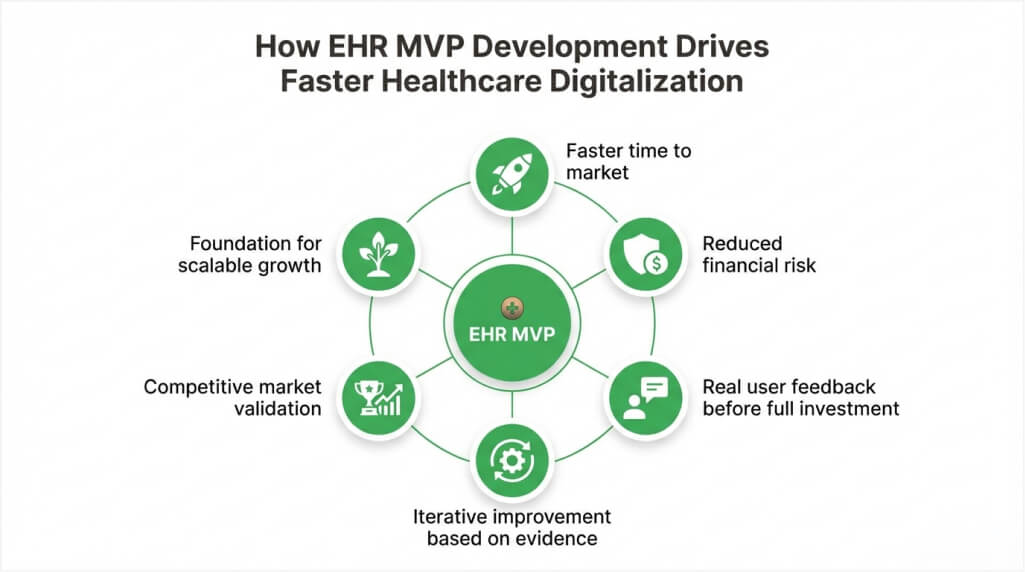
Building an EHR MVP provides significant advantages over traditional full-scale development approaches. Startups gain flexibility to adapt their product based on real market feedback.
1. Faster time to market
MVP development dramatically accelerates the launch timeline compared to building complete systems. Core features can reach users within months rather than years. Early market presence establishes competitive positioning before larger competitors respond.
Speed matters in healthcare technology markets. Regulatory changes create windows of opportunity that close quickly. Startups that launch faster capture early adopters who influence later market adoption.
Faster launches also generate revenue sooner. Cash flow from early customers extends the runway for additional development. Self-funding growth becomes possible rather than relying entirely on investment capital.
2. Reduced financial risk
MVP development requires significantly less initial investment than comprehensive EHR systems. Startups preserve capital for iteration and growth rather than exhausting resources before launch. Failed concepts consume less money when discovered early through MVP testing.
Limited budgets stretch further with a focused development scope. Every feature adds cost, so fewer features mean lower initial investment. Resources saved on unnecessary features are redirected to marketing and customer acquisition.
Investors prefer startups that demonstrate market validation before requesting larger funding rounds. An MVP with paying customers proves demand exists. This validation improves fundraising outcomes and reduces dilution for founders.
3. Real user feedback before full investment
MVP users provide invaluable insights about actual needs versus assumed requirements. Clinical workflows reveal problems that research and interviews cannot anticipate. Real usage data guides development priorities more reliably than speculation.
Feedback loops shorten dramatically with working software in users’ hands. Features that seemed essential turn out to be unnecessary, while overlooked capabilities emerge as critical. This learning prevents expensive development of unwanted functionality.
Early users often become product champions when their feedback shapes development. These relationships create referral networks and case studies for marketing. Engaged users provide testimonials that attract additional customers.
4. Iterative improvement based on evidence
MVP methodology enables continuous product refinement based on measured outcomes. Each iteration addresses verified user needs rather than hypothetical requirements. Products evolve toward market fit through systematic experimentation.
Data from MVP usage reveals which features create retention and satisfaction. Engagement metrics identify areas requiring improvement. Conversion analytics show where users encounter friction in their workflows.
Iterative development reduces the risk of building products nobody wants. Small bets with rapid feedback prevent catastrophic failures. Course corrections happen early when changes remain affordable.
5. Competitive market validation
MVP launches a test to determine whether there is sufficient market demand for the proposed solution. Real purchasing decisions validate willingness to pay. Competitor responses reveal market dynamics invisible from the outside.
Market validation strengthens investor presentations with concrete evidence. User counts, retention rates, and revenue growth demonstrate traction. Validated markets attract funding more readily than untested concepts.
Early market presence also establishes brand recognition with potential customers. Awareness builds even among organizations not ready to purchase immediately. When making buying decisions, familiar brands are considered first.
6. Foundation for scalable growth
Well-architected MVPs provide technical foundations for future expansion. Clean code structures accommodate additional features without complete rebuilds. Modular designs allow capability additions without disrupting existing functionality.
MVP development forces architectural decisions that support long-term growth. Database structures must handle increasing data volumes. Authentication systems must scale to larger user populations.
Starting with a scalable architecture prevents costly rebuilds later. Technical debt accumulated in rushed development compounds over time. MVPs built properly from the beginning support sustainable growth trajectories.
Need Help Building an EHR MVP?
Work with experienced healthcare developers who understand MVP methodology and compliance requirements. Build what matters first, then grow based on real user feedback.

Essential EHR MVP Features for Rapid Validation and Growth
Selecting the right features determines whether an MVP succeeds or fails when you build an EHR software solution. Including too many features delays launch and increases cost. Including too few creates a product that fails to solve real problems.
1. User authentication and access control
Secure user authentication protects sensitive healthcare data from unauthorized access. This foundational capability enables all other system functionality. Without proper authentication, no healthcare software can achieve regulatory compliance.
Essential capabilities:
- Secure login with strong password requirements.
- Role-based access control for different user types.
- Session management with automatic timeout.
- Multi-factor authentication options.
- Password reset and recovery workflows.
- Audit logging of all authentication events.
- HIPAA-compliant access documentation.
Authentication systems must meet healthcare security standards from day one. Retrofitting security into existing systems proves difficult and expensive. Building compliance into the foundation prevents costly remediation later.
2. Patient registration and demographics
Patient registration creates the foundation for all clinical documentation and scheduling. Basic demographic capture enables patient identification and communication. This module stores the information that other features constantly reference.
Essential capabilities:
- Patient demographic data capture and storage.
- Unique patient identifier generation.
- Contact information management.
- Insurance information recording.
- Emergency contact designation.
- Patient search and lookup functionality.
- Duplicate patient detection and merging.
Keep registration focused on truly necessary information initially. Additional demographic fields can be added based on user feedback. Over-collecting information slows registration workflows and frustrates users.
3. Clinical documentation
Clinical documentation allows providers to record patient encounters and medical information. This core EHR functionality captures the clinical narrative at the heart of healthcare delivery. Documentation quality directly impacts care continuity and reimbursement.
Essential capabilities:
- Progress note creation and editing.
- Problem list management.
- Medication list recording.
- Allergy documentation with severity levels.
- Vital signs capture and trending.
- Template-based documentation options.
- Note signing and authentication.
Start with flexible documentation that accommodates various workflows. Specialty-specific templates can be added after understanding user preferences. Rigid documentation structures frustrate providers accustomed to different approaches.
4. Appointment scheduling
Scheduling functionality coordinates patient visits with provider availability. This operational capability directly impacts practice efficiency and patient satisfaction. Effective scheduling reduces no-shows and optimizes resource utilization.
Essential capabilities:
- Provider schedule management.
- Appointment booking and modification.
- Patient appointment reminders.
- Schedule conflict detection.
- Appointment type configuration.
- Calendar view displays.
- Basic reporting on scheduling metrics.
Scheduling complexity varies significantly across practice types. Start with straightforward single-provider scheduling before tackling multi-resource coordination. Complex scheduling logic adds development time without proportional value for many MVPs.
5. Basic reporting and analytics
Reporting capabilities transform stored data into actionable insights. Even minimal analytics help practices better understand their operations. Reports demonstrate value and justify continued investment in the system.
Essential capabilities:
- Patient volume reporting.
- Appointment utilization metrics.
- Basic financial summaries.
- User activity logs.
- Data export functionality.
- Simple dashboard displays.
- Customizable date range filtering.
Reporting requirements vary dramatically across organizations. Building flexible export capabilities allows users to perform custom analysis externally. Advanced analytics can be added later based on demonstrated demand.
6. Data security and compliance
Healthcare software must protect patient information in accordance with regulatory requirements. HIPAA compliance is mandatory for any system handling protected health information. Security measures must be comprehensive despite MVP scope limitations.
Essential capabilities:
- Data encryption at rest and in transit.
- Access audit trail logging.
- Backup and recovery procedures.
- Business associate agreement support.
- Security incident detection basics.
- Privacy policy implementation.
- Consent management fundamentals.
Security cannot be treated as a feature to add later. Regulatory violations carry severe penalties regardless of company size. Integrate compliance into the MVP from the outset.
7. Simple integration capabilities
Integration functionality connects the EHR with other healthcare systems and services. Even basic integration enables data exchange, improving clinical workflows. API foundations support future connectivity expansion.
Essential capabilities:
- RESTful API architecture.
- Basic HL7 or FHIR message support.
- Lab result import capabilities.
- Document attachment handling.
- External system authentication.
- Error handling and logging.
- API documentation for partners.
Focus initial integration development on specific, high-value connections. Universal interoperability requires massive development investment. Targeted integrations with common partners deliver value faster.
End-to-End EHR MVP Development Process: From Concept to Deployment
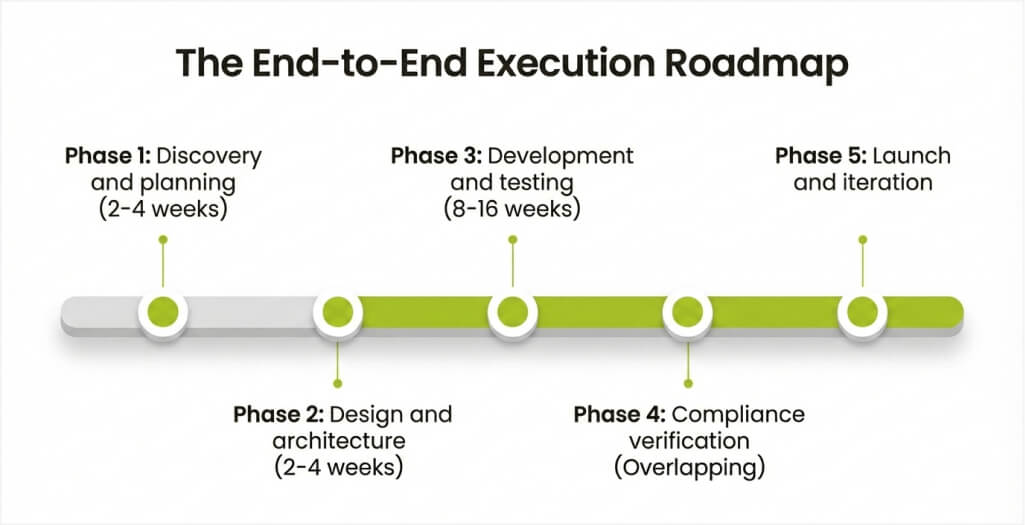
Building healthcare MVPs follows structured processes that balance speed with compliance requirements. Understanding each phase helps set realistic expectations for your project.
Phase 1: Discovery and planning
Timeline: 2 to 4 weeks
Discovery establishes the foundation for effective MVP development. This phase clarifies target users, core problems, and essential features. Rushing discovery leads to building the wrong product efficiently.
Key activities:
- User research: Interviews with target users reveal actual pain points and workflow requirements. Observation of current processes identifies opportunities for improvement. User personas guide feature prioritization decisions.
- Problem validation: Confirming that the identified problem affects enough potential customers justifies development investment. Competitive analysis reveals market gaps and positioning opportunities.
- Feature prioritization: Collaboratively ranking potential features separates must-haves from nice-to-haves. User story mapping visualizes the minimum feature set for launch.
- Compliance planning: Identifying applicable regulations shapes architecture and security requirements. Early compliance planning prevents costly redesigns during development.
Discovery delivers clear product requirements and development roadmaps. Skipping this phase results in costly rework when assumptions prove incorrect.
Phase 2: Design and architecture
Timeline: 2 to 4 weeks
Design translates requirements into visual interfaces and technical specifications. This phase defines how users will interact with the system. Architecture decisions establish foundations that persist throughout the product lifecycle.
Key activities:
- User experience design: Wireframes and prototypes visualize user workflows before coding begins. User testing validates designs with feedback from the target audience.
- Technical architecture: System structure decisions balance current MVP needs with future scalability. Technology stack selection considers team capabilities and long-term maintenance.
- Database design: Data model planning ensures information structures support both current features and planned extensions.
- Security architecture: Authentication, encryption, and access control designs ensure compliance from the foundation.
Design deliverables provide clear specifications for the development team. Stakeholder approval prevents costly mid-development direction changes.
Phase 3: Development and testing
Timeline: 8 to 16 weeks
Development transforms designs into working software. Agile methodologies deliver functionality incrementally for continuous feedback. Testing ensures quality and compliance throughout the build process.
Key activities:
- Sprint-based development: Two-week iterations deliver testable features regularly. Product owners review progress and adjust priorities based on emerging insights.
- Continuous testing: Automated tests validate code quality with every change. Manual testing catches issues that automation cannot detect.
- Security testing: Vulnerability scanning and code analysis identify security weaknesses early. Penetration testing validates defenses before launch.
- User acceptance testing: Real users validate system behavior against their workflow expectations. Feedback drives refinements before public release.
Development follows the prioritized roadmap while maintaining flexibility for scope adjustments. Regular demonstrations keep stakeholders informed and engaged.
Phase 4: Compliance verification
Timeline: 2 to 4 weeks, overlapping with development
Healthcare software requires explicit compliance verification before launch. This phase documents security measures and validates regulatory adherence.
Key activities:
- HIPAA assessment: A systematic review ensures that all required safeguards are implemented. Gap identification drives remediation before launch.
- Security documentation: Policies, procedures, and technical controls are documented for audit readiness. Business associate agreements are prepared for customer relationships.
- Risk analysis: Formal risk assessment identifies and addresses potential vulnerabilities. Mitigation measures are documented and implemented.
- Compliance testing: Explicit verification that all regulatory requirements are met. Evidence collection supports future audit responses.
Compliance verification cannot be rushed or skipped. Regulatory violations expose startups to severe penalties and reputation damage.
Phase 5: Launch and iteration
Timeline: 2 to 4 weeks for initial launch, ongoing iteration
Launch transitions the MVP from development to production use. Careful planning minimizes risk while enabling rapid learning from real users.
Key activities:
- Soft launch: Limited release to early adopters enables controlled feedback collection. Issues surface with smaller user populations before broader release.
- User onboarding: Training and support resources help initial users succeed. Early success stories build momentum for broader adoption.
- Feedback collection: Systematic gathering of user insights guides post-launch priorities. Analytics reveal usage patterns and pain points.
- Iteration planning: User feedback and metrics inform the next development cycle. Continuous improvement begins immediately after launch.
MVP launch marks the beginning of market learning, not the end of development. Successful products—especially those built with experienced EHR development agencies—evolve continuously based on real user feedback and changing healthcare needs.
Turn Your EHR Vision Into a Working MVP With Our Experts
With extensive experience delivering healthcare software solutions, our team helps startups build compliant and scalable EHR platforms.
EHR MVP Development Cost Breakdown
Understanding cost components helps startups budget accurately for MVP investments. Development costs vary based on complexity, features, and development approach.
Cost by MVP complexity
| MVP Type | Cost Range | Timeline |
|---|---|---|
| Basic MVP | $50,000 – $100,000 | 3-4 months |
| Standard MVP | $100,000 – $200,000 | 4-6 months |
| Advanced MVP | $200,000 – $350,000 | 6-9 months |
| Complex MVP | $350,000 – $500,000 | 9-12 months |
Cost breakdown by development phase
| Phase | Percentage of Total Cost |
|---|---|
| Discovery and Planning | 10-15% |
| Design and Architecture | 15-20% |
| Development | 45-55% |
| Testing and QA | 10-15% |
| Compliance and Launch | 5-10% |
Factors that increase MVP costs
Several variables push costs toward higher ranges in EHR MVP projects.
- Feature scope: Each additional feature increases development time proportionally. Careful prioritization keeps MVP scope and costs manageable.
- Integration requirements: External system connections add significant development complexity. Each integration requires understanding partner APIs and handling errors gracefully.
- Compliance stringency: Stricter compliance requirements increase documentation and testing overhead. Specialized compliance expertise adds to team costs.
- Design complexity: Custom interfaces require more effort than template-based approaches. Complex workflows multiply testing requirements.
- Technology choices: Newer technologies may require specialized developers commanding premium rates. Proven technology stacks often reduce costs through developer availability.
Ongoing cost considerations
MVP launch represents the beginning of ongoing expenses, not a one-time investment.
- Hosting and infrastructure: Cloud services typically cost $500 to $2,000 monthly for MVP-scale applications. Costs increase with user volume and data storage.
- Maintenance and support: Budget 15% to 20% of the initial development cost annually. Bug fixes, security patches, and minor improvements require ongoing attention.
- Compliance maintenance: Annual security assessments and compliance updates require $10,000 to $25,000 annually. Regulatory changes may require system modifications.
- Feature development: Plan $50,000 to $150,000 annually for post-MVP feature additions. User feedback drives continuous product improvement.
Find Out Exactly What Your EHR Will Cost
Answer a few questions about your clinical features, compliance scope, and integration needs below. Our EHR team will price your project free.
Risk Factors and Challenges in EHR MVP Development & How to Overcome
Healthcare MVP development presents unique obstacles that require proactive management, especially when planning how to hire EHR software developers. Anticipating these challenges enables effective mitigation strategies.
Challenge 1: Balancing speed with compliance
Healthcare regulations cannot be bypassed regardless of launch urgency. HIPAA violations carry penalties that can financially destroy startups. Founders face tension between competitive pressure and compliance requirements.
How to overcome this challenge
- Build compliance into architecture from day one rather than retrofitting later.
- Engage compliance expertise early to efficiently identify requirements.
- Use compliance-focused development frameworks that accelerate compliant coding.
- Prioritize security features alongside functional features in sprint planning.
- Document compliance measures throughout development for audit readiness.
Challenge 2: Feature prioritization paralysis
Founders struggle to determine which features are truly essential and which are merely desirable. Clinical advisors often request functionality beyond the MVP scope. Fear of launching incomplete products indefinitely delays market entry.
How to overcome this challenge
- Define clear MVP criteria before development begins.
- Use user research to validate the importance of features with target customers.
- Implement strict prioritization frameworks that force difficult decisions.
- Accept that MVP means missing some features users will request.
- Plan post-launch feature additions to address user-identified gaps.
Challenge 3: Healthcare domain complexity
Software developers unfamiliar with healthcare face steep learning curves. Clinical workflows involve nuances that outsiders cannot anticipate. Miscommunication between clinical and technical team members creates feature gaps.
How to overcome this challenge
- Include healthcare domain experts throughout the development process.
- Use clinical advisors to review designs and test completed features.
- Create detailed workflow documentation that developers can reference.
- Build in extra time for healthcare-specific learning and iteration.
- Partner with development teams experienced in healthcare software.
Challenge 4: Integration complexity
Healthcare systems use various data formats and communication protocols. Legacy systems in target markets may lack modern API capabilities. Integration challenges extend timelines and increase EHR development costs.
How to overcome this challenge
- Limit initial integrations to the highest-value connections only.
- Research integration requirements for target customer environments early.
- Build a flexible integration architecture that accommodates different systems.
- Use healthcare interoperability standards where partners support them.
- Plan integration development as separate workstreams from core features.
Challenge 5: User adoption uncertainty
Healthcare providers resist workflow changes that increase documentation burden. New systems face skepticism from users burned by previous technology implementations. Adoption failure wastes development investment regardless of technical quality.
How to overcome this challenge
- Involve target users throughout the design and development process.
- Minimize clicks and data entry required for common tasks.
- Provide excellent onboarding and training resources.
- Address user feedback rapidly to demonstrate responsiveness.
- Identify and cultivate early adopter champions who influence peers.
Challenge 6: Funding and runway constraints
Limited capital creates pressure to launch the product before it’s ready. Development delays consume runway faster than anticipated. Founders face difficult tradeoffs between feature completeness and cash preservation.
How to overcome this challenge
- Create realistic budgets with contingency reserves from the start of the project.
- Monitor spending closely and adjust the scope proactively when needed.
- Consider phased development that delivers value incrementally.
- Explore revenue opportunities from early adopters during development.
- Maintain investor relationships for potential bridge funding if needed.
Let Expert Developers Handle Your EHR MVP Challenges
Partner with experienced healthcare development teams to build compliant and scalable EHR solutions backed by proven methodologies.
Best Practices for Successful EHR MVP Development
Following proven practices dramatically increases the likelihood of MVP success. To implement these practices effectively, healthcare startups should hire expert EHR software developers who bring specialized knowledge and experience. These guidelines represent accumulated wisdom from healthcare startups that have launched successfully.
1. Start with a focused problem
Successful MVPs solve specific problems exceptionally well rather than addressing everything poorly. A narrow focus enables a deep understanding of user needs and competitive differentiation. Trying to serve everyone typically means serving no one effectively.
Identify the single most important problem your target users face. Validate that this problem creates sufficient pain to justify purchasing a solution. Build your MVP to solve this problem better than any available alternative.
Resist the temptation to expand the scope based on adjacent opportunities. Stay focused until your core problem solution achieves market fit. Expansion can happen after establishing a strong foundation with initial users.
2. Validate assumptions continuously
MVP development assumes certain things about users, markets, and technology. Testing these assumptions early prevents costly mistakes driven by incorrect beliefs. Every assumption represents a risk that can be reduced through validation.
Document key assumptions explicitly at project start. Design experiments that test critical assumptions before major investments. Adjust direction based on validation results rather than proceeding on hope.
User interviews, prototype testing, and small-scale pilots all efficiently validate assumptions. Invest in validation activities proportionate to the risk each assumption represents. High-risk assumptions warrant more rigorous testing.
3. Build for compliance from the start
Healthcare compliance cannot be added after the fact. Security architecture, audit logging, and access controls must be foundational in EHR development for small practices. Retrofitting compliance into existing systems proves expensive and often incomplete.
Engage compliance expertise during initial planning phases. Include compliance requirements alongside functional requirements in the technical specifications. Test compliance measures throughout development, not just before launch.
Document compliance measures as you build them. Audit preparation becomes straightforward when documentation happens continuously. Waiting until audits arrive to compile evidence creates unnecessary stress and risk.
4. Prioritize user experience ruthlessly
Healthcare providers have limited patience for difficult software. Systems that slow clinical workflows face abandonment regardless of feature richness. User experience quality directly impacts adoption rates and retention.
Study how target users currently work before designing new workflows. Minimize friction in common tasks through thoughtful interface design. Test designs with real users and iterate based on their feedback.
Every click and form field should justify its existence. Remove anything that does not directly serve user goals. Simplicity in MVP design leaves room for complexity later based on validated needs.
5. Plan for iteration from day one
MVP launch begins a learning process, not an endpoint of development. Systems must accommodate changes based on user feedback and market learning. Rigid architectures prevent the evolution that market success requires.
Build modular systems that allow component replacement without requiring a complete rebuild. Establish feedback collection mechanisms before launch. Create processes for evaluating and prioritizing user requests.
Budget time and money for post-launch iteration. Teams that disband after launch cannot effectively respond to user feedback. Continuous improvement requires continuous investment.
6. Choose development partners carefully
The selection of a development partner significantly impacts MVP outcomes. Healthcare expertise, compliance knowledge, and communication quality vary dramatically. Wrong choices create delays, cost overruns, and quality problems.
Evaluate potential partners based solely on their healthcare experience. Request references from similar projects and contact them directly. Carefully assess communication quality during initial discussions.
Consider cultural fit alongside technical capabilities. Long-term partnerships require working relationships that function smoothly. Technical excellence means little if teams cannot collaborate effectively.
7. Maintain realistic expectations
MVP development involves uncertainty that no amount of planning can eliminate. Timelines extend, costs increase, and unexpected challenges emerge. Realistic expectations prevent frustration and poor decisions.
Build contingency into budgets and timelines from the start of the project. Communicate uncertainty to stakeholders honestly throughout development. Celebrate progress while acknowledging remaining work.
Success rarely follows straight lines. Pivots based on learning represent progress, not failure. Persistence through challenges separates successful startups from abandoned concepts.
Partner with Space-O Technologies for Scalable, Secure, and Compliant EHR MVP Development
EHR MVP development is a strategic way to validate your product idea while minimizing risk and development cost. By focusing on core features, regulatory readiness, and real clinical workflows, an EHR MVP helps healthcare organizations and startups test assumptions, improve usability, and plan scalable growth.
Choosing the right development partner plays a critical role in the success of an EHR MVP. Partnering with Space-O Technologies enables healthcare startups to build EHR MVPs that balance speed with compliance requirements.
Our experienced development teams understand the unique challenges of healthcare software, including the need for seamless EHR integration services across complex systems. We help founders efficiently translate clinical insights into reliable, real-world products.
We go beyond coding to provide strategic guidance on feature prioritization and market positioning. Our healthcare domain expertise prevents common mistakes that delay launches and increase costs. This partnership approach maximizes the value of limited startup resources.
Our proven methodologies accelerate compliant EHR development without compromising quality. Transparent communication keeps founders informed throughout the development process. We treat your success as our success.
Connect with our technical consultants to discuss your EHR MVP requirements. We provide project assessments, realistic cost estimates, and customized development roadmaps. Let us help turn your healthcare software vision into a market-ready reality.
FAQs on EHR MVP Development
1. What is EHR MVP development?
EHR MVP development is the process of building a minimum viable electronic health records product with only essential features. This approach focuses on core functionality that enables startups to quickly validate their concepts with real users. Development prioritizes speed to market while maintaining necessary compliance standards. MVPs provide foundations for iteration based on actual user feedback.
2. How much does EHR MVP development cost?
EHR MVP development costs range from $50,000 for basic systems to $500,000 for complex implementations. Basic MVPs with core clinical documentation and scheduling cost $50,000 to $100,000. Standard MVPs with additional features cost $100,000 to $200,000. Advanced MVPs with integrations and complex workflows cost $200,000 to $350,000. Costs vary based on feature scope, compliance requirements, and development approach.
3. How long does EHR MVP development take?
EHR MVP development typically takes 3 to 12 months, depending on scope and complexity. Basic MVPs can launch within 3 to 4 months with focused feature sets. Standard implementations require 4 to 6 months for additional capabilities. Complex MVPs with integrations and advanced features may require 6 to 12 months. Timeline compression often increases costs by requiring a larger team.
4. What features are essential in an EHR MVP?
Essential EHR MVP features include user authentication, patient registration, basic clinical documentation, appointment scheduling, and security compliance. These capabilities enable core healthcare workflows while meeting regulatory requirements. Additional features like reporting, integrations, and advanced documentation can be added post-launch. Feature selection should focus on solving specific problems for target users.
5. Can an EHR MVP be HIPAA compliant?
Yes, EHR MVPs can achieve HIPAA compliance with proper architecture and development practices. Security measures, including encryption, access controls, and audit logging, must be built from the foundation. Compliance documentation and risk analysis are required regardless of product scope. Starting with compliance ensures MVPs can legally handle protected health information.
6. Should I build a custom EHR MVP or use existing platforms?
The decision depends on your differentiation strategy and available resources. Custom development suits startups with unique workflow requirements or novel approaches that existing platforms cannot accommodate. Platform-based approaches work when standard functionality meets needs, and faster launch matters most. Custom MVPs offer greater control but require a greater investment.
7. How do I prioritize features for my EHR MVP?
Prioritize features based on user research and problem validation, not assumptions. Identify the core problem your MVP solves and include only features essential to that solution. Use frameworks like MoSCoW to categorize features into must-have, should-have, and could-have groups. Defer nice-to-have features to post-launch iterations based on user feedback.
8. What are the risks of EHR MVP development?
Key risks include compliance violations, user adoption failure, and budget overruns. Compliance risks require expert guidance and thorough testing before launch. Adoption risks are reduced through user involvement in design and an excellent user experience. Budget risks are mitigated through realistic planning and scope discipline. Experienced development partners help navigate all these risks effectively.
9. How do I find the right development partner for my EHR MVP?
Evaluate potential partners based solely on their healthcare software experience. Request references from similar projects and carefully assess their compliance knowledge. Consider communication quality and cultural fit alongside technical capabilities. Look for partners who ask thoughtful questions about your users and market rather than just accepting requirements.
10. What happens after my EHR MVP launches?
After launch, focus shifts to learning from real user behavior and feedback. Collect user insights systematically and prioritize feature additions based on demonstrated needs. Plan an ongoing development budget for continuous improvement. Monitor key metrics including adoption rates, user satisfaction, and retention. Successful MVPs evolve continuously toward product-market fit.



 All our projects are secured by NDA




 4.8
4.8