
 By
By 
Contents
The rapid adoption of digital health technologies has made electronic health record systems a core component of modern healthcare delivery. According to a Fortune Business Insights report, the global EHR market was valued at USD 29.68 billion in 2023 and is projected to reach USD 46.63 billion by 2032. This growth reflects how strongly healthcare providers, hospitals, and healthtech companies are investing in EHR systems to improve clinical efficiency, data accuracy, and patient outcomes.
As demand increases, many organizations are moving beyond off-the-shelf EHR platforms and exploring custom EHR system development. Building an EHR system from scratch allows healthcare organizations to align the software with their workflows, compliance requirements, and long-term scalability goals. However, EHR development is complex and involves careful planning around security, interoperability, usability, and regulatory standards.
This guide explains how to build an EHR system step by step. Drawing from 15+ years of experience as a leading EHR software development company, we have shared insights on what EHR system development involves, the benefits of building a custom EHR, essential features to include, the development process, cost factors, and common challenges healthcare organizations should prepare for before starting development.
What is EHR System Development?
EHR system development is the process of creating software that captures, stores, and manages patient health information electronically. This software replaces paper medical records with digital systems that healthcare providers can access securely. The development encompasses everything from database design to clinical user interfaces.
Unlike basic record-keeping applications, EHR systems require specialized healthcare functionality. They must support clinical documentation, medication management, lab result tracking, and care coordination. Integration with external healthcare systems through standardized protocols is essential.
EHR development also demands strict attention to regulatory compliance from the outset. HIPAA regulations govern how patient data must be protected throughout the system. Additional certifications may apply depending on the intended market and use cases.
The following section examines why organizations choose custom EHR development over commercial alternatives.
Benefits of Building a Custom EHR System
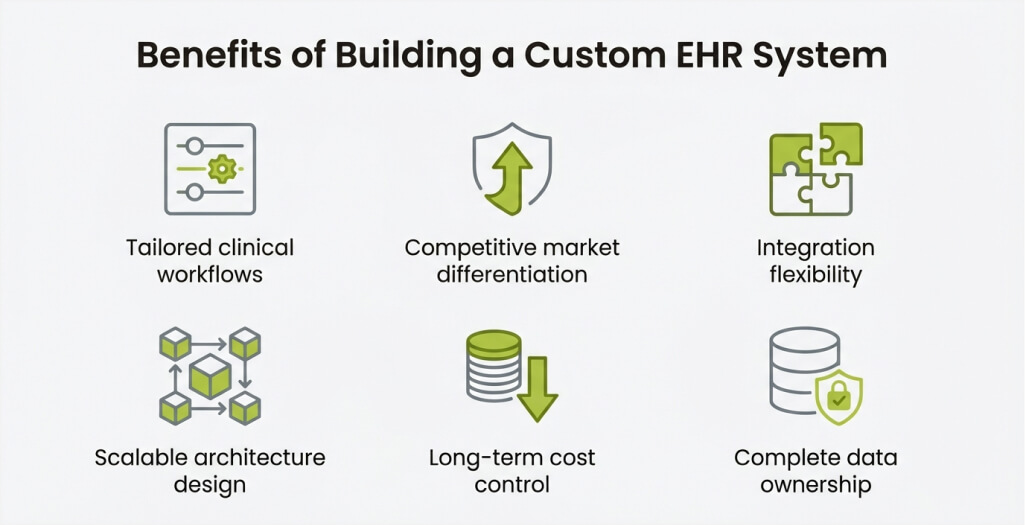
Developing a custom EHR system provides advantages that off-the-shelf solutions cannot deliver. Organizations gain complete control over functionality while eliminating ongoing licensing expenses.
1. Tailored clinical workflows
Custom EHR systems match exactly how your clinicians practice medicine. Commercial products force practices to adapt their workflows to the software. Custom development reverses this dynamic entirely.
Every specialty has unique documentation requirements and care patterns. Dermatologists need different interfaces than cardiologists or pediatricians. Custom systems accommodate these differences without awkward workarounds.
Staff adoption improves when software matches their mental models. Training requirements decrease because interfaces feel intuitive. Clinical efficiency gains compound over time as staff master their tools.
2. Competitive market differentiation
Custom EHR systems enable healthcare technology companies to offer unique capabilities. Features unavailable in commercial products attract customers seeking specific solutions. This differentiation justifies premium pricing and builds market position.
Startups can target underserved niches with specialized functionality. Established vendors overlook smaller specialty markets with unique needs. Custom development addresses these gaps profitably.
Proprietary features create barriers to competition. Rivals cannot easily replicate your innovations. Intellectual property accumulates value as the product matures.
3. Integration flexibility
Custom development enables seamless connections with any external system. Commercial products limit integrations to their preferred partners. Custom systems integrate with whatever your organization requires.
Healthcare organizations use diverse software ecosystems. Laboratory systems, imaging archives, billing platforms, and pharmacy networks must exchange data. Custom development accommodates all integration requirements.
Modern healthcare delivery depends on interoperability. Patient data must flow smoothly between care settings. Custom EHR systems implement standards without vendor limitations.
4. Scalable architecture design
Custom EHR systems grow with your organization without artificial constraints. Commercial licenses often limit users, locations, or transaction volumes. Custom systems scale based on infrastructure, not licensing terms.
Architecture decisions made during development anticipate future growth. Database designs handle increasing data volumes efficiently. Application structures support new features without major rewrites.
Multi-location healthcare organizations benefit particularly from scalable custom systems. Central management combines with location-specific customizations. Acquisitions integrate more smoothly without the need for license negotiations.
5. Long-term cost control
While initial development requires substantial investment, custom systems eliminate recurring license fees. Commercial EHR products charge per-user fees that increase annually. Large organizations pay millions of dollars each year for software they never own.
Ownership eliminates vendor lock-in concerns that complicate technology decisions. Your organization controls the enhancement roadmap. No surprise price increases appear at contract renewal time.
Total cost of ownership often favors custom development for large implementations. The crossover point depends on user count and implementation complexity. Organizations should model both scenarios before deciding.
6. Complete data ownership
Custom EHR systems keep patient data under your complete control. Commercial vendors hold data in their systems on their terms. Switching vendors becomes difficult when data extraction proves complicated.
Data ownership enables advanced analytics initiatives without vendor approval. Machine learning projects access all historical data freely. Research collaborations proceed without licensing negotiations.
Regulatory compliance becomes simpler when you control the data environment. Audit responses happen quickly without vendor coordination. Data retention policies are implemented exactly as your organization requires.
Ultimately, the benefits of building a custom EHR system extend far beyond functionality—they create a strategic advantage through flexibility, control, and long-term scalability. Many healthcare organizations look to the top EHR development companies to translate these advantages into high-performing, future-ready platforms. By choosing the right partner and approach, you can build a solution that not only meets today’s needs but also evolves with your organization’s growth.
Planning to Build a Custom EHR Software?
Space-O Technologies specializes in custom EHR system development for healthcare providers, startups, and enterprises.

Core Features and Modules of an EHR System
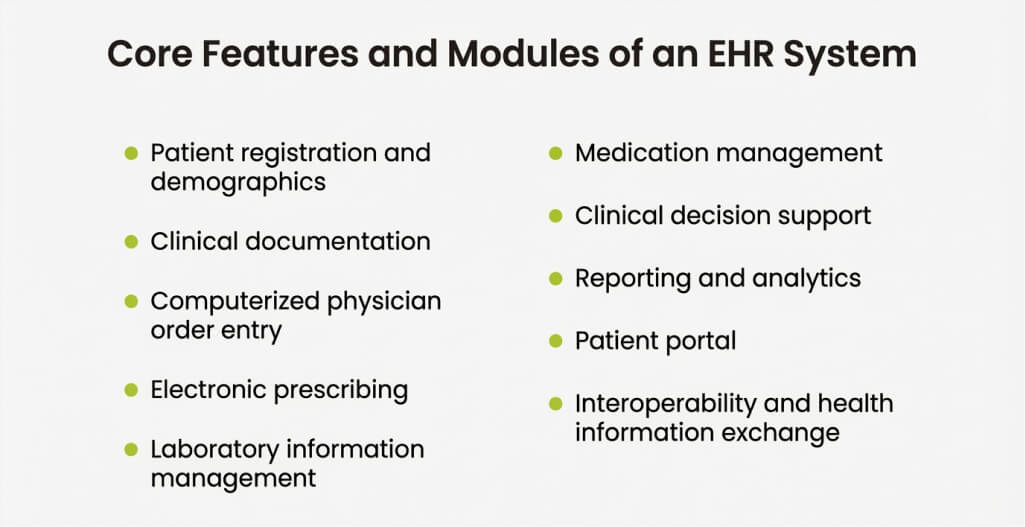
Successful EHR systems combine foundational capabilities with specialty-specific functionality. Understanding these components helps prioritize development investments across project phases.
1. Patient registration and demographics
Patient registration captures essential identifying information for all subsequent clinical activities and is a critical component of EHR development for mental health providers. This module maintains demographic data, contact information, and insurance details. Registration accuracy affects billing, care coordination, and reporting.
Essential capabilities:
- Patient search with multiple identifier options.
- Demographic data capture with validation rules.
- Insurance eligibility verification integration.
- Patient portal account provisioning.
- Duplicate patient detection and merging.
- Photo capture for visual identification.
- Emergency contact and proxy designation.
Accurate registration prevents downstream errors in billing and care delivery. Automated verification significantly reduces manual data entry errors.
2. Clinical documentation
Clinical documentation captures the patient encounter in structured and narrative formats. This module supports various note types across specialties and care settings. Documentation quality directly affects care continuity and reimbursement.
Essential capabilities:
- Customizable templates by specialty and visit type.
- Voice-to-text dictation with clinical vocabulary.
- Structured data capture for discrete elements.
- Copy-forward functionality with safeguards.
- Real-time clinical decision support alerts.
- Signature capture and note authentication.
- Addendum and amendment tracking.
Clinical documentation requires balancing thoroughness with efficiency. Templates accelerate documentation while maintaining quality and completeness.
3. Computerized physician order entry
Computerized physician order entry (CPOE) enables clinicians to enter orders electronically. This module handles medications, laboratory tests, imaging studies, and referrals. Electronic ordering reduces errors while improving turnaround times.
Essential capabilities:
- Drug-drug and drug-allergy interaction checking.
- Formulary integration with therapeutic alternatives.
- Dose calculation based on patient parameters.
- Order sets for common clinical scenarios.
- Electronic prescribing to retail pharmacies.
- Controlled substance prescription monitoring.
- Order status tracking and result routing.
CPOE implementation requires careful attention to clinical workflow. Alert fatigue from excessive warnings undermines safety benefits.
4. Electronic prescribing
Electronic prescribing transmits medication orders directly to pharmacies. This module integrates with prescription monitoring programs and formulary databases. E-prescribing improves medication safety and patient convenience.
Essential capabilities:
- Surescripts network connectivity for pharmacy routing.
- Prescription monitoring program database queries.
- Medication history retrieval from pharmacy networks.
- Prior authorization initiation and tracking.
- Controlled substance electronic prescribing (EPCS).
- Refill request management and approval.
- Prescription benefit coverage checking.
Electronic prescribing requirements vary by jurisdiction. Controlled substance prescribing demands additional authentication measures.
5. Laboratory information management
Laboratory modules manage test ordering, result receiving, and clinical interpretation. This functionality integrates with external laboratory systems and point-of-care devices. Result management ensures a timely clinical response to abnormalities.
Essential capabilities:
- Order entry with specimen collection instructions.
- Interface engines for laboratory result delivery.
- Critical value alerting with acknowledgment tracking.
- Cumulative result views and trending displays.
- Discrete result storage for analytics.
- Preliminary and final result differentiation.
- Microbiology culture and sensitivity displays.
Laboratory integration complexity varies by testing partner. Interface development timelines require careful planning.
6. Medication management
Medication management tracks patient medications throughout their care journey. This module maintains active medication lists and documents administration events. Accurate medication records prevent dangerous interactions and omissions.
Essential capabilities:
- Active medication list maintenance and reconciliation.
- Medication administration record for inpatients.
- Barcode medication administration verification.
- Home medication documentation from patient reports.
- Allergy and adverse reaction documentation.
- Drug information reference integration.
- Medication therapy management support.
Medication reconciliation at care transitions prevents harmful discrepancies. Automated reconciliation tools reduce clinician burden.
7. Clinical decision support
Clinical decision support provides evidence-based guidance during clinical workflows. This module analyzes patient data to generate relevant alerts and recommendations. Effective decision support improves care quality without disrupting workflow.
Essential capabilities:
- Rule-based alerting for drug interactions and allergies.
- Preventive care reminders based on patient demographics.
- Diagnostic support with differential suggestions.
- Treatment protocol recommendations.
- Quality measure gap identification.
- Care pathway guidance for chronic conditions.
- Alert configuration and override tracking.
Decision support effectiveness depends on the relevance and timing of alerts. Overly aggressive alerting causes dangerous alert fatigue.
8. Reporting and analytics
Reporting capabilities transform clinical data into actionable information. This module supports operational, clinical, and regulatory reporting requirements. Analytics enable population health management and quality improvement.
Essential capabilities:
- Standard report libraries for common needs.
- Ad-hoc report builders for custom queries.
- Quality measure dashboards with drill-down.
- Population health registries and outreach.
- Regulatory submission report generation.
- Clinical outcome tracking and trending.
- Data export for external analytics platforms.
Reporting requirements should influence data capture design. Structured data enables analytics that narrative text cannot support.
9. Patient portal
Patient portals extend EHR functionality to patients and their caregivers. This module enables secure communication, appointment scheduling, and record access. Portal engagement improves patient satisfaction and adherence to care.
Essential capabilities:
- Secure messaging with clinical staff.
- Appointment scheduling and reminders.
- Prescription refill requests.
- Laboratory result viewing.
- Visit summary access.
- Online bill payment.
- Health education materials.
Patient portal adoption requires ongoing engagement efforts. Features alone do not guarantee patient utilization.
10. Interoperability and health information exchange
Interoperability enables data sharing with external healthcare organizations. This module implements healthcare data exchange standards. Information sharing improves care coordination across providers.
Essential capabilities:
- HL7 FHIR API implementation.
- Direct messaging for secure provider communication.
- Health information exchange network connections.
- Clinical document architecture (CDA) generation.
- External record query and retrieval.
- Referral and transition of care coordination.
- Public health reporting interfaces.
Interoperability requirements continue evolving through regulatory mandates. Development must anticipate future standards adoption.
EHR System Development Process: Steps to Build an EHR Platform
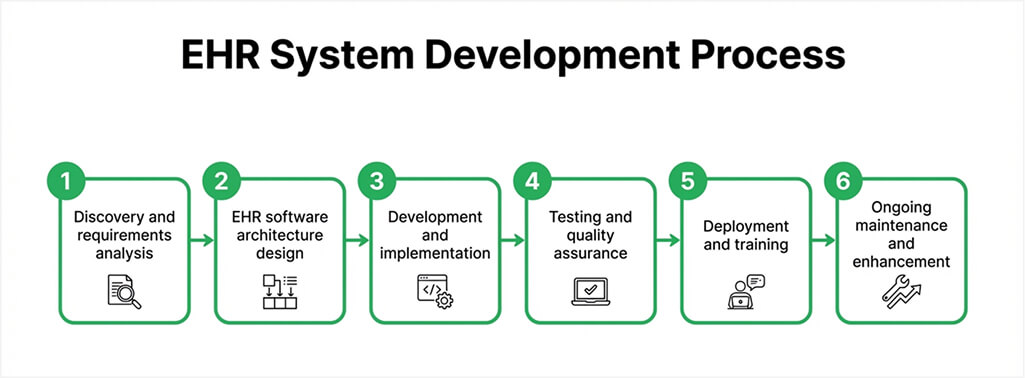
Building an EHR system follows a structured process balancing thorough planning with iterative delivery. Understanding each phase helps set realistic expectations for your development project.
Phase 1: Discovery and requirements analysis
Timeline: 6 to 10 weeks
Discovery establishes the foundation for successful EHR development. This phase documents clinical workflows, regulatory requirements, and technical constraints. Rushing discovery creates expensive problems throughout later phases.
- Stakeholder interviews: Conversations with clinicians, administrators, and patients reveal diverse requirements. Front-line staff identify daily pain points with existing systems. Leadership provides strategic direction and success criteria.
- Clinical workflow mapping: Detailed process documentation exposes inefficiencies and integration requirements. Visual workflow diagrams clarify handoffs between departments and systems. Edge cases and exceptions receive explicit attention.
- Regulatory assessment: Compliance requirements shape architecture and feature decisions. HIPAA requirements define baseline security and privacy controls. ONC certification requirements influence functionality and reporting.
- Technical evaluation: Assessment of existing systems identifies integration requirements and the scope of data migration. Infrastructure capabilities determine deployment options. Security posture informs protection strategies.
Discovery delivers comprehensive requirements documentation guiding all subsequent phases. Inadequate discovery causes scope changes that disrupt schedules and budgets.
Phase 2: EHR software architecture design
Timeline: 4 to 8 weeks
Architectural design translates requirements into technical blueprints. This phase defines database structures, application layers, and security frameworks. Decisions made here affect system capabilities for years.
- Database design: Schema design balances normalization with query performance. Clinical data models accommodate diverse documentation requirements. Audit logging structures support compliance reporting.
- Application architecture: Component designs define how system modules interact. API specifications enable future integrations and extensions. Microservices versus monolithic decisions affect scalability and maintenance.
- Security architecture: Authentication mechanisms, encryption standards, and access controls are detailed. Threat modeling identifies vulnerabilities requiring mitigation. Compliance requirements drive security decisions.
- User interface design: UX designers create wireframes and interactive prototypes. Clinical workflow optimization guides interface decisions. User testing validates designs before development begins.
Architecture deliverables include technical specifications, security documentation, and design mockups. Stakeholder approval prevents costly changes during development.
Phase 3: Development and implementation
Timeline: 16 to 52 weeks, depending on the scope
Development transforms architectural designs into working software. Agile methodologies deliver functionality incrementally for continuous feedback. Sprint-based delivery enables course correction before significant investment accumulates.
- Sprint-based development: Two-week iterations deliver testable functionality regularly. Product owners prioritize features based on clinical value. Demonstrations keep stakeholders informed throughout development.
- Integration development: Connections with external systems are implemented during relevant sprints. Laboratory, pharmacy, and health information exchange interfaces require careful testing. API documentation supports future integration needs.
- Continuous integration: Automated testing validates code quality with every change. Build pipelines ensure consistent deployment procedures. Issues surface immediately rather than accumulating.
- Documentation: Technical documentation develops alongside the software. User guides are prepared for training activities. Compliance documentation accumulates throughout development.
You can partner with an expert healthcare software development company like Space-O Technologies to get experienced developers to work on your EHR software. Development follows the prioritized roadmap while maintaining flexibility for discovered requirements. Regular demonstrations enable timely feedback and adjustment.
Phase 4: Testing and quality assurance
Timeline: 6 to 12 weeks overlapping with development
Comprehensive testing ensures the EHR system meets clinical requirements while maintaining security. Testing validates both individual components and complete clinical workflows. Quality cannot be tested into a product but must be built in.
- Functional testing: Test cases verify every feature against specifications. Clinical scenarios validate end-to-end workflows. Edge cases and error conditions receive explicit attention.
- Integration testing: Data flows correctly between EHR modules and external systems. Round-trip testing validates complete clinical processes. Interface error handling works as designed.
- Performance testing: Load testing confirms system capacity under expected usage patterns. Stress testing identifies breaking points before production. Response time benchmarks establish performance standards.
- Security testing: Vulnerability scanning identifies potential exploits. Penetration testing simulates attack scenarios. Compliance validation confirms regulatory requirements are met.
- User acceptance testing: Clinical users validate system behavior in realistic scenarios. Feedback drives final refinements before deployment. Acceptance criteria confirm readiness for production.
Testing shortcuts creates problems that compound after deployment. Adequate testing investment prevents expensive post-launch remediation.
Phase 5: Deployment and training
Timeline: 4 to 8 weeks
Deployment transitions the EHR system from development to production use. Careful planning minimizes clinical disruption while ensuring smooth adoption. Training prepares staff for new workflows before go-live.
- Data migration: Patient data transfers from legacy systems to the new EHR. Validation confirms the accuracy and completeness of migrated information. Historical data availability ensures care continuity.
- Training delivery: Role-based training prepares clinicians, administrators, and support staff. Hands-on practice builds confidence with new workflows. Training materials remain available for ongoing reference.
- Cutover execution: Detailed runbooks define every step of the production transition. Rollback procedures provide a safety net against unexpected issues. Communication plans keep stakeholders informed.
- Go-live support: Intensive support during the initial operation helps address issues quickly. Rapid response maintains clinical confidence in the new system. Feedback collection identifies improvement opportunities.
Phased rollouts reduce risk for large implementations. Pilot deployments validate readiness before broader release.
Phase 6: Ongoing maintenance and enhancement
Timeline: Continuous
Post-deployment support ensures system stability while enabling continuous improvement. EHR systems require ongoing attention to maintain clinical value. Enhancement development responds to emerging requirements.
- Issue resolution: Production problems receive prompt attention based on severity. Critical clinical issues demand immediate response. Bug tracking ensures complete resolution.
- Performance monitoring: System health metrics identify capacity needs and performance trends. Proactive intervention prevents user-facing degradation. Optimization maintains responsiveness as usage grows.
- Regulatory updates: Certification requirements and healthcare regulations evolve continuously. Planned updates maintain compliance as rules change. Proactive monitoring identifies upcoming requirements.
- Feature enhancement: New capability requests are added to the development backlog for prioritization. Continuous improvement maintains clinical relevance. User feedback shapes enhancement direction.
Budget for ongoing support from project inception. Systems without maintenance investment degrade and eventually require replacement.
Work with an Experienced EHR Development Partner
From planning to deployment, our team builds scalable and secure EHR systems aligned with healthcare regulations.
How Much Does EHR Development Cost?
Understanding the cost of EHR development helps organizations budget accurately for EHR development. Costs vary based on complexity, features, and compliance requirements.
Cost by implementation scope
| EHR System Type | Cost Range | Timeline |
| Basic EHR (Single Specialty) | $150,000 – $350,000 | 4-7 months |
| Standard EHR (Multi-specialty) | $350,000 – $700,000 | 7-12 months |
| Advanced EHR (Full-featured) | $700,000 – $1,500,000 | 12-18 months |
| Enterprise EHR (Health System) | $1,500,000 – $4,000,000+ | 18-30 months |
Cost breakdown by development phase
| Phase | Percentage of Total Cost |
| Discovery and Requirements | 8-12% |
| Architecture and Design | 12-18% |
| Development | 45-55% |
| Testing and QA | 12-18% |
| Deployment and Training | 5-10% |
Factors that impact EHR development costs
Several variables push costs toward higher ranges in EHR development projects.
- Regulatory certification: ONC Health IT certification adds significant testing and documentation requirements. Certification costs range from $100,000 to $300,000, including testing fees. The timeline for certification completion extends substantially.
- Integration complexity: Each external system integration adds $20,000 to $80,000, depending on interface availability. Legacy systems without modern APIs require custom middleware development. Health information exchange connections demand additional compliance measures.
- Specialty-specific features: Unique specialty requirements significantly expand development scope. Imaging integration for radiology adds significant complexity. Behavioral health documentation requires specialized confidentiality controls.
- Mobile application development: Native iOS and Android applications multiply interface development costs. Offline capability requirements add synchronization complexity. Mobile security demands additional protection mechanisms.
Ongoing cost considerations
Initial development represents only part of the total EHR ownership cost. Plan for ongoing expenses throughout the system lifecycle.
- Annual maintenance: Budget 18% to 25% of the initial development cost for bug fixes, security updates, and minor enhancements.
- Infrastructure: Cloud hosting costs range from $2,000 to $15,000 per month, depending on user volume and data storage requirements.
- Compliance maintenance: Annual security assessments, penetration testing, and certification updates require $25,000 to $60,000 annually.
- Feature development: Budget $100,000-$300,000 annually for new functionality addressing emerging clinical needs.
Get an Accurate EHR Development Estimate
Share your requirements with our healthcare development team for a detailed cost breakdown tailored to your specific clinical needs.
Common Challenges in EHR System Development
Even well-planned EHR projects encounter obstacles during development. Anticipating these challenges enables proactive mitigation rather than reactive crisis management, especially when considering how to hire EHR software developers.
Challenge 1: Regulatory compliance complexity
Healthcare regulations impose extensive requirements on EHR systems. HIPAA mandates specific privacy and security controls throughout the application. ONC certification requires feature completeness and interoperability.
How to overcome this challenge
- Engage compliance expertise before development begins.
- Build security architecture as the foundation rather than an afterthought.
- Budget explicitly for certification testing and documentation.
- Track regulatory changes that affect development requirements.
- Document compliance measures thoroughly for audit readiness.
Challenge 2: Clinical workflow complexity
Healthcare delivery involves intricate processes varying across specialties and settings. Clinicians resist systems that disrupt their natural workflow. Documentation requirements compete with patient care time.
How to overcome this challenge
- Shadow clinicians during actual patient care to understand workflows.
- Design interfaces that minimize clicks for common tasks.
- Involve clinical champions throughout the development process.
- Test prototypes with real users before committing to implementation.
- Iterate quickly based on clinical feedback during development.
Challenge 3: Integration with existing systems
Healthcare organizations use diverse systems that must exchange data with the EHR. Legacy systems often lack modern APIs or adequate documentation. Data format inconsistencies compound integration challenges.
How to overcome this challenge
- Thoroughly assess all integration targets during discovery.
- Budget additional time for systems with poor documentation.
- Build robust error handling for integration failures.
- Implement monitoring to quickly detect integration issues.
- Plan fallback procedures when integrations become unavailable.
Challenge 4: Data migration from legacy systems
Migrating historical patient data creates unexpected complications. Data quality issues in source systems transfer to the new EHR. Mapping between different data models requires clinical judgment.
How to overcome this challenge
- Assess source data quality early to identify cleanup requirements.
- Develop transformation rules with input from clinical stakeholders.
- Execute multiple test migrations before production cutover.
- Validate the completeness of migrated data through clinical review.
- Maintain temporary access to the legacy system for reference.
Challenge 5: User adoption and change management
Clinical staff resist changing familiar workflows, regardless of the new system’s benefits. Inadequate training leaves users struggling with basic tasks. Poor adoption undermines return on development investment.
How to overcome this challenge
- Involve end users throughout development to build ownership.
- Provide comprehensive role-based training before go-live.
- Identify clinical champions who advocate for the new system.
- Offer intensive support during the initial production operation.
- Address concerns quickly to prevent negative sentiment.
Challenge 6: Performance at clinical scale
Systems that perform well in testing may struggle in production. Concurrent users and growing data volumes reveal hidden bottlenecks. Slow response times frustrate clinicians and compromise patient care.
How to overcome this challenge
- Conduct performance testing with realistic data volumes.
- Simulate peak usage scenarios before production deployment.
- Build scalability into the architecture from the beginning.
- Implement monitoring to identify performance degradation early.
- Plan capacity expansion before limits impact users.
Best Practices for Successful EHR Development
Following proven practices dramatically increases the probability of project success in EHR MVP development. These guidelines represent accumulated wisdom from successful healthcare software implementations.
1. Prioritize clinical input throughout development
Clinicians must guide EHR development from discovery through deployment. Their workflow knowledge cannot be replaced by technical assumptions. Systems designed without clinical input fail to achieve adoption.
Interview clinicians across specialties and roles to understand varied needs. Observe actual patient care rather than relying solely on described processes. Test prototypes with clinical users before committing development resources.
Maintain clinical advisory involvement throughout the project. Regular demonstrations gather feedback while changes remain affordable. Clinical champions advocate internally for the new system.
2. Design for HIPAA compliance from the start
Security and privacy requirements must shape architecture from project inception. Retrofitting compliance into completed systems proves expensive and incomplete. HIPAA violations carry severe financial and reputational penalties.
Implement encryption for data at rest and in transit without exception. Role-based access controls appropriately limit information visibility. Audit logging tracks all access to protected health information.
Engage compliance expertise before development begins. Regular security assessments identify vulnerabilities during development. Penetration testing validates the effectiveness of protection before production.
3. Implement healthcare interoperability standards
Modern EHR systems must exchange data with external healthcare organizations. Proprietary data formats create integration barriers that limit clinical value. Standard implementations enable connections with the broader healthcare ecosystem.
Prioritize implementing the HL7 FHIR API for modern interoperability. Support legacy HL7 v2 interfaces where trading partners require them. Plan for evolving regulatory mandates around information blocking.
Test interoperability with actual partner systems rather than simulations. Certification testing validates standards compliance formally. Documentation enables future integration partnerships.
4. Build modular, scalable architecture
EHR systems must accommodate growth without requiring complete rebuilds. Monolithic designs create bottlenecks as usage increases. Modular architecture enables component-level scaling and updates.
Design database schemas to efficiently handle growing data volumes. Application layers should scale horizontally across additional servers. Cloud-native approaches enable automatic resource adjustment.
Plan for multi-location deployment from the architecture conception. Regional data requirements may mandate specific infrastructure placement. Acquisition integration should not require system replacement.
5. Invest in comprehensive testing
Testing quality directly determines clinical safety and user satisfaction. Inadequate testing creates production problems that damage adoption. Healthcare software demands higher testing standards than typical applications.
Automate testing wherever possible throughout development. Automated tests execute consistently with every code change. Manual testing alone cannot keep pace with modern development velocity.
Include security testing throughout development, not just pre-launch. Clinical scenario testing validates complete care workflows. User acceptance testing confirms the clinician’s readiness.
6. Plan data migration carefully
Historical patient data must transfer accurately to maintain care continuity. Migration failures leave clinicians without the necessary historical information. Data quality problems transfer to the new system if not addressed.
Assess source data quality during discovery to identify issues early. Develop transformation rules in collaboration with clinical stakeholders. Execute multiple test migrations with validation before production.
Plan for extended parallel operation where historical access matters. Maintain legacy system availability until migration validation completes. Document data lineage for future reference and compliance.
7. Prepare for ongoing evolution
EHR systems require continuous enhancement to maintain clinical relevance. Initial deployment represents the beginning rather than the end. Budget and plan for ongoing development from project inception.
Collect user feedback systematically after deployment begins. Prioritize enhancement requests based on clinical impact. Maintain development capacity for continuous improvement activities.
Track regulatory changes that require system updates. Healthcare standards evolve continuously through government mandates. Proactive monitoring prevents compliance gaps.
Why Choose Space-O Technologies for EHR System Development
Building an EHR system is a long-term commitment that goes far beyond software development. From regulatory compliance and data security to usability and interoperability, every decision made during development directly affects system adoption and patient care. A well-designed EHR system should support clinicians, scale with organizational growth, and adapt to evolving healthcare regulations.
This is where choosing the right EHR development partner becomes critical. Partnering with Space-O Technologies enables healthcare organizations to build EHR solutions that transform clinical operations. Our custom EHR development addresses the limitations of commercial products. We create systems that precisely match your unique clinical workflows.
We understand that EHR development requires more than technical expertise alone, especially when delivering seamless EHR software integration services across healthcare systems. Our teams bring deep domain knowledge to every project, and understanding clinical workflows shapes our approach from discovery through deployment.
Regulatory compliance expertise protects your organization from costly violations. We design HIPAA-compliant architecture as the foundation of every EHR system. Our security practices address current requirements and anticipate evolving standards.
Connect with our consultants to discuss your EHR requirements. We provide thorough assessments, transparent cost estimates, and detailed development roadmaps. Let us help transform your clinical vision into a high-performing EHR system.
FAQs on EHR System Development
1. How much does it cost to build an EHR system?
EHR development costs range from $150,000 for basic single-specialty systems to over $4,000,000 for enterprise health system implementations. Basic EHR systems typically cost $150,000 to $350,000. Standard multi-specialty systems range from $350,000 to $700,000. Advanced full-featured EHR platforms cost $700,000 to $1,500,000. Enterprise implementations for health systems exceed $ 1.5 million. Costs vary based on features, integrations, and compliance requirements.
2. How long does it take to build an EHR system?
EHR development timelines range from 4 months for basic systems to 30 months for enterprise implementations. Basic single-specialty EHR systems typically require 4 to 7 months. Standard multi-specialty systems take 7 to 12 months. Advanced full-featured platforms require 12 to 18 months. Enterprise health system EHR implementations take 18 to 30 months, including phased deployments.
3. What features are essential in an EHR system?
Essential EHR features include patient registration, clinical documentation, computerized order entry, and electronic prescribing. Medication management and clinical decision support improve safety. Laboratory result management and reporting capabilities support clinical operations. Patient portals enable engagement. Interoperability through HL7 FHIR standards enables health information exchange. Security features ensure HIPAA compliance throughout the system.
4. How do we ensure HIPAA compliance in EHR development?
HIPAA compliance requires architectural decisions from project inception. Key measures include encryption for data at rest and in transit. Role-based access controls limit information visibility based on job functions. Comprehensive audit logging tracks all access to protected health information. Multi-factor authentication protects against unauthorized access. Regular security assessments and penetration testing validate the effectiveness of protection.
5. What technologies are used for EHR development?
EHR development uses various technologies depending on requirements. Backend technologies include Java, Python, .NET, and Node.js. Frontend frameworks include React, Angular, and Vue.js. Databases include PostgreSQL, MongoDB, and SQL Server. Cloud platforms include AWS, Azure, and Google Cloud. Healthcare-specific technologies include HL7 FHIR APIs, Direct messaging, and CDA document standards.
6. Can custom EHR systems integrate with existing healthcare systems?
Yes, custom EHR systems integrate with virtually any healthcare system using appropriate technologies. Common integrations include laboratory systems, imaging archives, pharmacy networks, and billing platforms. Integration complexity depends on the availability of APIs and the quality of their documentation. Modern systems with FHIR APIs integrate more easily than legacy platforms. Custom middleware development bridges connectivity gaps when standard interfaces are unavailable.
7. Should I build a custom EHR or buy commercial software?
The decision depends on organizational factors, including unique workflows, user count, and budget. Custom development suits organizations with specialized needs that commercial products cannot address. Large user populations benefit from eliminating per-seat licensing costs. Commercial solutions work better for standard requirements and immediate implementation needs. Organizations should model the total cost of ownership for both options before deciding.



 All our projects are secured by NDA




 4.8
4.8