
 By
By 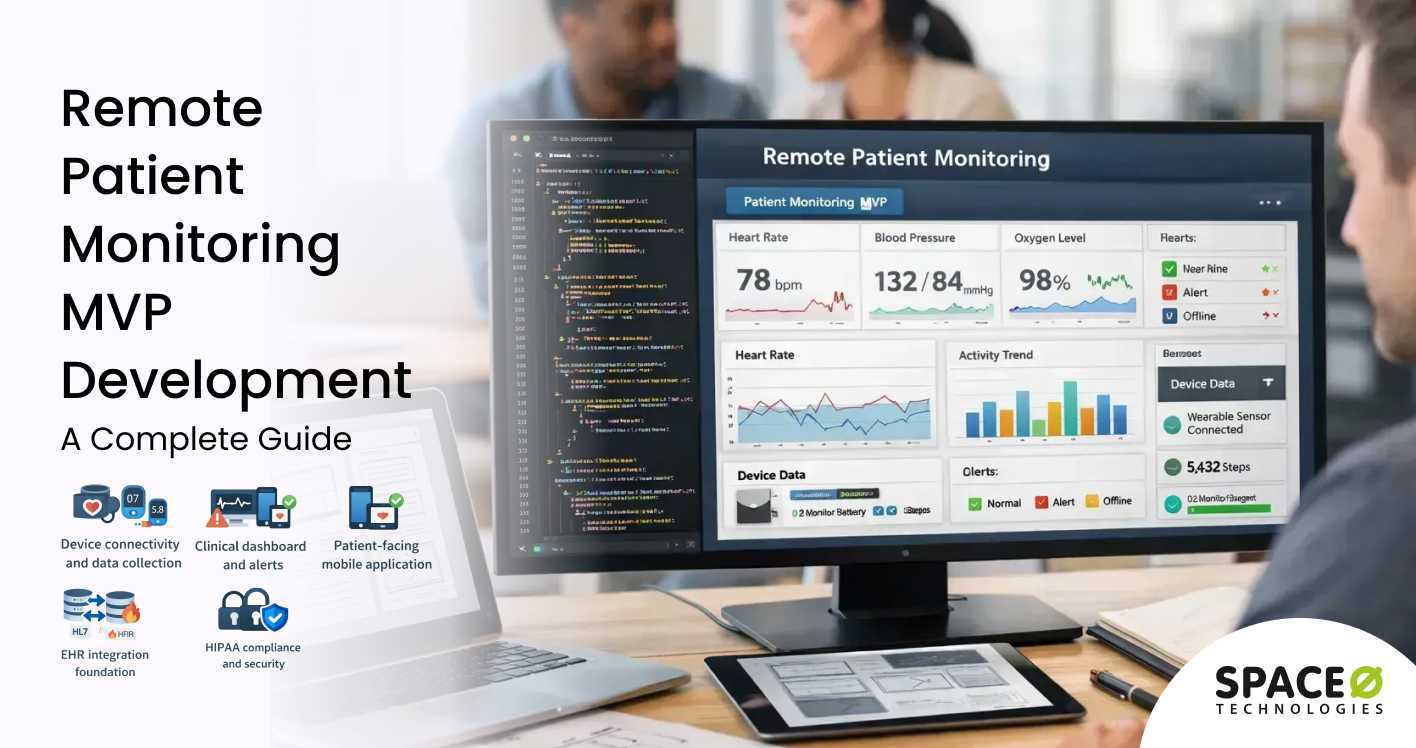
Contents
Remote patient monitoring software MVP development is gaining momentum as healthcare providers and digital health companies look to validate innovative care models before investing in full-scale platforms.
As per Markets and Markets, the global RPM market reached USD 27.7 billion in 2024 and is projected to reach USD 57 billion by 2030. This rapid growth highlights the increasing demand for scalable and reliable RPM solutions that can support continuous monitoring, chronic care management, and proactive clinical intervention.
An RPM MVP allows organizations to test core capabilities such as device connectivity, data capture, alerts, and clinician workflows with real users. By focusing on essential features first, teams can reduce development risk, control cost, and gather meaningful insights to guide future product development.
This guide covers everything you need to know about remote patient monitoring software MVP development. Drawing from our 15+ years of experience as a leading remote patient monitoring software company, we have shared insights on the benefits, essential features, development process, cost considerations, and best practices for building a scalable MVP.
What is Remote Patient Monitoring MVP Development?
Remote patient monitoring MVP development is the process of building a minimum viable version of an RPM platform that focuses on delivering core patient monitoring functionality with minimal complexity. The goal is to validate the product concept, clinical workflows, and technical feasibility before investing in a full-scale remote patient monitoring solution.
An RPM MVP typically includes essential capabilities such as patient onboarding, device or wearable connectivity, secure data collection, basic analytics, alerts for abnormal vitals, and clinician dashboards. These features allow healthcare teams to test how real-time patient data flows through the system and how effectively clinicians can act on that information
For founders building remote patient monitoring platforms, the MVP simultaneously validates several critical assumptions.
- Can you acquire healthcare providers as customers?
- Will clinicians integrate your solution into daily workflows?
- Does your approach measurably improve patient outcomes or reduce readmissions?
- What features do healthcare organizations request most frequently?
- Can you achieve HIPAA compliance without over-engineering?.
By limiting scope to critical features, remote patient monitoring MVP development helps organizations reduce upfront development cost, shorten time to market, and gather feedback from clinicians and patients early in the product lifecycle. Insights gained from MVP usage guide feature prioritization, architecture decisions, and compliance planning for future iterations.
Why MVP Development Matters for Remote Patient Monitoring Software
Building remote patient monitoring software without an MVP approach creates substantial risk. Top RPM development companies understand that the healthcare technology industry serves diverse provider types with varying clinical workflows, compliance requirements, and integration needs. Comprehensive RPM platforms take years to develop and millions to fund.
1. Validate market demand before major investment
The remote patient monitoring market seems attractive on paper. Healthcare providers face pressure to reduce readmissions, manage chronic conditions, and extend care beyond facility walls. These pain points suggest opportunity.
However, validating that healthcare organizations will adopt your specific solution requires real-world testing. An MVP lets you confirm demand exists for your approach before committing extensive resources. You learn whether practices will integrate your solution and whether patients will engage with monitoring tools.
2. Reduce development costs significantly
Full remote patient monitoring platforms cost $200,000-$400,000+ to develop comprehensively. This includes device integration, real-time monitoring dashboards, EHR connectivity, clinical alerts, patient mobile apps, reporting analytics, and compliance frameworks.
Healthcare MVP development reduces the initial investment to $50,000-$150,000 by focusing on core functionality. You allocate remaining capital to customer acquisition, clinical pilots, and scaling based on validated learnings rather than burning resources on features that may not resonate with users.
3. Accelerate time to market
Comprehensive remote patient monitoring software takes 12-18 months to develop and deploy. During this time, competitors launch, reimbursement policies shift, and your assumptions become outdated.
Rapid RPM prototyping delivers a launch-ready healthcare prototype in 3-4 months. You enter the market faster, begin learning immediately, and iterate while competitors are still building their initial versions.
4. Gather clinical feedback early
Patient monitoring workflows vary dramatically across specialties, care settings, and organization sizes. Assumptions about clinical needs often prove incorrect when tested against reality.
MVP launches generate actual usage data and direct feedback from clinicians and patients. You discover which features providers request, which they ignore, and how they actually use your platform versus how you expected. This feedback is invaluable for guiding subsequent development decisions.
5. Attract investors with validated traction
Investors increasingly require proof of market validation before funding digital health startups. Pitched concepts without user data are met with skepticism.
An MVP demonstrating pilot customers, engagement metrics, and clinical outcomes provides the validation investors need. Traction speaks louder than projections, especially in healthcare, where adoption barriers are high and regulatory complexity is significant.
Ready to Validate Your Remote Patient Monitoring Idea?
Work with experienced healthcare software developers who have built HIPAA-compliant platforms serving thousands of providers. We help founders launch healthcare MVPs in 3-4 months with the right features to prove market fit.

Essential Features for Your Remote Patient Monitoring MVP
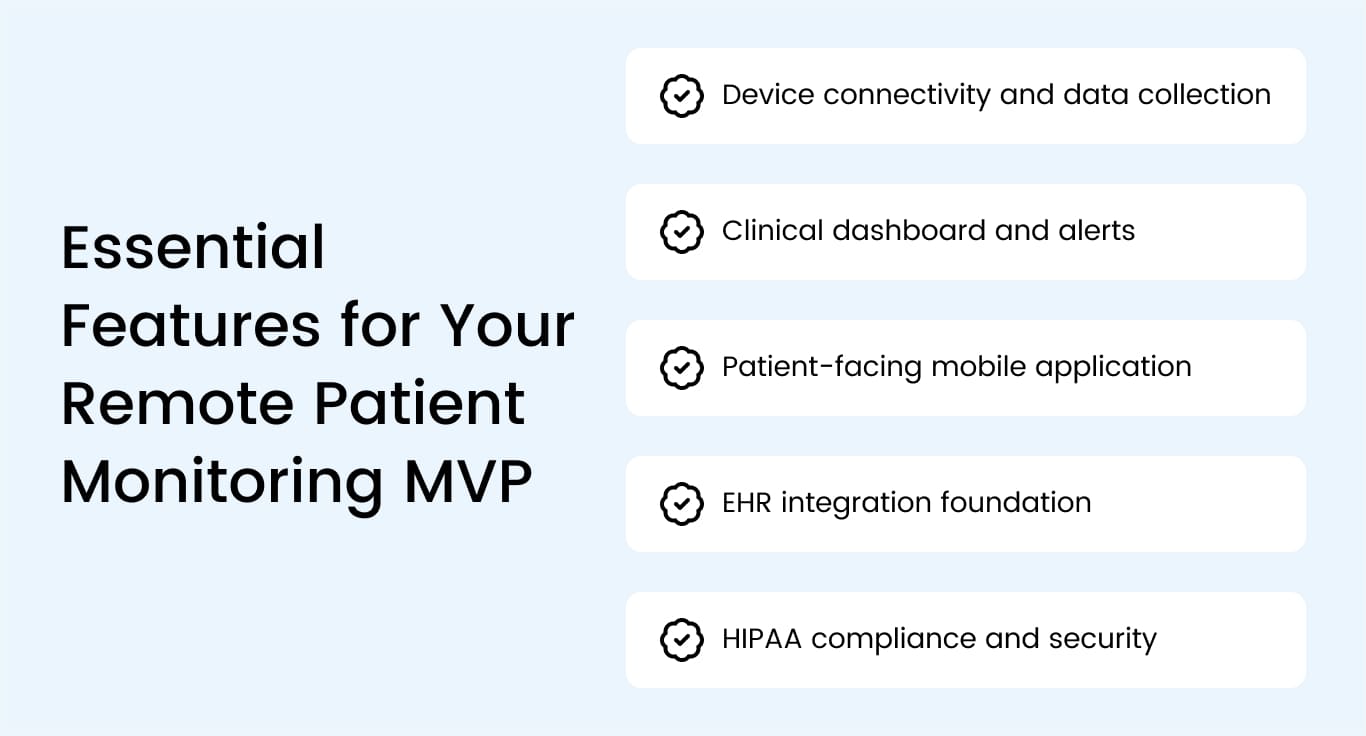
When you outsource remote patient monitoring software development, selecting MVP features requires balancing clinical value against development complexity. Include too few features, and healthcare organizations cannot perform meaningful monitoring. Include too many and you delay launch while burning capital.
The following features represent the core functionality most remote patient monitoring MVPs require. Your specific feature set depends on your target condition, care setting, and the primary problem you solve.
1. Device connectivity and data collection
Every remote patient monitoring platform needs the ability to receive health data from monitoring devices. Healthcare organizations cannot evaluate your solution without core data collection functionality.
MVP-level device connectivity includes
- Integration with 2-3 FDA-cleared monitoring devices (blood pressure cuff, pulse oximeter, glucose monitor)
- Bluetooth or cellular data transmission protocols
- Basic data validation and error handling
- Structured data storage for clinical review
- Device setup and pairing workflows for patients
Features to defer
- Integration with dozens of device manufacturers
- Custom hardware development
- Real-time continuous monitoring streams
- Advanced wearable ecosystem support
2. Clinical dashboard and alerts
Your MVP needs sufficient monitoring capabilities to demonstrate workflow improvement. Clinicians must efficiently review patient data and receive actionable alerts.
MVP-level dashboard includes
- Patient list with current health metrics
- Threshold-based alerts for out-of-range readings
- Basic trend visualization (daily, weekly views)
- Simple patient prioritization indicators
- Clinician acknowledgment and note capture
Features to defer
- AI-powered predictive analytics
- Complex risk stratification algorithms
- Multi-condition monitoring dashboards
- Advanced population health analytics
3. Patient-facing mobile application
Patients need a simple way to submit readings and engage with their monitoring program. Even MVP versions need basic patient engagement capabilities.
MVP-level patient app includes
- Device pairing and reading submission
- Medication and measurement reminders
- Basic educational content for their condition
- Secure messaging with the care team
- Simple health goal tracking
Features to defer
- Gamification and rewards systems
- Social features and community support
- Comprehensive health record integration
- Video consultation capabilities
4. EHR integration foundation
Healthcare organizations increasingly require RPM data to flow into existing clinical systems. Basic EHR connectivity often determines adoption.
MVP-level integration includes
- HL7 FHIR API foundation for data exchange
- Manual or semi-automated data export capabilities
- Basic patient demographic synchronization
- Documentation of integration capabilities for major EHRs
Features to defer
- Deep bidirectional Epic/Cerner integration
- Real-time EHR workflow embedding
- Complex clinical decision support integration
5. HIPAA compliance and security
Remote patient monitoring handles protected health information. Even MVPs must implement appropriate security foundations to operate legally.
MVP-level security includes
- Data encryption at rest and in transit
- Role-based access controls
- Basic audit logging for PHI access
- Secure authentication mechanisms
- Business Associate Agreement readiness
Features to defer
- Advanced identity federation
- Comprehensive security information and event management
- Multi-factor authentication options beyond basic
MVP Feature Prioritization Framework
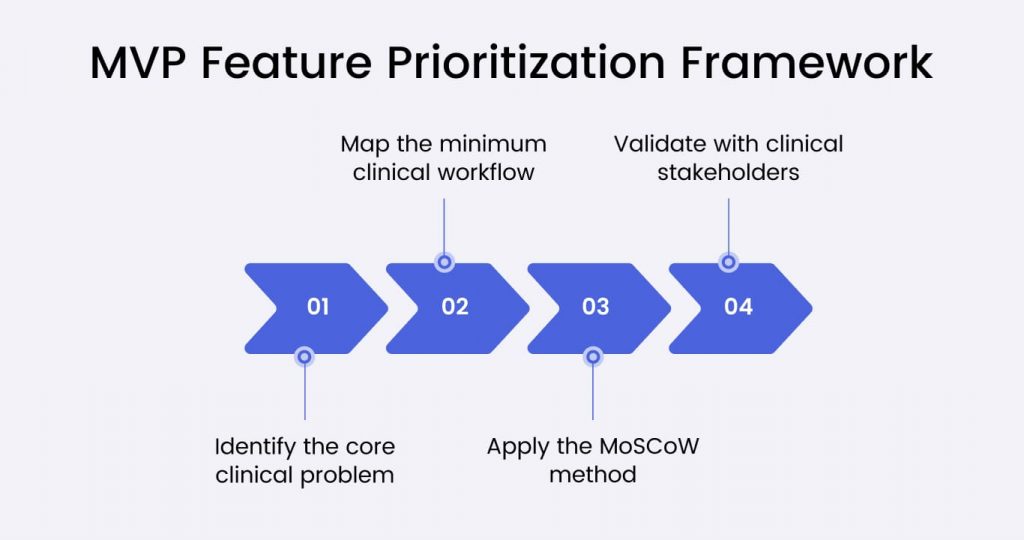
Deciding which features to include in your RPM MVP versus your future roadmap requires a structured evaluation process. The following framework helps founders make these decisions objectively.
Step 1: Identify the core clinical problem
Define the single most painful problem your target healthcare organizations face. Your MVP should solve this problem better than existing alternatives.
Example core problems by clinical focus:
| Clinical Focus | High-Friction Problem | MVP Focus |
|---|---|---|
| Chronic Care Management | Missed deterioration between visits | Real-time vitals with alerts |
| Post-Acute Care | Preventable readmissions within 30 days | Discharge monitoring with early warning |
| Cardiac Monitoring | Undetected arrhythmias at home | Continuous heart rhythm tracking |
| Diabetes Management | Poor glycemic control visibility | Blood glucose trends and coaching |
| Hypertension Programs | Medication non-adherence detection | Blood pressure tracking with reminders |
Step 2: Map the minimum clinical workflow
Document the complete workflow clinicians must accomplish to solve their core problem. Every step in this journey requires feature support in your MVP.
A chronic care monitoring MVP journey might include:
- Patient enrolls in RPM program
- Patient receives and pairs the monitoring device
- Patient submits daily readings
- System validates data and stores it securely
- Dashboard displays patient metrics to the care team
- Alerts trigger for out-of-range readings
- Clinician reviews alert and patient data
- Clinician documents intervention or outreach
Each step requires corresponding functionality. Missing steps break the clinical workflow and prevent validation.
Step 3: Apply the MoSCoW method
Categorize all potential features using the MoSCoW prioritization framework.
| Priority | Definition | MVP Inclusion |
|---|---|---|
| Must Have | Features without which the product fails | Include all |
| Should Have | Important features that add significant clinical value | Include if the development cost is low |
| Could Have | Nice-to-have features that enhance the experience | Defer to post-MVP |
| Won’t Have | Features explicitly excluded from this version | Document for roadmap |
Step 4: Validate with clinical stakeholders
Before finalizing features, validate your prioritization with potential users. Interview 10-15 clinicians and healthcare administrators in your target market. Confirm that your core problem resonates and your proposed solution addresses it.
Clinical validation often reveals incorrect assumptions. Features founders consider essential sometimes matter little to actual providers. Features that are considered optional sometimes prove critical to adoption.
How to Build a Remote Patient Monitoring Software MVP?
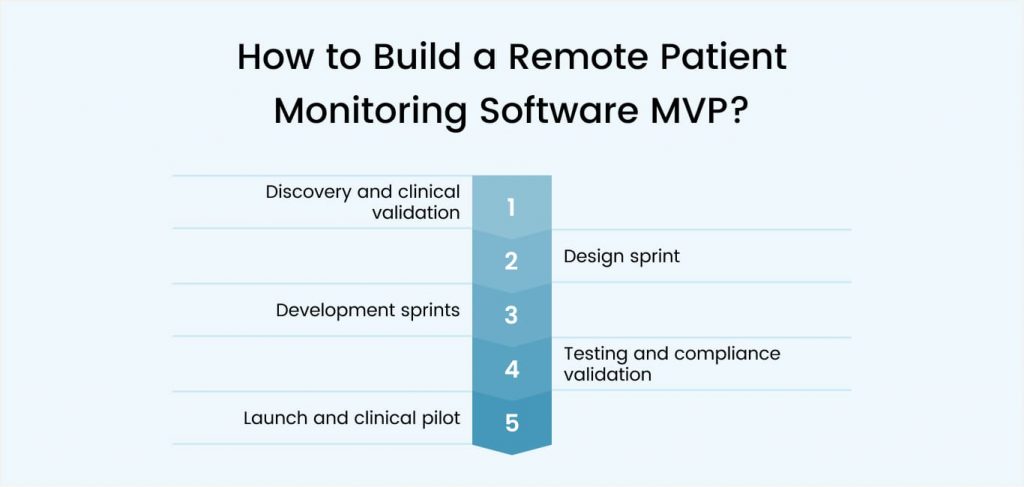
Successful remote patient monitoring MVPs follow agile development methodologies optimized for rapid iteration and integration of clinical feedback. Unlike traditional waterfall approaches, remote patient monitoring development with agile breaks projects into manageable sprints that produce working software incrementally. This approach is particularly valuable in healthcare, where clinical requirements evolve as stakeholders see functional prototypes.
Phase 1: Discovery and clinical validation (2-4 weeks)
Discovery establishes your MVP foundation through stakeholder interviews with physicians, nurses, care coordinators, and patients. This phase confirms target clinical pain points, documents core monitoring workflow requirements, and validates the technical feasibility of device integrations.
Teams define MVP feature scope using prioritization frameworks and plan the HIPAA compliance approach. Investment here prevents building solutions to non-existent problems and typically saves three to five times its cost by preventing expensive rework during development.
Key objectives
- Confirm target clinical pain points through stakeholder interviews
- Document core monitoring workflow requirements
- Validate the technical feasibility of device integrations
- Define MVP feature scope
- Plan HIPAA compliance approach
Phase 2: Design sprint (2-3 weeks)
Design sprints transform discovery findings into tangible prototypes that stakeholders can evaluate. Teams create clinical dashboard interface designs and patient application prototypes, then validate these with actual clinicians and patients before writing code.
This intensive period compresses months of iteration into weeks by enabling early usability testing. The finalized visual design system guides development and ensures consistency across all interfaces.
Key objectives
- Create clinical dashboard interface designs
- Develop patient application prototypes
- Validate designs with clinicians and patients
- Finalize visual design system
Phase 3: Development sprints (8-16 weeks)
Development transforms validated designs into functional software through iterative two-week cycles. Each sprint delivers specific, testable functionality including device integrations, HIPAA security controls, and EHR connectivity foundations.
Clinical stakeholders see progress through regular sprint demos and can adjust priorities based on emerging learnings. This incremental approach enables continuous feedback without derailing the project timeline or budget.
Key objectives
- Build functional MVP components using 2-week iterations
- Integrate monitoring devices
- Implement HIPAA security controls
- Develop EHR connectivity foundation
- Conduct ongoing testing with sprint demos
Phase 4: Testing and compliance validation (2-4 weeks)
Comprehensive testing ensures your RPM platform meets clinical requirements while maintaining security and performance standards. This phase includes quality assurance across all features, HIPAA security assessments, device integration validation, and clinical user acceptance testing with representative end users.
Thorough testing prevents launch failures that damage clinical confidence and complicate adoption. Rushing this phase creates technical debt that compounds over time.
Key objectives
- Comprehensive quality assurance
- HIPAA security assessment
- Device integration validation
- Clinical user acceptance testing
Phase 5: Launch and clinical pilot (ongoing)
Launch deploys your MVP to a HIPAA-compliant production environment and begins onboarding pilot healthcare organizations. This phase initiates the most valuable learning period as real clinical use generates usage analytics and outcome data.
Teams systematically collect feedback, measure against success criteria, and prioritize feature iterations based on actual user behavior rather than assumptions. Continuous improvement cycles refine the product toward market fit.
Key objectives
- Deploy to a HIPAA-compliant production environment
- Onboard pilot healthcare organizations
- Collect usage analytics and clinical outcomes
- Prioritize feature iterations based on learnings
Following this structured five-phase approach enables healthcare organizations and digital health startups to launch validated RPM solutions faster while minimizing development risk and maximizing clinical adoption through RPM software modernization.
Let Our Experts Build Your RPM MVP
From discovery and prototyping to development and testing, our team manages the complete RPM MVP development lifecycle.
Common Challenges in Remote Patient Monitoring MVP Development
Even well-planned MVP projects encounter obstacles. Anticipating these challenges enables proactive mitigation.
Challenge 1: HIPAA compliance complexity
Healthcare software must comply with HIPAA regulations from day one. Founders often underestimate the technical and administrative requirements.
Solution: Engage HIPAA compliance expertise during discovery, build security controls into architecture from inception, use HIPAA-compliant cloud infrastructure, and budget 15-25% additional development time for compliance features.
Challenge 2: Device integration fragmentation
Remote patient monitoring requires integration with various medical devices. Each manufacturer has different APIs, data formats, and connectivity protocols.
Solution: Start with 2-3 well-documented, FDA-cleared devices for your target condition, thoroughly evaluate APIs, build a flexible data ingestion architecture, and budget device integration time separately.
Challenge 3: Clinical workflow alignment
RPM solutions that disrupt existing clinical workflows face resistance to adoption. Clinicians are time-constrained and resist tools that add burden.
Solution: Observe actual clinical workflows before designing, minimize clicks required from clinicians, design actionable alerts, and conduct usability testing throughout development.
Challenge 4: EHR integration barriers
Healthcare organizations expect RPM data to flow into their electronic health records. EHR integration is technically complex and vendor-dependent.
Solution: Build on FHIR standards, start with data export before deep integration, consider Epic App Orchard or Cerner Code programs, and budget EHR integration separately from core MVP.
Challenge 5: Patient engagement and adherence
Remote monitoring only works if patients consistently use the devices. Engagement often drops after initial enrollment.
Solution: Design simple patient experiences, implement helpful reminder systems, provide immediate feedback on submissions, and build escalation workflows for non-adherent patients.
Challenge 6: Scope creep from clinical stakeholders
Clinical advisors and early customers discover additional needs during development. Each addition seems important, but collectively delays launch.
Solution: Define a clear MVP scope in writing, implement formal change request processes, maintain a parking lot for post-MVP features, and focus on validating the core hypothesis first.
Remote Patient Monitoring MVP Development Cost Breakdown
Understanding RPM development costs helps founders budget appropriately and evaluate partner proposals. MVP costs vary based on feature scope, technical complexity, and team structure.
Cost ranges by MVP complexity
| MVP Complexity | Feature Scope | Timeline | Cost Range |
|---|---|---|---|
| Basic | Single device + dashboard + basic alerts | 8-12 weeks | $50,000-$100,000 |
| Standard | Multi-device + patient app + EHR foundation + compliance | 12-16 weeks | $100,000-$175,000 |
| Advanced | Full device ecosystem + deep EHR integration + analytics | 16-24 weeks | $175,000-$250,000 |
Cost breakdown by development phase
Discovery and planning: $8,000-$20,000
- Clinical workflow requirements documentation
- Technical architecture design
- UI/UX wireframing
- HIPAA compliance planning
- Device integration assessment
Design phase: $10,000-$30,000
- Clinical dashboard interface design
- Patient mobile application design
- User experience optimization
- Interactive prototype development
Development phase: $30,000-$150,000
- Backend infrastructure development
- Frontend dashboard development
- Patient mobile application development
- Device integration and data pipeline
- Security and compliance implementation
Testing and QA: $8,000-$30,000
- Functional testing across all features
- Security penetration testing
- HIPAA compliance validation
- Clinical user acceptance testing
Deployment and launch: $5,000-$15,000
- HIPAA-compliant cloud infrastructure setup
- Deployment automation
- Launch support and monitoring
Factors that increase MVP costs
Several factors push development costs higher than baseline estimates.
- HIPAA compliance requirements: Add $15,000-$40,000 for security controls, audit logging, encryption, and BAA readiness.
- Device integration complexity: Each additional device manufacturer adds $8,000- $20,000, depending on the API quality and documentation.
- EHR integration depth: Basic FHIR connectivity costs $15,000-$30,000. Deep Epic or Cerner integration can cost $40,000-$80,000+.
- Multi-platform requirements: Native iOS and Android apps alongside web increase costs by 40-60% compared to web-only MVPs.
Working with an experienced healthcare app development partner like Space-O Technologies helps you optimize costs while ensuring clinical viability and regulatory compliance from day one.
Get a Clear Cost Estimate for Building Your RPM MVP
Share your remote patient monitoring software requirements with our team and get a free, no-obligation quote for your project. NDA protection guaranteed.
Best Practices for Successful Remote Patient Monitoring MVP Development
Following proven practices dramatically increases MVP success rates. These guidelines represent lessons from hundreds of healthcare and digital health projects.
1. Start with clinical research, not feature lists
Founders often begin by listing features they want to build. Successful healthcare MVPs start by deeply understanding clinical problems.
Conduct 15-20 interviews with clinicians and healthcare administrators before defining features. Document their current monitoring workflows, pain points, and existing tools. Features derived from clinical research solve real problems.
2. Build for one clinical use case first
Remote patient monitoring spans chronic care management, post-acute monitoring, specialty conditions, and more. Each use case has different needs.
MVPs that target everyone serve no one well. Select a single clinical use case and build specifically for that workflow. Expansion into additional use cases follows validation of the first.
3. Implement analytics from day one
Clinical usage data drives MVP iteration decisions. Without analytics, you rely on anecdotes instead of evidence.
Track feature usage, workflow completion rates, alert response times, and patient adherence from initial launch. Analytics reveal what clinicians actually do versus what they say they do.
4. Plan for rapid iteration post-launch
MVPs are not finished products. They are starting points for learning and iteration.
Reserve 30-50% of development resources for post-launch iteration. The most valuable MVP insights emerge after real healthcare organizations engage with your product.
5. Maintain HIPAA compliance throughout
Healthcare software must comply with regulations from the start. Building compliance as an afterthought proves expensive and creates legal risk.
Implement HIPAA-ready architecture from project inception. Compliance retrofitting costs 3-5x as much as building correctly from the start.
6. Test with real clinicians and patients before launch
Internal testing catches technical bugs but misses clinical usability problems. Real users encounter issues that internal teams overlook.
Conduct clinical acceptance testing with 5-10 target users before launch. Observe clinicians completing monitoring workflows and fix critical usability issues before broader release.
Build Your Remote Patient Monitoring MVP with Space-O Technologies
Remote patient monitoring software MVP development is an effective way to validate healthcare product ideas, test real-world workflows, and reduce risk before committing to full-scale development. By focusing on essential features and user feedback, organizations can build RPM solutions that align with clinical needs and long-term growth goals.
However, the success of an RPM MVP depends on careful planning, the right feature prioritization, and strong technical execution. Choosing an experienced development partner helps ensure your MVP is secure, compliant, and designed to evolve into a scalable RPM platform.
Space-O Technologies is an experienced remote patient monitoring software MVP development company with over 15 years of expertise in healthcare software development and modernization. We have served 1,200+ clients globally and successfully delivered more than 300 software solutions across healthcare, mobile, and web platforms.
Our RPM MVP development services help healthcare providers and digital health companies transform ideas into validated products. From MVP strategy and feature prioritization to development, device integration, and post-launch support, Space-O Technologies partners with you to build RPM MVPs that are ready for scale and long-term success.
Contact our software developers to discuss your remote patient monitoring MVP and receive a customized development roadmap.
FAQs on Remote Patient Monitoring MVP Development
1. How long does it take to develop a remote patient monitoring MVP?
Remote patient monitoring MVP development typically takes 3-4 months from project kickoff to launch. Basic MVPs with single-device integration are complete in 8-12 weeks. Complex MVPs requiring multi-device connectivity and EHR integration take 16-24 weeks. The timeline depends on feature scope, device complexity, and compliance requirements.
2. What is the minimum cost to build a remote patient monitoring MVP?
The minimum cost for a viable remote patient monitoring MVP ranges from $50,000 to $100,000 for basic functionality, including single-device integration, clinical dashboard, basic alerting, and HIPAA compliance foundations. Standard MVPs cost $100,000 to $175,000. Advanced MVPs with multi-device ecosystems cost $175,000-$250,000.
3. Which features should I include in my remote patient monitoring MVP?
Essential features include device connectivity for your target condition, a clinical monitoring dashboard with threshold-based alerts, basic patient engagement tools, HIPAA-compliant data storage, and role-based access controls. Defer AI-powered analytics, comprehensive EHR integration, and multi-condition monitoring to post-MVP phases.
4. How do I ensure HIPAA compliance in my remote patient monitoring MVP?
HIPAA compliance requires encryption for data at rest and in transit, role-based access controls, comprehensive audit logging, secure authentication, and administrative safeguards. Use HIPAA-eligible cloud services, partner with healthcare-experienced developers, and budget 15-25% additional development time for compliance.
5. Can I build a remote patient monitoring MVP without a technical co-founder?
Yes, many successful digital health startups launch MVPs through development partnerships. Choose partners with healthcare domain expertise, HIPAA compliance experience, and medical device integration capabilities. Ensure contracts include knowledge transfer provisions if you plan to bring development in-house later.
6. How do I validate my remote patient monitoring idea before building?
Interview 15-20 clinicians, healthcare administrators, and potential patients in your target market. Understand their current monitoring workflows and pain points. Confirm willingness to participate in pilots. Use these insights to prioritize MVP features and confirm clinical demand exists.
7. What metrics should I track after launching my remote patient monitoring MVP?
Track clinical adoption (organization sign-ups, clinician activation, patient enrollment), engagement (daily active users, reading submission rates, alert response times), clinical outcomes (patient health improvements, readmission reductions), and business metrics (conversion, churn, reimbursement capture).
8. Should I build a web app or a mobile app for my remote patient monitoring MVP?
Build both, prioritizing based on user needs. Clinicians prefer web-based dashboards accessible from workstations. Patients need mobile applications for device pairing and reading submission. Consider a responsive web dashboard for clinicians and a native mobile app for patients.



 All our projects are secured by NDA




 4.8
4.8