
 By
By 
Starting a startup is exciting, but turning a vision into a functioning product can feel overwhelming. For most startups, software is at the core of their business, whether it’s a mobile app, web platform, or SaaS solution. However, building software on a tight budget, with limited resources, and under time pressure comes with unique challenges.
As per Grand View Research, the global custom software development market was valued at USD 43.16 billion in 2024 and is projected to reach USD 146.18 billion by 2030. This highlights the growing demand for tailored software solutions among businesses, especially startups looking to gain a competitive edge.
This guide walks startup founders, technical co-founders, and product teams through every step of software development for startups. From defining your product vision and choosing the right tech stack to hiring software developers for your project, learn strategies to launch your product faster, avoid common pitfalls, and set your startup up for success.
Contents
Why Software Development for Startups Works Differently
Before we dive into how to build, it helps to understand what makes startup software development fundamentally different from how enterprises approach it.
Startup software development refers to the process of designing, building, and maintaining software solutions specifically tailored for early-stage companies. Unlike traditional enterprise software, startup software development emphasizes speed, flexibility, and lean practices to bring a product to market quickly while staying cost-effective.
The goal is often to create a minimum viable product (MVP), validate it with real users, and iterate rapidly based on feedback.
Enterprise vs. Startup software development: The core differences
While both startups and enterprises develop software to meet business needs, the approach, priorities, and challenges differ significantly. For a deeper look at how larger organizations build software, see our guide on enterprise software development.
| Feature / Aspect | Startups | Enterprises |
|---|---|---|
| Goal | Rapid MVP launch and market validation | Long-term stability, compliance, and efficiency |
| Budget | Limited; cost-sensitive | Large; can invest heavily in infrastructure |
| Development Speed | Fast-paced, iterative | Slower, structured, and formalized |
| Team Size | Small, cross-functional | Large, specialized teams |
| Flexibility | High; frequent pivots and changes | Moderate; changes go through formal processes |
| Technology Stack | Modern, scalable, cost-effective options | Mature, enterprise-grade solutions |
| Risk Tolerance | High; willing to experiment | Low; focused on reliability and compliance |
| User Feedback | Continuous, early-stage testing | Structured, post-release evaluation |
| Maintenance & Updates | Agile, frequent iterations | Planned, periodic updates |
Now that you understand how startup development works differently, you need to make five critical decisions before you start building.
Critical Decisions Before You Start Building
Before you begin the development process, four foundational decisions will shape everything that follows. Get these right, and the rest becomes much clearer.
Decision 1: Build vs. Buy
The Question: Should you build custom software or use existing solutions?
Build Custom Software When:
- Your competitive advantage depends on unique features
- Existing solutions don’t fit your specific workflow
- You need to own your entire technology stack
- The long-term cost of customization is lower than licensing
Buy Existing Solutions When:
- Standard tools solve your problem adequately
- You need to launch faster than building allows
- The budget is extremely limited
- Your business model is straightforward
The Reality: Most startups do both. You might use off-the-shelf tools (Stripe for payments, Twilio for messaging) while building custom startup software development for your core product. Hybrid is often the smartest approach.
Real Example: A healthcare startup might buy existing telemedicine APIs but build custom prescription management because that’s their competitive edge. They launched in 4 months instead of 8 by choosing wisely.
Decision 2: In-House vs. Outsource
The Question: Who builds your software, your own team or an external partner?
In-House (Hire Developers):
- Full control and immediate communication
- Team invested in your mission
- Higher fixed costs ($100,000+ per developer annually)
- Takes 2–3 months to hire and onboard
- Best after Series A funding
Outsource (Agency or Freelancers):
- 50–70% cheaper than full-time salaries
- Flexible if you need to scale up/down
- Access to specialized expertise
- Less day-to-day control
- Best for MVP and early validation
Hybrid Approach:
- Outsource MVP development to an agency
- Hire 1–2 senior technical leaders in-house
- You get to market fast, then maintain internally
Decision Rule: Can you afford 3-5 developers at $100,000+ each? Hire in-house. Otherwise, work with a software development outsourcing agency with the right expertise and talent.
Why It Matters: Many successful startups start with outsourced MVPs, validate their idea with real users, then hire internal teams once they have funding and clearer product direction.
Decision 3: MVP vs. Full-Scale Product
The Question: How much should you build before launch?
MVP (Minimum Viable Product):
- Smallest version solving the core problem
- 5–8 core features only
- 3–4 months to build
- $15,000–$70,000 cost
- Goal: Validate the problem and gather user feedback
Full-Scale Product:
- Complete feature set based on user feedback
- 15–25+ features
- 6–12 months of additional development after MVP
- Additional $30,000-$100,000+ cost
- Goal: Market-ready product for growth
The MVP-First Path (Recommended):
Following proven software development best practices, launch your MVP in month 4, get 100–500 early users, gather feedback for 2 months, and build full product features that users actually want.
The “Build Everything First” Path (Higher Risk):
Spend 12 months building every feature you imagined. Launch to find users wanted something completely different. Now pivot and rebuild.
The Winner: MVP-first always wins. You learn faster, adjust cheaper, and validate sooner. One on-demand service startup we know launched with just booking + basic ratings. Six months later, they added 12 features, all requested by users.
Decision 4: Technology stack
The Question: What technologies should your software use?
Choose Based On:
- Proven vs. trendy (proven wins for startups)
- Your team’s expertise (don’t learn new languages under pressure)
- Scalability (can it handle 10x growth?)
- Community support (is it easy to hire developers for it?)
Safe Choices for Most Startups:
- Frontend: React, Vue.js, or Flutter
- Backend: Node.js, Python, or Java
- Database: PostgreSQL or MongoDB
- Cloud: AWS, Azure, or Google Cloud Platform
Key Rule: Use technologies your developers already know. Speed matters more than using cutting-edge frameworks. The startup that launches with boring tech beats the one still debating frameworks.
With these five decisions made, you now have the foundation to begin building. The next step is understanding the actual development process, the proven path that successful startups follow from day one to launch and beyond.
Build Your Startup Software With Our Experienced Developers
With over 15 years of experience and more than 300 software solutions delivered, we help startups build fast, scale confidently, and launch successfully.

The 7-Stage Software Development Process for Startups
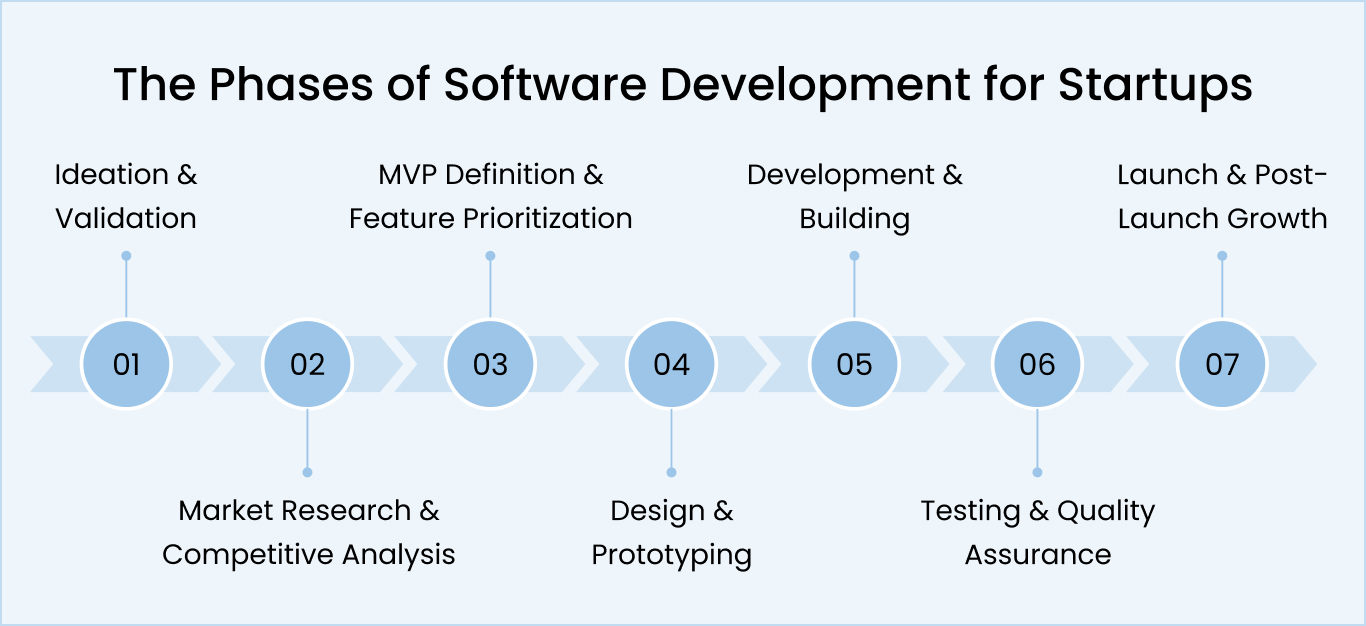
Every successful startup follows a predictable development path. Each stage of the software development process has a clear purpose, timeline, and outcome. Whether you’re building in-house or using a software development company for startups, these stages remain the same. Here’s exactly how to navigate them.
Stage 1: Ideation & validation
Timeline: Weeks 1–2
Before you spend a dime on custom software development for startups, validate that you’re solving a real problem for real people. Talk to potential customers or end users. Understand their pain. This stage is about clarity and validation, not building anything yet. Get comfortable with being wrong early.
Key activities:
- Define your core problem (not your solution)
- Identify your specific target user
- Create a simple value proposition
- Validate demand through conversations and surveys
- Document success metrics
Outcome: Clear problem statement and validated customer need
Stage 2: Market research & competitive analysis
Timeline: Weeks 2–3
Now, understand the landscape you’re entering. Study what competitors are doing well and where they’re failing. Read user reviews to see what features people actually want. Competitive analysis informs your positioning and tells you exactly where the gaps are that you can fill.
Key activities:
- Analyze competitor apps, websites, and reviews
- Identify user pain points that current solutions miss
- Find feature gaps and underserved niches
- Understand regulatory and compliance requirements
- Spot technology trends in your market
Outcome: Competitive positioning statement and market understanding
Stage 3: MVP definition & feature prioritization
Timeline: Weeks 3–4
Define the smallest version of your product that delivers real user value. Not a barebones prototype that nobody would use. A real version that actual customers would pay for. This is where you make the hard decision: what stays and what gets cut until the next phase.
Key activities:
- List every feature you imagined
- Keep only what solves the core problem
- Cut everything else ruthlessly
- Estimate development effort and timeline
- Document your MVP scope in writing
Outcome: Clear MVP feature list and development estimate
Stage 4: Design & prototyping
Timeline: Weeks 4–8
Design is where 40% of startups stumble, even those with good technology. Great design equals higher adoption and retention. Bad design means users leave regardless of how well your code works. You’re translating your MVP concept into something real that users can actually interact with.
Key activities:
- Create user flows and wireframes
- Build high-fidelity mockups
- Develop interactive prototypes for testing
- Ensure accessibility and mobile-first layouts
- Validate design with potential users
Outcome: Approved design mockups and clickable prototypes
Stage 5: Development & building
Timeline: 2–6 months, depending on complexity
This is where the actual software gets built using the best software development tools. You’re building the frontend that users see, the backend that powers everything, integrations with payment systems and tools, and security infrastructure. This is where your software development process for startups moves from planning to execution, and the code actually starts shipping.
Key activities:
- Build frontend (what users see)
- Build backend (servers, databases, logic)
- Integrate payment systems and third-party tools
- Implement security and encryption
- Deploy to production infrastructure
Outcome: Working software ready for testing
Stage 6: Testing & quality assurance
Timeline: 2–4 weeks (parallel to development)
Testing happens alongside development, not after. Catch bugs early when they’re easy to fix. You’re verifying that every feature works, that the app performs under load, that security is solid, and that real users can actually figure out how to use it without getting lost.
Key activities:
- Functional testing (does every feature work?)
- Performance testing (is it fast with thousands of users?)
- Security testing (can hackers break in?)
- Usability testing (do real users understand it?)
Outcome: Bug-free software ready for launch
Stage 7: Launch & post-launch growth
Timeline: Ongoing
Launching is day one, not the finish line. This is where you learn from real usage and watch how actual users interact with your product. Whether you’re outsourcing software development for startups or managing internal teams, the post-launch phase is where your real learning begins, and you plan your next iteration based on data.
Key activities:
- Deploy to production servers
- Set up monitoring and support systems
- Conduct a soft launch with trusted users
- Launch to the public with a marketing campaign
- Gather feedback and plan next features
Outcome: Live product with real users and feedback loops
You’ve mapped out the entire development journey from validation to launch. But before you move forward, there’s one critical question that will either enable or derail your plans: how much will this actually cost? Most founders severely underestimate because they only budget for development. Let’s look at what you really need.
Let Our Team Manage the Entire Development Process for You
From discovery and design to development, testing, and launch, we handle everything. We ensure your startup gets a smooth, predictable, and high quality development journey.
How Much Does Startup Software Development Cost?
Knowing how to optimize software development budget is one of the most critical skills a startup founder needs before writing a single line of code. Most founders budget for development and ignore everything else. Then launch arrives and money runs out before you cover hosting, marketing, compliance, and support. The result? Startups compromise on critical things or run out of cash before gaining real traction.
Let’s be clear about the actual software development costs.
-
Cost by complexity
The first decision is determining what you’re actually building. Your MVP scope dramatically impacts both timeline and budget. A simple app with core features ships fast and cheap. A platform with multiple user types costs significantly more.
Complexity Development Time Estimated Cost (USD) Notes Basic Features 2–6 weeks $5,000–$15,000 Simple functionality like static pages, basic forms, login/signup, basic dashboard Medium Features 6–12 weeks $15,000–$50,000 Features like user profiles, payment integration, notifications, basic APIs Advanced Features 12–24 weeks $50,000–$150,000 Real-time updates, chat/messaging, AI/ML features, complex workflows Enterprise-Level Features 24+ weeks $150,000+ Custom integrations, high security, multi-user architecture, advanced analytics Most successful startups launch simple MVPs with just the basic/most essential features, the most miniature version solving the core problem. You validate assumptions with real users before building complexity nobody wants.
These costs reflect realistic pricing for outsourcing software development to quality firms for startups. If you hire in-house developers instead, add 30–50% to account for salaries, benefits, and recruitment overhead.
-
Outsourcing vs. In-House
This decision shapes your entire budget. You’re not just comparing hourly rates; you’re comparing total cost of ownership, timeline to launch, and risk.
Option 1: Hire in-house team
Building your own team sounds appealing until you see the math. The cost to hire a software developer with senior-level expertise is around $80,000–$150,000 annually. A mid-level developer’s annual salary can cost $60,000–$100,000. Then add 25–30% for benefits, 15–20% recruitment fees, and 2–3 months where they’re paid but not yet productive.
A 3-person team hits $360,000+ in year one before writing a single line of code. This only makes sense after Series A funding when you have a runway.
Option 2: Outsource MVP to a software development company
Experienced software development companies handle everything: discovery, design, development, testing, and launch support. Boutique agencies charge $8,000–$15,000/month. Mid-tier firms charge $5,000–$10,000/month.
Eastern European agencies offer the same quality for $3,000–$8,000/month. Total cost for an MVP: $30,000–$70,000. Your product ships in 4–5 months without recruitment delays or payroll overhead.
Option 3: Hybrid approach (Recommended for most startups)
Launch your MVP with an external agency ($40,000–$50,000 over 3–5 months). Simultaneously hire 1–2 senior technical leads in-house ($100,000–$150,000). Year one total: $140,000–$200,000. You get to market fast, validate your idea, and have internal tech leadership ready to scale.
Approach Year 1 Cost Timeline Best For In-house team $360,000+ Month 7+ shipping Post-Series A Outsource only $30,000–$70,000 Month 4–5 shipping MVP validation Hybrid model $140,000–$200,000 Month 5 + scaling Most startups Decision rule: Can you afford 3+ developers at $100,000+ each annually? Hire in-house. Otherwise, choose experienced software developers for startups from a quality agency.
-
Hidden costs that destroy budgets
Development is just the beginning. Most startups underestimate what happens after launch, and that’s where money disappears. It is important to account for hidden software development costs to plan your budget.
Cost Amount Why It Matters Hosting & infrastructure $100–$500/month Scales as users grow; cloud providers like AWS or Azure charge ongoing usage-based fees Maintenance & patches 15–20% of dev cost/year Covers OS updates, security fixes, and critical bug patches that keep the app stable and secure Post-launch marketing $5,000–$20,000+ Drives user acquisition through app store optimization, ads, partnerships, and other campaigns Legal & compliance $2,000–$5,000 Pays for privacy policies, terms of service, and regulatory compliance reviews that reduce legal risk Design iterations $2,000–$5,000 Funds user testing and UX improvements to fix design issues before they become expensive to change Real example: Your $50,000 MVP doesn’t stay $50,000.
- MVP development: $50,000
- Year 1 maintenance & patches: $10,000
- Post-launch marketing: $15,000
- Legal & compliance: $5,000
- Design updates: $3,000
- App store fees, hosting: $1,500
- Total year one: $84,500
You now know what you’re actually paying. The question is: how do you ensure every dollar delivers results? The difference between startups that succeed and those that burn through budgets isn’t the amount spent, it’s how they spend it. Here are the six practices that separate winners from the rest.
Get an Accurate Cost Estimate for Your Software Development Project
Share your idea and receive a custom cost breakdown from our experts. Plan your software development budgets with confidence.
6 Best Practices for Startup Software Development Success
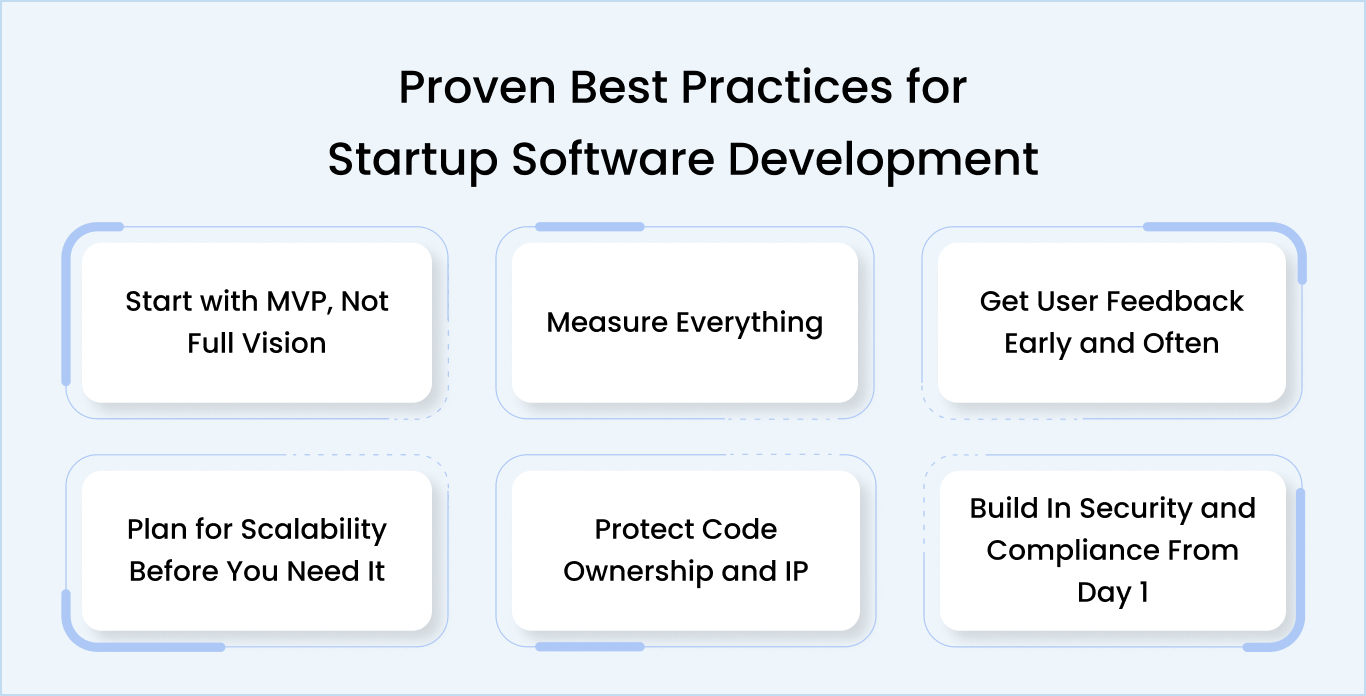
Building software for a startup is different from building software for enterprises. You operate with limited budgets, tight timelines, and constant market pressure. These six practices keep your software development process for startups on track, focused, and profitable.
-
Start with MVP, not full vision
Why it matters: You see your complete product in your mind. But shipping everything takes 12 months. Shipping just the core takes 3–4 months. The team that ships first wins.
What to do:
- Define one core value proposition (the one thing your app does better than everyone else)
- Build only features that deliver that value
- Cut everything else ruthlessly
- Launch in 3–4 months, not 12
The payoff: You iterate faster, learn from real users, and pivot cheaply than competitors trying to build everything at once.
-
Measure everything (data beats intuition)
Why it matters: Your assumptions about what users want are probably wrong. You only know for sure by watching what they actually do.
What to do:
- Install analytics before launch (Amplitude, Mixpanel, Google Analytics)
- Track: daily active users, retention curves, where users drop off, which features drive revenue
- Review metrics weekly
- Build features based on data, not gut feeling
The payoff: You spend development budget on what users actually need, not what you imagined they needed.
-
Get user feedback early and often
Why it matters: Waiting for “perfect” to launch guarantees you’re solving the wrong problem.
What to do:
- Beta test with 50–200 users before public launch
- Conduct weekly user interviews (5–10 users, 30 minutes each)
- Track Net Promoter Score (NPS)
- Read support tickets to find patterns in complaints
- Categorize feedback: one-off complaints vs. patterns vs. critical issues
The payoff: You catch design flaws before they reach thousands of users. You learn what to build next from the people actually using your app.
-
Plan for scalability before you need it
Why it matters: The worst time to discover your app breaks at 10x users is when you actually hit 10x users. Redesigning architecture mid-growth costs 3x more.
What to do:
- Ask developers upfront: “If we 10x users tomorrow, does this break?”
- Review database architecture, server infrastructure, and payment processing limits
- Use cloud platforms (AWS, Azure, Google Cloud) that auto-scale
- Build caching and CDN strategies early
The payoff: Cost upfront: $5,000–$10,000 for proper architecture review. Cost of fixing later: $100,000+ rewrite.
-
Protect code ownership and IP
Why it matters: You own your code. Full stop. If you don’t, you’re stuck if your developer vanishes.
What to do:
- Ensure the contract clearly states: You own all source code, not licensed
- Get full documentation so another developer can maintain it
- Verify code isn’t in a proprietary framework; only the vendor understands
- Confirm no vendor lock-in clauses
The payoff: If your developer leaves mid-project or you need to switch teams, you’re not rebuilding from scratch.
-
Build in security and compliance from day 1
Why it matters: Adding security later costs 5-10x more than building it in. One breach can destroy your startup.
What to do:
- All startups: Use HTTPS/SSL, encrypt passwords, implement access controls, and maintain audit logs
- Healthcare apps (HIPAA): Encryption at rest and in transit, multi-factor authentication, data backup plans
- Fintech/payments (PCI-DSS): Use tokenization, never store raw card numbers, secure payment gateways
The payoff: Cost upfront: $5,000–$10,000 for proper security. Cost of a breach: $1,000,000+ in liability and lost business.
These practices aren’t optional. They’re the difference between startups that scale smoothly and startups that face costly rewrites, security disasters, or wasted development spending. The teams that execute well follow all six.
Build Your Startup Software With Confidence
Building software for startups requires understanding three critical realities. Most founders underestimate costs by 40–50%, forgetting hosting, marketing, compliance, and ongoing support. Outsourcing MVPs saves considerable time versus hiring in-house while getting to market 3 months faster. Real success is determined by execution, not budget alone.
Space-O Technologies specializes in startup software development with proven expertise. With 15+ years of delivering custom solutions for 1,200+ clients globally, we’ve partnered with startups and established enterprises across industries. Our team of 140+ experienced software developers specializes in MVP-first thinking, agile development, and cost-conscious execution.
We guide startups through the complete journey, from validating your idea to scaling beyond your first 10,000 users. Whether you outsource software development for startups or need guidance on building your internal team, we deliver. Check our portfolio to see how we’ve helped startups succeed.
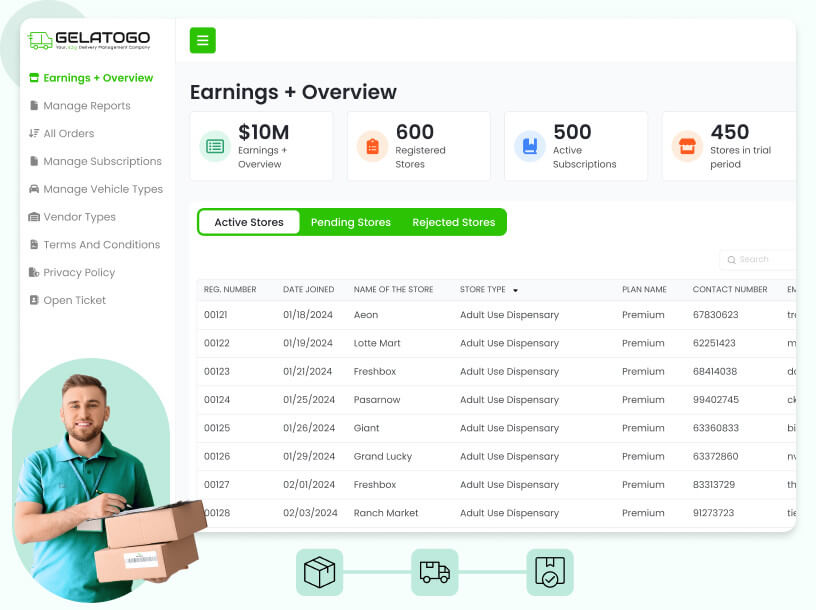
GelatoGoes: Delivery Management Software
Space-O Technologies developed GelatoGoes, a comprehensive delivery management system optimizing door-to-door operations across New York and New Jersey. Built with React.js, Node.js, and Flutter, this cross-platform solution enhances delivery efficiency through intelligent route optimization across iOS and Android platforms.
RaeCRM: NDIS Fund Management Software
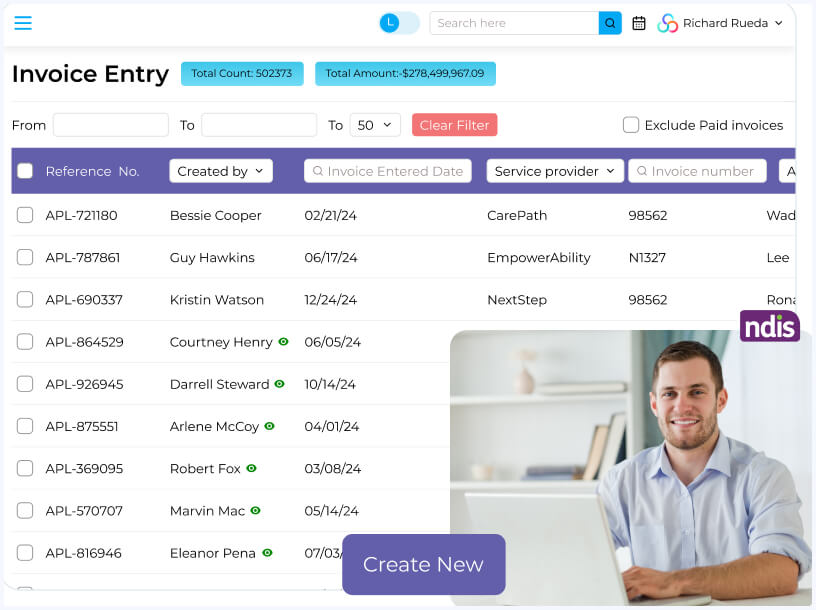
Our team upgraded and maintained RaeCRM, an online NDIS fund management platform streamlining invoice application processes. Utilizing Laravel, MySQL, and Amazon S3, Space-O improved system performance, resolved technical challenges, and enhanced user experience within 1.5 years of dedicated maintenance.
Field Service Management Solution
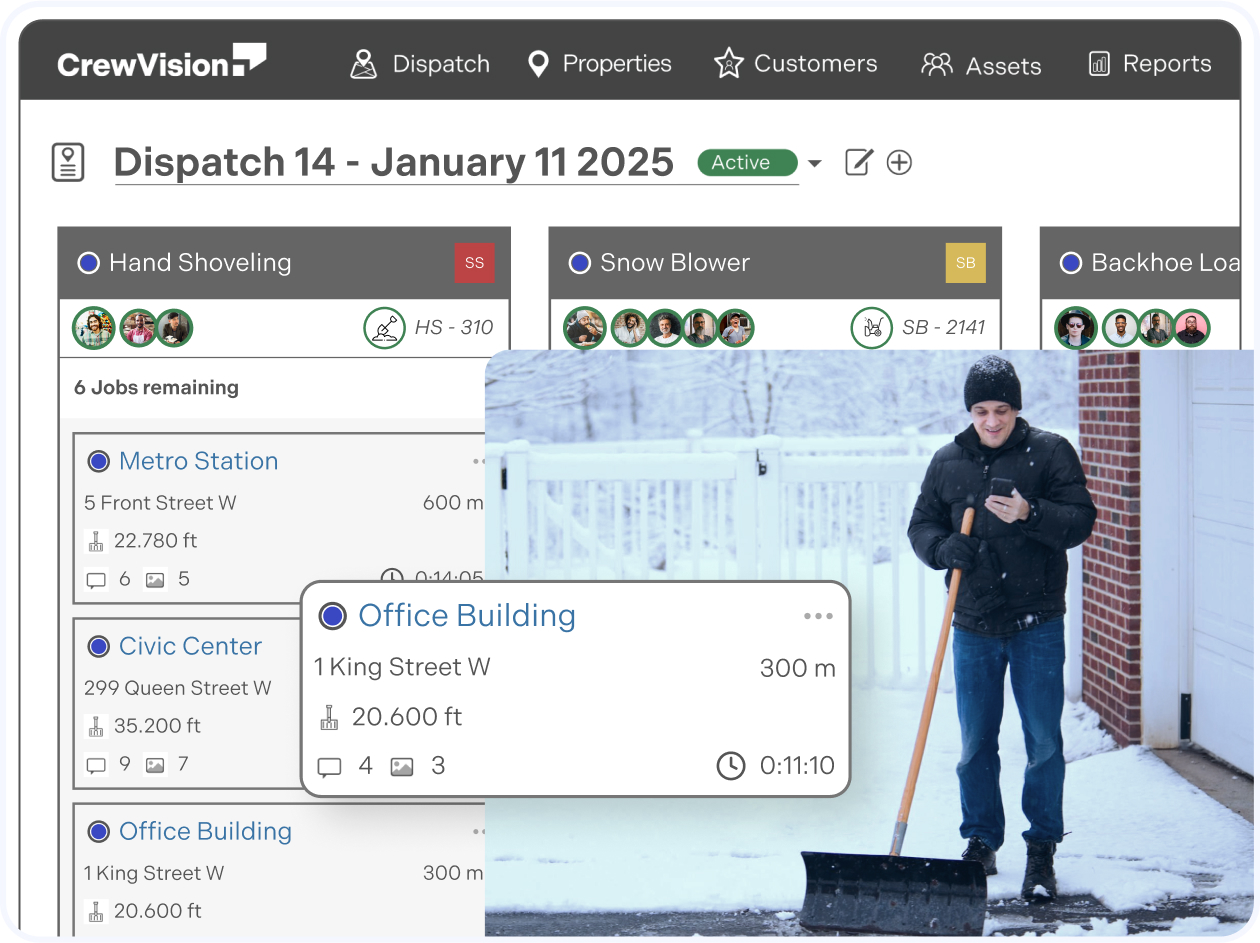
Space-O Technologies engineered a field service management platform for Canadian snow removal operations, serving 800-900 crew members during winter seasons. Developed with Laravel, ReactJS, SwiftUI, Jetpack Compose, and Google Maps API, the solution enables efficient task assignment and geographic zone mapping.
Ready to build software that truly scales? Get a free consultation with our startup software development experts today. We’ll discuss your project, timeline, and budget, then provide a clear roadmap and realistic cost breakdown tailored to your specific situation. Let’s transform your vision into reality.
Frequently Asked Questions About Startup Software Development
What’s the difference between MVP and a full product?
An MVP is the smallest version solving your core problem with 5–8 features in 3–4 months. A full product has 15–25+ features developed over 6–12 additional months based on user feedback. This is how successful product development for startups actually works: launch your MVP, gather feedback from real users, then build features they’re requesting instead of features you imagined they’d want.
How do I choose the right development partner for my startup?
Define requirements first (problem solved, features, timeline, budget). Find 3–5 qualified partners with startup experience. Vet them with discovery calls, technical deep dives, and reference calls with past startup clients. When evaluating software development services for startups, prioritize those with proven experience shipping MVPs, not just enterprise projects. Trust, expertise, and agile approach matter more than price.
What should I measure after launching my software?
Track daily/monthly active users, retention curves, where users drop off, which features drive revenue, churn rates, lifetime value, and unit economics. Review metrics weekly. All product development for startups decisions should flow from data, not assumptions. Tools like Amplitude or Mixpanel help you track engagement automatically and spot what’s working.
How do I ensure my software is secure from day one?
Use HTTPS/SSL encryption, encrypt passwords and sensitive data, implement proper authentication, and maintain audit logs. Good software developers for startups understand security isn’t optional; it’s built into the architecture from day one. For healthcare: add HIPAA compliance. For fintech: add PCI-DSS compliance. Cost upfront: $5,000–$15,000. Cost of a breach: $1,000,000+.
What happens if I need to change development teams mid-project?
If a startup outsources software development, selecting the right partner from the start is critical because switching teams mid-project can increase timelines by 2–3 months and add 20–30% to overall costs. The best prevention is choosing a stable firm with strong processes, documentation, and long-term commitment.
If a switch becomes necessary, ensure your contract includes full code ownership and detailed documentation to enable a smoother transition.
Should I outsource software development for startups or hire in-house?
Most startups should outsource until raising $1–2 million. Hiring in-house means paying salaries, benefits, recruitment, and onboarding for months before shipping anything. With quality software development services for startups, you get experienced teams that move faster and cost 50–70% less. Once you have traction and funding, then hire 1–2 senior technical leaders to maintain and scale what was built.



 All our projects are secured by NDA




 4.8
4.8