
 By
By 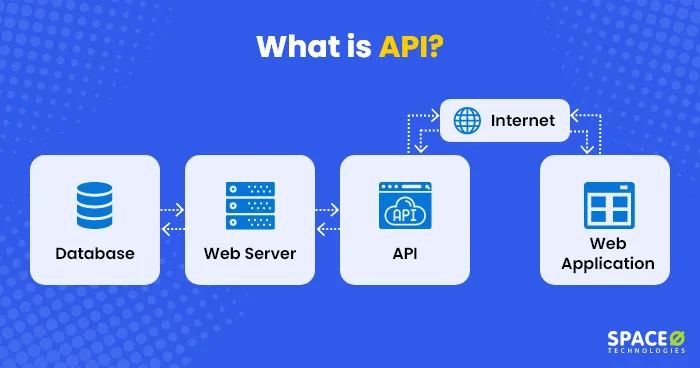
Contents
- API development covers the full lifecycle, from endpoint design and authentication through deployment, versioning, and ongoing maintenance.
- REST fits most web and mobile projects, GraphQL suits complex client queries, and gRPC handles low-latency microservice communication.
- Custom APIs make sense when your data transformations, compliance requirements, or performance targets exceed what third-party options support.
- Security is architectural, not additive. It depends on OAuth 2.0, encryption, rate limiting, and compliance controls designed in from day one.
Key Takeaways
Every modern business depends on software systems that need to communicate with each other. Whether it is syncing customer data between a CRM and an ERP, processing payments through a gateway, or connecting IoT devices to a central dashboard, APIs make it all possible.
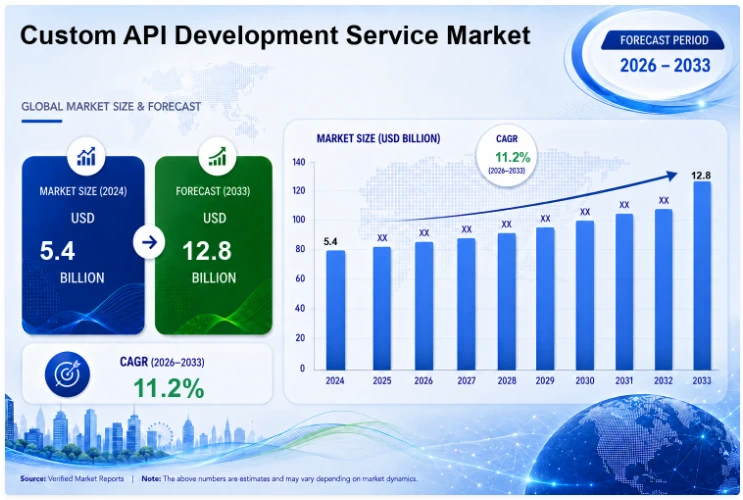
According to Verified Market Reports, the custom API development service market was valued at USD 5.4 billion in 2024. The market is projected to reach USD 12.8 billion by 2033, growing at a compound annual growth rate (CAGR) of 11.2% during the forecast period from 2026 to 2033.
A major driver behind that growth is straightforward. Businesses can no longer rely on pre-built, off-the-shelf APIs alone. The decision to develop an API in-house or with a partner usually follows. When standard solutions fall short of your requirements, custom API development services become the strategic choice.
A tailored API designed around your data flows, security protocols, and integration needs gives you full control. You decide how your systems exchange information and how they interact with each other.
Teams comparing vendors often start by reviewing top API development companies before scoping the work. Others begin with software development consulting to validate the approach first. This API development guide covers both the technical and the commercial side of that decision.
What Is an API?
An API, or application programming interface, is a defined set of rules that lets one software application request data or functionality from another. It specifies which requests are allowed, how they must be formatted, and what the response will look like.
Think of an API as a contract between two systems. One side agrees to accept certain requests. The other side agrees to return certain responses in a predictable format.
A practical example makes this concrete. When a customer checks out on your eCommerce store, your application sends payment details to a gateway through its API. The gateway processes the transaction, then returns an approval or a decline response.
Your store never touches the card network directly. That separation is the point. The API exposes exactly the functionality you need while hiding everything else.
The same pattern repeats across every industry. A logistics dashboard calls a carrier API for tracking updates. A booking platform calls a mapping API for distance calculations. A hospital system calls a lab API for test results.
In each case, one system asks, and another answers. For a plain-language breakdown of what an API is, including API categories and everyday examples, see our tech terms glossary.
What Is API Development?
API development is the process of designing, building, testing, documenting, and maintaining an interface that lets software systems exchange data. It covers the full lifecycle, from defining endpoints and data models through deployment, versioning, and long-term support.
The work splits into two paths. Integration projects connect your systems to existing third-party APIs. Custom API development builds a new interface from scratch around your own data and business logic.
Most enterprise projects involve both. A retail platform might consume a payment gateway API while exposing its own inventory API to warehouse partners.
The distinction matters for budgeting and staffing. Integration work is measured in connections. Custom development is measured in endpoints, data models, and compliance scope. Knowing how to build an API starts with deciding which of those two paths your project needs.
How Do APIs Actually Work?
Understanding the request cycle helps you evaluate proposals, read documentation, and diagnose problems. Any API development guide has to cover this before the commercial questions make sense. The mechanics are simpler than most explanations suggest.
The client-server request cycle
Every API interaction has two participants. The client sends the request. The server receives it, processes it, and returns a response.
Your mobile app is a client when it requests order data. Your order management system is the server when it returns that data. The same system can act as both, depending on the direction of the call.
The cycle runs in five stages:
- The client sends a request to a specific endpoint, including credentials and any required parameters.
- The server authenticates the caller and validates the request structure.
- The server checks authorization to confirm the caller may perform this action.
- The server processes the request, querying databases or calling other services as needed.
- The server returns a status code and a response body, which the client then parses.
Each stage can fail independently. Good API design makes each failure distinguishable, which is exactly why status codes matter.
HTTP methods and request anatomy
Every HTTP request combines a method, a path, optional parameters, and often a request body. The method declares intent, and the path identifies the resource being acted on.
| Method | Purpose | CRUD Operation |
|---|---|---|
| GET | Retrieve a resource without changing it | Read |
| POST | Create a new resource under a collection | Create |
| PUT | Replace an existing resource entirely | Update |
| PATCH | Modify selected fields on a resource | Update |
| DELETE | Remove a resource permanently | Delete |
Resource modeling determines your path structure. Use plural nouns for collections and identifiers for individual records, so /v1/orders returns a list while /v1/orders/48213 returns one order.
Requests carry data in three places. Path parameters identify the resource, query parameters filter or sort the result, and the request body carries the JSON payload for create and update operations.
- Path parameter:
/v1/orders/48213where 48213 identifies the specific order. - Query parameter:
/v1/orders?status=shipped&limit=50which filters and limits the response. - Request body: a JSON payload sent with POST, PUT, or PATCH containing the fields to write.
Most modern APIs use a JSON payload for both requests and responses. An XML payload remains common in SOAP services, particularly across banking and government systems.
What does an API request look like?
Here is a request that retrieves the status of a single order. The client sends a GET request with a bearer token in the header.
GET /v1/orders/48213/status HTTP/1.1
Host: api.yourcompany.com
Authorization: Bearer eyJhbGciOiJIUzI1NiIsInR5cCI6...
Accept: application/json
When the request succeeds, the server returns a 200 status code with a JSON body.
{
  "order_id": "48213",
  "status": "in_transit",
  "carrier": "FedEx",
  "tracking_number": "794657612345",
  "estimated_delivery": "2026-08-06",
  "last_updated": "2026-08-01T14:22:11Z"
}
When the token is missing, expired, or invalid, the server returns a 401 instead.
{
  "error": "unauthorized",
  "message": "Access token has expired.",
  "documentation_url": "https://api.yourcompany.com/docs/errors#401"
}
Notice the error response. It names the problem, explains it in plain language, and links to documentation. That third field saves consuming developers hours of guesswork.
What do API status codes mean?
Status codes tell the client what happened without requiring it to parse the response body. Consistent use of the right code is one of the clearest signals of a well-built API.
| Code | Meaning | When it Applies |
|---|---|---|
| 200 | OK | Request succeeded, response contains data |
| 201 | Created | New resource was created successfully |
| 204 | No Content | Request succeeded, nothing to return |
| 400 | Bad Request | Malformed syntax or invalid parameters |
| 401 | Unauthorized | Missing, expired, or invalid credentials |
| 403 | Forbidden | Valid credentials, insufficient permissions |
| 404 | Not Found | Resource does not exist |
| 409 | Conflict | Request conflicts with current resource state |
| 422 | Unprocessable Entity | Syntax valid, business rules violated |
| 429 | Too Many Requests | Rate limit exceeded |
| 500 | Internal Server Error | Unhandled failure on the server |
The distinction between 401 and 403 trips up many teams. A 401 means the system does not recognize you. A 403 means it knows exactly who you are, and the answer is still no.
What Is Custom API Development?
Custom API development is the process of designing, building, and deploying application programming interfaces tailored to a specific business’s needs. Unlike generic or third-party APIs that offer standardized functions, a custom API is built from scratch to handle your exact data structures, workflows, and integration requirements.
Off-the-shelf APIs provide pre-defined endpoints and data models. They work well when your needs align with what the provider offers. But when you need to connect proprietary systems, enforce specific security protocols, or handle unique data transformations, these generic solutions create bottlenecks.
Custom APIs give you full control over endpoint design, data formatting, authentication methods, and performance optimization. You decide what data flows where, how it is validated, and who has access.
Types of custom APIs businesses build
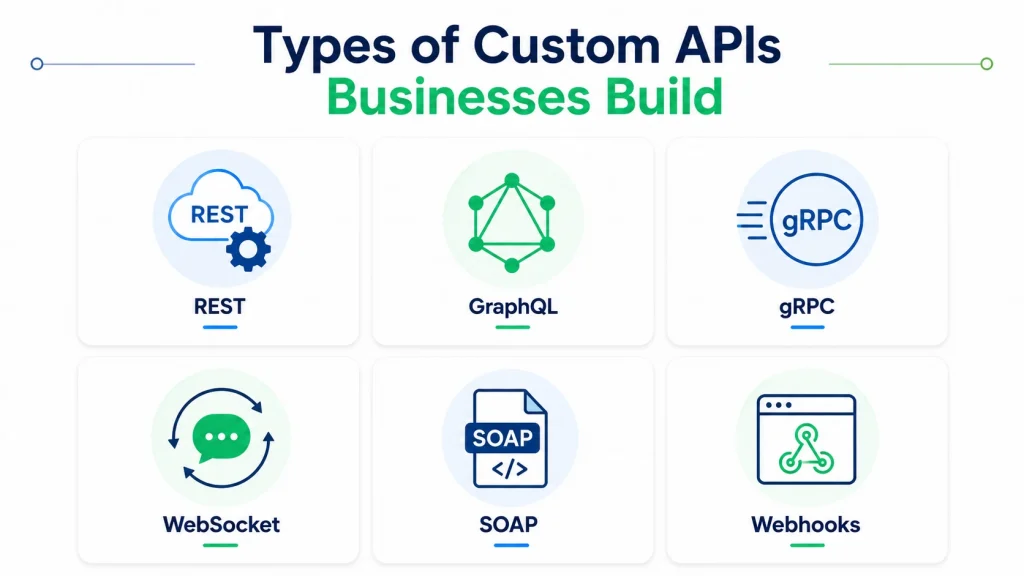
The API architecture you choose depends on your use case, performance requirements, and team expertise. The following table summarizes the main API types used in custom development.
| API Type | Best For | Key Characteristics |
|---|---|---|
| REST | General-purpose web services | HTTP-based, stateless, JSON format, widely adopted |
| GraphQL | Complex data queries | Client-defined queries, single endpoint, reduce over-fetching |
| gRPC | High-performance microservices | Protocol Buffers, bidirectional streaming, low latency |
| WebSocket | Real-time communication | Persistent connections, live updates, event-driven |
| SOAP | Banking and legacy enterprise | XML messaging, WS-Security, strict contracts, high reliability |
| Webhooks | Event-driven notifications | Server-initiated, push-based, no polling required |
REST remains the most widely adopted standard for web APIs across browser and mobile clients. Our guide to REST API integration covers endpoint design, authentication choices, and the implementation process in detail. GraphQL and gRPC adoption continue to grow for specific use cases.
Webhooks work in the opposite direction from everything else on this list. Rather than your client asking the server for updates, the server notifies your endpoint when something happens. That eliminates constant polling and reduces both latency and infrastructure cost. Picking the right architecture is the first real decision in how to create an API that fits your use case.
API types by access scope
Architecture describes how an API communicates. Scope describes who is allowed to call it. Both classifications matter when planning security and documentation.
- Public APIs are open to any developer, sometimes with registration or usage fees. Payment gateways and mapping services fall into this category.
- Private APIs operate only inside your organization. They connect internal systems and never leave your network perimeter.
- Partner APIs are shared with a defined set of external organizations under contract. Supply chain integrations and reseller platforms typically use this model.
- Composite APIs bundle several underlying calls into one request. They reduce round trips for workflows that would otherwise require four or five separate calls.
When businesses need custom API solutions
Not every project requires a custom API. Here are the scenarios where building one makes clear business sense:
- Your business logic requires data transformations that no third-party API supports.
- You need to connect legacy systems with modern applications.
- Security and compliance requirements demand custom authentication flows.
- Performance needs exceed what generic APIs can deliver.
- You want full ownership of your integration layer without vendor dependency.
Understanding what custom API development involves sets the foundation for recognizing its business value. Let’s explore the key benefits next.
Scoping an API Without a Cost Baseline Backfires
Share your integration count, data volume, and compliance scope. Our team returns a transparent estimate with architecture notes within 24 hours.

Why Businesses Invest in Custom API Development
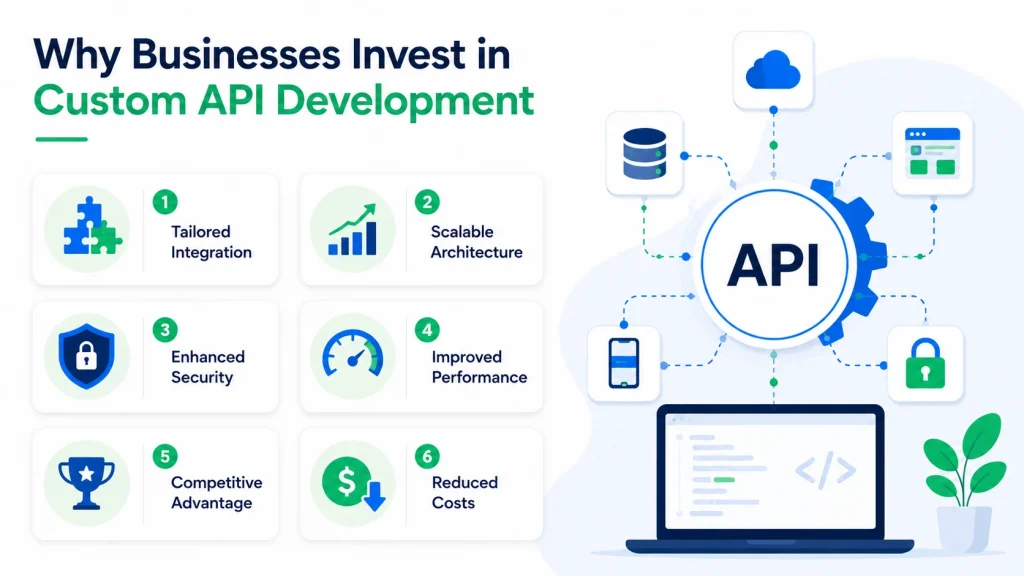
Building a custom API requires upfront investment, but the long-term returns often outweigh the costs. Here are the primary benefits.
1. Tailored integration for your specific systems
Custom APIs connect your systems without forcing data into generic formats. Endpoints match your exact business logic, eliminating workarounds and manual data handling.
An order routing process that previously required manual reconciliation across ERP, CRM, and shipping systems can run automatically through a single API layer.
2. Scalable architecture that grows with your business
A custom API is sized for your actual load pattern, not a vendor’s average. You design the infrastructure around expected request volumes, so performance stays consistent as traffic grows.
Well-architected platforms sustain thousands of API calls per minute across multiple sales channels. Generic connectors buckle well before that ceiling.
3. Enhanced security and compliance control
Full control over authentication, authorization, and encryption means you implement exactly what your industry demands. A third-party provider’s configuration choices do not constrain you.
This matters most in regulated sectors, where audit trails and access controls must satisfy a specific standard rather than a general one.
4. Improved performance with optimized data transfer
Custom APIs eliminate unnecessary data transfer. Your endpoints return only what your applications need, which reduces latency and bandwidth consumption across the stack.
A generic product API might return 40 fields when your mobile app displays six. Over millions of calls, that difference becomes an infrastructure line item.
5. Competitive advantage through proprietary integrations
Proprietary APIs create integrations your competitors cannot replicate. This builds a technology moat around your business processes and delivers unique customer experiences.
The value sits in the integration layer rather than in any single component. That layer is difficult to copy because it encodes your specific operating model.
6. Reduced long-term costs and vendor dependency
Eliminating recurring third-party subscription fees lowers operational expense. You also remove dependency on providers who may change pricing or deprecate features without warning.
Realizing these benefits depends on where your business operates. Some industries face integration pressures that make custom APIs the only workable answer.
Industries That Rely on Custom API Development
Every sector uses APIs. A few face integration and compliance demands that off-the-shelf options cannot meet.
Healthcare and patient data interoperability
Healthcare systems must exchange records across providers, laboratories, pharmacies, and insurers. HL7 FHIR defines the standard, but every implementation differs in practice.
Electronic health record platforms such as Epic, Cerner, and Allscripts each expose data differently. Custom APIs handle the mapping between them while enforcing HIPAA-compliant audit trails.
Access control is the harder problem. Patient data requires role-scoped permissions that vary by clinician, department, and treatment relationship.
Fintech and payment processing
Payment flows demand idempotency, reconciliation logic, and PCI-DSS compliance at every layer. A duplicate charge caused by a retried request is a business incident, not a bug.
Custom APIs enforce idempotency keys so that repeating a request never repeats the transaction. They also handle structured error responses that distinguish a declined card from a network timeout.
Encrypted audit logging is mandatory rather than optional. Generic connectors typically leave this responsibility to the consuming developer.
eCommerce and multi-channel inventory sync
Selling across a web store, marketplaces, and physical locations requires one source of truth for stock levels. Delays produce oversells, refunds, and marketplace penalties.
Custom APIs push inventory changes to every channel in near real time. They also handle conflict resolution when two channels claim the same unit within the same second.
Pricing adds a second layer. Dynamic pricing rules often differ per channel, which means the API must apply channel-specific logic before responding.
Logistics and real-time shipment tracking
Carriers expose inconsistent APIs. Some use REST, others still use SOAP, and each returns a different status vocabulary for the same physical event.
A custom API normalizes all of them behind a single interface. Your dashboard consumes one consistent format regardless of which carrier moved the package.
Rate shopping depends on the same normalization. Comparing quotes across carriers requires translating each response into a common structure first.
SaaS and multi-tenant platform integration
Multi-tenant products need tenant-scoped data isolation enforced at the API layer, not the application layer. A tenancy leak is a security incident with contractual consequences.
Custom APIs embed tenant context in every authorization check. That makes cross-tenant access structurally impossible rather than merely unlikely.
Usage metering runs through the same layer. Per-tenant rate limits and billing counters belong at the API boundary where every call passes through.
Manufacturing and IoT device connectivity
Factory equipment produces continuous telemetry from devices that were never designed for cloud connectivity. Protocols vary by vendor and by equipment generation.
Custom APIs handle protocol translation, buffering during connectivity loss, and aggregation before data reaches your analytics platform.
Edge filtering matters at scale. Sending every sensor reading to the cloud is expensive, so the API layer decides what to transmit and what to summarize.
Best Tools and Technologies for Custom API Development
Choosing the right technology stack determines your API’s performance, maintainability, and scalability. API software development spans backend languages, frameworks, testing tools, and gateway platforms. Here is an overview of the most widely used technologies for custom API projects.
Top programming languages for API development
The language you choose depends on your team’s expertise, performance requirements, and existing infrastructure. The following table outlines the most used languages for API development.
| Language | Strengths | Common Frameworks | Best For |
|---|---|---|---|
| Node.js | Non-blocking I/O, large ecosystem | Express, Fastify, NestJS | Real-time apps, microservices |
| Python | Clean syntax, rich libraries | Django REST, FastAPI, Flask | Data-heavy APIs, ML integration |
| Java | Enterprise-grade, strong typing | Spring Boot, Quarkus | Large-scale enterprise APIs |
| Go | High performance, concurrency | Gin, Echo, Fiber | High-throughput services |
| C# | .NET ecosystem, enterprise support | ASP.NET Core | Windows and Azure environments |
| PHP | Widespread hosting, large community | Laravel, Symfony | Web application APIs |
Each language has a strong community and a proven track record in production API environments. Your choice should align with your team’s existing skills and long-term maintenance capacity.
Frameworks and libraries for API development
Frameworks accelerate development by providing built-in routing, middleware, authentication, and database connectivity. Spring Boot dominates enterprise Java API development, while FastAPI has become the preferred choice for Python developers building high-performance APIs. Treat the framework list in any API development guide as a snapshot, since adoption shifts every few years.
For businesses using Node.js development as their primary backend technology, Express remains the most popular framework. NestJS offers a more structured approach for larger projects.
API testing and documentation tools
Quality API development tools ensure your API works as expected before deployment. The most widely adopted tools include:
- Postman handles API testing, documentation, and team collaboration in one workspace.
- Swagger and OpenAPI define your API specification and generate interactive documentation.
- Insomnia provides lightweight testing for both REST and GraphQL endpoints.
- JMeter runs performance and load testing against production-like traffic volumes.
- SoapUI covers comprehensive testing for both SOAP and REST services.
What is an API gateway and when do you need one?
An API gateway is a single entry point that sits in front of your APIs and handles authentication, rate limiting, routing, and monitoring. Instead of building those controls into every service, you enforce them once at the perimeter.
You need a gateway when any of these become true. You run more than a handful of services. You expose APIs to external consumers. You need consistent rate limiting across endpoints. You require centralized request logging for compliance.
Common options include Kong, Apigee, AWS API Gateway, and Azure API Management. These platforms also handle API management tasks such as consumer onboarding, key issuance, usage analytics, and API publishing to a developer portal.
For a small internal API with a single consumer, a gateway adds operational overhead without meaningful benefit. The case strengthens as soon as external consumers appear.
With your technology stack selected, the next step is understanding the development process itself.
How to Build a Custom API: Step-by-Step Process
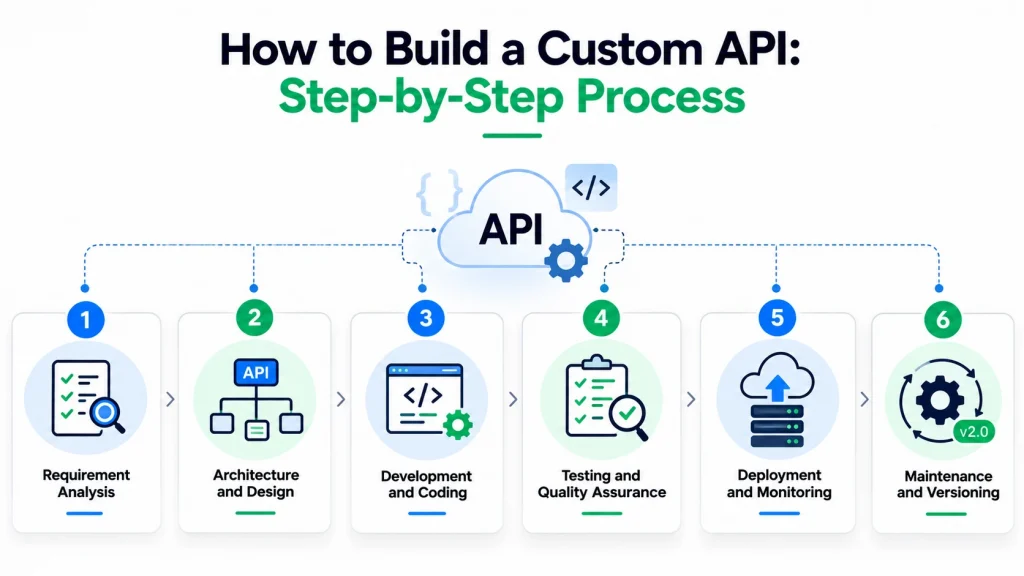
A structured development process reduces risk and delivers consistent results. Here are the six key phases every custom API project should follow.
Step 1: Requirement analysis and API planning
Understanding business requirements before writing any code prevents costly rework later. This phase defines what your API needs to accomplish and how it fits into your existing architecture.
Action items
- Identify all systems the API must connect to.
- Define data models, input and output formats, and validation rules.
- Map user roles and access permissions.
- Document performance benchmarks and scalability targets.
- Establish compliance requirements such as GDPR, HIPAA, and PCI-DSS.
Step 2: API architecture and design
Designing your API’s structure before development ensures consistency and developer-friendliness. This phase produces the API specification that guides all subsequent work.
Action items
- Choose the API style, whether REST, GraphQL, or gRPC, based on use case analysis.
- Define endpoint naming conventions and URL structures.
- Design authentication and authorization flows.
- Create the OpenAPI or Swagger specification document.
- Plan the versioning strategy for future updates.
Step 3: Development and coding
Building the API based on approved specifications turns designs into functional code. When you hire dedicated developers, the team follows the architecture blueprint while implementing business logic and data handling.
Action items
- Set up the development environment and project structure.
- Implement endpoint logic, data validation, and error handling.
- Build database queries and data transformation layers.
- Integrate authentication middleware and security controls.
- Write unit tests alongside the code for each endpoint.
Step 4: Testing and quality assurance
Thorough testing catches issues before they reach production. This phase validates functionality, performance, security, and reliability under various conditions.
Action items
- Run functional tests for every endpoint and edge case.
- Execute load and stress tests to verify performance thresholds.
- Perform security testing, including penetration testing and vulnerability scanning.
- Conduct integration testing with all connected systems.
- Validate error handling and response codes.
Step 5: Deployment and monitoring
Moving the API to production requires careful infrastructure setup and monitoring configuration. This phase ensures a stable launch with full observability.
Action items
- Configure production servers, load balancers, and API gateways.
- Set up monitoring dashboards for response times, error rates, and throughput.
- Implement logging and alerting for anomalies.
- Deploy using CI/CD pipelines for consistent releases.
- Run smoke tests in the production environment.
Step 6: Ongoing maintenance and versioning
APIs require continuous attention after launch. This phase covers updates, performance optimization, and backward-compatible changes over the API’s lifecycle.
Action items
- Monitor API usage patterns and optimize slow endpoints.
- Release new versions while maintaining backward compatibility.
- Apply security patches and update dependencies.
- Update documentation to reflect changes.
- Respond to developer feedback and feature requests.
This structured process mirrors the software development process used across enterprise projects. With the development process understood, let’s address one of the most critical aspects of any API: security.
Ready to Build an API Your Partners Can Actually Rely On?
Space-O Technologies has delivered production APIs for platforms handling millions of requests a day, covering REST, GraphQL, versioning, auth, rate limiting, and documentation.
What Skills Are Needed for API Development?
API development requires backend programming, data modeling, security implementation, and API design judgment, supported by testing and deployment skills. No single skill carries a project on its own.
Use this list two ways. If you are building the API yourself, it maps your learning path. If you are evaluating a partner, it tells you what to probe during technical interviews. This is the section of an API development guide worth keeping open during vendor calls.
| Skill Area | What It Covers | Why It Matters |
|---|---|---|
| Backend programming | Node.js, Python, Java, Go, or C# | Implements endpoint logic and data handling |
| HTTP and REST principles | Methods, status codes, statelessness, caching | Prevents design mistakes that break clients |
| Data modeling | Schema design, relationships, indexing | Determines query performance at scale |
| Security implementation | OAuth 2.0, JWT, encryption, input validation | Protects data and satisfies compliance audits |
| API specification | OpenAPI, Swagger, contract definition | Keeps documentation and code in sync |
| Testing | Unit, integration, load, and contract testing | Catches breaking changes before release |
| DevOps basics | CI/CD, containers, monitoring, logging | Supports reliable deployment and debugging |
Skills that separate senior API developers
Most developers can build a working endpoint. Fewer can build one that survives three years of changing requirements.
- Versioning judgment: knowing which changes break consumers and which do not.
- Failure design: planning retry logic, timeouts, and graceful degradation before an outage forces it.
- Error message quality: writing responses that tell a consuming developer exactly what to fix.
- Compliance fluency: understanding how HIPAA, PCI-DSS, or SOC 2 change architecture decisions.
- Consumer empathy: designing for the developer who will integrate the API, not for internal convenience.
The last point is the hardest to teach and the easiest to test. Ask a candidate to critique a public API’s documentation and listen to what they notice.
How to Secure Your Custom API
API security is not optional. Nearly every organization running production APIs reports at least one security incident within a given year, according to industry survey data.
Protecting your endpoints requires deliberate, multi-layered implementation. Every custom API must address authentication, encryption, rate limiting, and compliance from the design phase itself.
Authentication and authorization
Authentication verifies identity. Authorization determines what that identity can access. Implement both correctly to protect your custom API:
- OAuth 2.0 handles delegated access between services and third-party applications.
- JWT tokens enable stateless authentication across distributed microservices.
- API keys provide basic identification in lower-risk internal scenarios.
- Mutual TLS secures high-sensitivity service-to-service communication.
- Role-based access control enforces granular permissions per user or system.
Data encryption and HTTPS enforcement
Every API request and response must be encrypted in transit. Additionally:
- Enforce HTTPS and TLS for all communications without exception.
- Encrypt sensitive data at rest in databases and storage systems.
- Use strong algorithms, specifically AES-256 at rest and TLS 1.3 in transit.
- Implement proper credential management and scheduled secret rotation.
- Never expose sensitive data in URL parameters or application logs.
Rate limiting and threat protection
Rate limiting prevents abuse and protects your infrastructure from both malicious attacks and accidental overloads:
- Set request limits per user, per IP address, and per API key.
- Implement throttling that returns appropriate HTTP 429 responses.
- Use API gateways to enforce rate policies consistently across services.
- Deploy web application firewalls for threat detection at the perimeter.
- Monitor for unusual traffic patterns that indicate automated attacks.
- Apply input validation against an allowlist before any value reaches your business logic.
- Place a reverse proxy in front of application servers to absorb malicious traffic at the edge.
Industry-specific compliance requirements
Different industries have specific compliance requirements that affect API design:
- HIPAA governs healthcare, requiring PHI handling controls, audit trails, and access restrictions.
- PCI-DSS governs payments, mandating cardholder data protection and quarterly vulnerability scans.
- GDPR governs EU data, requiring consent management, portability, and erasure endpoints.
- SOC 2 governs SaaS, covering security, availability, and confidentiality controls.
Space-O Technologies maintains ISO 9001 and ISO 27001 certification, which shapes how security controls are documented and audited across every API engagement.
The OWASP API Security Top 10 remains the standard reference for vulnerability classes. Reviewing your design against it before development starts is faster than remediating afterward.
Understanding the investment needed to implement these measures connects directly to overall cost. Before that, it is worth looking at how AI has changed what APIs are expected to do.
Struggling With Integrations That Never Ship on Time?
We build and maintain the API layer so your team ships product instead of plumbing.
How AI Is Changing API Development
The fundamentals of API design have not changed. What has changed is who consumes your API and how predictably they behave.
APIs as the tool layer for AI agents
AI agents now call APIs directly to complete tasks. An agent booking travel calls a flight search API, then a payment API, then a calendar API, without a human reviewing each step.
That shifts design priorities. Your endpoint descriptions become instructions the agent reads. Ambiguous parameter names that a human developer would resolve by asking a colleague become failure points.
Write descriptions that explain not just what a parameter accepts, but when it should be used.
Model Context Protocol and standardized tool exposure
Model Context Protocol standardizes how AI systems discover and call external tools. Rather than writing bespoke integration code for each model, you expose your API once through a common interface.
For businesses already running well-documented REST APIs, the additional work is modest. An OpenAPI specification carries most of the information a protocol layer needs.
The strategic question is access control. Deciding which endpoints agents may call, at what rate, and with what audit trail is now an architecture decision.
AI gateways for token metering and cost control
When your application calls a language model API, cost scales with token consumption rather than request count. A single request can cost a fraction of a cent or several dollars.
AI gateways sit between your services and model providers. They meter token usage per team, enforce spending caps, cache repeated prompts, and route requests to cheaper models when quality permits.
Without one, model costs become visible only when the invoice arrives.
Why non-deterministic consumers raise versioning stakes
A traditional client breaks loudly when an API changes. Tests fail, exceptions surface, and someone gets paged.
An AI agent often adapts silently. It may misread a renamed field, substitute a plausible value, and continue operating with incorrect data. The failure surfaces days later in a downstream report.
That makes strict versioning and explicit deprecation windows more important, not less.
How Much Does API Development Cost?
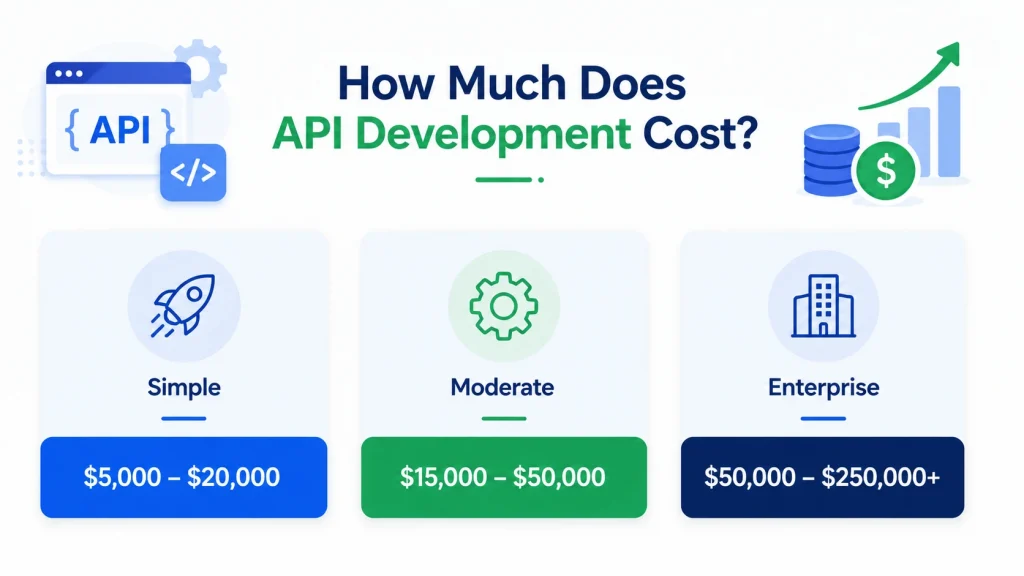
The cost of API development varies significantly based on complexity, features, and team location. Building an API is priced by scope rather than by hours alone. Here is a realistic breakdown to help you plan your budget.
| Complexity | Features Included | Timeline | Cost Range |
|---|---|---|---|
| Simple | Basic CRUD, minimal endpoints, standard auth | 2–4 weeks | $5,000–$20,000 |
| Moderate | User auth, rate limiting, multiple integrations, caching | 1–3 months | $15,000–$50,000 |
| Enterprise | Real-time updates, advanced security, microservices, high availability | 3–6+ months | $50,000–$250,000+ |
These ranges represent fully loaded costs, including design, development, testing, and deployment.
Three variables move the number most. Integration count drives testing effort, since every connected system requires custom mapping. Compliance scope adds specialized work, because HIPAA and PCI-DSS introduce audit and encryption obligations. Team location changes rates substantially between US-based and offshore engineering.
Annual maintenance typically runs 15 to 20 percent of your original build cost, covering security patches, dependency updates, infrastructure, and version support.
For a factor-by-factor breakdown including regional rate comparisons and hidden cost categories, see our complete API development cost analysis.
API Governance and Lifecycle Management
Most organizations do not fail at building their first API. They fail at managing their fortieth.
How do you prevent API sprawl?
API sprawl happens when teams ship endpoints independently with no shared catalog. Within two years, nobody knows how many APIs exist, which are still called, or who owns them.
Three practices contain it:
- Maintain a central API catalog with a named owner for every service.
- Require an OpenAPI specification before any endpoint reaches production.
- Enforce naming and versioning conventions through automated CI checks.
The cost of skipping this is not immediate. It arrives as an unfixable security audit finding three years later.
How do you build fault tolerance into an API?
Fault tolerance means your API keeps serving requests when a dependency fails rather than failing alongside it. Design for partial failure, because full uptime across every downstream service is not realistic.
- Retry logic with exponential backoff recovers from transient network failures without amplifying load.
- Circuit breakers stop calling a failing dependency after a threshold, then test recovery periodically.
- Graceful degradation returns cached or reduced data when a non-critical service is unavailable.
- Health checks expose a lightweight endpoint that load balancers poll to route traffic away from unhealthy instances.
- Exception handling catches errors at the service boundary so an unhandled failure never leaks a stack trace.
Retry logic requires idempotent endpoints to be safe. Retrying a POST that creates an order can produce duplicates unless the endpoint accepts an idempotency key.
Service availability targets should be written into your SLA and monitored continuously. A target that nobody measures is an intention rather than a commitment.
How do you deprecate an API responsibly?
Removing an endpoint that other systems depend on requires a defined process rather than an announcement.
- Announce deprecation with a firm sunset date, allowing 6 to 12 months minimum.
- Add a deprecation header to every response from the affected endpoint.
- Publish a migration guide showing old and new request patterns side by side.
- Monitor call volume to the deprecated version and contact remaining consumers directly.
- Return a clear 410 Gone response after sunset, rather than a silent 404.
The final point matters more than teams expect. A 404 suggests a typo. A 410 with a documentation link tells the caller exactly what happened.
Common Custom API Development Challenges and Solutions
Even experienced development teams encounter obstacles during API projects. Here are the most common challenges and practical solutions for each.
1. Handling versioning and backward compatibility
As your API evolves, existing consumers depend on current behavior. Introducing breaking changes without a versioning strategy disrupts all connected systems and damages developer trust. This is especially critical when undertaking API modernization services for legacy systems.
Solution
- Use URL-based versioning such as /v1/ and /v2/ for clear separation between versions.
- Maintain deprecated versions for a defined sunset period of 6 to 12 months minimum.
- Communicate changes through detailed changelogs and migration guides.
- Run automated backward compatibility tests before every release.
- Implement feature flags to gradually roll out new functionality.
2. Ensuring performance at scale
APIs that perform well with 100 users can fail under production loads of 10,000 concurrent requests. Performance bottlenecks surface at the worst possible moments, typically during peak traffic periods.
Solution
- Design database queries with indexing and query optimization from the start.
- Implement caching at multiple layers, including application, gateway, and CDN.
- Use connection pooling and asynchronous processing for heavy operations.
- Set up load testing early to identify bottlenecks before launch.
- Plan a horizontal scaling strategy with load balancers and auto-scaling groups.
3. Managing third-party dependencies
Custom APIs often need to connect with external services. When a third-party API changes its interface, raises prices, or goes offline, your system is directly affected.
Solution
- Abstract third-party integrations behind adapter patterns for easy replacement.
- Implement circuit breakers to handle external service failures gracefully.
- Cache external API responses where freshness requirements allow.
- Monitor third-party API status and performance continuously.
- Maintain fallback strategies for critical external dependencies.
4. Maintaining API documentation and developer experience
Poor documentation forces developers to waste time through trial and error. Without clear API references, onboarding new developers and maintaining integrations becomes significantly harder.
Solution
- Generate interactive documentation and schema definitions from OpenAPI specifications automatically.
- Publish sample requests in cURL alongside code examples in multiple programming languages.
- Ship an SDK or client libraries for your most common consumer languages to reduce integration time.
- Provide onboarding guides and a sandbox environment for testing without production consequences.
- Write clear error messages that tell developers exactly what went wrong and how to fix it.
- Keep documentation in sync with API changes through automated deployment pipelines.
5. Balancing security with developer experience
Strict security measures can slow down development workflows and create friction for API consumers. Finding the right balance between protection and usability is an ongoing challenge.
Solution
- Automate security checks within CI/CD pipelines so they do not block velocity.
- Provide clear, actionable error messages for authentication and authorization failures.
- Use API gateways to handle enforcement without adding complexity to application code.
- Offer sandbox environments with relaxed security for testing purposes.
- Document security requirements clearly so developers understand constraints upfront.
Overcoming these challenges requires both technical expertise and a structured approach. That makes partner selection a technical decision as much as a commercial one.
How do you handle pagination and caching?
Pagination limits how many records a single response returns, and caching prevents the server from recomputing responses it has already produced. Both protect performance as data volume grows.
Two pagination approaches dominate production APIs. Each suits a different data pattern.
| Approach | How it Works | Best For |
|---|---|---|
| Limit and offset | Skip a fixed number of rows, then return the next batch | Small, stable datasets |
| Cursor-based | Return records after a pointer from the previous page | Large or frequently changing datasets |
Offset pagination is simpler but degrades on large tables, because the database still scans skipped rows. Cursor pagination stays fast at any depth and avoids duplicate records when data changes mid-scroll.
Caching operates at several layers. HTTP caching uses ETag and Cache-Control headers so clients can skip repeat downloads. An in-memory cache such as Redis stores computed results server-side for reuse across requests.
Track cache hit ratio alongside your other metrics. A low hit ratio means the cache adds latency without saving work.
Poorly Versioned APIs Break Every Connected System
Building APIs since 2010, our engineers design versioning, security, and scaling strategy before a single endpoint ships. Get a technical roadmap first.
What to Look for in an API Development Partner
Custom API development enables businesses to connect disparate systems, automate critical data exchange, and build competitive advantages through purpose-built integrations. Choosing who builds it determines whether those advantages survive contact with production.
Four criteria separate capable partners from the rest.
- Documented architecture before code: A partner should produce an OpenAPI specification and a versioning plan before development starts. If the proposal jumps straight to timelines, design decisions are being deferred to whoever writes the first endpoint.
- Compliance experience in your specific industry: HIPAA, PCI-DSS, and SOC 2 each impose different obligations on API design. General security competence is not the same as having shipped under audit.
- A stated maintenance model: Ask what happens after launch. Confirm who applies security patches, who monitors error rates, and what the response time is when an endpoint fails overnight.
- Clear ownership terms: Confirm in writing that you own the code, the specification, and the documentation when the engagement ends.
Space-O Technologies has built custom software since 2010, backed by ISO 9001 and ISO 27001 certification. Our team of 140 or more in-house developers has served 1,200 or more clients across healthcare, fintech, and enterprise industries.
Our backend team builds secure, high-performance REST and GraphQL APIs using Node.js, Python, Java, and Go. Share your integration requirements and our API specialists will return an architecture recommendation, a project estimate, and a delivery timeline.
Frequently Asked Questions
Why is my API returning 401 or 403 errors even though my token looks correct?
A 401 Unauthorized error means the server could not verify your identity, while a 403 Forbidden error means your identity was verified but you do not have permission to perform the requested action. For 401 errors, verify the Authorization header format, token expiration, and whether the token belongs to the correct environment. For 403 errors, check that your user role or OAuth scopes include permission to access the requested resource.
How do I debug invalid or expired JWT tokens?
Decode the JWT and inspect the exp, iat, and nbf claims to ensure the token is valid based on the server’s clock. Also verify that the signing algorithm (such as HS256 or RS256), issuer (iss), and audience (aud) match your API’s authentication configuration.
What steps should I follow when my API works in Postman but fails in my frontend app?
Start by checking your CORS configuration because browsers enforce cross-origin policies while Postman does not. Ensure the server returns the correct Access-Control-Allow-Origin header. Then compare the browser’s Network tab with the Postman request to identify differences in headers, content type, authentication, or preflight OPTIONS requests.
Why am I getting 400 Bad Request or 422 Unprocessable Entity?
A 400 Bad Request means the server could not parse your request due to malformed JSON, missing headers, or invalid query parameters. A 422 Unprocessable Entity means the request format is correct, but the submitted values fail validation rules such as required fields, invalid dates, or unsupported enum values.
How do I systematically debug recurring 500 Internal Server Errors?
Assign a unique correlation ID to every request and trace it through application logs and downstream services. Record complete stack traces on the server while returning a generic error message to the client. If failures occur only on specific endpoints, investigate application logic. If they occur during peak traffic, review infrastructure resources and external service dependencies.
Why is my API timing out or slowing down under load?
Most API performance issues originate from inefficient database queries, missing indexes, or N+1 query patterns. Profile database performance first, then review connection pool settings to ensure they support expected concurrency. Long-running tasks should be processed asynchronously using background workers or message queues.
How do I implement rate limiting without breaking legitimate users?
Apply rate limits per authenticated user instead of per IP address whenever possible. A token bucket algorithm allows short bursts while preventing sustained abuse. Return standard response headers such as Retry-After and X-RateLimit-Remaining with HTTP 429 responses to help clients recover gracefully.
What should I check if my API returns different data between staging and production?
Compare environment variables, feature flags, API endpoints, and third-party integrations between staging and production. Also verify database migration status and dataset consistency, since outdated schemas or differently seeded databases frequently produce inconsistent results.
How should I version my API to avoid breaking existing clients?
Use URL-based versioning such as /v1/ and /v2/. Treat removing or renaming existing fields as breaking changes, while adding optional fields is generally backward compatible. Automated API contract testing should validate compatibility before every production release.
What are the most common API security mistakes and how do I avoid them?
The most common security issue is broken object-level authorization, where users can access resources that do not belong to them. Always verify ownership on every request. Additional best practices include limiting exposed data, enforcing authentication and authorization consistently, enabling rate limiting on authentication endpoints, and disabling debug endpoints in production.
How long does it take to build a custom API?
A simple custom API generally takes 2 to 4 weeks to develop. Mid-sized APIs with authentication, caching, and third-party integrations typically require 1 to 3 months. Enterprise-grade APIs with advanced integrations, security requirements, and compliance needs usually take 3 to 6 months or longer.
How much does it cost to develop an API?
API development costs typically range from $5,000 for basic APIs to more than $250,000 for enterprise-grade solutions. Most medium-complexity API projects fall between $15,000 and $50,000. Costs depend primarily on integration complexity, compliance requirements, architecture, and development team location. Businesses should also budget approximately 15% to 20% of the initial development cost annually for API maintenance and support.
Is API development difficult to learn?
API development is one of the more approachable areas of backend engineering because the core concepts are consistent across languages. A developer who knows one programming language can usually build a basic REST API within a few weeks. The difficulty scales with production requirements rather than with the fundamentals, since authentication, versioning, error handling, and performance tuning take considerably longer to master than routing and responses.
How do I develop my own API?
Start by defining what data or functionality the API will expose and who will consume it. Then design your endpoints and write an OpenAPI specification before coding. Build the endpoints in a framework you already know, such as Express, FastAPI, or Spring Boot, adding authentication and validation from the start. Test every endpoint, document it, then deploy behind HTTPS with monitoring in place.



 All our projects are secured by NDA




 4.8
4.8