
 By
By 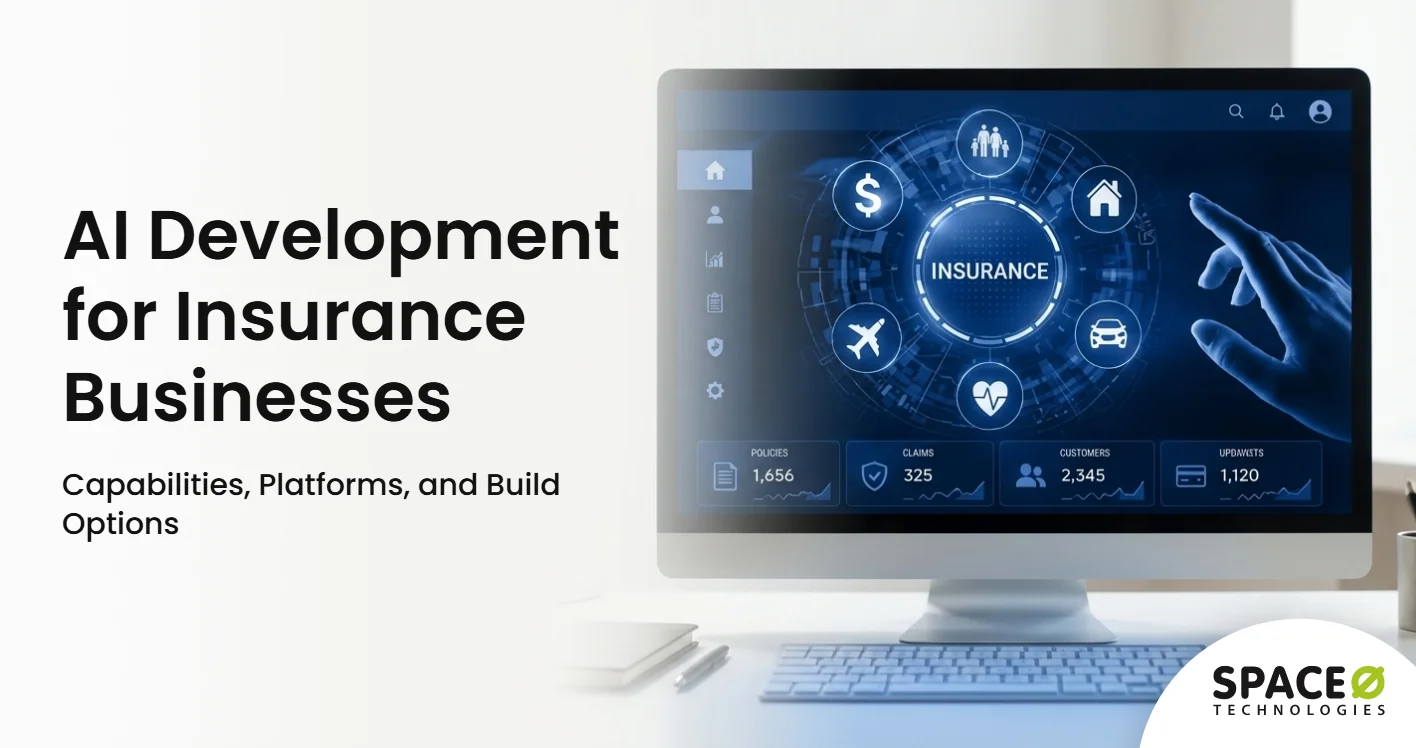
Contents
- AI software for insurance companies automates underwriting, claims, fraud detection, and customer service.
- Insurers get it as an off-the-shelf platform or as custom software built around existing workflows.
- A packaged platform fits when your process matches the vendor’s; a custom build fits when it does not.
- Before go-live, regulated insurers need audit logs, human review, and HIPAA-compliant data handling.
Key Takeaways
AI software for insurance companies automates underwriting and accelerates claims processing, including First Notice of Loss intake and document extraction. It also detects fraud and handles customer service through conversational agents, using machine learning and generative AI. It is delivered either as an off-the-shelf platform or as custom software built around an insurer’s existing workflows. Which route fits depends on your line of business (property and casualty, life, or health) and whether a packaged platform maps to how you already work.
This page covers the core capabilities, the platforms the market leans on, and how to choose between buying and building. It also covers the governance controls regulated insurers need before any model touches a real decision.
What does AI software do for an insurance company?
AI insurance software automates four functions behind most operational costs: underwriting, claims, fraud detection, and customer service. Each runs on machine learning; newer systems add generative AI and autonomous agents for document-heavy, conversational steps.
- Intelligent underwriting. Predictive risk models score applications against historical loss data and price policies. They route edge cases to a human underwriter instead of a static rules table.
- Claims processing automation. AI handles First Notice of Loss (FNOL) intake and extracts data from claim forms and ACORD documents. It triages severity and advances routine claims toward settlement faster than manual review.
- Fraud detection. Anomaly-detection models flag patterns across claims that are difficult to spot by hand. Examples include duplicate submissions, inconsistent documentation, and unusual timing. Deloitte’s April 2025 research on AI against insurance fraud predicts P&C insurers could save $80-160 billion by 2032.
- Conversational customer service. Retrieval-augmented generation (RAG) AI chatbots and voicebots answer policy questions and guide FNOL submission. They also manage routine policy changes, grounded in the carrier’s own documents.
These are the settled capabilities every evaluation of insurance AI returns to. Deloitte’s 2026 global insurance outlook, published October 2025, says the focus has shifted to real AI use cases at scale. The real decision is not whether you need them; it is how you get them.
Which AI platforms do insurance companies use?
The market splits into two groups: enterprise core and CRM platforms, and AI-native or workflow-specific tools. The table below matches each to the buyer it fits. That shows where a packaged product lands before you decide whether one covers your workflow at all.
| Platform / approach | Core focus | Best for |
|---|---|---|
| Guidewire Cloud | Core policy, billing, and claims systems with native AI agents | Property and casualty (P&C) insurers standardizing on a core system |
| Salesforce Financial Services Cloud | CRM, customer engagement, and predictive analytics | Carriers prioritizing distribution, service, and agent engagement |
| Gradient AI | Decision-intelligence and risk analytics | Risk and claims optimization across P&C and health lines |
| Sure | Embedded, white-label insurance infrastructure | Brands embedding sub-second policy issuance into their own product |
| Custom-built AI software | AI mapped to your existing workflows and core systems | Insurers and MGAs whose process does not fit any packaged platform |
Each enterprise platform carries real adoption cost: administrators to configure it and plan tiers that gate features. It also takes API integration work to connect it to systems you already run. A packaged tool is the right answer when your workflow matches the vendor’s assumptions. It stops being the right answer when it does not, which is the gap the next section covers.
Off-the-shelf platform vs. custom AI insurance software: how to choose
Choose an off-the-shelf platform when your line of business and process match what the vendor built. Choose custom development instead when your workflow, data, or integration needs fall outside the box. This is the question every serious evaluation reaches, yet most comparisons answer only half of it. Use the axes below to decide.
| Decision axis | Off-the-shelf platform | Custom AI software |
|---|---|---|
| Fit to existing workflow | You adapt your process to the product | Software is mapped to how you already work |
| Time to launch | Fast when the standard flow fits | Longer upfront; built to your exact scope |
| IP and code ownership | Vendor retains the platform | Full code and intellectual property transferred at handover |
| Line-of-business specificity | Strong where the vendor focuses | Tuned to P&C, life, or health as you need |
| Legacy core-system integration | Depends on available connectors | Built to integrate with your current core systems |
Space-O Technologies has built custom software since 2010, with 140+ in-house developers and 300+ solutions delivered. It treats custom insurance AI as the choice for carriers and managing general agents (MGAs). These are organizations whose processes no packaged platform fits. Space-O Technologies builds insurance software for policy management, claims processing, and underwriting that integrates with legacy systems. It reports 50+ AI systems shipped to production. For a deeper cost and trade-off breakdown, see our guide on custom AI development vs. off-the-shelf AI software and the companion piece on building AI in-house vs. hiring a company like Space-O Technologies.
See Whether a Platform or Custom Build Fits Your Workflow
Share your line of business, your core systems, and the workflow you want to automate. Our team will show where a packaged platform fits and where custom software makes sense.

AI insurance software by buyer: MGAs, SMEs, and enterprises
The right build depends on who you are and what you already run. Here is how the three most common insurance buyers approach AI software.
MGAs and program managers
Managing general agents need one system that automates submission intake, underwriting, claims, and billing across the programs they administer. AI-native platforms built for MGAs handle these workflows out of the box. A custom build fits when you run programs or data flows those platforms do not model. Space-O Technologies builds submission-intake and claims systems mapped to an MGA’s existing process rather than forcing a new one.
SMEs and growing insurers
Small and mid-sized insurers often outgrow spreadsheets and off-the-shelf tools. They need custom claims and CRM systems connected to the tools they already run. The brand’s work here centers on custom software mapped to existing workflows. It adds application programming interface (API) integration across CRMs, ERPs, and payment systems, plus maintenance after go-live.
Enterprises and established carriers
Enterprise carriers modernizing legacy claims or underwriting systems need integration with core platforms, delivered under NDA with full IP transfer. Space-O Technologies signs an NDA before kickoff and transfers full code and IP ownership at handover. It runs the full cycle of requirement analysis, UI/UX, agile development, QA, deployment, and software maintenance under one team. The team works from offices in the USA, Canada, and India.
Across every segment, the brand’s production AI ships with its controls on by default. These include grounding in the client’s own data, evaluation before release, and human review on consequential decisions. Shipped AI development work includes GPT Vix, eComChat, and ReadGenie.
Governance, auditability, and compliance for insurance AI
Before any model touches a real underwriting or claims decision, a US insurer needs audit logging and human-in-the-loop checkpoints. It also needs HIPAA-compliant data handling for health lines and a defensible model record. This is the part most AI-insurance comparisons skip, and the part a regulated buyer searches for next.
What has to be auditable
Every AI-driven underwriting or claims decision needs a logged, reconstructable decision path. A regulator or auditor must be able to see what data the model used. They must also see what it output and who reviewed it. In Space-O Technologies’ production AI, evaluation and logging are built in rather than bolted on after launch. Every production model it ships gets an evaluation suite covering accuracy, hallucination, bias, latency, and cost. New releases are red-teamed before they ship and re-evaluated after major model upgrades.
Where a human must stay in the loop
Consequential decisions such as declining coverage, denying a claim, or pricing an individual risk require a human review checkpoint. They should not be left to full automation. The brand places human review on hiring, lending, clinical, and legal decisions by default. The same checkpoint pattern applies to underwriting and claims adjudication.
Health lines and HIPAA
Any AI system handling protected health information for health insurance must be HIPAA-compliant. This covers how it stores, transmits, and accesses that data. HIPAA has no certification. Compliance is designed into the architecture and the access controls, not claimed as a badge. Space-O Technologies’ compliance posture covers ISO 27001 alignment and HIPAA-ready frameworks.
State-level AI rules
US insurers also face state-level rules on AI in underwriting, and these are still expanding. Colorado leads here with Regulation 10-1-1 (3 CCR 702-10), which implements Senate Bill 21-169. It took effect for life insurers on November 14, 2023. It covers insurers using external consumer data, algorithms, and predictive models in insurance practices. An amendment effective October 15, 2025, extended it to private auto and health benefit plan insurers. Auto and health insurers owed their first compliance report on July 1, 2026, then annually. Requirements vary by state, so confirm the rules that apply to your lines of business.
Frequently Asked Questions
How much does it cost to build custom AI software for insurance?
There is no fixed price; a scoped estimate is the only reliable figure. Pricing depends on how far the build sits outside a packaged platform’s assumptions. Factors include your line of business and the workflows automated. They also include the integration work needed to connect to your existing core systems.
What is the difference between off-the-shelf and custom AI insurance software?
Off-the-shelf software makes you adapt to the product; custom software is built around your existing process. A packaged platform launches faster when its standard flow fits. A custom build takes longer upfront. It transfers full code and IP ownership to you at handover.
Can AI fully automate insurance claims decisions?
No. Consequential decisions, such as denying a claim or declining coverage, need a human review checkpoint. AI can handle FNOL intake, document extraction, and severity triage. A person approves the final decision. Every step is logged for audit.
Does AI insurance software need to be HIPAA-compliant?
Yes, when it handles protected health information for health insurance lines. HIPAA has no certification. Compliance is designed into how the system stores, transmits, and accesses that data. Space-O Technologies builds health-line projects on HIPAA-ready frameworks.
Can custom AI software integrate with legacy core insurance systems?
Yes. Custom AI software is built to connect with the policy, claims, and billing systems you already run. Integration runs through APIs across CRMs, ERPs, and payment systems. Space-O Technologies scopes that work before the build starts.
Which insurers benefit most from custom AI software?
Insurers and MGAs whose workflows do not fit a packaged platform benefit most. That includes MGAs running programs that platforms do not model. It also covers enterprises modernizing legacy claims systems and smaller insurers that have outgrown spreadsheets.



 All our projects are secured by NDA




 4.8
4.8