
 By
Contents
- Write the Definition of Done and document the manual process before choosing any model.
- Start with 2-3 tools behind strict schemas, sandboxing, and least-privilege access.
- Roll out in three stages: Shadow Operation, Approval-Gated Pilot, then Bounded Production.
- Budget 15%-25% of the original build cost every year for maintenance after launch.
Key Takeaways
AI agent development is a step-by-step process from a clear goal to a tool-using agent. It runs in six steps: scope, architecture, context, tools, testing, and deployment. Space-O Technologies has built custom software since 2010.
The AI Agent Development Lifecycle (ADLC) governs how teams build, test, and run agents. Most step lists stop at launch, which leaves leaders asking about cost and ownership. Our custom AI agent development teams plan for those questions from discovery onward.
Below are six build steps, each with three practical controls. Five lifecycle phases follow, then cost, ownership, and a go/no-go checklist. Our AI agent development guide explains agent types if you are still choosing one.
Step 1: Define the Goal, Scope, and Definition of Done
Step 1 sets the business outcome, the scope, and a Definition of Done before anyone picks a technology. Without a written finish line, testing has nothing to measure against, and scope keeps growing. Define outcomes first, and technical requirements follow from them. Gartner predicts over 40% of agentic AI projects will be canceled by the end of 2027.
- Write the Definition of Done: List the agent’s inputs, expected outputs, and boundaries, so reviewers can tell when a task is complete.
- Document the manual process: Capture the current Standard Operating Procedure (SOP) step by step, including exceptions and who approves them today.
- Set the autonomy level early: Choose between a low-autonomy structured assistant and a goal-driven agent, and record which actions always need a person.
Once the outcome and boundaries are on paper, our AI development services team can scope the technology quickly.
Step 2: Choose the LLM and Agent Architecture
Step 2 pairs a large language model (LLM) with an orchestration framework that runs the agent’s reasoning loop. A poor pairing shows up later as brittle tool calls and expensive rework. Pick the stack for the workflow you mapped in Step 1, not for a demo.
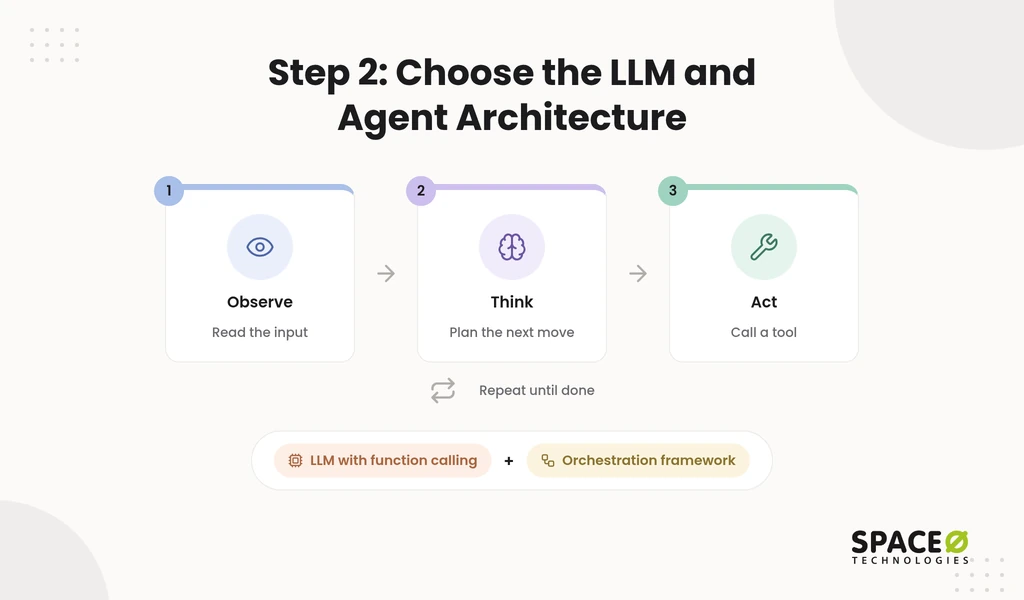
- Pick an LLM with function calling: Models from OpenAI and Claude call tools through structured function calls, which agents need to take action.
- Choose an orchestration framework: LangChain covers common agent patterns, while LangGraph models multi-step, stateful flows as a graph with explicit branches.
- Design the Observe → Think → Act loop: The agent observes the input, reasons about its next move, acts through a tool, then repeats.
Our comparison of AI agent frameworks covers the trade-offs in more depth. With the engine chosen, the agent still needs to learn your business.
Step 3: Add Context and Memory
Step 3 gives the agent its instructions, your company knowledge, and a record of what already happened. A capable model with no context still produces generic answers your team cannot use. This step closes that gap.
- Write a precise system prompt: Define the agent’s role, objective, boundaries, and tone in plain language, and version it like code.
- Ground answers with RAG: Retrieval-augmented generation (RAG) pulls approved documents from a vector database such as Pinecone when the agent needs them.
- Separate short- and long-term memory: Short-term memory holds the current task, while long-term memory stores durable facts across sessions.
Context makes the agent useful, and our generative AI development services team builds the RAG pipelines behind it. Tools make it able to act, which is where risk enters.
Step 4: Connect Tools and APIs Safely
Step 4 connects the agent to your systems through a small set of tightly controlled tools. Every new tool widens what the agent can break, so access has to be earned. Start narrow and widen only with evidence.
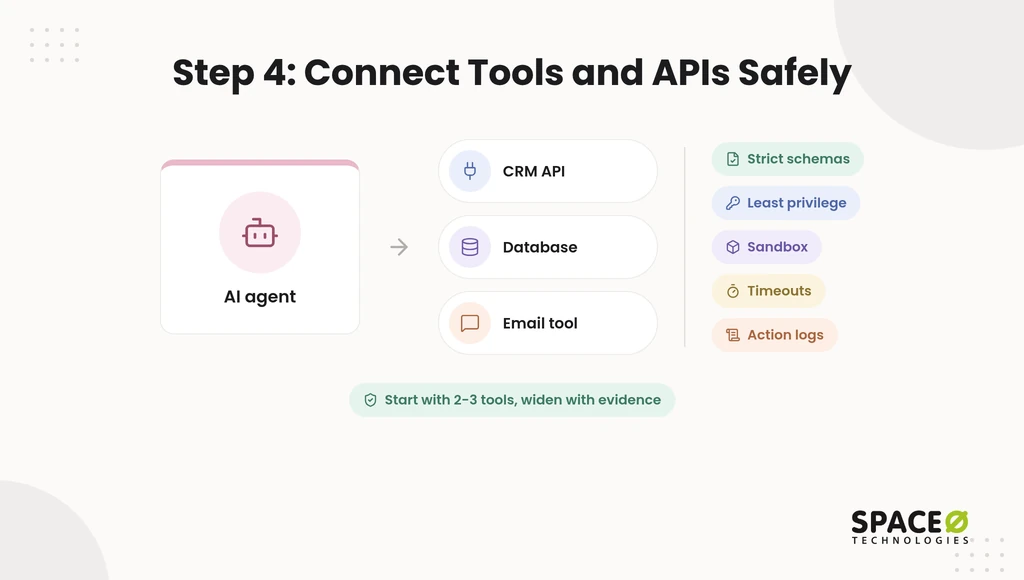
- Start with 2-3 tools: Add more only after the first set passes testing, which keeps failures easy to trace back.
- Enforce strict tool schemas: Define exact input and output formats for each application programming interface (API), so malformed calls fail fast.
- Contain risky actions: Sandbox code-execution and data-mutation tools, grant least-privilege access, set strict timeouts, and log every action.
Our AI agent security best practices cover access and deployment controls in detail. With tools connected, the agent is ready for structured testing.
Step 5: Test, Evaluate, and Add Human Review
Step 5 proves the agent behaves correctly before real users or real data depend on it. Agents are probabilistic, so one good demo says little about the next thousand runs. Testing has to cover normal work, edge cases, and deliberate attacks.
- Begin with 5-10 test cases: Cover the common path, the edge cases, and the exceptions your SOP documented in Step 1.
- Run scenario and adversarial tests: Use the NIST AI Risk Management Framework and the OWASP Agentic AI Top 10 as guardrail references.
- Keep humans in the loop: Route actions to human approval for the first 30 days, and escalate to a person when confidence drops.
Monitor errors, token usage, and API failures with LangSmith and Sentry from the first test run. We apply responsible AI by default. We never train on client data, and we mask personally identifiable information (PII). We also test every production model for accuracy, hallucination, bias, latency, and cost.
Our machine learning development services team tests trained models against real-world conditions before deployment. When results hold steady across runs, deployment can begin in controlled stages.
Step 6: Deploy and Scale in Stages
Step 6 packages the agent, hosts it, and widens its authority in three controlled stages. A full launch on day one turns small errors into business incidents. A staged rollout lets the agent earn trust with evidence.
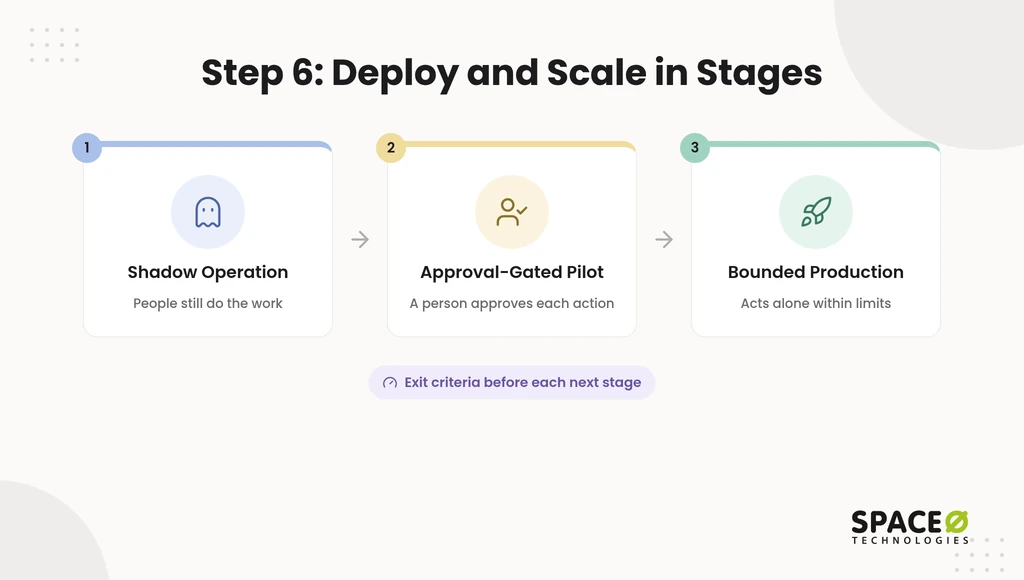
In Shadow Operation, the agent runs on live inputs while people still do the work. In the Approval-Gated Pilot, the agent acts only after a person approves each action. In Bounded Production, it acts alone within set limits on volume, value, and scope.
- Containerize and host: Package the agent with Docker, serve it through FastAPI, and run event-driven workloads on AWS Lambda where they fit.
- Set exit criteria per stage: Agree in advance on the error rate and reviewer agreement each stage must reach before the next begins.
- Expand scope gradually: Add processes, tools, or multi-agent workflows one at a time, only after the current stage meets its criteria.
Those six steps build the agent, and dedicated AI developers can carry it through production deployment. Business owners also need a governance view of the same work, which the lifecycle provides.
AI Agent Development Lifecycle for Business: The Five ADLC Phases
The AI agent development lifecycle for business runs through five phases, from discovery to continuous monitoring. Leaders need to know who signs off on each phase and what proves it is done. Deloitte predicts 25% of gen AI companies will launch agentic AI pilots in 2025 and 50% by 2027. The table maps each ADLC phase to the build steps above.
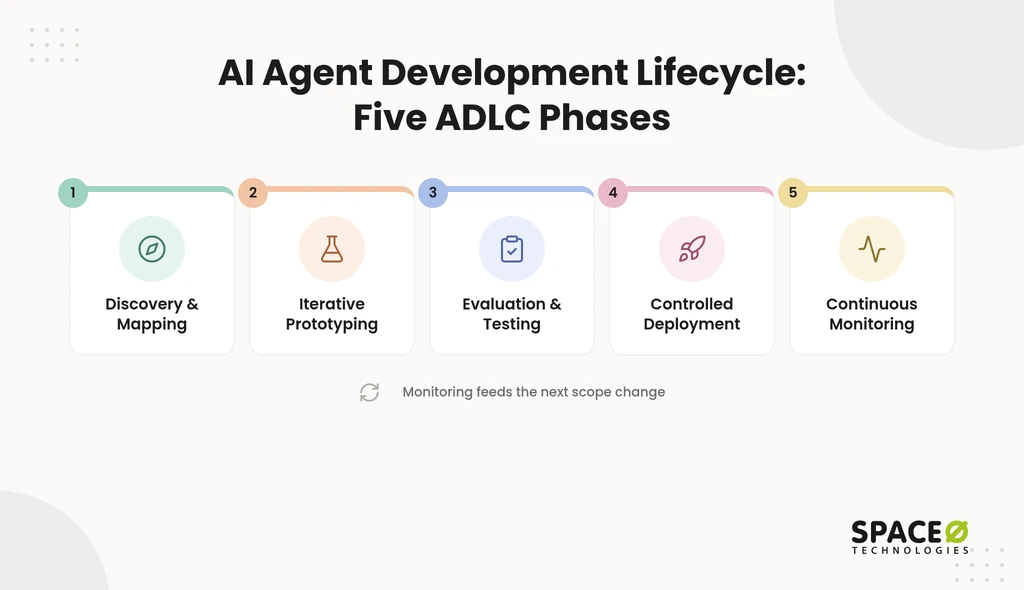
| ADLC phase | Business goal | Exit criteria | Owner | Build steps |
|---|---|---|---|---|
| Conception, Discovery & Mapping | Tie the agent to one measurable outcome | Definition of Done, SOP, and autonomy level signed off | Business sponsor and process owner | Step 1 |
| Design & Iterative Prototyping | Prove the loop works on real tasks | Prototype completes core cases with grounded answers and 2-3 tools | Engineering lead | Steps 2-4 |
| Rigorous Evaluation & Testing | Prove safe, repeatable behavior | Test cases, adversarial results, and human review findings accepted | Quality and risk lead | Step 5 |
| Controlled Deployment & Orchestration | Earn authority in stages | Each of the three rollout stages meets its exit criteria | Engineering lead with process owner | Step 6 |
| Continuous Monitoring & Optimization (AgentOps) | Keep performance and cost within bounds | Ongoing, with a go/no-go review before each scope change | Process owner | Step 7 |
The fifth phase never formally ends, and it is where ownership costs build up. Step 7 covers that phase in detail.
Not Sure Which Process to Automate First?
Our AI consulting team maps your manual process, sets the autonomy level, and defines exit criteria before any build, so your first agent targets a measurable outcome.

Step 7: Run It in Production (Cost, Ownership, and Go/No-Go)
Step 7 treats the agent as a product you own, with a budget, named reviewers, and a go/no-go gate. Launch starts the ownership period rather than ending the project. Agent operations (AgentOps) tracks drift, policy violations, and error rate. It also versions prompts, toolsets, and reasoning rules, not just code.
What it costs to own an agent after launch
Annual maintenance for an AI build typically costs 15%-25% of the original development cost. This range comes from our AI development cost research. Infrastructure, API usage, and maintenance all add to the total. Plan each one as a separate budget line, because each one grows for a different reason.
| Cost line | What drives it | How to budget it |
|---|---|---|
| Maintenance | Bug fixes, updates, and security patches | 15%-25% of build cost per year |
| Monitoring and AgentOps | Drift, policy violation, and error-rate tracking | Fixed monthly effort per agent |
| Model and prompt updates | Model version changes and prompt tuning | Versioned releases, tested before rollout |
| Tool and API changes | Upstream systems changing their schemas | Engineering time per connected system |
| Governance and human review | Reviewer hours on sampled and gated actions | Reviewer time per approved action |
| LLM tokens | Task volume and reasoning steps per task | Billed by the LLM provider per token |
| Hosting | Compute, storage, and traffic | Billed by the cloud provider based on usage |
The example below prices the three largest lines for a $100,000 build. The token and infrastructure figures are illustrative planning estimates, not a measured bill from one live agent.
| Line | Low case | High case |
|---|---|---|
| Maintenance (15% / 25% of build) | $1,250/month | $2,083/month |
| LLM tokens | $500/month | $5,000+/month |
| Infrastructure | $200/month | $2,000+/month |
| Monthly total | $1,950 | $9,083+ |
| Annual total | $23,400 | $109,000+ |
At this scale, maintenance accounts for $15,000-$25,000 of the annual total, which matches the 15%-25% range above. Token and infrastructure spend sits on top and grows with task volume.
Ownership is settled before the build starts. We sign an NDA before the project begins. All source code, data, and IP (intellectual property) built during the project transfer to you at completion.
Human review checkpoints for high-stakes decisions
Human review checkpoints stay on by default for lending, clinical, and other high-stakes decisions. High-stakes outputs in finance or healthcare need stricter accuracy testing and often human review. Automation handles the volume, but a qualified human approves before any output influences a final decision. Our compliance posture covers HIPAA-ready frameworks for healthcare AI engagements.
In a lending workflow, the agent only drafts an approve-or-decline recommendation with its reasoning. A human underwriter then signs off on every case above the exposure threshold.
Go/no-go checklist before you expand scope
Expand the agent’s scope only when every item below holds.
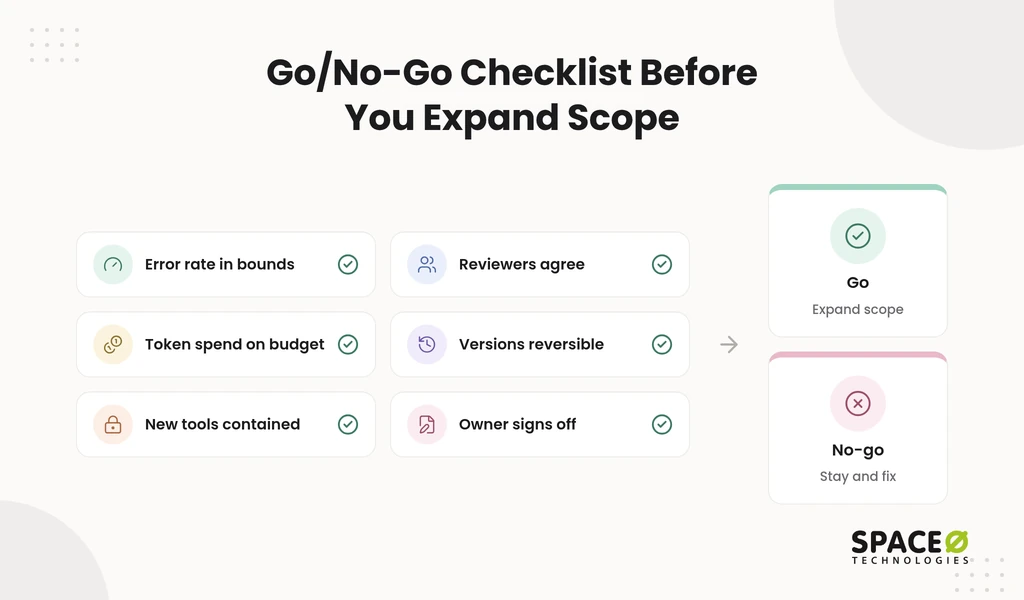
- Error rate and policy violations stay within the thresholds set in Phase 1.
- Human reviewers agree with the agent’s actions on sampled cases.
- Token spend per completed task stays inside the agreed budget.
- Prompt, toolset, and reasoning-rule versions are logged and reversible.
- Each new tool carries least-privilege access, timeouts, and sandboxing.
- The process owner signs off on the wider scope in writing.
If any item fails, the agent stays at its current stage while the team fixes the cause. That gate is also the clearest place to see how agent work differs from ordinary software work.
ADLC vs. SDLC: What Changes for AI Agents
A traditional software development lifecycle (SDLC) ships deterministic code, while the ADLC governs probabilistic agents. A team running an agent like a normal release will under-test it and under-budget it. The differences show up in five places.
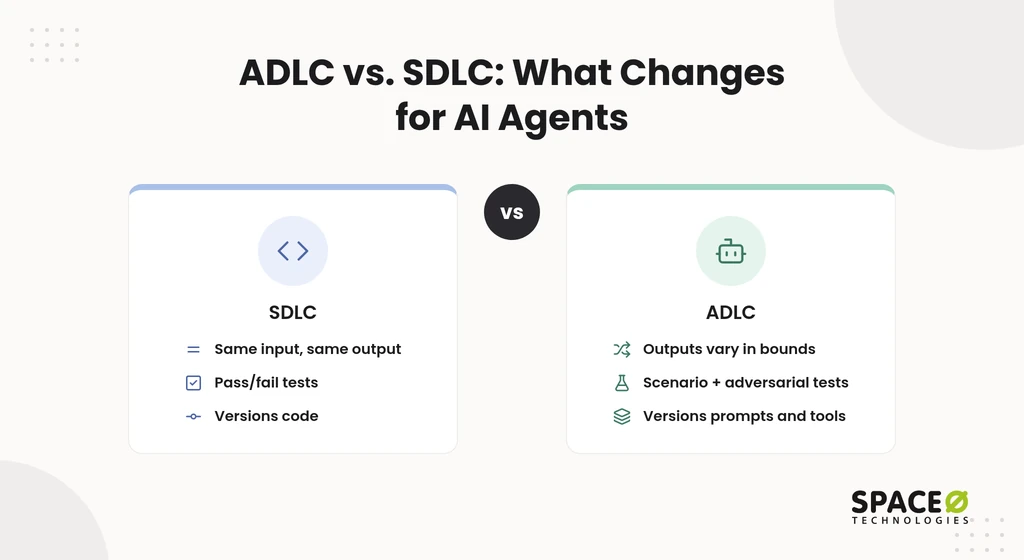
| Dimension | SDLC | ADLC |
|---|---|---|
| Behavior | Deterministic: same input, same output | Probabilistic: outputs vary within boundaries |
| Definition of done | Features shipped to specification | Business outcome reached within set boundaries |
| Testing | Pass/fail unit and integration tests | Scenario, adversarial, and human-reviewed evaluation |
| What gets versioned | Code | Code, prompts, toolsets, and reasoning rules |
| After launch | Maintenance releases | AgentOps monitoring for drift and policy violations |
Our guide to AI software development shows how AI changes each SDLC stage. The ADLC adds steps to the process because the agent makes decisions. That also shapes who you should build it with.
How to Choose an AI Agent Development Partner
Choose a delivery model that can own discovery through maintenance, because an agent’s cost and risk continue after launch. Many teams can build a prototype. Fewer can run it safely for years. Compare your options on the axes that matter after go-live.
| Factor | Build in-house | Staff augmentation | Full-cycle partner |
|---|---|---|---|
| Discovery to maintenance | Your team owns every phase and every hire | You own the process; added engineers join your sprints | One team covers discovery, build, rollout, and AgentOps |
| Production AI experience | Depends on who you can hire | Depends on the engineers you select | Ask for live production systems, not demos |
| Responsible AI controls | You design and enforce them | You set them; engineers follow your policies | Default controls on data, PII, testing, and human review |
| Code and IP ownership | Yours by default | Yours, as set in the contract | Confirm full transfer at completion, in writing |
| Confidentiality | Internal policies | Contract terms per engineer | NDA signed before the project starts |
| Engagement flexibility | Fixed headcount | Scale engineers up or down | Dedicated team, time and material, or fixed cost |
Building in-house fits teams that already employ AI engineers and own the process end to end. Space-O Technologies works as a full-cycle partner or adds engineers to your team. We offer four engagement models: Dedicated Team, Time & Material, Fixed Cost, and Staff Augmentation.
If you only need capacity, you can hire AI agent developers from our 140+ in-house developers. We report 97% client retention.
Start With One Process and a Clear Oversight Level
The fastest route to a production agent is one well-mapped business process with a defined level of human oversight. Before your first call with any team, answer two questions:
- Decide which business process the agent should handle first.
- Decide what level of human oversight that process needs.
Share those answers with our team and get a free, expert-reviewed estimate with a phased rollout plan.
Frequently Asked Questions
What are the four main components of an AI agent?
An agent combines a large language model (LLM), instructions and knowledge, memory, and tools connected through APIs. Together, they run a loop: observe the input, think through the next move, act with a tool, and repeat.
What can an AI agent do that a basic chatbot cannot?
An AI agent can reason about its next move and act through connected tools and APIs. It keeps short-term memory for the current task and long-term memory for durable facts across sessions. Once it has proven itself, it can act alone in Bounded Production within set limits on volume, value, and scope.
Can AI agents work together?
Yes, multi-agent workflows are possible. Add them one at a time, and only after the current rollout stage meets its agreed exit criteria.
What do I need in place before starting to build an AI agent?
Before building, write a Definition of Done that sets out the agent’s inputs, expected outputs, and boundaries. Document the current manual process as a Standard Operating Procedure (SOP), including exceptions and who approves them today. Also choose the autonomy level and record which actions always require a person.
What technology stack do I need to build a first AI agent?
A typical stack pairs a function-calling LLM, such as OpenAI or Claude models, with LangChain or LangGraph. For RAG, a vector database such as Pinecone holds the approved documents. Deployment commonly uses Docker, FastAPI, and AWS Lambda for event-driven workloads. LangSmith and Sentry monitor errors, token usage, and API failures.
How to make an AI agent for beginners?
Start small: pick one narrow process and write down what done looks like. Choose an LLM and framework, write a precise system prompt, and connect only 2-3 tools with strict schemas. Run 5-10 test cases, then keep a human approving the agent’s actions for the first 30 days.
How do I add a new tool to an agent that is already running?
Add it only after the current toolset passes testing, so failures stay easy to trace. Define strict schemas for the API, grant least-privilege access, set timeouts, sandbox risky actions, and log every action. Then confirm the go/no-go checklist still holds and have the process owner sign off on the wider scope.
How much does it cost to maintain an AI agent after launch?
Plan for 15%-25% of the original build cost per year for maintenance. LLM tokens and hosting are billed separately and grow with task volume.



 All our projects are secured by NDA




 4.8


