
 By

Contents
- Define a strict ICP and clean your CRM data before automating any sales step.
- Give each agent one funnel stage: top-of-funnel work first, with people leading late-stage deals.
- Connect the agent to your CRM and intent signals so it skips current clients.
- Plan yearly maintenance after launch, and route high-intent leads to a rep with full context.
Key Takeaways
AI sales agent development for B2B teams automates prospecting, enrichment, and first-touch outreach. It needs a strict ideal customer profile (ICP) and clean data first. Our AI agent development team builds each agent around one defined funnel stage.
Most teams automate first and fix data later. That order produces vague outreach at machine speed and weak lead scores. Our custom CRM development work fixes record ownership before any agent goes live.
Space-O Technologies has built custom software since 2010 for 1,200+ clients. This guide covers ICP, funnel stages, CRM sync, handoff rules, and running costs. It also answers what an AI lead qualification agent does.
Start With Your ICP and Clean Data
Define a strict ICP and clean your data before you automate any sales step. Many B2B sales teams start with the agent and fix data later. That order fails. Dirty data and a loose ICP often cause poor agent performance.
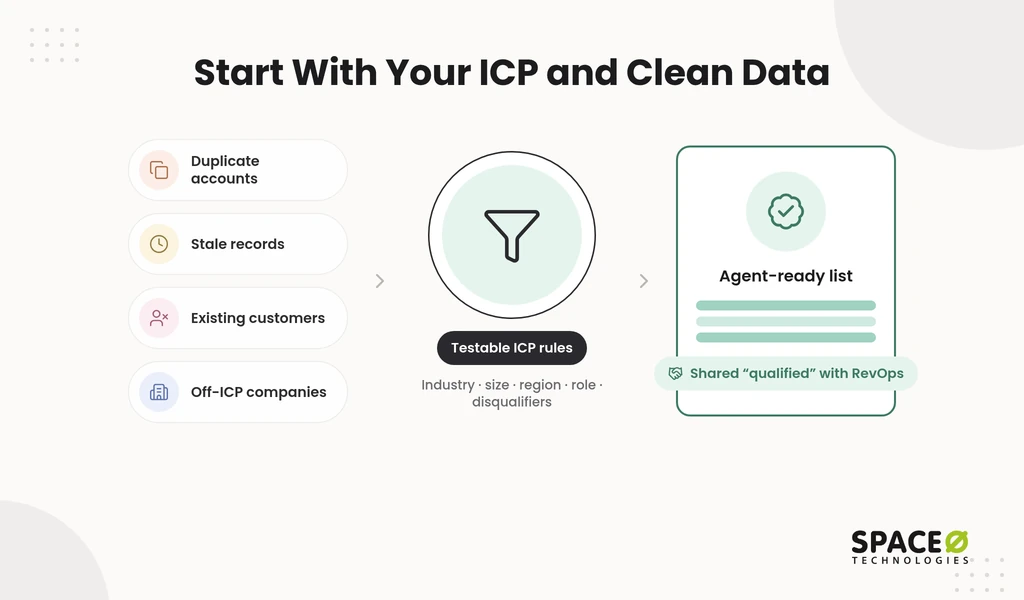
- ICP rules: Write your ICP as rules the agent can test, including industry, company size, region, buying role, and hard disqualifiers. Vague targeting produces vague outreach at machine speed.
- Data hygiene: Remove duplicate accounts, fix record ownership, and flag every existing customer. An agent cannot tell a clean record from a stale one.
- Shared definition: Agree with revenue operations (RevOps) on what “qualified” means before launch. Your agent’s scoring then matches how your reps already judge a lead.
Map AI Agents to Funnel Stage
AI agents fit high-volume top-of-funnel work, support mid-funnel steps, and leave late-stage deals to people. Problems start when one agent is asked to do everything. Mapping each stage first sets clear limits on what the agent handles.
| Funnel stage | Agent role | Human role |
|---|---|---|
| Top of funnel | Inbound qualification, FAQ answers, and meeting booking | Reviews scoring rules and exceptions |
| Mid-funnel | Augments reps by drafting proposals, monitoring deals, and sending follow-ups | Owns the relationship and approves outbound content |
| Late stage | Supplies research and deal context on request | Leads negotiation and executive relationships |
What Is an AI Lead Qualification Agent?
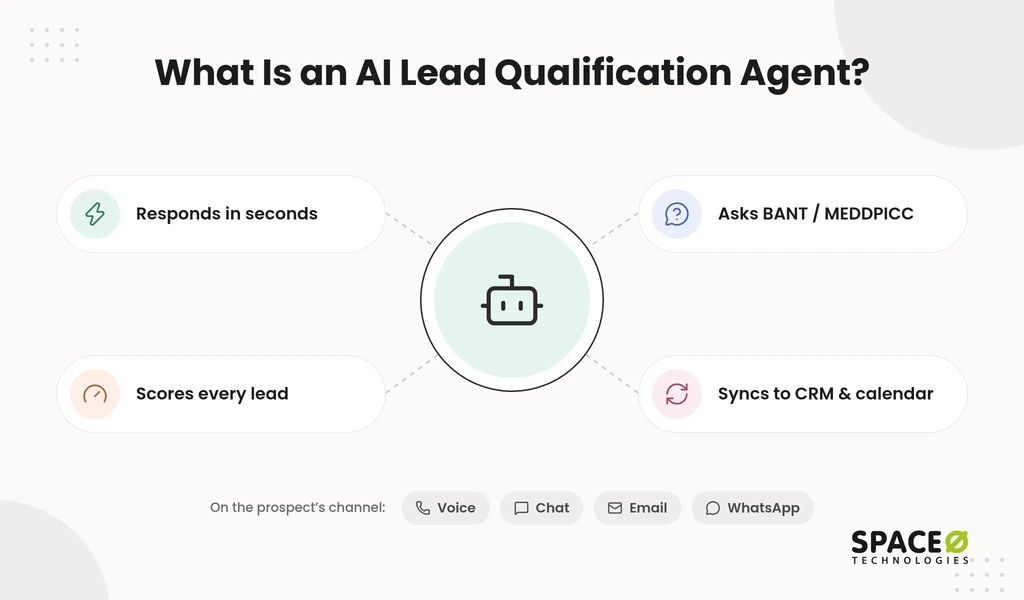
An AI lead qualification agent is an autonomous software system that evaluates, scores, and routes inbound prospects in real time. It sits in the top-of-funnel tier. It works across voice, chat, email, and WhatsApp, so a prospect gets an answer on the channel they chose.
Core capabilities
A qualification agent does four jobs: it responds, scores, asks, and syncs.
- Instant engagement: It responds to a new inbound lead within seconds, day or night. A prospect who fills in a form late at night gets a reply right away.
- Dynamic scoring: It combines firmographic signals, such as company size and industry, with behavioral signals, such as pages viewed or replies. Each lead gets a priority score.
- Framework evaluation: It asks BANT-style (budget, authority, need, timeline) or MEDDPICC-style discovery questions. It records the answers against your qualification criteria.
- CRM and tool sync: It logs transcripts and lead fields to your CRM. It sends Slack alerts and books meetings directly on the rep’s calendar.
Popular platforms and tools
Packaged qualification platforms exist, and each one works within its own configuration limits. Examples include Microsoft Dynamics 365 Sales Qualification Agent, Patagon AI, ElevenLabs, JustCall AI Voice Agent, and Lyzr. Adopting one means fitting your process to its connectors, settings, and plan structure. Teams with custom CRM objects or their own scoring logic should check that fit before signing.
Off-the-Shelf Agents vs a Custom-Built Agent
Off-the-shelf agents run on vendor defaults, while a custom-built agent runs on your CRM data and your rules. Many teams weigh custom AI development vs. off-the-shelf tools once qualification logic gets specific. The deciding factors are integration depth, ownership, and control.
| Factor | Off-the-shelf agent | Custom-built agent |
|---|---|---|
| CRM and ERP fit | Limited to the vendor’s pre-built connectors | Built natively against your CRM and ERP data model |
| Code and IP ownership | You license access; the vendor owns the software | All source code, data, and IP transfer to you at completion |
| Qualification rules | Configured within the vendor’s available options | Your own scoring, routing, and disqualification logic |
| Confidentiality | Governed by the vendor’s standard terms | NDA signed before the project starts |
| Commercial model | Subscription plans and tiers set by the vendor | Dedicated Team, Time & Material, Fixed Cost, or Staff Augmentation |
Space-O Technologies’ 140+ in-house developers build custom sales agents on your CRM data and rules.
Connect CRM and Intent Signals
Connect the agent to your CRM and to intent signals so it contacts the right accounts and skips current clients. An agent without CRM access may cold-email a customer you closed last quarter. That mistake costs trust quickly.
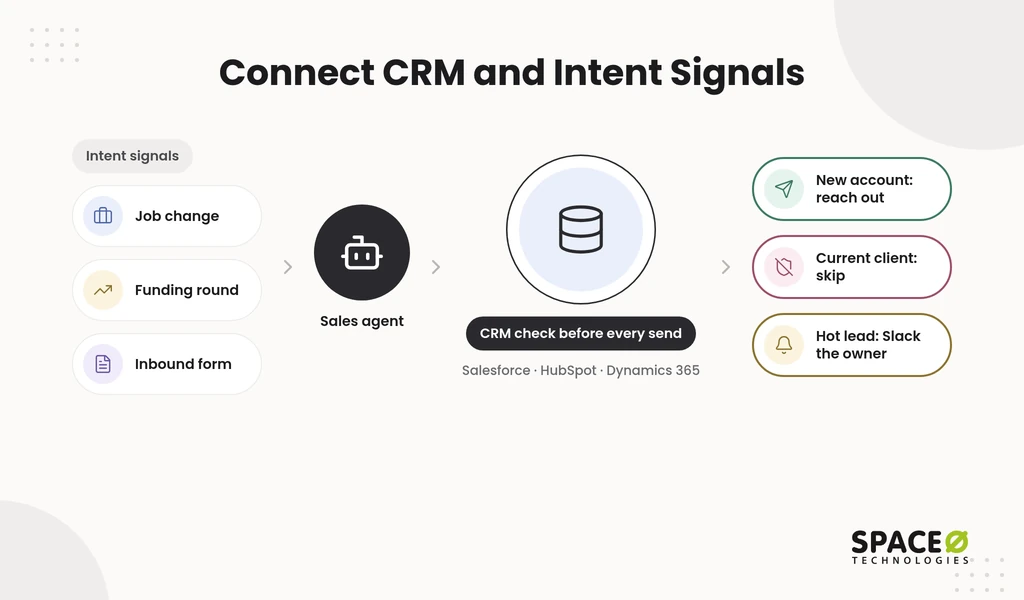
- CRM sync: The agent reads from and writes to Salesforce, HubSpot, or Microsoft Dynamics 365. Every touch, score, and transcript lands on the correct record.
- Intent triggers: Job changes and funding rounds at target accounts prompt timely, relevant outreach instead of generic sequences.
- Client suppression: A CRM check before every send keeps the agent from emailing existing clients or open opportunities.
- Rep alerts: Slack alerts notify the account owner as soon as a lead crosses the score threshold.
We handle API integration for CRM sync, enrichment, and intent data sources.
Design Human Handoff and Escalation Rules
Write escalation rules so high-intent or technical prospects reach a rep with full context. A rep who opens an empty record repeats discovery, and the prospect feels it. Human-in-the-loop design prevents that.
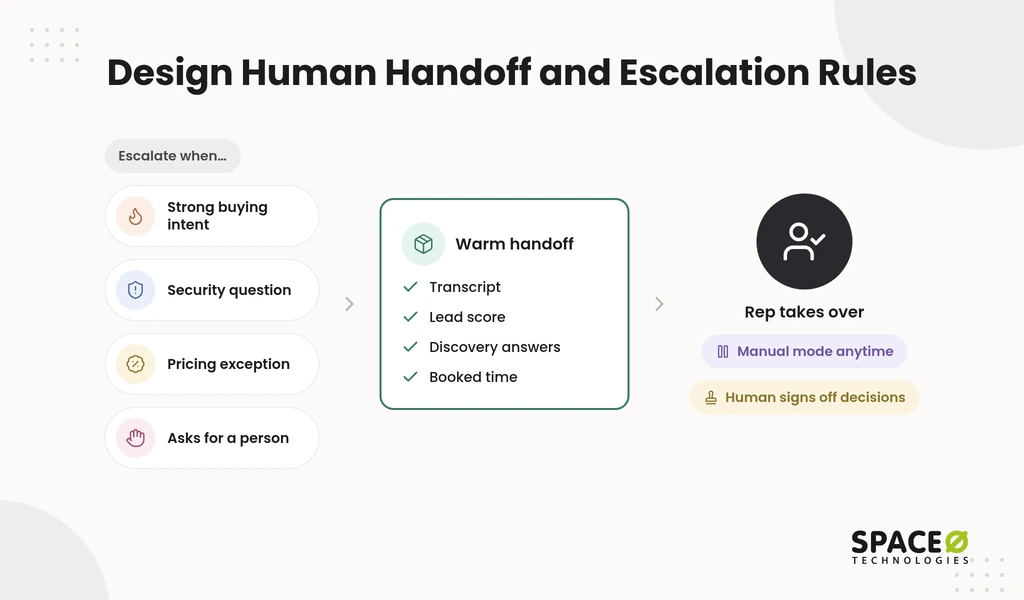
- Escalation triggers: The agent escalates on strong buying intent, technical or security questions, pricing exceptions, or a request for a person.
- Warm handoff: The rep receives the transcript, score, BANT or MEDDPICC answers, and booked time in one place.
- Human approval: No score or message shapes a final sales decision until a qualified person signs off.
- Evaluation: Every production agent passes an evaluation suite before reaching live leads. It tests accuracy, hallucination rate, bias, latency, and cost. We keep monitoring those measures afterward.
- Manual mode: Reps can pause the agent and take over any conversation in manual mode.
- Data privacy: We mask personal data and never train models on client data.
What an AI Sales Agent Costs to Run After Launch
Budget 15% to 25% of the original build cost every year for maintenance. Many buyers plan only for the build. Our AI development cost guide shows why this ongoing cost catches them off guard.
- Annual maintenance: Infrastructure and model API usage add to that yearly maintenance figure.
- Usage fees: Model API fees depend on conversation volume and the model you choose.
- Proof of concept: A proof of concept costs $15,000 to $40,000 over 4 to 8 weeks.
- Entry point: A basic MVP sales agent starts at $15,000. Richer feature sets run to $50,000 or more. Details are on our MVP development services page.
- Payment terms: Payments are milestone-based and tied to deliverables, so spend tracks visible progress.
- Ownership: Code, data, and IP ownership and the NDA terms follow the custom-build column in the comparison table above.
Need Your CRM Data Ready For Agents?
Our team audits your CRM records, defines your ICP rules, and builds a custom sales agent around your data, with full code and IP ownership.

Scoping Your Build: Stack, Build vs Buy, Inbound vs Outbound
Scope the agent around five decisions before any development starts. Teams that skip scoping often rebuild after the first pilot. These five choices determine cost, timeline, and fit.
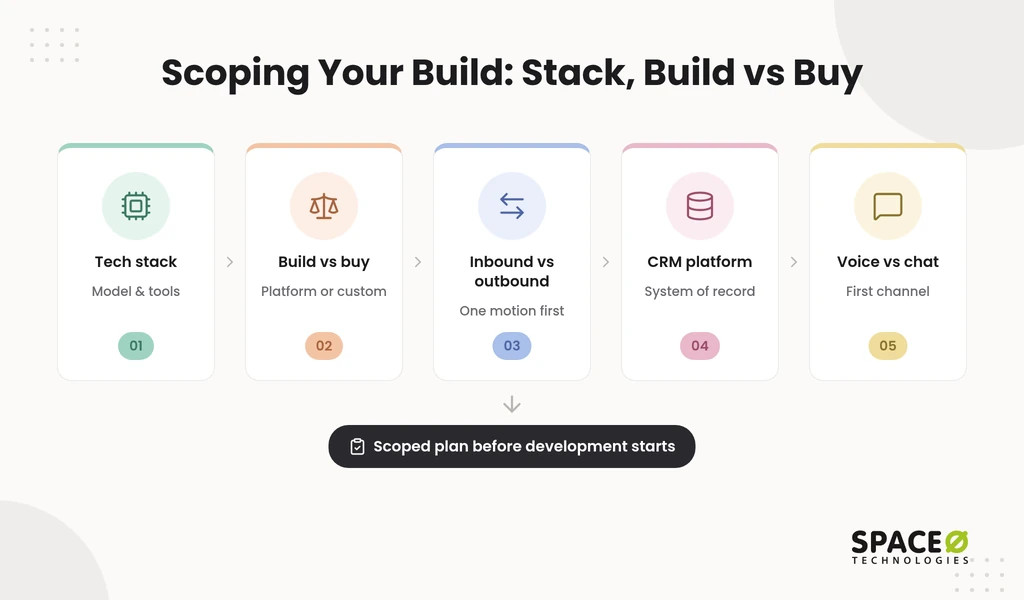
- Tech stack: Decide which model, enrichment tools like Clay, and email provider the agent will use.
- Build vs buy: Choose a packaged platform or a custom-built agent, using the comparison table above. Teams without AI talent can weigh the benefits of outsourcing AI development.
- Inbound vs outbound: Pick one motion to start with. Inbound qualification is usually the narrower first scope.
- CRM platform: Confirm whether Salesforce, HubSpot, or Microsoft Dynamics 365 holds your system of record.
- Voice vs chat: Choose the first channel, then add the others. Our chatbot work covers chat-first builds.
Tell us your CRM, email provider, and enrichment tools, and get a scoped plan with a free, expert-reviewed estimate.
Frequently Asked Questions
Should an AI sales agent start with inbound or outbound?
Use a simple test. If forms, chat, and calls already bring in more leads than reps can answer quickly, launch inbound first. Outbound also needs reliable intent triggers and client suppression checks. Treat it as a second phase once CRM sync is proven.
How to use AI to qualify leads?
Turn your ICP into testable rules and the RevOps definition of “qualified” into scoring criteria. The agent then blends firmographic and behavioral signals into a priority score. It asks BANT or MEDDPICC-style questions and logs the answers to your CRM. Route high-scoring leads to a rep with the full transcript.
How do I test an AI sales agent before it goes live?
Run it through the evaluation suite from the handoff section. Keep monitoring after launch rather than treating testing as a one-time gate. Before go-live, confirm that escalation triggers fire. Also confirm that a qualified person approves any output that influences a final decision.
What is a qualified lead in sales?
A qualified lead is a prospect who meets criteria your team has agreed on in advance. Those criteria are usually tested with a framework such as BANT (budget, authority, need, timeline) or MEDDPICC. That agreed definition is the benchmark the agent’s scoring is checked against.
Who on a B2B team should own an AI sales agent?
Split ownership: RevOps owns the qualified-lead definition, and account owners own the leads the agent passes on. Account owners get Slack alerts at the score threshold and take the warm handoff described above. A qualified person should approve any output that influences a final decision.
Do AI sales agents replace human SDRs?
No. An AI sales agent handles repetitive prospecting, scoring, and booking work. Reps still own relationships, negotiation, and final sales decisions.
What CRM access does an AI sales agent need to work safely?
Give it read and write access only to the fields it needs. It needs contact, account, and ownership data to skip current clients. Log every touch to the record.
How much does it cost to build an AI sales agent?
A basic MVP sales agent starts at $15,000. A proof of concept costs $15,000 to $40,000 over 4 to 8 weeks. Richer builds run to $50,000 or more.



 All our projects are secured by NDA




 4.8


