
 By

Contents
- Agentic workflow automation delivers adaptability, orchestration, governed decisions, faster resolution, oversight, and lower rework.
- Agents re-plan when inputs change, while rule-based RPA stops at the first unexpected error.
- Annual upkeep typically runs 15% to 25% of the original build cost.
- Start with one high-volume, exception-heavy process and keep human review in the loop.
Key Takeaways
Automation scripts break when a process stops matching the script. Teams then spend hours rerouting exceptions by hand. Agentic workflow automation closes that gap with AI agents that reason, plan, and use tools. The agents finish multi-step processes without a fixed script.
Adoption is moving from pilots to production, with McKinsey reporting that 40% of organizations above $1 billion in annual revenue are scaling AI agents.
Our AI agent development team builds these workflows for clients. Below, you will find six benefits, the yearly cost of keeping them, an RPA comparison, and a practical start plan.
What Are the Key Benefits of Agentic Workflow Automation?
Agentic workflow automation delivers six benefits that rule-based scripts and manual handling cannot match. Each benefit comes from one shift: an agent chooses the next step instead of replaying a fixed one.
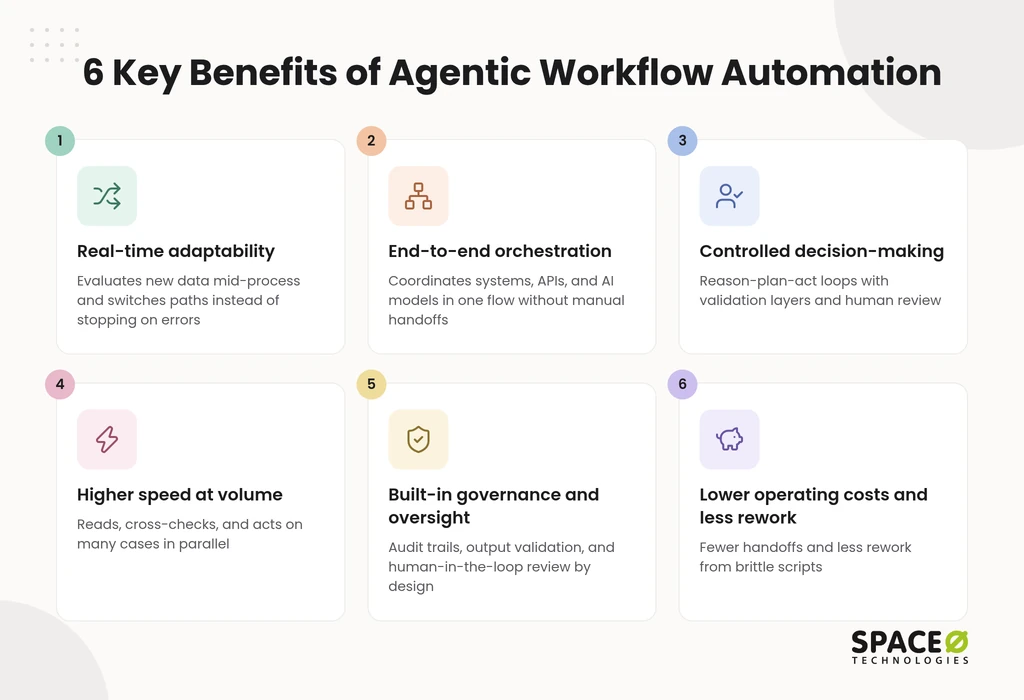
- Real-time adaptability: An agentic workflow evaluates new data mid-process, then switches paths, loops back, or adjusts its plan. Rule-based robotic process automation (RPA) follows a fixed script and stops when an unexpected error appears.
- End-to-end orchestration: AI agents coordinate work across business systems, application programming interfaces (APIs), and AI models in one flow. A customer service case moves from intake to resolution without manual handoffs between tools.
- Controlled decision-making: AI agents work in reason-plan-act loops, also called thought-action-observation loops. Validation layers and human review check each consequential step.
- Higher speed at volume: Agentic workflows read, cross-check, and act on many cases in parallel. A manual queue moves one case at a time.
- Built-in governance and oversight: Agentic workflows keep audit trails, validate outputs, and route sensitive steps to human-in-the-loop review. Teams design oversight in rather than adding it after a failure.
- Lower operating costs and less rework: Agentic automation cuts manual handoffs and the rework that brittle scripts create. Staff moves from repetitive processing to exceptions, customers, and approvals.
What Does It Cost to Keep These Benefits?
Keeping agentic workflow benefits typically costs 15% to 25% of the original build cost every year. Space-O Technologies’ AI development cost guide reports this range for AI builds.
For every $100,000 of build cost, expect roughly $15,000 to $25,000 in annual maintenance. Treat that upkeep as part of the cost-benefit, not a footnote to it.
What annual maintenance pays for
Annual maintenance keeps the agent accurate, connected, and safe as your business changes. Connected systems update their APIs, and data sources shift. Teams must rerun evaluation tests after each change.
Ongoing software maintenance services cover that work, and human reviewers also spend time on the checkpoints you keep. Skipping this work erodes adaptability and governance first.
How to weigh savings against upkeep
A process qualifies for agentic automation when yearly savings clearly exceed yearly upkeep. Add the labor, rework, and handoff time the agent removes. Then subtract yearly upkeep, which typically runs 15% to 25% of the build cost.
If the result is thin, pick a higher-volume process or narrow the scope. Budget owners then see an honest cost benefit.
Get a Scoped Agentic Workflow Estimate
Share your process, systems, and monthly case volume. Our engineers will return an expert-reviewed estimate covering build scope and yearly upkeep.

Cost is only half the comparison, so the next question is how agents stack up against the automation you already run.
How Does Agentic Automation Differ From Rule-Based RPA?
Agentic automation adapts to change, while rule-based RPA repeats fixed steps and halts on surprises. Many teams already run RPA and wonder whether agents justify the switch. The difference shows up in four places.
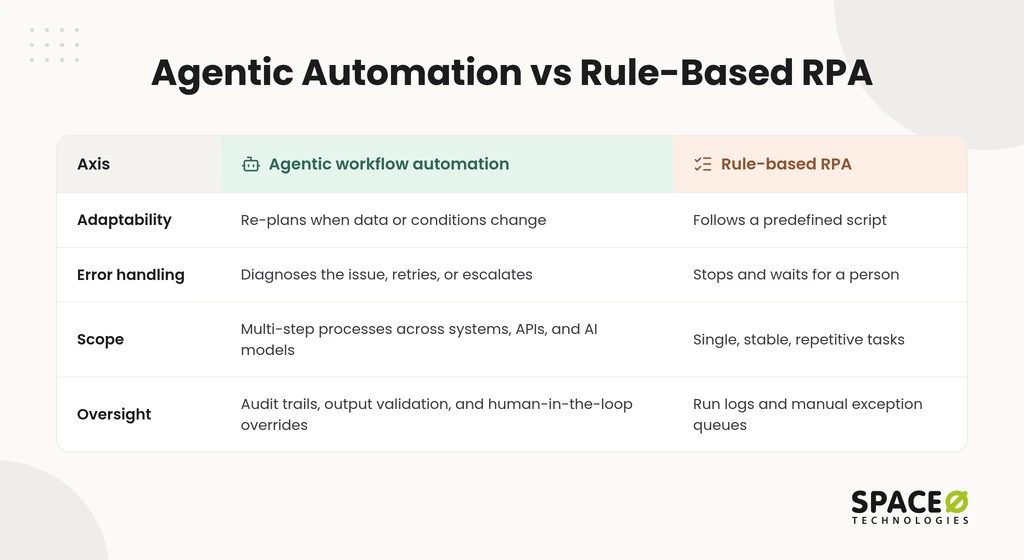
| Axis | Agentic workflow automation | Rule-based automation (RPA) |
|---|---|---|
| Adaptability | Re-plans when data or conditions change | Follows a predefined script |
| Error handling | Diagnoses the issue, retries, or escalates | Stops and waits for a person |
| Scope | Multi-step processes across systems, APIs, and AI models | Single, stable, repetitive tasks |
| Oversight | Audit trails, output validation, and human-in-the-loop overrides | Run logs and manual exception queues |
RPA still suits stable tasks with fixed screens and predictable inputs. Agents earn their place where inputs vary, and exceptions are frequent.
Where Do the Benefits Show Up in Real Use Cases?
The benefits appear fastest in high-volume processes that have frequent exceptions. These are the queues where your team spends hours rerouting work that scripts cannot finish.
In customer service, an agent reads the request, checks order and account systems, and resolves routine cases. The agent hands complex or sensitive ones to a person with full context.
In IT incident response, an agent triages alerts, gathers diagnostics, and runs approved fixes. For ServiceNow workflows, our ServiceNow development services let the agent open, update, and close tickets.
In finance operations, agents handle invoice exceptions, reconciliations, and approval routing across enterprise resource planning (ERP) systems. In sales operations, agents keep customer relationship management (CRM) records current across tools.
Each use case depends on the agent reaching the right systems.
What Does It Take to Realize These Benefits?
The benefits depend on integration quality and governance, not on the AI model alone. A capable agent with poor system access stalls at the first handoff. An agent without controls creates risk faster than it saves time.
Why integration quality decides the benefits
Agentic benefits are best realized where agents connect to the systems a business already runs. Orchestration only works when the agent can read and write to your ERP, CRM, ticketing, and payment tools.
Reliable API integration services give agents permissioned access to each of those systems.
Older on-premises systems often need application modernization services first, so agents have stable interfaces to call.
Governance controls that should ship with every workflow
Every production agentic workflow needs human-in-the-loop checkpoints, audit trails, and output validation. Strong governance also includes personally identifiable information (PII) masking and hallucination and bias testing before release.
The gap is common. According to Deloitte, only 21% of organizations have a mature governance model for agentic AI. Deloitte reported the figure in its 2026 State of AI in the Enterprise survey.
People approve consequential decisions, and the agent drafts and retrieves evidence. We apply the same controls to generative AI integration services inside existing products.
How Space-O Technologies builds agentic workflows
Space-O Technologies has built AI-powered custom software since 2010, with 140+ in-house developers. We have served 1,200+ clients, developed 300+ software solutions, and report 97% client retention.
Our process starts with your business goal. Then we choose the agent design that solves it most reliably.
How Do You Get Started With Agentic Workflow Automation?
Start with one measurable process, then expand once the agent proves its value in production. Broad pilots often stall because nobody owns the outcome.
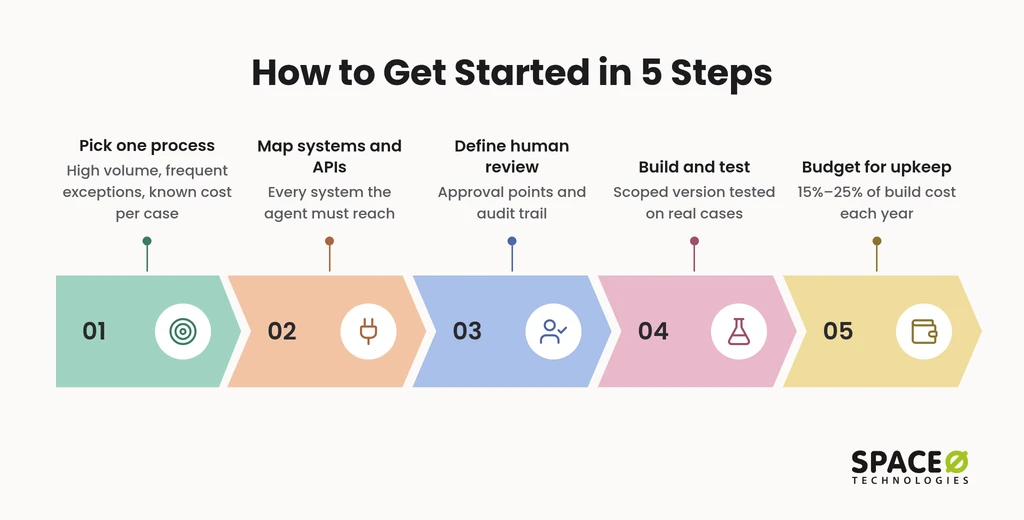
First, pick a process with high volume, frequent exceptions, and a known cost per case. Second, list every system and API the agent must reach.
Third, define where people review and approve, and what the audit trail must record. Fourth, build a scoped version and test it against real cases before launch.
Finally, budget for upkeep using the 15% to 25% range covered earlier. If you want an outside view on fit and sequencing, AI consulting services can pressure-test the plan before you build.
Frequently Asked Questions
What is agentic workflow automation?
Agentic workflow automation uses AI agents that reason, plan, and use tools to finish multi-step processes. Agents adapt when inputs change instead of following a fixed script. People keep control of consequential decisions.
What are the main benefits of agentic workflow automation?
The main benefits are adaptability, end-to-end orchestration, controlled decisions, faster resolution, built-in governance, and lower rework. Each gain is measured against RPA, which stops at unexpected errors. Value shows fastest in high-volume, exception-heavy processes.
How is agentic automation different from RPA?
Agentic automation re-plans when conditions change, while RPA follows a fixed script and stops on errors. Agents diagnose, retry, or escalate. RPA suits stable, repetitive tasks with predictable inputs.
How much does it cost to maintain an agentic workflow?
Annual maintenance typically costs 15% to 25% of the original build cost. Maintenance covers API updates, evaluation reruns, and human review checkpoints. Weigh the range against yearly savings before you commit.
How do you stop an AI agent from giving wrong or unsupported answers?
Put governance controls into the workflow before release. Use output validation, audit trails, human-in-the-loop checkpoints, and hallucination and bias testing. People approve consequential decisions while the agent drafts and retrieves evidence.
Who should own an agentic workflow project?
Name one accountable owner for each process. Broad pilots often stall when nobody owns the outcome. Start with a high-volume, exception-heavy process, and have budget owners check that yearly savings exceed yearly upkeep.



 All our projects are secured by NDA




 4.8


