
 By
Contents
- A responsible AI development company builds AI that is fair, transparent, private, secure, and accountable.
- Judge a partner by written controls and evidence you can request, not by published principles.
- Space-O Technologies avoids client-data training and adds personal data masking, bias testing, and human review.
- Ask every AI partner for proof before you sign.
Key Takeaways
A responsible AI development company builds AI that is fair, transparent, private, secure, and accountable. Governance and human oversight run through every stage of the AI lifecycle. That covers training data, testing, launch, and post-launch monitoring.
Many buyers hear principles but never see the controls behind them. Rules such as the EU AI Act raise the stakes for every vendor. A strong partner shows written controls and the evidence to prove them.
Space-O Technologies builds responsibly by default for startups, SMEs, and enterprises. Every build avoids client-data training and adds personal data masking, bias testing, and human review. Read our guide to AI governance and compliance consulting for the oversight side.
Which Type of Responsible AI Partner Do You Need?
The right partner depends on whether you need models, governance tooling, an assessment, or a team that builds your product. Buyers usually compare five kinds of organizations. Each covers a different part of responsible AI, and each asks something different of your team.
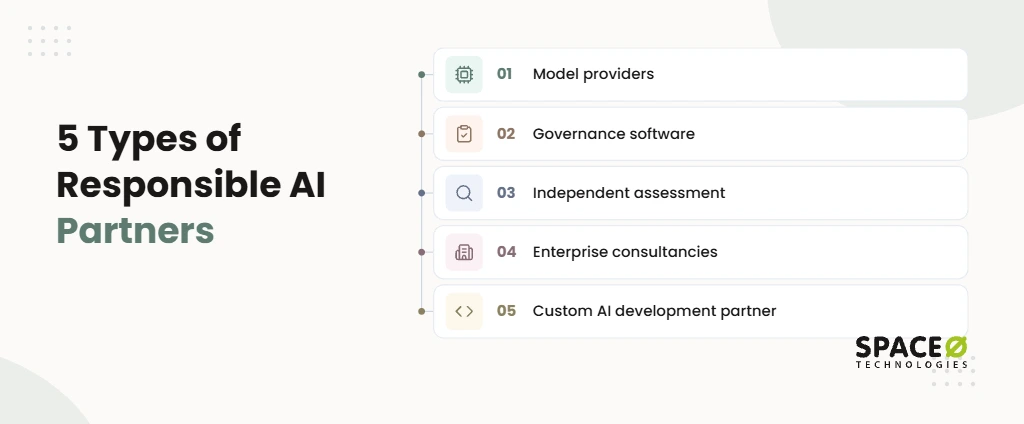
| Partner type | Organizations often named | What it provides | What adopting it requires from you |
|---|---|---|---|
| Model providers | Anthropic, known for Constitutional AI; Microsoft (Responsible AI Standard, Responsible AI Dashboard); IBM (watsonx governance toolkits); Google (AI Principles, Responsible Generative AI Toolkit, Vertex AI) | Foundation models and responsible-AI tooling | A team to build, integrate, test, and run a product on top |
| Governance software | Credo AI | AI governance software for policies, oversight, and documentation | AI systems already in place, plus staff to administer the tool |
| Independent assessment | Responsible AI Institute | Independent responsible-AI assessment and guidance | A built system to assess and a team to act on the findings |
| Enterprise consultancies and integrators | Cognizant (Cognizant Trust™ framework), Accenture, EY | Enterprise-framed responsible-AI advisory and integration | An engagement sized for large enterprise programs |
| Custom AI development partner | Space-O Technologies | Designs, builds, and runs your AI product with controls in place | Your business goals, data access, and a named reviewer for key decisions |
Many teams combine types. A product built on Anthropic or OpenAI models still needs someone to build it and add the controls.
Core Pillars of Responsible AI Development
Responsible AI rests on five pillars, and transparency and governance appear in every serious definition. Each pillar below gives a plain definition, followed by the control Space-O Technologies applies.
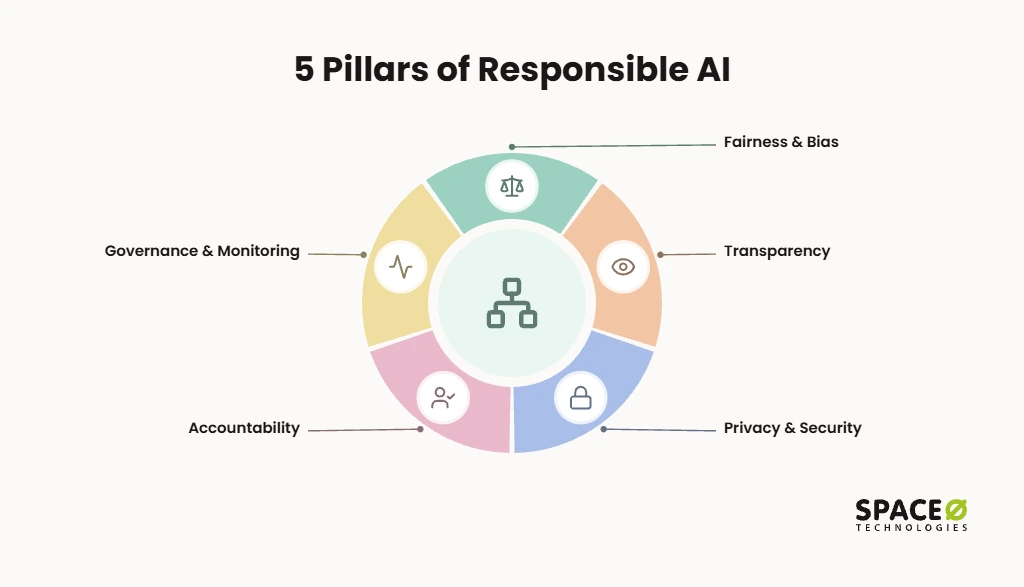
- Fairness & Bias Mitigation: Checking training data and model outputs so the system does not treat groups of people unequally. Space-O Technologies runs bias testing on every model before release.
- Transparency & Explainability: Making clear how a model was built, what data it learned from, and why it produced an output. Space-O Technologies documents datasets, models, and decision paths, so your team can explain each result.
- Privacy & Security: Protecting personal and business data at every step, from development through daily production use. Space-O Technologies never trains models on client data and applies PII (personally identifiable information) masking. Data residency is available in the US, EU, or India. See our guidance on data privacy in AI development projects.
- Accountability & Human Oversight: Keeping named people answerable for AI outcomes, with authority to approve or override consequential decisions. Space-O Technologies places human review checkpoints wherever an AI output carries real business or personal consequences.
- Governance & Continuous Monitoring: Running responsible AI as a governed lifecycle, with policies, owners, and checks that continue after launch. Space-O Technologies tracks model drift and performance after launch, not only during testing.
What to Look For in a Responsible AI Development Partner
Look for a partner that has shipped AI to production and can show the controls behind its principles. Publishing principles is easy. These signs show whether a partner can actually deliver on them.
- Production Experience: A track record of deploying safe AI into live use, not just running early demos. Space-O Technologies has 50+ AI systems live in production. Its 30+ AI engineers work within a team of 140+ in-house developers, delivering software since 2010.
- Controls You Can Verify: Every principle should map to a control, and every control to evidence you can request. The principle-to-evidence table below shows what to ask for.
- Delivery Transparency: You should see decisions, progress, and risks while the system is being built. Every Space-O Technologies project has a dedicated project manager and daily updates.
- Client Outcomes Over Time: Clients should stay with the partner and recommend it after launch. Space-O Technologies reports 97% client retention.
Which AI Models Does Space-O Technologies Build On?
Space-O Technologies builds on OpenAI and Claude models, as an OpenAI Select Partner and AWS Partner with Claude Certified Architects. Choosing a model is the easy part. Responsible behavior depends on how the model is used inside your workflow. Read about secure AI software development practices for the build side.
Whether a build runs on OpenAI or Claude models, it pairs the model with three controls. Answers are grounded in your own data. Outputs are evaluated before release. People approve consequential decisions. Space-O Technologies also advises on retrieval-augmented generation (RAG) versus fine-tuning, and recommends whichever solves the problem most cost-effectively.
Which Responsible AI Frameworks Should Your Partner Follow?
US buyers usually start with the NIST AI Risk Management Framework. Next come the EU AI Act, ISO/IEC 42001, GDPR, and HIPAA. Each one answers a different compliance question.
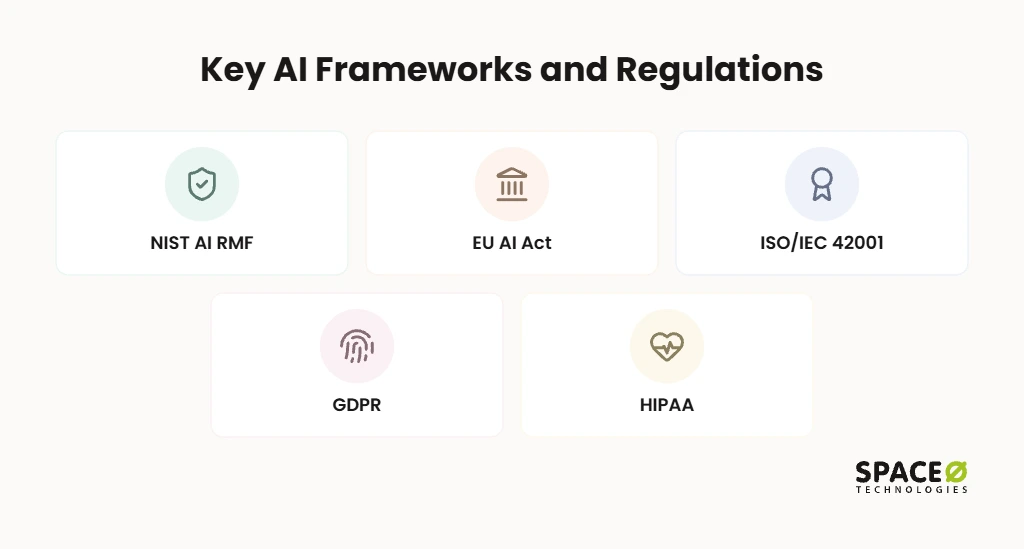
- NIST AI RMF: The National Institute of Standards and Technology’s voluntary US framework for identifying and managing AI risk.
- EU AI Act: The European Union’s AI regulation. It applies to teams that operate or sell in the EU.
- ISO/IEC 42001: An international standard for running an AI management system.
- GDPR: The General Data Protection Regulation, which governs the personal data of people in the EU.
- HIPAA: The Health Insurance Portability and Accountability Act, which protects patient health information in the US.
What does Space-O Technologies hold today?
Space-O Technologies holds ISO 27001 and ISO 9001 certifications and delivers HIPAA-compliant and GDPR-compliant work. See our awards and certifications for what we hold. Ask any partner which frameworks it holds and which it only follows. That difference matters in an audit.
Responsible AI for Healthcare, Fintech, and Insurance
Regulated teams need sensitive data locked down, and they need people, not models, signing off on high-stakes outcomes. Space-O Technologies works across industries, and these three carry the strictest requirements. In all three, Space-O Technologies encrypts data at rest and in transit. Human review checkpoints are on by default for high-stakes decisions.
How does responsible AI work in healthcare?
Healthcare AI must protect patient data and keep clinicians in charge of clinical decisions. Space-O Technologies builds HIPAA-compliant electronic health record (EHR), telemedicine, patient scheduling, and medical device software.
How does responsible AI work in fintech and lending?
Lending and payments AI must be fair and explainable before it touches a customer’s money. Space-O Technologies builds lending, payments, and wealth management platforms. On these platforms, a person approves every lending decision the model informs.
How does responsible AI work in insurance?
Insurance AI must handle claims and underwriting data securely, with people accountable for final outcomes. Space-O Technologies modernizes policy, claims, and underwriting systems. Review checkpoints can be placed at any claims or underwriting step your team defines as high-stakes.
Responsible AI From Pilot to Production for Startups, SMEs, and Enterprises
Space-O Technologies helps startups, small and mid-sized enterprises (SMEs), and large enterprises take AI from pilot to production. Many teams get a pilot working, then stall on security, testing, and review. The work below is how each type of buyer gets past that stage.
- Startups and founders: A fixed-cost minimum viable product (MVP) with responsible-AI controls scoped in from day one through our MVP development services. Space-O Technologies has built unicorn products, including Glovo, MrSool, and FTcash.
- SMEs and growing businesses: AI added to the customer relationship management (CRM), enterprise resource planning (ERP), or workflow tools you already run.
- Enterprises: Responsible AI built into existing platforms. Space-O Technologies has served 1,200+ clients since 2010.
- Teams putting AI into production: AI agents, chatbots, generative AI, machine learning, and computer vision, built with all five pillars in place.
Our engagement models include fixed cost, time and materials, dedicated team, and staff augmentation. Space-O Technologies does not quote hourly rates. You get a scoped range after a free, expert-reviewed estimate.
| CTA | Headline | Supporting content | Radio button |
|---|---|---|---|
| In-line CTA | Get Your AI Build Scoped With Controls Included | Share your use case and data needs with our experts. You receive a scoped range with controls, timelines, and review checkpoints on paper after a free estimate. | Book Your Consultation |
Building, Adding, or Governing AI: Where Do You Start?
Your starting point decides which partner type and which controls you need first. Two questions sort most projects.
- Are you building a new AI product, adding AI to existing software, or governing AI you already run?
- Which industry are you in: healthcare, fintech, insurance, SaaS, or another?
- Building a new AI product: A custom development partner owns the build and applies all five pillars from the first sprint.
- Adding AI to existing software: Work centers on data access, privacy, and monitoring around the systems you already have.
- Governing AI you already run: Start by mapping each system against the five pillars to find missing controls. Space-O Technologies can then add monitoring and human review where gaps appear.
Your industry answer sets which frameworks apply, for example HIPAA in healthcare or GDPR for EU customer data.
How to Verify a Responsible AI Partner’s Claims
A responsible-AI principle only means something once a written control backs it. Use this table to ask any partner for the evidence behind each claim. The middle column shows the controls Space-O Technologies publishes.
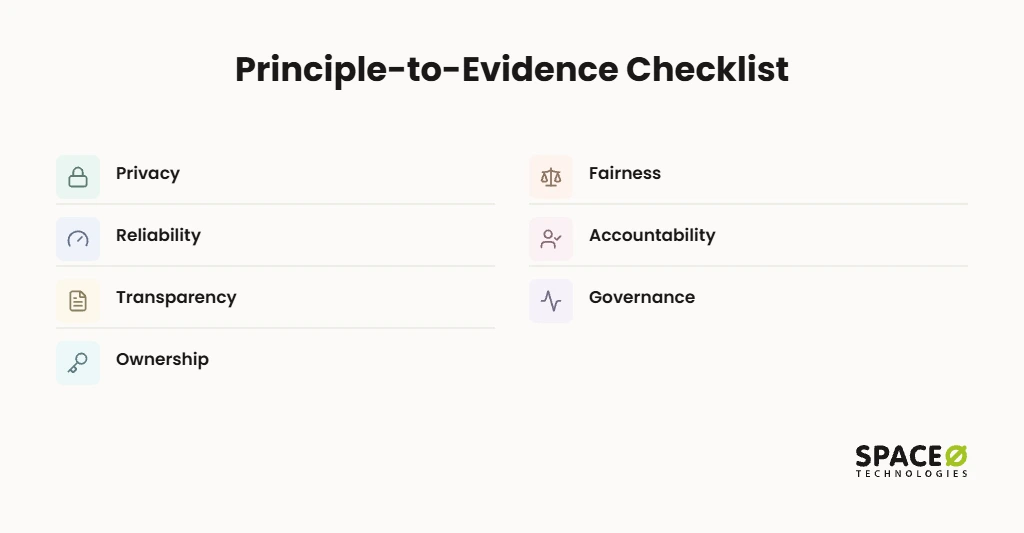
| Principle | Space-O Technologies control | Evidence you can request |
|---|---|---|
| Privacy | No training on client data; provider contracts prohibit training on inputs and outputs; PII masking; data residency in the US, EU, or India | No-training contract clause and data-residency option |
| Fairness | Bias testing before every release | Bias test report |
| Reliability | Evaluation suite on every production model for accuracy, hallucination rate, bias, latency, and cost; red-teaming of new releases | Evaluation results |
| Accountability | Low-confidence outputs routed to a qualified reviewer; hiring, lending, clinical, and legal decisions need a person’s approval | Review-checkpoint log |
| Transparency | Documented datasets, models, and decision paths | Model and dataset documentation |
| Governance | Post-launch drift monitoring; re-evaluation after every meaningful provider upgrade; quarterly RAG vs. fine-tuning review | Monitoring report |
| Ownership | All code, data, and IP transfer at project completion; nothing retained after handover | IP transfer clause |
Ask for each document before you sign, and read how AI development IP ownership and NDA terms work. A partner with real controls can show them.
Frequently Asked Questions
Who inside my company should be accountable for AI decisions when I hire a development partner?
Name a specific person on your side as the reviewer for key decisions. Accountability means named individuals answer for AI outcomes. They can approve or override consequential decisions. A partner builds the review checkpoints, but your named reviewer makes the final call.
What does a human review checkpoint actually do in an AI workflow?
A human review checkpoint pauses an AI output at a high-stakes step before it moves forward. At that point, a named reviewer can either approve the AI output or override it. Checkpoints belong wherever an output carries real business or personal consequences, such as lending, claims, or underwriting decisions. A checkpoint log can record the decision type, reviewer role, outcome, and timestamp.
What evidence should I request to verify an AI vendor’s responsible-AI claims?
Ask the partner for a document behind each principle. Request a no-training and data-residency contract clause, a bias test report, and a hallucination evaluation summary. Also ask for a human review checkpoint log, dataset documentation, a drift monitoring report, and the IP transfer clause.
What makes an AI development company responsible?
A responsible AI development company backs every principle with a written control and evidence. It builds for fairness, transparency, privacy, security, and accountability. It also keeps governance and human oversight running after launch.
Which regulations and frameworks should a responsible AI partner follow?
Start with the NIST AI Risk Management Framework, then add the rules your market requires. The EU AI Act applies if you operate or sell in the EU. GDPR covers EU personal data, HIPAA covers US patient data, and ISO/IEC 42001 sets an AI management standard.
Does Space-O Technologies train AI models on client data?
No, Space-O Technologies never trains models on client data. It also applies personal data masking and offers data residency in the US, EU, or India. All code, data, and IP transfer to you at project completion.



 All our projects are secured by NDA




 4.8


