
 By
Contents
- Machine learning development runs through five connected stages, from strategy and data preparation to monitoring and retraining.
- Data preparation is usually the largest single cost line in an ML build, ahead of the model itself.
- Budget a yearly share of the original build cost to keep a live model accurate.
- Choose an engagement model by business stage and scope, not by the algorithm you want.
Key Takeaways
What are machine learning development services? It is the work of designing, building, and running models that learn from data. You can launch ML without a full in-house data science team.
Most leaders already have data and a decision they want to automate. Their real problem is a model that works in a notebook but never ships. A machine learning development company closes that gap by owning every stage.
This guide covers core stages, usage examples, related terms, engagement models, and cost. For methods and tooling, see our guide to machine learning development. Each section stands alone, so you can jump to your question.
Core Stages of Machine Learning Development Services
Machine learning development services run through five core stages, from strategy to ongoing retraining. The usual business problem is stalled work: a promising model that never reaches users. Each stage feeds the next, from the data your custom AI app needs to a monitored model.
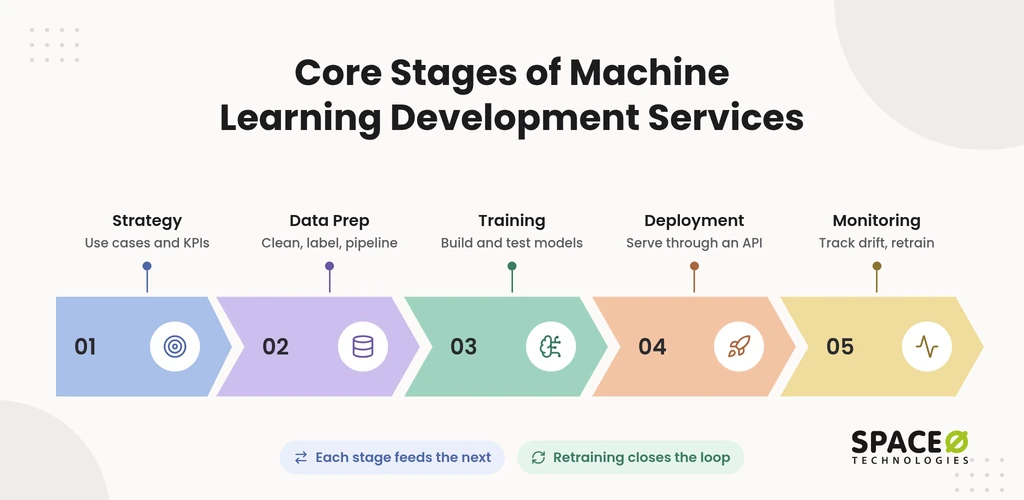
- Strategy and discovery: Pick use cases worth solving, set key performance indicators (KPIs), and confirm the data exists before coding.
- Data preparation: Cleaning, labeling, and structuring raw data, then building ETL (extract, transform, load) pipelines into warehouses.
- Model building and training: Selecting supervised, unsupervised, or deep learning algorithms, training them on prepared data, and testing them against held-back data.
- Deployment and integration: Embedding the trained model into existing applications, back-end systems, or cloud infrastructure so it serves users through an API.
- Monitoring and retraining: Track live accuracy and data drift, then retrain and redeploy through continuous integration and delivery (CI/CD) pipelines.
Why discovery comes before any data work
Discovery decides whether machine learning is the right tool at all. Google’s Rules of Machine Learning open by telling teams not to be afraid to launch a product without ML. Our machine learning consulting work tests that question first. It also settles whether retrieval-augmented generation (RAG) or fine-tuning fits the problem better than a model trained from scratch.
What evaluation adds between training and release
Evaluation checks that a model performs on real-world cases, not only on the data it learned from. The team tests against held-back data and edge cases. People review those edge cases before release. Frameworks such as TensorFlow, PyTorch, and scikit-learn handle the training. The release decision stays with people who understand the business impact.
A missing stage often leaves a model stalled or not accurate enough for production. With the stages in place, the next question is where a finished model earns its keep.
Common Usage Examples
The most common uses of machine learning development services turn historical data into forward-looking decisions. Businesses usually start where a wrong guess costs real money, such as stock levels, fraud losses, or customer churn. These five patterns recur across industries.
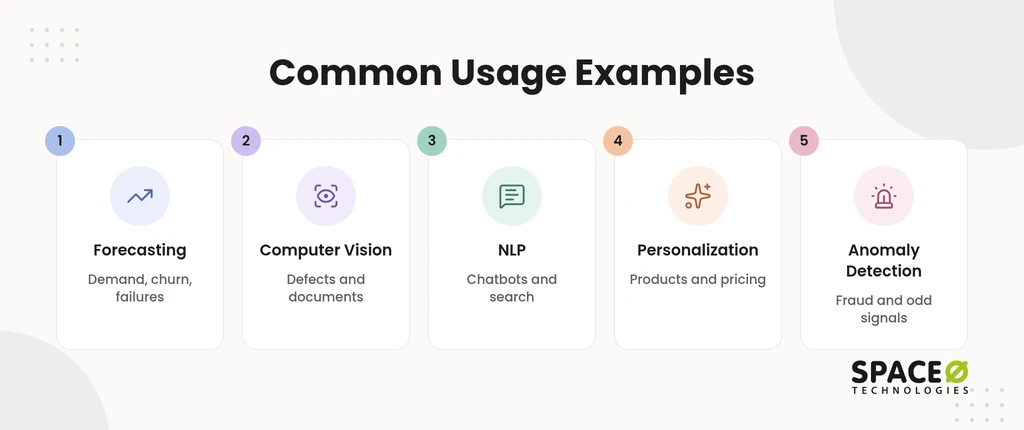
- Predictive analytics and forecasting: Forecasting demand, sales, churn, or equipment failures, including predictive maintenance that flags a machine before it breaks.
- Computer vision: Analyzing images and video for quality control, defect detection, object recognition, and document processing.
- Natural language processing (NLP): Powering chatbots, search, sentiment analysis, document screening, and text or speech processing.
- Recommendation and personalization: Suggesting products, content, or next actions for each user, and setting dynamic pricing as demand shifts.
- Fraud and anomaly detection: Flagging unusual transactions, logins, or sensor readings that break from normal patterns so a person can review them.
Space-O Technologies shipped GPT Vix for generative-AI candidate screening and eComChat for AI search in e-commerce. Our computer vision development services build image and video systems with human review checkpoints on consequential decisions.
The right use case is the one your data can already support. Before you scope one, it helps to know the terms vendors use for the same work.
Find the Machine Learning Use Case That Fits
Tell us what to automate. We map it to the right use case and send a free, expert-reviewed estimate based on your own data.

Related Terms and Synonyms
Several terms overlap with machine learning development services, and buyers often see them in the same proposal. Mixing them up leads to scope documents that promise the wrong thing. Each term below has a one-sentence definition.
- Machine learning as a service (MLaaS): Cloud-hosted ML. Businesses use managed tools and pre-built models from cloud machine learning platforms instead of running their own infrastructure.
- Machine learning operations (MLOps): The practice of automating deployment, monitoring, and retraining so live models stay accurate, as Google Cloud’s MLOps guide describes.
- Automated machine learning (AutoML): Tooling that automates repetitive steps such as feature engineering and hyperparameter tuning to reach a baseline model faster.
- Machine learning consulting: Advisory work on use cases, data readiness, and roadmaps, sold before or alongside a development engagement.
- AI development services: The broader category that covers machine learning plus generative AI, chatbots, and AI agents.
- Data drift: The gradual shift of live data away from training data over time, which lowers accuracy until retraining.
Custom ML versus MLaaS
Custom ML fits problems specific to your data, while MLaaS fits common, well-defined tasks. The choice comes down to speed of starting versus fit to your process. Three options cover most projects, and the trade-offs mirror custom AI development vs. off-the-shelf software.
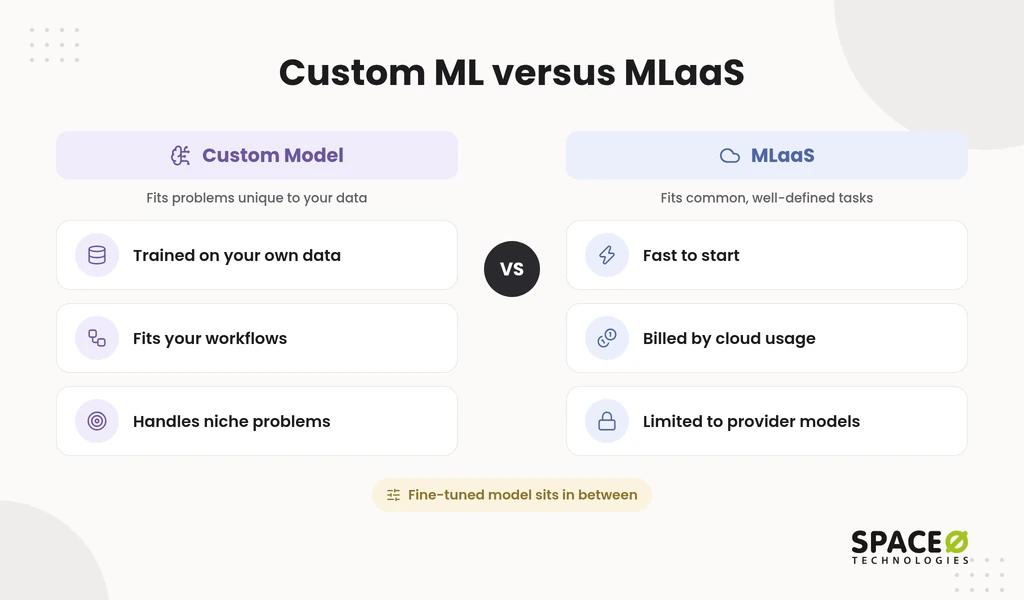
- Custom model: Trained on your own data and workflows, so it fits problems a generic model cannot handle.
- MLaaS: Faster to start, billed by the cloud provider based on usage, and limited to what the provider’s models support.
- Fine-tuned pre-built model: Adapting an existing model to your data, which sits between the other two on cost and fit.
Once you know which option fits, the next decision is how to buy the work.
Choosing an Engagement Model by Business Stage
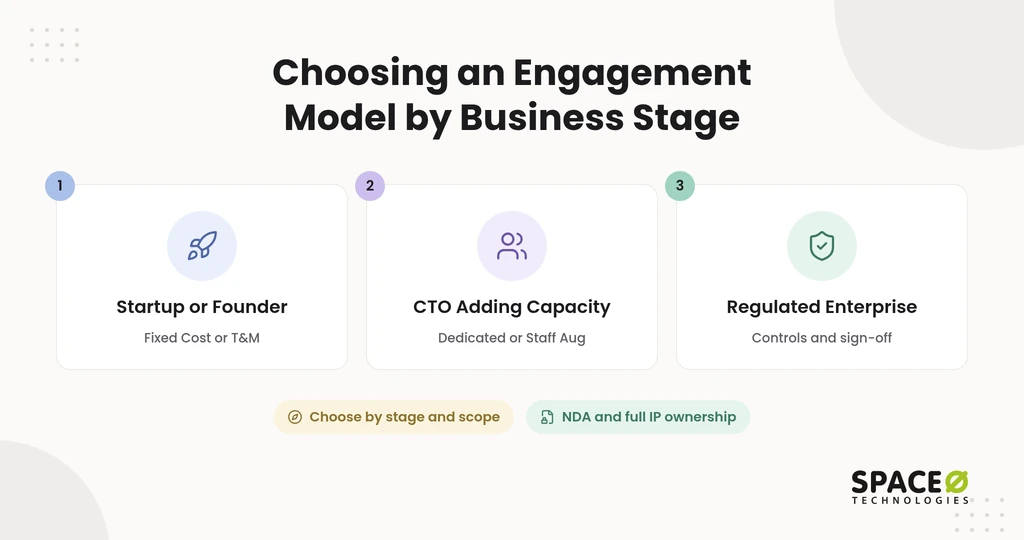
The right engagement model depends on your business stage, team, and scope, not on the model you want. Choosing how to buy the work matters as much as choosing the model. Space-O Technologies offers four engagement models: Dedicated Team, Staff Augmentation, and Fixed Cost or Time & Material pricing. Every project starts under a non-disclosure agreement (NDA), and you own all code, data, and IP at completion.
Which model fits a startup or founder?
A Fixed Cost or Time & Material model fits a startup with a well-defined minimum viable product (MVP) scope. It suits founders with no in-house ML team who need to reach users and raise funding. You get requirement analysis and idea validation before code, with room to grow into version two without a rebuild.
A basic MVP starts from $15,000, and a feature-rich MVP runs up to $50,000+. Payments are milestone-based and tied to deliverables.
A simple MVP takes 4 to 8 weeks, while complex MVPs with multiple integrations take 3 to 4 months. Products built this way include Glovo, with 50M+ downloads, and MrSool.
Which model fits a CTO adding capacity?
A Dedicated Team or Staff Augmentation model fits an engineering leader who needs ML developers quickly. The problem is usually a release date that will not wait for a hiring cycle. Vetted developers join your sprint cycles, repositories, and tools, with structured onboarding and secure development practices.
When you hire ML developers this way, matching takes 48 to 72 hours and onboarding takes days. Engagements start at 80 hours a month part-time or 160 full-time, each with a one-month minimum. Hourly engagements start at 25 hours.
Which model fits an enterprise in regulated workflows?
Legacy modernization paired with production AI fits an enterprise moving models into regulated workflows. Regulated work needs documented controls, strong data privacy in AI development, and human sign-off before a model acts. Deployment runs on Amazon Web Services (AWS), Microsoft Azure, or Google Cloud Platform (GCP).
Space-O Technologies’ AI consulting services put implementation support at $50,000 to $150,000+. Engagements that include a proof of concept and implementation oversight run 3 to 6 months.
In-house vs. outsourced ML development
An outsourced partner starts faster, while an in-house build depends on hiring and internal MLOps maturity. The table compares the two on four axes.
| Axis | In-house build | Outsourced partner |
|---|---|---|
| Time to market | Gated by hiring an ML team | Starts with an existing team |
| Production readiness | Depends on internal MLOps maturity | MLOps and evaluation built in |
| Full-cycle ownership | You carry every phase | Discovery through maintenance under one team |
| Flexibility | Fixed headcount | Four engagement models, scaled to scope |
Space-O Technologies differs from enterprise-only and staffing-only providers on end-to-end product ownership. That ownership spans discovery, design, build, and maintenance, which is where the benefits of outsourcing AI development show up. Whichever model you pick, the budget question comes next.
What Drives the Cost of Machine Learning Development
Data work, integrations, and upkeep drive most of an ML budget, more than the algorithm itself. Buyers are often surprised by cost later, so it helps to see the drivers early. Pilots are cheap, but data preparation, integrations, and ongoing model costs grow quickly once AI reaches production. Left unplanned, that growth causes AI software development budget overruns.
Where the build budget goes
Data preparation is usually the largest single line in the build. Space-O Technologies’ AI development cost research shows data preparation can consume 25% to 40% of the total project budget. That makes it the single largest cost driver in an AI build.
- Data quality: Messy, unlabeled, or scattered data raises preparation hours before training can start.
- Model complexity: Deep learning and multi-model systems need more training, evaluation, and compute than simpler models.
- Integration depth: Each connected system adds data mapping, security work, and testing.
- Hosting and latency: GPU workloads, low-latency responses, and hybrid or on-premises hosting raise both build and monthly costs.
In most builds, the model is the smaller line, while data work, integrations, and production engineering cost more.
What a live model costs each year
A live model carries yearly costs that a build quote often leaves out. Annual maintenance typically costs a meaningful share of the original build cost. It is a core part of AI app total cost of ownership. The other recurring lines look like this.
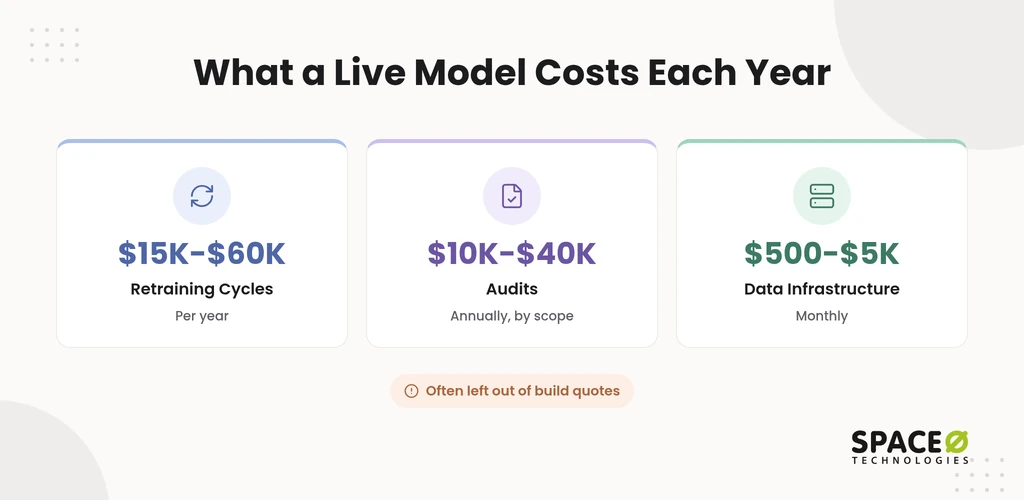
- Retraining cycles: Plan for $15,000 to $60,000 per year.
- Audits: Each audit can cost $10,000 to $40,000 annually, depending on scope.
- Data infrastructure: Budget $500 to $5,000 monthly.
How to keep machine learning costs predictable
Cost overruns usually start with data surprises, so check the data first. These three steps keep spending tied to proven value and help reduce risk in AI development projects.
- Audit data first: Confirm volume, labels, and access before committing to a model approach.
- Start with a proof of concept: Test feasibility on a narrow use case before funding the full build.
- Budget the first year: Price maintenance, retraining, and infrastructure alongside the build, not after launch.
A realistic ML budget covers the first year of operation, not only the build.
Get a Scoped Cost Estimate for Your Model
Share your data sources and integrations. Our ML team breaks down build, data preparation, and ongoing yearly maintenance costs before you commit any budget.
How Space-O Technologies Approaches Machine Learning Development
Space-O Technologies runs every stage under one team, with evaluation and human review built into production AI. That team covers requirements analysis, UI/UX, agile development, QA, deployment, and maintenance. Every production model gets an evaluation suite for accuracy, hallucination, bias, latency, and cost. Our MLOps capabilities add continuous monitoring.
Confidence scoring sends any output below an acceptable threshold to a human-review checkpoint. People approve consequential decisions, and the model handles the routine ones.
Since 2010, Space-O Technologies has built 300+ software solutions. Our 140+ in-house developers work from offices in Mesa, Arizona; Brampton, Ontario; and Ahmedabad, India.
If you are weighing a machine learning project, tell us about your data and the decision you want to automate. You will get a free, expert-reviewed estimate scoped to your problem.
Frequently Asked Questions
What is ML with an example?
Machine learning (ML) is software that learns patterns from data instead of following fixed rules a developer wrote. A common example is predictive maintenance, where a model trained on equipment data flags a machine before it breaks. Other examples include forecasting demand or churn and flagging unusual transactions for a person to review.
Which type of machine learning fits my project?
The right type depends on your problem and data. Supervised learning trains on labeled examples to predict outcomes such as churn. Unsupervised learning finds patterns in unlabeled data. Deep learning uses layered neural networks for vision, language, and complex signals.
Do I need my own data scientists to use ML development services?
No. A core reason businesses use these services is to deploy ML without building a full in-house data science team. Under a Dedicated Team or Staff Augmentation model, vetted ML developers join your sprint cycles, repositories, and tools.
How do ML development services keep a model accurate after launch?
They use machine learning operations (MLOps) to track live accuracy and data drift. The team retrains on fresh data and redeploys updates through automated pipelines. Without this maintenance layer, accuracy declines as live data shifts away from the data the model was trained on. Plan to budget a yearly share of the original build cost for upkeep.
How does ML development differ from buying ML software?
Buying off-the-shelf ML software gives you a fixed, pre-trained tool. ML development services build a custom model on your own data and workflows, then integrate and maintain it. The trade-off is time and cost against fit: a custom model solves problems a generic product cannot.
What do ML development services include?
They cover five stages. These are strategy and discovery, data preparation, model building and training, deployment and integration, and monitoring and retraining.
How much do machine learning development services cost?
Cost depends on scope, data readiness, and model complexity. A proof of concept runs $15,000 to $40,000, and a basic MVP starts at $15,000. Plan for yearly maintenance on top of the build cost.
How long does machine learning development take?
A simple MVP takes 4 to 8 weeks. Complex builds with multiple integrations take 3 to 4 months. Enterprise engagements that include a proof of concept run 3 to 6 months.



 All our projects are secured by NDA




 4.8


