
 By
By 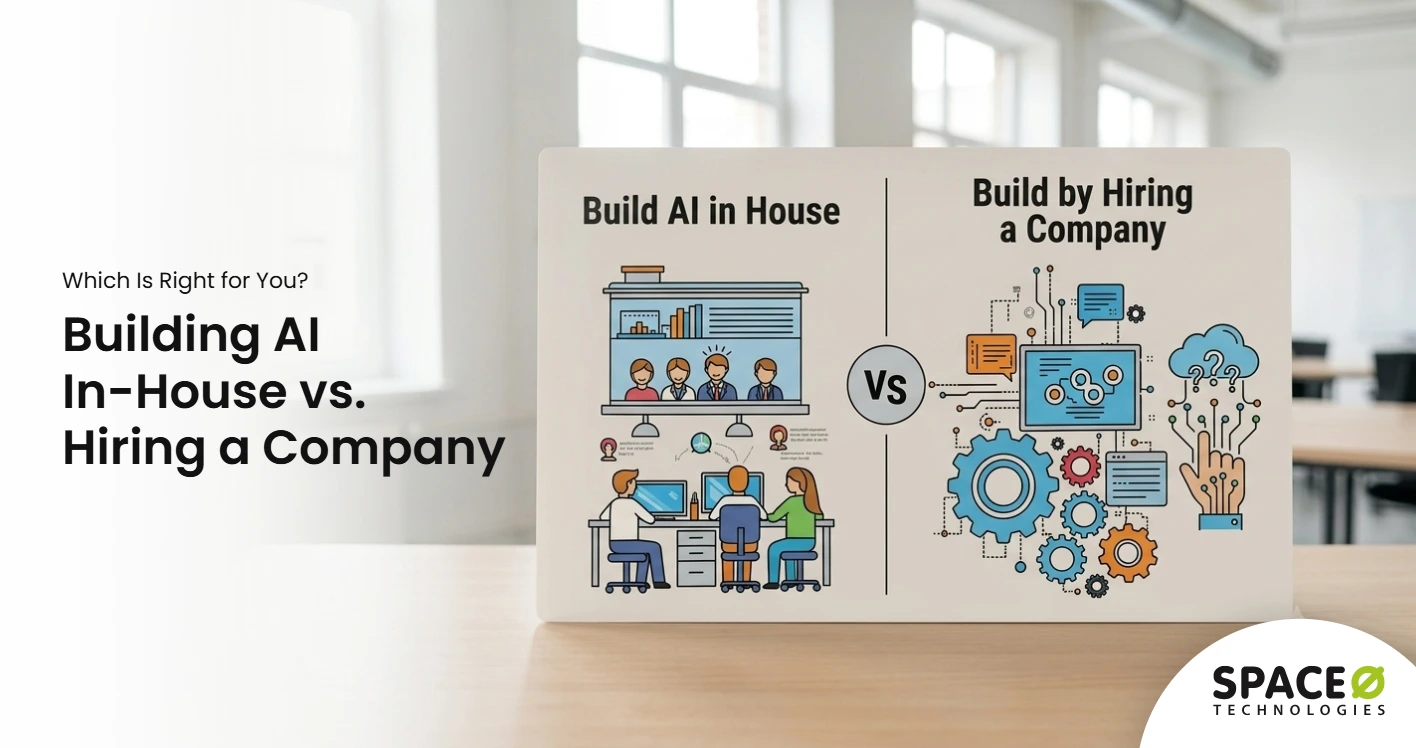
Contents
The right call depends on whether AI is your core product and whether it is a lasting competitive edge. It also depends on whether your data and timeline demands justify committing to a long-term internal build.
Building In-house vs. hiring a company: side-by-side comparison
The two paths diverge most on control, cost, and time to a working product. The table below weighs the factors buyers decide on. Figures are ranges, not quotes; a scoped estimate depends on model choice, data readiness, and integration surface.
| Factor | Building AI In-House | Hiring an AI Company |
|---|---|---|
| Timeline to first deployment | Slow: months to a usable build | Fast: weeks instead of months |
| Upfront cost | High: salaries, infrastructure, recruiting | Lower, project-scoped |
| Ongoing cost | Fixed payroll, retained whether building or not | Variable by engagement model |
| Control | Full and direct | Shared; managed through the partner |
| Data & IP | Total data control, full IP ownership | IP ownership transferable at handover |
| Specialized expertise | Must be hired and retained | Immediate, cross-industry |
| Risk | Higher: pilots can stall before production | Lower: delivery is the partner’s job |
| Best for | AI as your core product, regulated data you cannot move | Speed to market, filling an AI skills gap |
Building AI In-House
Building AI in-house gives you total data control, deep customization to your workflows, and full ownership of code and IP. The tradeoff is a high upfront cost and a slow start before anything ships to production.
What building in-house gives you
- Total data control and data privacy. Proprietary data never leaves your environment. CNBC’s reporting on why enterprises want in-house AI frames this as not handing your data to any other company.
- Deep customization. Models are tailored to your unique workflows rather than fitted to a general-purpose template.
- Full IP ownership. The code, the models, and the know-how stay inside the company by default.
What building in-house costs you
- High upfront cost. Salaries, infrastructure, and recruiting land before the first model ships.
- A slow 4-6 month hiring ramp. Specialized AI engineers are scarce, and the recruiting cycle delays the start of real work.
- Pilot-stall risk. Internal AI projects can stall before production, turning budget into a proof of concept that never ships.
Hiring an AI Company
Hiring an external AI company delivers faster speed-to-market, immediate access to specialized cross-industry expertise, and more predictable project-based costs. The tradeoff is less direct control and ongoing reliance on the vendor to deliver. You need a working product in weeks and do not want to carry a permanent AI payroll. That is exactly when hiring an external AI company becomes the right path for your team.
What hiring a company gives you
- Faster speed-to-market. A partner who has solved similar problems can launch in weeks rather than months.
- Specialized expertise. You get data scientists and engineers with cross-industry experience on day one, not after a hiring cycle.
- Predictable project costs. Work is scoped and priced per project or per team instead of carried as fixed headcount.
What hiring a company costs you
- Less direct control. Day-to-day delivery runs through the partner rather than your own managers.
- Vendor reliance. You depend on an external provider for roadmap, fixes, and continuity, a dependency worth planning for in the contract.
Where Space-O Technologies fits
Its production AI is built with grounding, evaluation, and human review by default. People approve consequential decisions on hiring, lending, clinical, and legal outcomes.
Space-O Technologies offers four engagement models: Dedicated Team, Time and Material, Fixed Cost, and Staff Augmentation. This range lets one partner serve a scoped MVP and a hybrid capacity-add equally well.
See how Space-O Technologies would scope your build. Get a free, expert-reviewed estimate.
Which should you choose?
Choose based on whether AI is your core product and how far your data can travel. Your timeline for a working result also shapes which of the three paths fits.
- Choose in-house if AI is the product you sell, and your data cannot leave your environment. You also need to fund a permanent team through a slow ramp and real pilot-stall risk.
- Choose a company like Space-O Technologies if you need a working product in weeks. You also want cross-industry expertise without going through a slow hiring cycle. A Fixed Cost model fits a well-defined MVP scope when predictable project cost matters more than control.
- Choose a hybrid model if you want to keep strategy and proprietary data in-house while outsourcing the heavy build. Dedicated Team and Staff Augmentation add that capacity inside your own sprints.
Regulated industries: does in-house win by default?
The compliance question is about where data lives and who signs off on consequential calls. It is not about the building-versus-hiring label itself.
How a hybrid AI model actually runs
A hybrid model keeps strategy and data in-house while a partner handles the heavy build. Most guides name the hybrid path but never explain how it runs. Here is the operating model, step by step.
- Strategy and data stay with you. Your team owns the roadmap, the proprietary data, and final sign-off.
- Developers join your workflow. Space-O Technologies’ dedicated developers work inside your sprints, tools, and communication channels. They operate in your time zone and report to your managers.
- The start is fast. Developers are matched within 48 to 72 hours and onboarded within days.
- Production AI controls are built in. Space-O Technologies handles the heavy build, with RAG before fine-tuning decided during discovery. Evaluation and human-review checkpoints run before anything reaches users.
- Continuity is protected. If a developer is not the right fit, Space-O Technologies replaces them at no extra cost.
- Ownership stays yours. Every developer signs an NDA, and full code and IP transfer at handover.
Dedicated Team and Staff Augmentation add capacity inside your own tooling. Fixed Cost scopes a standalone MVP outside your sprints. Developers can join part-time at 80 hours a month or full-time at 160. Compare how the engagement models differ before you commit.
Frequently Asked Questions
How much does it cost to build an AI team in-house versus hiring a company?
In-house is the higher fixed commitment: salaries, infrastructure, and recruiting are carried whether or not a model ships. Third-party research points to annual figures well into six and seven figures for even a small team. Hiring a company converts that into a project-scoped cost under one of four engagement models. Space-O Technologies’ hiring guide puts a full-time US developer at $80,000 to $140,000 a year. Its published custom AI development range is $10,000 to $300,000+, scoped per project.
How long does it take to hire AI engineers for an in-house team?
The specialized-talent shortage means the hiring ramp alone commonly runs 4-6 months before real work starts. That delay is a frequent reason timelines to a working product favor an external partner with staff in place.
What is a hybrid AI model and when does it make sense?
A hybrid model keeps strategy and proprietary data in-house while outsourcing the heavy build to a partner. It makes sense when you want to protect sensitive data and roadmap ownership but lack internal AI capacity. The hybrid section above explains how that runs day-to-day.
Do I lose ownership of my AI if I hire an external company?
Not with a partner who transfers it. With Space-O Technologies, an NDA precedes every project, and full code and IP ownership transfers at handover. So the “full IP ownership” advantage usually credited to in-house is actually available through hiring, provided the contract says so.
Should a startup build its AI in-house or outsource it?
Most early-stage startups outsource because a slow in-house ramp and high fixed payroll compete with runway. That runway is what they need to reach users and raise funding. A fixed-cost MVP built to grow into version two without a rebuild is the common path. Founders who treat AI itself as the core product are the exception that leans in-house.



 All our projects are secured by NDA




 4.8
4.8