
 By
By 
Contents
Every week, another competitor ships an AI-powered feature, cuts operational costs with an intelligent automation layer, or closes deals faster using AI-assisted sales tools. If you are a business leader trying to understand how that is actually happening, the answer is rarely a single breakthrough moment. It is a series of deliberate, well-scoped investments in AI development that compound over time.
The problem is that most guides on this subject are written for engineers. They assume you want to understand transformer architectures, configure GPU clusters, or debate the merits of PyTorch versus TensorFlow. You do not. You need to understand what AI development actually requires from a business standpoint: what decisions you will face, what it costs, who builds it, how long it takes, and what separates a successful deployment from an expensive proof of concept that never scales.
That gap is exactly why many organizations make avoidable mistakes early on. They adopt tools before defining the problem. They underestimate data readiness. They build when they should buy, or buy when they should partner. Working with a trusted AI development company changes that dynamic entirely because experienced teams have already made those mistakes on previous engagements and built frameworks to avoid repeating them.
This guide is designed to give you that clarity without the technical overhead. You will walk away with a solid understanding of what AI development involves, what it costs, which tools and platforms matter in 2026, how to structure your team, and what the most capable organizations are building right now.
What Is AI Development?
AI development is the process of designing, training, and deploying software systems that can perform tasks requiring human-like reasoning, including understanding language, recognizing patterns, generating content, making predictions, and taking autonomous action.
Unlike rule-based software that follows fixed instructions, AI systems learn from data through a process called training. They continuously improve as they are exposed to more examples, feedback loops, and real-world outputs. This core difference is what makes AI powerful for complex, variable tasks where no single written rule would work.
AI development glossary: Key terms every business leader should know
Before you evaluate vendors, compare platforms, or sit across the table from an AI development team, you need a working vocabulary. You do not need to understand the math behind these concepts. You need to understand what they mean for your business decisions, your budget, and your risk exposure.
- Large Language Models (LLMs) are deep learning models trained on massive text datasets that can understand, generate, and reason about language. Models like ChatGPT (OpenAI), Claude (Anthropic), and Google Gemini fall into this category. They power everything from intelligent chatbots to contract review automation.
- Natural Language Processing (NLP) is the branch of AI focused on enabling machines to understand and process human language. It underpins voice assistants, sentiment analysis, document classification, and conversational AI.
- Machine Learning (ML) is the broader discipline of training algorithms to learn patterns from data without being explicitly programmed. It includes supervised learning, unsupervised learning, and reinforcement learning, each suited to different problem types.
- Fine-tuning is the process of taking a pre-trained model, such as Claude or GPT-4, and adapting it to a specific domain using your own data. Fine-tuning gives you the performance of a large foundation model with the specificity your business requires.
- Inference is what happens when a trained model is actually used, receiving an input and producing an output. Inference costs and latency are key operational factors in any production AI system.
- AI Agents are systems capable of taking multi-step actions autonomously, using tools, making decisions, and adapting based on intermediate results without human intervention at every step.
- Retrieval-Augmented Generation (RAG) is a technique that connects an LLM to an external knowledge source so it can retrieve relevant information before generating a response. RAG is how companies safely deploy LLMs against proprietary internal data without retraining the entire model.
These seven concepts come up repeatedly in AI development conversations, vendor pitches, and project scoping calls. Having a confident grasp of each one puts you in a far stronger position to ask the right questions, challenge unrealistic claims, and make decisions that hold up under scrutiny.
Turn Your AI Strategy Into a Working Business Solution
Our team handles everything from data readiness and model development to integration and scaling, so you can focus on outcomes, not engineering.

The Two Approaches Every Business Leader Must Understand
Not all AI adoption looks the same, and treating it as a single category is one of the most common reasons business leaders make poor early decisions. Before you evaluate any AI development framework, vendor, or development partner, you need to understand the two fundamentally different ways organizations are putting AI to work today. Each has a different cost profile, timeline, risk level, and strategic purpose. Choosing the right one for each use case is where most of the real leverage sits.
AI-assisted development
AI-assisted development means layering AI capabilities on top of existing workflows to make your teams faster, more accurate, and less dependent on manual effort. You are not replacing systems or rebuilding processes. You are augmenting what already exists with an intelligent layer that handles the repetitive, low-judgment work so your people can focus on the decisions that actually require them.
In practice, this approach works best when your goal is speed, consistency, and operational leverage across existing functions. Here is where businesses are seeing the strongest results:
- Customer support: Teams using ChatGPT-powered response drafting cut average handle time from 8 minutes to 3, with agents reviewing and sending rather than writing from scratch.
- Software development: Engineering teams using Claude Code handle test generation, documentation, and refactoring across large codebases, freeing senior developers for architecture decisions instead of boilerplate work.
- Sales operations: AI analytics platforms score and prioritize leads automatically, so reps spend their time on accounts with the highest conversion likelihood rather than working down a flat list.
- Content and communications: Marketing teams use LLMs to produce first drafts, localize content across markets, and maintain brand consistency at a volume that would otherwise require significantly more headcount.
- Development velocity: Tools like GitHub Copilot and Amazon Q Developer reduce coding time by 30 to 50% on routine tasks, compressing release cycles without adding engineering resources.
The common thread is speed and leverage. AI-assisted development does not change what your business does. It changes how fast and how consistently your team can do it. For most organizations, this is the right first investment because the feedback loop is short, the cost is manageable, and the results are visible within weeks rather than quarters.
Custom AI development
Custom AI development means building a system that is trained or fine-tuned specifically on your data, designed around your workflows, and optimized for outcomes that matter to your business. The output is not a tool you subscribe to. It is a capability your organization owns.
The business case for going custom is strongest in situations where off-the-shelf tools consistently fall short and where your proprietary data holds genuine value. The most common scenarios include:
- Proprietary data advantage: A logistics company that trains a forecasting model on five years of its own shipment history, seasonal patterns, and carrier performance will consistently outperform any generic tool because the model understands context that no external provider has access to.
- Domain-specific accuracy requirements: A healthcare platform that fine-tunes an LLM on its own clinical documentation standards produces outputs that a general-purpose model cannot match for compliance alignment and terminology precision.
- Core product differentiation: When AI functionality is central to your product, an off-the-shelf model means your competitors can access the same capability. A custom model is an IP that belongs to you.
- Workflow specificity: When your process is unusual enough that generic tools require constant workarounds, a purpose-built system eliminates the friction and performs better from day one.
- Long-term cost efficiency: High-volume use cases where API consumption costs compound monthly can often be served more cheaply by a fine-tuned model running on your own infrastructure.
The tradeoff is real. Custom development requires larger upfront investment, longer timelines, stronger data foundations, and ongoing maintenance. It is not the right choice for every problem. But for the use cases where it fits, the performance gap between a purpose-built AI system and an off-the-shelf alternative is significant and durable.
Neither approach is universally better. The right choice depends on your use case complexity, data maturity, timeline, and how central the capability is to your competitive position. Many organizations run both simultaneously, using off-the-shelf tools for operational efficiency while investing in custom development for the one or two areas where a proprietary AI advantage is genuinely worth building. The sections that follow will help you make that call with confidence.
Why 2026 Is a Defining Moment for AI Investment
According to the McKinsey report, 72% of organizations now use AI in at least one business function, up from 55% the previous year. Companies that have moved past experimentation report cost reductions of 10 to 20% in targeted areas and revenue uplifts of 5 to 15%, depending on the use case.
GitLab’s research found that 78% of development, security, and operations professionals are either using AI already or plan to within the next two years. Among C-level executives, 62% now view AI integration as essential to staying competitive.
The window is still open, but the advantage gap between early movers and late adopters is widening. The organizations pulling ahead are not necessarily spending the most. They are making faster, better-informed decisions about which AI investments to prioritize and how to operationalize them.
The Core Components of Every AI Development Project
Regardless of whether you are deploying a pre-built tool or building something custom, every AI development project depends on the same four foundations. Understanding these components helps you ask better questions, catch risks earlier, and evaluate vendor claims more accurately.
Data: the foundation that determines everything
Data is the raw material of every AI system. The quality, volume, and diversity of your data directly determine the quality of your AI output. This is not a technical footnote. It is the single most common reason AI projects fail to perform in production.
Before committing to any AI initiative, ask three questions. First, do you have enough relevant, labeled data for the task? A fraud detection model at a financial institution typically needs millions of labeled transactions to perform reliably. A document classification tool for a mid-sized law firm might only need a few thousand examples. The volume requirement scales with task complexity.
Second, is your data clean, consistent, and accessible? Models trained on incomplete or inconsistently formatted data produce unreliable outputs. If your CRM has missing fields, your transaction logs have duplicate records, or your customer data sits across three unconnected systems, data preparation will consume more time and budget than model development itself.
Third, are there regulatory constraints on using this data for AI training? GDPR, HIPAA, CCPA, and sector-specific frameworks affect what data you can collect, store, and use for model training. These questions need answers before any development contract is signed.
ML models: choosing between build, fine-tune, and consume
A model is the mathematical engine at the center of an AI system. For business leaders, the most important decision is not which architecture to use. It is the development path that makes sense for your situation.
- Training from scratch gives you maximum specificity and control, but it requires large, labeled datasets, significant ML engineering resources, and multi-month development cycles. This path is reserved for organizations with unique data assets and use cases that existing models cannot address.
- Fine-tuning a foundation model involves pretraining an LLM or ML model and adapting it to your specific domain using your own data. Fine-tuning Claude, GPT-4, or an open-source model like Llama on your internal knowledge base, support history, or product documentation is far more practical than building from scratch and delivers strong domain accuracy at significantly lower cost.
- Consuming a model via API means sending data to a third-party AI service and receiving a structured output. No training is required. This is the fastest path to production and works well for a wide range of language, classification, and summarization tasks. The tradeoff is dependency on an external provider and less control over model behavior.
Choosing the right path for each use case is a core function of ML development services and ML consulting services, both of which help organizations avoid investing in custom training when fine-tuning or API consumption would deliver equivalent results.
Infrastructure: cloud, compute, and operational costs
AI systems require computing power to train, run, and scale. In practice, this means cloud infrastructure: managed GPU clusters, data pipelines, and model serving platforms provided by AWS, Google Cloud, or Microsoft Azure.
Three infrastructure questions matter most for leaders. First, can your existing data systems connect to an AI layer? If your data lives in disconnected silos, that integration dependency must be scoped and budgeted before development begins. Second, what does the system cost to operate at production scale? A tool that looks affordable during a pilot can become expensive when it processes millions of API calls per month. Third, who manages ongoing infrastructure? If your team lacks ML engineering capacity, that operational ownership must be explicitly assigned to a vendor or partner.
Integration: connecting AI outputs to business workflows
A highly accurate AI model that surfaces its outputs in a report that nobody reads delivers no business value. Integration is the work of connecting AI outputs to the tools and workflows your teams actually use, from your CRM, ERP, and helpdesk systems to customer-facing products and internal dashboards.
Integration is consistently underestimated in project planning. Budget for it explicitly. During vendor evaluations, ask each potential partner to describe precisely how their solution integrates with your existing stack and what the typical integration timeline is for comparable deployments.
Not Sure Where to Begin With AI Development?
Get a structured discovery session with Space-O Technologies and walk away with a clear, honest roadmap tailored to your business goals and data.
How to Build an AI Solution for Your Business: A Step-by-Step Process
Most AI projects do not fail because the technology was wrong. They fail because the process was incomplete: a problem never clearly defined, data never properly assessed, or a vendor selected before requirements were understood. Before diving in, it helps to understand how to build an AI app so every decision that follows is grounded in the right foundation.
Step 1: Define the problem with a measurable business outcome
“We need to add AI” is not a problem statement. It is a solution in search of a problem.
Start by identifying a specific, measurable business outcome you want to improve. Reduce customer churn by 12%. Cut invoice processing time from 3 days to 4 hours. Improve first-call resolution in your support team from 60% to 78%. These are the kind of targets AI development can be designed toward, tested against, and evaluated on.
Once you have a clear target, pressure-test whether AI is actually the right tool. AI performs best on tasks involving pattern recognition, large data volumes, language understanding, and prediction under uncertainty. If a better workflow or simpler software integration would solve the problem, that is often the smarter investment.
Step 2: Run an honest data readiness audit
Before evaluating any tool or vendor, conduct a structured data audit specific to your use case. Identify where the relevant data lives, how complete and consistent it is, whether you have the volume required for your development path, and what regulatory constraints apply.
If your data is not ready, build a data readiness plan before your AI development plan. This includes data labeling workflows, cleaning pipelines, storage architecture decisions, and a data governance policy that defines who can use which data for AI training. Skipping this step is the most reliable way to ensure your pilot never scales.
Step 3: Decide whether to build, buy, or partner
This is the most consequential strategic decision in any AI initiative, and the answer is different for every use case.
- Build when your use case is genuinely unique, your proprietary data creates a competitive advantage, and you have or can contract the engineering resources to execute. Build makes sense when AI is central to your product or IP, and a custom solution is the only path to the performance level you need.
- Buy when a commercially available solution already solves the problem at acceptable quality, when deployment speed matters more than customization, and when the use case is operational rather than strategically differentiating. The market for business AI tools in 2026 is deep and mature. Expense processing, meeting transcription, document summarization, and sales forecasting are well-served by existing products.
- Partner when you need a custom solution but do not want to build a full internal AI team. This is the most common path for mid-market businesses pursuing custom development. You can hire an AI development team through an agency or specialized firm, access ML engineering expertise without the overhead of full-time hiring, and benefit from the institutional knowledge a dedicated team has accumulated across comparable projects.
Step 4: Understand your AI development cost before committing
The cost of AI development varies widely depending on the approach, scope, and team structure. Understanding the cost ranges before you enter a procurement process prevents scope misalignment and budget surprises.
- Off-the-shelf AI tools typically cost $20 to $500 per user per month, depending on the platform and usage tier. Enterprise contracts for tools like Microsoft Copilot, Salesforce Einstein, or ChatGPT Enterprise run from $30,000 to several hundred thousand dollars annually, depending on seat count and API consumption.
- AI-assisted development projects using pre-built models and API integration generally run $25,000 to $150,000 for a focused single-use-case deployment, depending on integration complexity and the number of systems involved.
- Custom AI development covering model fine-tuning, custom training, and full-stack deployment typically ranges from $100,000 to $500,000 or more for a production-ready system. Projects requiring specialized capabilities such as computer vision development, real-time inference, or enterprise-scale agent workflows sit at the higher end of that range.
- Ongoing operational costs include cloud compute, model retraining, monitoring, and engineering support. For most mid-market deployments, annual operational costs run 20 to 40% of the initial build cost. This must be included in any honest ROI model.
These ranges assume you either hire AI developers in-house or engage an external partner. Solo freelance engagements carry lower upfront costs but introduce risk around quality, continuity, and production-readiness that most business deployments cannot afford.
Step 5: Choose your tools and AI development platforms
The AI tools landscape in 2026 has matured into distinct, well-populated categories. Here is a practical overview of the tools worth your attention by use case.
- For large language model applications and generative AI: ChatGPT (OpenAI) and Claude (Anthropic) are the two dominant LLMs for business applications covering text generation, summarization, document review, knowledge retrieval, and customer communication. Claude in particular is favored for enterprise deployments involving long-document reasoning, structured output, and safe, guideline-following behavior. Both are accessible via API with enterprise-grade security options. Google Gemini is the leading option for organizations already invested in the Google Cloud ecosystem.
For teams building applications on top of these models, OpenClaw offers an AI agent platform that allows businesses to design, deploy, and manage multi-step AI workflows across their operations without building agent infrastructure from scratch. Platforms like OpenClaw are particularly useful for businesses that want agent-powered automation without the engineering overhead of building agentic architecture internally.
- For AI-assisted software development: Claude Code is Anthropic’s command-line tool for agentic software development. It allows engineering teams to delegate multi-file coding tasks, debugging, test writing, and codebase navigation to an AI that can operate across an entire project context. GitHub Copilot remains the most widely adopted AI pair-programming tool. Amazon Q Developer integrates AI assistance directly into AWS development workflows. For teams that are building AI applications, these tools meaningfully reduce development time and catch bugs that manual review misses.
- For AI development platforms and managed ML: Amazon SageMaker, Google Vertex AI, and Microsoft Azure Machine Learning are the three leading managed ML platforms. They handle data pipelines, model training, evaluation, deployment, and monitoring within a governed cloud environment. For organizations pursuing Generative AI development services or custom model training, these platforms reduce the infrastructure burden significantly and provide audit trails required for compliance.
- For AI chatbot and conversational AI: Tools like Intercom with Fin AI, Zendesk AI, and Drift fall into the chatbot category for customer-facing deployments. For more custom conversational AI, building on top of Claude or ChatGPT APIs with a RAG layer and conversation memory gives you significantly more control over tone, escalation behavior, and domain accuracy than out-of-the-box chatbot products. Our guide on how to build an AI chatbot walks through the full process of choosing models, building knowledge bases, and designing conversation flows.
- For no-code and low-code AI: Microsoft Copilot Studio, Salesforce Einstein, and Google AppSheet allow business teams to build AI-powered workflows without dedicated engineering resources. These are effective for internal automation, knowledge management, and simple customer communication use cases where customization requirements are limited.
Step 6: Build and staff the right team
The team structure for an AI development project depends heavily on the approach you chose in step 3. Here is what each path typically requires.
- For off-the-shelf tool deployment, you need a project lead who can drive vendor evaluation and integration, an IT or systems team to handle API connections and security review, and change management support to drive adoption. This is achievable with existing staff in most organizations.
- For fine-tuning or API-based custom development, you need ML engineering expertise, either in-house or contracted. If you choose to hire ML developers directly, look for experience with the specific model family you are working with, production deployment track record, and familiarity with your industry’s data characteristics and compliance requirements. ML consulting services are useful here for organizations that need strategic ML guidance without committing to a full engineering team.
- For generative AI application development, the key roles are prompt engineers, LLM integration engineers, and backend developers familiar with vector databases and RAG architectures. Companies that want to hire generative AI developers should prioritize candidates who have shipped production applications on top of foundation models, not just experimented in notebooks.
- For AI agent development, the engineering requirements are more complex. AI agent development services involve designing state management, tool-use frameworks, memory architecture, and error handling for systems that operate autonomously across multiple steps. If you plan to hire AI agent developers, look for experience with frameworks like LangGraph, AutoGen, or CrewAI alongside strong systems engineering fundamentals.
- For AI chatbot development specifically, whether you build internally or engage AI chatbot development services through a vendor, the critical success factors are domain knowledge depth, conversation design quality, escalation logic, and integration with your backend systems. Teams that hire AI chatbot developers should evaluate portfolio examples on accuracy, fallback behavior, and measured customer satisfaction impact. For a detailed breakdown of AI chatbot development cost by chatbot type, features, and deployment model, refer to our pricing guide.
Step 7: Run a focused pilot with defined success metrics
Never deploy AI at scale before validating performance in your actual environment. A focused pilot with a narrow scope, a clear hypothesis, and a defined time horizon is the most efficient way to validate your approach.
A strong pilot is narrow enough to execute in 6 to 12 weeks, anchored to a measurable outcome rather than a technical benchmark, and involves real users in real workflows. The goal is not to prove that the AI works technically. It is to understand whether it delivers the business outcome you targeted and whether your team will actually use it.
Document everything during the pilot. Capture what changed from the original design, where the AI performed below expectations, and what the real cost looked like versus the projection. This documentation becomes the foundation for your scaling plan and, if you are working with an external partner, the performance evidence that validates continued investment.
Step 8: Scale, monitor, and maintain
A successful pilot earns the right to scale. Moving from pilot to production requires three additions that most teams underinvest in: monitoring, governance, and a retraining cadence.
- Monitoring means tracking model performance in production continuously, not just at deployment. Accuracy drift, latency increases, and unexpected output patterns are all signals that something has changed, either in the input data distribution or the model’s environment. Set up dashboards and alert thresholds before you scale.
- Governance covers who is authorized to deploy AI in your organization, what data can be used for model training, how AI outputs are reviewed before they affect customers, and how your organization responds when an AI system makes an error. None of this needs to be a heavy bureaucratic process, but it must be explicit and documented.
- Retraining cadence is the schedule on which you update your models with fresh data. A customer support AI trained on 2024 ticket data will progressively misalign with your 2026 product and customer language. Quarterly retraining cycles are reasonable for most dynamic business contexts.
Build Smarter AI Solutions Without the Guesswork
From generative AI to custom ML models and intelligent agents, Space-O Technologies delivers production-ready solutions built on a proven development framework.
Industry Use Cases Where AI Development Is Delivering Measurable Results
AI development is no longer limited to tech companies with large engineering teams. Across industries, businesses of every size are deploying AI in targeted, high-impact areas and seeing returns that justify the investment. Below are the AI use cases where the results are most consistent, and the business case is clearest.
1. AI in customer support and service
Businesses investing in AI chatbot development services are seeing intelligent chatbots built on LLMs with RAG architecture resolve 40 to 60% of inbound support queries without human escalation, maintaining consistent quality at any volume. What separates high-performing deployments from disappointing ones is knowledge base depth, escalation logic quality, and backend system integration. Organizations that hire AI chatbot developers with production deployment experience consistently outperform those that treat chatbot setup as a plug-and-play activity.
- Automated resolution of FAQs, order status checks, and account updates without agent involvement
- Context-aware handoffs to human agents with full conversation history attached
- Sentiment detection that flags frustrated customers for priority routing
- 24/7 availability across time zones without additional headcount
- Measurable reduction in average handle time and cost per ticket
2. AI in software development
Engineering teams that fully integrate AI development tools report output equivalent to adding 2 to 3 developers without increasing headcount. Claude Code, GitHub Copilot, and Amazon Q Developer are now core parts of the modern development stack across both startups and enterprise teams.
- Automated test generation and documentation across large codebases
- Code review assistance that catches bugs and security vulnerabilities before deployment
- Refactoring suggestions that reduce technical debt without manual audit cycles
- Natural language to code conversion for boilerplate and repetitive logic
- Faster onboarding for new developers through AI-assisted codebase navigation
3. AI in finance and accounting
Finance teams are using AI to eliminate the manual effort behind high-volume, rule-intensive processes that have historically consumed disproportionate analyst time with limited strategic value.
- Automated invoice processing and three-way matching with accuracy rates above 95%
- Anomaly detection in transaction data that surfaces fraud signals faster than manual review
- Cash flow forecasting models trained on historical patterns, seasonality, and business context
- Automated financial report generation with narrative summaries for leadership review
- Contract value extraction and obligation tracking from unstructured agreement documents
4. AI in sales and marketing
Sales and marketing teams are using AI to close the gap between the volume of activity required and the capacity of their teams, without sacrificing personalization or quality. Retail and e-commerce businesses in particular are seeing strong returns, and if you want a deeper look at how AI is transforming e-commerce specifically, the use cases go well beyond marketing into personalization, inventory, and customer retention.
- Lead scoring models that rank prospects by conversion likelihood based on behavioral and firmographic signals
- Personalized outreach generation at scale using ChatGPT or Claude, integrated with CRM data
- Competitive intelligence monitoring that surfaces relevant market changes automatically
- Content performance prediction before publication based on historical engagement patterns
- Meeting transcription and CRM auto-update so reps spend time selling rather than logging
5. AI in HR and recruitment
HR teams are applying AI to reduce the administrative burden of high-volume hiring workflows while improving candidate experience and decision quality.
- Resume screening models trained on your historical hiring data to surface best-fit candidates faster
- AI-generated job descriptions optimized for search visibility and candidate conversion
- Interview scheduling automation that eliminates back-and-forth coordination entirely
- Employee sentiment analysis from survey and communication data to surface retention risks early
- Onboarding content personalization based on role, location, and experience level
6. AI in legal and compliance
Legal and compliance teams are using AI to process large volumes of documents faster and with greater consistency than manual review allows, particularly in high-stakes environments where accuracy and audit trails are non-negotiable.
- Contract review automation that flags non-standard clauses, missing terms, and risk indicators
- Regulatory change monitoring that alerts teams when relevant rules or requirements shift
- Due diligence document processing that reduces review time from weeks to days
- Policy compliance checking against internal standards across large document sets
- Legal research assistance using RAG-powered tools trained on relevant case law and regulatory guidance
7. AI in supply chain and logistics
Supply chain environments are among the strongest fits for custom AI development because the underlying conditions are ideal: large historical datasets, complex interdependent variables, and a high cost of error that makes precision genuinely valuable. Teams applying machine learning to demand forecasting, route optimization, and supplier risk management are consistently outperforming rule-based systems and manual analysis, and the performance gap widens as the models accumulate more of your operational data over time. For organizations exploring this path, ML development services provide the modeling expertise and data pipeline infrastructure needed to move from raw operational data to production-ready forecasting systems.
- Demand forecasting models that incorporate historical sales, seasonal patterns, and external signals
- Route optimization engines that reduce fuel costs and improve on-time delivery rates
- Supplier risk monitoring that surfaces financial, geopolitical, and operational signals proactively
- Warehouse automation powered by computer vision for inventory tracking and order verification
- Predictive maintenance models that flag equipment failure risk before downtime occurs
8. AI agents for complex multi-step workflows
AI Agent development services represent the leading edge of what businesses are deploying in 2026. Platforms like OpenClaw allow organizations to design and deploy agents for research, outreach, operations, and decision support without building the underlying agent infrastructure from scratch. Organizations that hire AI agent developers to build purpose-specific agents for their highest-value workflows are seeing the largest efficiency gains of any AI investment category this year. Unlike a chatbot that responds to a single input, an agent pursues a goal across multiple actions and tools autonomously, triggering a sequence of steps from a single event.
- Prospect research, outreach drafting, CRM logging, and follow-up scheduling from a single sales trigger
- Invoice receipt, validation, approval routing, and payment initiation without manual touchpoints
- IT ticket triage, diagnosis, resolution attempt, and escalation with full context attached
- Regulatory filing preparation that pulls data, validates completeness, and routes for sign-off
- Customer onboarding workflows that move a new account from contract signed to fully configured without manual coordination
AI is not delivering incremental improvements in these areas. It is compressing timelines, reducing error rates, and freeing experienced people for the work that actually requires their judgment. The organizations seeing the strongest results are not those that adopted AI the fastest. They are the ones who matched the right use case to the right approach and executed with discipline.
Your AI Development Partner From Strategy to Deployment
Space-O Technologies works with business leaders at every stage, from initial scoping and cost assessment to full-scale deployment and ongoing model optimization.
Common AI Development Mistakes and How to Avoid Them
Even well-funded, well-intentioned AI initiatives fail regularly, and the reasons are rarely technical. The most expensive mistakes in AI development happen at the strategy, planning, and execution layer, long before a single model is trained or a tool is deployed. Understanding these patterns in advance is one of the clearest advantages you can carry into any AI investment.
1. Starting with technology instead of the problem
Most stalled AI projects began with a tool evaluation rather than a business problem definition. When the starting question is “how do we use AI?” instead of “what specific outcome do we need to improve?”, the project lacks the anchor it needs to make good decisions about scope, approach, and success criteria.
How to avoid it
- Define a specific, measurable business outcome before any vendor conversation begins
- Pressure-test whether AI is actually the right solution or whether a simpler fix would achieve the same result
- Require every AI initiative to have a named problem owner who is accountable for the business outcome, not just the technical delivery
2. Underestimating data preparation time
In most custom AI development projects, 40 to 60% of total engineering time is spent on data collection, cleaning, labeling, and pipeline construction. Teams that budget only for model development consistently run over time and over budget because the data work was invisible in the original plan.
How to avoid it
- Conduct a structured data readiness audit before scoping any development work
- Include data preparation as a named, budgeted workstream in every project plan
- Identify data quality issues, regulatory constraints, and access dependencies during discovery, not mid-project
3. Choosing the wrong build versus buy path
Organizations routinely overbuild when a commercial tool would have delivered 90% of the value in a fraction of the time, and underbuild when a generic tool consistently falls short, and a custom solution was the right answer from the start.
How to avoid it
- Research top AI development companies and evaluate at least three commercial alternatives before committing to custom development for any use case
- Reserve custom builds for situations where proprietary data creates a genuine advantage or where off-the-shelf tools have already been tested and found insufficient
- Revisit the build versus buy decision at each major project milestone as requirements become clearer
4. Deploying AI without a human review layer
AI models produce errors. High-stakes use cases affecting customer decisions, financial outputs, or compliance-sensitive processes require a human review step until the model’s accuracy in your specific environment is validated at a sufficient confidence threshold.
How to avoid it
- Define acceptable accuracy thresholds for each use case before deployment, not after
- Build escalation and override mechanisms into every AI-powered workflow from day one
- Treat the human review layer as a permanent feature for high-risk outputs, not a temporary workaround
5. Measuring deployment instead of adoption
An AI system that is technically live but unused by your team delivers zero ROI. Low adoption is the most common silent failure mode in AI deployments, and it is rarely caused by the technology itself.
How to avoid it
- Track usage rates and workflow integration metrics alongside accuracy and performance data
- Involve end users in the design and pilot process so the system reflects how they actually work
- Invest in change management, training, and visible leadership endorsement as part of every rollout plan
6. Ignoring AI security and data governance
Sending sensitive business, customer, or employee data to third-party AI APIs without reviewing provider data processing terms creates real legal and operational risk, particularly in regulated industries where data residency, consent, and audit trail requirements are binding.
How to avoid it
- Review every AI vendor’s data processing agreement before any data passes through their system
- Classify your data by sensitivity level and define clear policies on which data can be used for AI training
- Establish a named data governance owner for every AI initiative before development begins
These mistakes are not inevitable. They are predictable, which means they are preventable with the right planning process in place. Organizations that build a structured evaluation and governance framework before their first significant AI investment consistently avoid the most costly detours and build on a foundation that scales.
AI Development Best Practices That Actually Work
Getting AI development right is not just about avoiding mistakes. It is about building the habits and frameworks that make every subsequent AI investment faster, cheaper, and more likely to succeed.
1. Start every initiative with a problem statement, not a tool
Define the business outcome you want to change before evaluating any solution. It keeps projects anchored to results rather than technical possibilities and gives every stakeholder a shared definition of success.
- Write the problem in one sentence: what outcome needs to change, by how much, and by when
- Validate it with the team that owns the outcome before any development work begins
- Return to it at every major milestone to confirm the work is still aligned
2. Treat data as a strategic asset, not a byproduct
Data quality and governance are upstream decisions that determine the ceiling on every AI system you build. Organizations that manage data intentionally before a project begins consistently outperform those that scramble mid-project.
- Maintain a living inventory of key data assets, including source, format, volume, and quality status
- Establish data ownership roles so quality has a named accountable person
- Implement data versioning so model training runs can be reproduced and audited
3. Build in phases rather than pursuing full deployment from day one
Phased delivery reduces risk, accelerates time to value, and surfaces the real-world feedback needed to make each next phase better.
- Define a narrow, high-value pilot scope executable within 8 to 12 weeks
- Establish clear go or no-go criteria before the pilot begins so the scaling decision is objective
- Use pilot learnings to refine scope, cost estimates, and integration requirements for the next phase
4. Design for human oversight from the beginning
Human oversight is not a constraint on AI capability. It is a core design requirement that protects the value of the system and manages operational and compliance risk.
- Identify review and approval points in every AI-powered workflow before development begins
- Build override mechanisms that allow operators to correct AI outputs without friction
- Log AI decisions and human overrides to support audit and model improvement workflows
5. Invest in change management with the same seriousness as technology
The most common cause of AI adoption failure is organizational resistance driven by unclear communication and insufficient training, not a technical issue.
- Communicate the purpose and expected impact of every AI initiative to affected teams before deployment
- Involve end users in the pilot design so the system reflects their actual workflows
- Provide structured training covering not just how to use the tool, but when to trust it and when to escalate
6. Establish AI governance before you need it
Governance feels unnecessary until something goes wrong. Building a lightweight framework before your first significant deployment is far easier than retrofitting one after an incident.
- Define who has the authority to approve new AI tool deployments and use cases
- Establish clear policies on which data can be used for AI training and under what conditions
- Schedule quarterly reviews of deployed AI systems to assess performance and emerging risks
7. Monitor continuously and retrain proactively
AI models degrade over time as your business context evolves. Continuous monitoring and a structured retraining cadence are core to sustaining the value of your investment.
- Define performance baselines and alert thresholds for every deployed model at launch
- Schedule retraining reviews at regular intervals based on how rapidly your context changes
- Maintain version control on models so you can roll back if a retrained model underperforms
8. Measure what matters, not what is easy
The metrics that matter are the ones tied directly to the business outcome the initiative was designed to improve, not technical benchmarks that look good in a report.
- Define two to three primary business outcome metrics before development begins
- Track adoption rate as a leading indicator of realized value
- Include the total cost of ownership in every ROI calculation, covering build, integration, and ongoing maintenance
These practices will not guarantee every AI initiative succeeds. What they will do is eliminate the most predictable failure modes and give your team a repeatable framework that compounds the value of every AI investment from this point forward.
Get a Clear AI Development Cost Estimate for Your Project
Stop guessing what AI development will cost. Share your requirements with Space-O Technologies and get a transparent, detailed estimate within 48 hours.
How to Measure ROI from AI Development
One of the most common reasons AI investments lose executive support is not poor performance. It is a poor measurement. When results are not tracked against a clear baseline, reported on the wrong timeline, or stripped of their true cost, even genuinely successful deployments look unconvincing. Getting the measurement framework right from the start protects your investment and builds the organizational credibility needed to scale.
Every AI investment needs a baseline, a measurement framework, and a realistic time horizon for evaluation.
- Establish the baseline before deployment: If you want to demonstrate that AI reduced invoice processing time, you need a documented baseline of current processing time, error rate, and cost per invoice. Without that baseline, you cannot credibly measure improvement.
- Separate efficiency gains from revenue impact: Efficiency benefits such as hours saved, error rates reduced, and tickets deflected are typically measurable within 30 to 60 days of deployment. Revenue impact from AI is real, but takes longer and is harder to attribute cleanly. Know which category your use case falls into.
- Include the total cost of ownership: AI development cost does not end at deployment. Factor in cloud compute, model retraining, integration maintenance, monitoring tooling, and the human oversight required to keep AI outputs reliable. Projects that exclude these costs systematically overstate ROI.
- Set a realistic evaluation timeline: AI-assisted tool deployments can show ROI within 60 to 90 days. Custom model development and agent platform deployments typically require 9 to 18 months of compounding improvement before the numbers are compelling. Communicate these timelines to stakeholders before they commit, not after.
The goal of ROI measurement is not to justify a decision already made. It is to give your organization an honest, consistent view of what AI is actually delivering so you can double down on what works, course-correct what does not, and make the next investment with better information than the last.
AI Development Trends Shaping 2026 and Beyond
The pace of change in AI development makes it easy to focus entirely on what is working today and miss what is going to matter most in the next 12 to 24 months. The trends below are not speculative. They are already in production at leading organizations and moving fast enough that waiting to engage with them is itself a strategic decision with real competitive consequences.
1. The rise of production-ready AI agents
What was experimental in 2024 is now shipping in enterprise software. Platforms including Salesforce, ServiceNow, and Microsoft are embedding agentic AI into their core products. Purpose-built AI agent platforms like OpenClaw are enabling businesses to deploy agents for research, outreach, operations, and decision support without building the underlying infrastructure themselves.
2. Smaller, specialized models outperforming general ones
The assumption that larger models always perform better is breaking down. Fine-tuned smaller models trained on domain-specific data are consistently outperforming much larger general-purpose models on specialized tasks. They are cheaper to run, faster to serve, and easier to keep compliant. This is significant for mid-market businesses: you do not need a hyperscaler relationship to access competitive AI performance on your specific problem.
3. Multimodal AI is expanding what can be automated
Modern foundation models can process text, images, documents, audio, and video in combination. This enables use cases that previously required separate specialized systems: processing invoices that combine tabular data with handwritten notes, analyzing medical imaging alongside clinical notes, or reviewing contracts with mixed formatting and embedded signatures. For industries dealing with complex, mixed-format information, multimodal AI is a step change.
4. AI governance is becoming a business requirement
The EU AI Act is now in phased enforcement, and similar regulatory frameworks are emerging in other major markets. For business leaders, the practical implication is clear: compliance requirements for high-risk AI applications are binding, not advisory. Building documentation, audit trails, explainability mechanisms, and human oversight into your AI systems is both a regulatory requirement in some contexts and sound risk management in all of them.
Staying current on these trends does not mean chasing every new development. It means understanding which shifts are directionally significant for your business, building the internal capability to evaluate them quickly, and positioning your organization to move when the timing is right. The businesses that will lead in AI over the next three years are making those calls now.
Ready to Know How to Develop AI Software? Space-O Technologies Can Help
Space-O Technologies is an AI-powered software development company with over 15+ years of experience delivering custom technology solutions across industries. With a dedicated AI practice, we bring expertise across the entire AI development lifecycle, from use case discovery and data strategy to custom model development, deployment, and ongoing optimization. Whether you are exploring your first AI initiative or scaling an existing proof of concept into a production-ready system, our team brings the technical depth and business context to move your project forward with confidence.
We understand that AI development decisions involve real budget, real timelines, and real organizational risk. That is why our AI consulting services start every engagement with a structured discovery process that gives you a clear picture of what you are building, what it will cost, what your data requires, and what success looks like before any development begins. No vague roadmaps, no scope surprises, and no solutions designed around technology for its own sake.
Take a look at our AI development projects to discover how we turn complex business challenges into practical, scalable, and high-impact AI solutions.
GPT Vix: AI Recruitment Platform
For a recruiting agency in New Jersey, we engineered a smart hiring platform that takes the friction out of video interviews and candidate screening. The build brought together OpenAI ChatGPT for adaptive question creation, Whisper for converting speech to text, and Synthesia AI avatars capable of speaking in more than 120 languages.
Learn More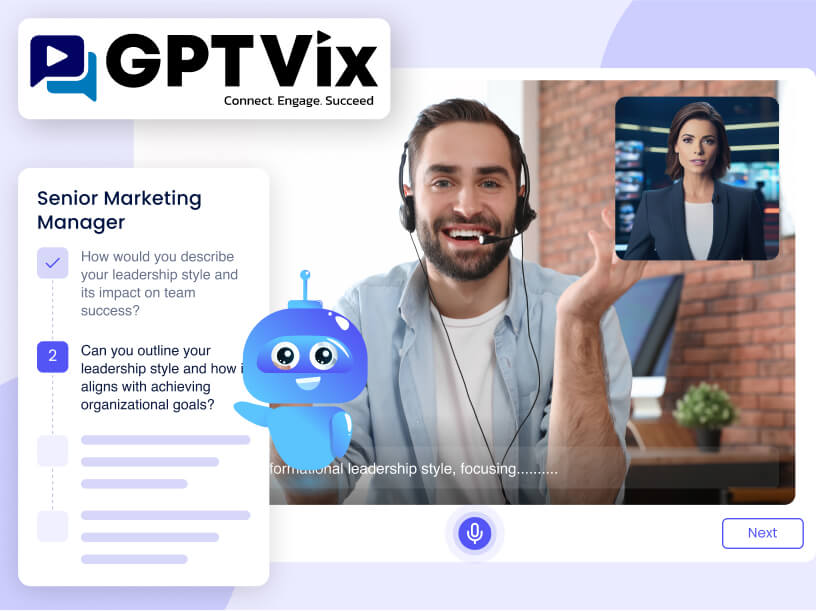
eComChat: AI Ecommerce Search Bot
A US online retailer with a catalog topping 47,000 products needed sharper on-site search, so we created an AI-powered search experience to deliver it. Using OpenAI embeddings alongside vector search, we made results far more accurate, grew revenue by 23%, and reduced the bounce rates tied to shoppers struggling to find what they wanted.
Learn More
ReadGenie: AI Reading Assistant App
We brought to life an iOS reading aid that turns photos into readable text using OCR, shortens lengthy material into quick summaries, and writes new content with GPT-3.5. Within seven days of launch the app passed 525 downloads, and it lets users translate across English, French, Spanish, and Japanese.
Learn More
If you are ready to move from strategy to execution, our team is ready to help. Contact Space-O Technologies today to discuss your AI development goals and get a clear, honest assessment of the best path forward for your business.
Frequently Asked Questions About AI Development
What is AI development?
AI development is the process of designing, building, and deploying software systems that perform tasks requiring human-like reasoning. These include understanding language, recognizing patterns, generating content, making predictions, and taking autonomous actions. It ranges from integrating pre-built AI tools to developing fully custom models using proprietary data.
How much does AI development cost?
AI development costs vary by scope and approach. Off-the-shelf tools typically cost $20 to $500 per user per month. AI-assisted development projects using APIs usually range from $25,000 to $150,000. Custom AI systems with full-stack development and model fine-tuning can cost $100,000 to $500,000 or more. Ongoing operational costs are typically 20% to 40% of the initial build annually.
How long does AI development take?
Timelines depend on complexity and data readiness. AI-assisted implementations can take 6 to 12 weeks, fine-tuned model development takes around 3 to 6 months, and fully custom AI systems may require 9 to 18 months. Data availability and quality are often the biggest factors affecting timelines.
What data do I need to start an AI development project?
Data requirements vary by use case. API-based solutions require minimal proprietary data, while fine-tuning models needs thousands to tens of thousands of labeled examples. Building custom models from scratch requires significantly larger datasets. A data readiness audit is essential to assess quality, gaps, and compliance needs.
Should I build a custom AI solution or buy an off-the-shelf tool?
Build a custom solution when your use case is unique and proprietary data provides a competitive advantage. Buy an off-the-shelf tool when it meets your needs with acceptable performance and faster deployment. Many organizations use a hybrid approach, combining both strategies.
What is the role of an AI development company?
An AI development company provides expertise, infrastructure, and structured processes to take AI projects from concept to production. They help select the right approach, manage data readiness, build and integrate solutions, and establish monitoring and governance frameworks for long-term success.
What is generative AI, and how is it different from other AI?
Generative AI refers to models that create new content such as text, images, code, and audio based on learned patterns. Traditional AI focuses on classification and prediction. Generative AI expands capabilities by producing original outputs, making it useful for content creation, conversational interfaces, and automation tasks.
What are AI agents, and how are they different from chatbots?
Chatbots respond to individual inputs with predefined outputs, while AI agents operate across multiple steps to achieve a goal. Agents can make decisions, use tools, and adapt dynamically without constant human input, making them suitable for complex workflows and automation scenarios. For a complete breakdown of chatbot types, capabilities, and how they work, read our guide on what is AI chatbot.



 All our projects are secured by NDA




 4.8
4.8