
 By
By 
Contents
Enterprise software development is a significant investment. Organizations need realistic cost expectations before committing resources to custom software projects. Understanding the average enterprise software development cost helps leaders make informed decisions about budgets and project feasibility.
The cost of enterprise software varies dramatically depending on scope, complexity, and team composition. According to Statista, in 2026, global spending on enterprise software was projected to reach approximately $1.43 trillion, marking a 15.2% increase compared to the previous year. Small applications cost between US $50,000 and US $100,000, while complex enterprise platforms exceed US $2 million.
Choosing the right enterprise software development company shapes everything from your final cost to your product’s long-term scalability. The wrong partner underestimates complexity, misses hidden expenses, and leaves you absorbing overruns mid-project. The right one brings transparent pricing, proven processes, and the technical depth to deliver on scope without surprises.
In this complete guide, you will discover cost ranges across project types and regions. You will learn factors that influence pricing decisions. You will understand engagement models and team structures. You will also explore hidden costs that impact final budgets. This knowledge base helps you plan accurately and control expenses throughout enterprise software development.
How Much Does Enterprise Software Development Cost?
Quick Answer: The cost to develop enterprise software typically ranges from US $80,000 for basic internal tools to over US $2 million for complex, large-scale systems, with mid-scale solutions often costing US $250,000–500,000.
Enterprise software development costs range widely based on project scope and complexity. A minimal viable product typically costs US $10,000 to US $50,000 for basic functionality. Mid-tier solutions requiring custom integrations cost US $50,000 to US $500,000 over several months. Large-scale enterprise platforms with advanced features range from US $500,000 to US $5 million or beyond.
Monthly team costs vary significantly by location and expertise levels. A development team in the United States costs US $30,000 to US $80,000 monthly. Teams in Eastern Europe average US $15,000 to US $40,000 per month. Indian development teams range from US $8,000 to US $25,000 monthly. These figures depend on team size, developer seniority, and specific skill requirements.
Hourly rates demonstrate similar geographic variations. United States developers charge US $100 to US $200 per hour. Western European professionals charge US $80 to US $150 hourly. Eastern European developers typically bill US $40 to US $80 per hour. Indian developers range from US $25 to US $50 per hour. Latin American teams charge US $40 to US $75 per hour on average.
The project timeline directly impacts total expenditure significantly. Quick turnaround projects cost more due to resource concentration. Standard timelines allow for better cost optimization and team efficiency. Extended schedules reduce per-unit costs but increase total project duration and overhead.
These ranges give you a working baseline, but your actual investment will depend on the specific factors covered in the next section. Understanding those variables is what separates an accurate budget from a costly guess.
What Factors Affect Enterprise Software Development Costs?
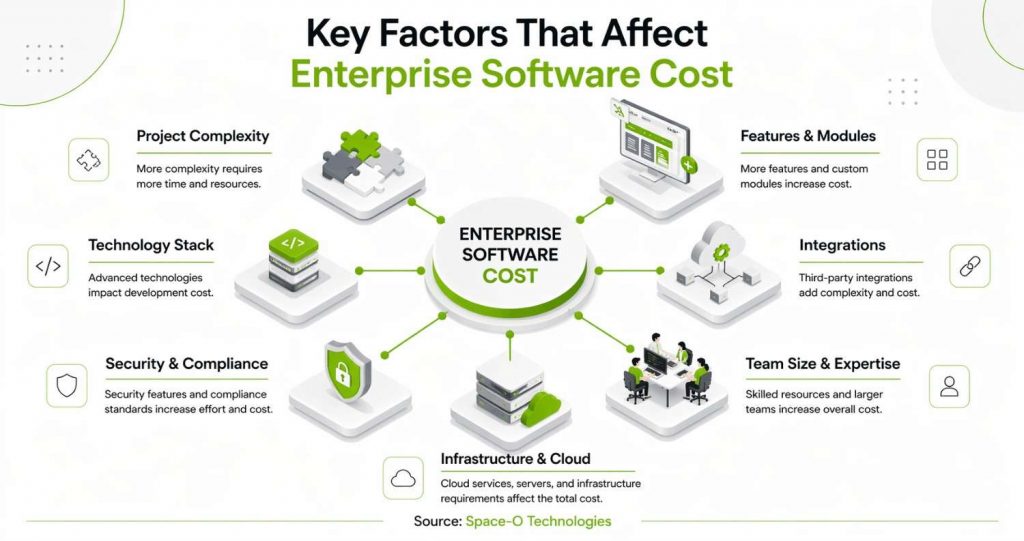
Multiple variables influence the final price of custom enterprise software solutions. Understanding these factors helps organizations estimate budgets more accurately. Control over these variables enables better cost management throughout implementation.
1. Project complexity and scope
Complexity is the primary driver of enterprise software costs. Simple applications with basic CRUD operations cost significantly less. Medium-complexity projects with workflow automation and reporting cost more. Highly complex systems requiring artificial intelligence and machine learning cost substantially more.
Scope definition determines what the software will accomplish. A narrow scope focusing on specific problems reduces costs considerably. A broad scope covering multiple departments and integrations increases expenses dramatically. Unclear scope leads to scope creep, which destroys budgets during development.
Feature requirements multiply costs proportionally across the project. Each additional feature requires design, development, and testing effort. Integration with existing systems adds complexity and specialized technical expertise. Custom reporting and analytics capabilities increase development time significantly.
2. Team size and composition
The people building your software directly determine costs most substantially. A junior developer costs less than a senior architect. Specialized roles like machine learning engineers cost more than generic developers. Project managers, quality assurance engineers, and DevOps specialists add essential expenses.
A typical enterprise software team includes these essential roles. Project managers coordinate timelines, budgets, and stakeholder communication. Solution architects design system structure and technology choices. Frontend developers build user interfaces and user experiences. Backend developers create core business logic and server infrastructure. Quality assurance engineers ensure functionality and security standards.
Team size varies based on project complexity and timeline constraints. Small teams of 3 to 5 people handle simple projects efficiently. Medium teams of 6 to 10 people manage mid-range complexity well. Large teams of 15 to 25 people tackle enterprise-scale platforms. Extremely large teams rarely improve productivity due to communication overhead.
3. Technology stack selection
Technology choices directly influence development speed and long-term costs. Using familiar, stable technologies reduces risk and accelerates development. Adopting cutting-edge technologies increases costs due to limited expertise availability. Legacy technology requirements increase maintenance costs significantly.
Modern stacks typically cost more initially but reduce long-term expenses. Cloud-native architectures enable better scalability and cost efficiency. Microservices architecture increases initial complexity but improves flexibility. Monolithic architecture reduces initial costs but limits future adaptability.
Database selection impacts both development and operational expenses. Relational databases like PostgreSQL offer proven reliability and cost efficiency. NoSQL databases suit specific use cases like real-time data processing. Enterprise database solutions increase licensing and operational costs substantially.
4. Geographic location and outsourcing models
Location dramatically influences per-hour and per-project costs globally. Onshore development in the United States costs the most. Nearshore development in Latin America offers moderate cost savings. Offshore development in Asia offers maximum cost reduction initially. For early-stage ventures specifically, outsourcing software development for startups is often the fastest way to preserve runway while building quickly.
Outsourcing to India reduces costs by 50 to 70 %, typically. Eastern Europe offers cost savings of 40 to 60 % commonly. Latin America provides a 30 to 50 % cost reduction. Hybrid models combine onshore and offshore to balance costs and control.
Time zone differences affect communication and project speed significantly. Same-timezone teams communicate more easily and make faster decisions. Distributed teams across time zones require structured communication processes. Asynchronous communication reduces real-time collaboration efficiency somewhat.
5. Compliance and security requirements
Regulatory compliance requirements increase development costs substantially. Healthcare software requiring HIPAA compliance costs 15 to 25 % more. Financial systems requiring SOC 2 certification add significant expense. GDPR compliance for European operations increases development and operational costs.
Security implementation requirements multiply project costs significantly. Basic encryption and authentication are now standard expectations. Advanced security measures like multi-factor authentication add costs. Penetration testing and security audits increase final project expenses.
Data protection standards vary by industry and geography. PCI DSS compliance for payment processing adds high costs. Industry-specific regulations require specialized expertise and processes. Compliance audits and certifications extend project timelines and budgets.
6. Integration and migration requirements
Integrating with existing systems adds complexity and specialized costs. Each integration point requires additional development and testing. APIs must be developed or modified to support new connections. Legacy system compatibility often increases overall project complexity.
Data migration costs depend on volume and quality requirements. Large data migrations require specialized tools and expertise. Data validation and cleansing add significant time and effort. Migration testing ensures data accuracy and system consistency.
Third-party service integrations increase development scope and costs. Payment gateways require specialized integration and security measures. Email services, SMS providers, and communication platforms add complexity. Marketplace integrations expand capabilities but increase development effort.
Every enterprise project carries a unique combination of these factors. Identifying which variables apply to your situation early is the most effective way to build an estimate you can actually rely on.
Build Enterprise Software That Scales With Your Business
From architecture to deployment, our engineers deliver custom enterprise solutions built for performance, security, and long-term growth.

Enterprise Software Development Costs by Project Type
Different types of enterprise software require varying investments and timelines. Understanding typical costs for specific applications helps with budget planning. Your project costs will depend on selected features and customization levels.
ERP systems (enterprise resource planning)
ERP systems integrate business operations across the entire organization. Manufacturing companies, distribution businesses, and large retailers use ERP solutions. These systems manage accounting, inventory, human resources, and supply chain functions.
Small ERP implementations cost between US $100,000 and US $300,000, typically. Mid-market ERP solutions range from US $300,000 to US $1 million. Large enterprise ERP platforms cost US $1 million to US $5 million or more. Implementation timelines extend from 6 months to 24 months, depending on complexity.
Customization requirements increase ERP costs substantially in most cases. Standard configurations cost less but may not match your processes exactly. Custom modifications allow precise workflow alignment but increase expenses. Integration with legacy systems significantly impacts final project budgets.
Customer relationship management (CRM) platforms
CRM systems manage customer interactions, sales pipelines, and marketing activities. Sales teams, customer service departments, and marketing organizations benefit most. These platforms centralize customer data and improve team collaboration effectiveness.
Basic CRM development costs between US $50,000 and US $150,000 for core functionality. Medium-complexity CRM solutions range from US $150,000 to US $400,000. Sophisticated CRM platforms with advanced automation cost US $400,000 to US $1 million. Multi-language and multi-currency support increases implementation expenses significantly.
Sales process automation, forecasting features, and analytics increase complexity. Integration with email systems, calendar applications, and messaging platforms adds costs. Mobile access for field teams requires additional development and testing efforts.
Human resources management systems (HRMS)
HRMS platforms manage employee data, payroll, benefits, and performance tracking. Organizations with hundreds or thousands of employees benefit most from custom HRMS. These systems streamline HR operations and improve employee data management.
Simple HRMS implementations cost between US $75,000 and US $200,000, typically. Comprehensive HRMS solutions with full compliance range from US $200,000 to US $600,000. Enterprise-scale platforms with advanced analytics cost US $600,000 to US $2 million. Annual maintenance costs typically equal 15 to 20 % of development expenses.
Payroll integration, benefit management, and compliance reporting add complexity. Multi-company support and regional regulatory compliance increase costs. Performance management, training tracking, and succession planning features add functionality.
Business intelligence and analytics platforms
BI platforms transform raw data into actionable business insights for decision-making. Executive dashboards, predictive analytics, and data visualization serve analytical needs. These solutions help organizations identify trends and opportunities quickly.
Basic BI platform development costs between US $80,000 and US $200,000 for foundational features. Mid-range solutions with advanced analytics cost US $200,000 to US $500,000. Enterprise analytics platforms cost US $500,000 to US $2 million or beyond. Real-time dashboards and machine learning features significantly increase expenses.
Data warehouse development, ETL processes, and data modeling add substantial complexity. Integration with multiple data sources requires a custom development effort. Advanced visualization and reporting capabilities extend development timelines.
Supply chain management software
Supply chain software optimizes procurement, inventory, and logistics operations. Manufacturing, retail, and distribution companies rely heavily on these systems. Real-time visibility and automated workflows improve operational efficiency significantly.
Typical supply chain solutions cost between US $150,000 and US $400,000 for implementation. Complex systems with advanced forecasting range from US $400,000 to US $1 million. Large-scale multi-facility systems exceed US $1 million in development costs. Integration with warehouse management and accounting systems increases expenses.
Inventory tracking, demand forecasting, and supplier management add functionality. Mobile access for field teams and vendor portals extends the scope. Real-time notifications and alert systems require additional development effort.
Each project type carries distinct complexity drivers that shape your final investment. Knowing the typical range for your category gives you a realistic anchor before you begin detailed scoping conversations with a development partner.
Get a Cost Estimate Built Around Your Project Type
Whether you’re building an ERP, CRM, HRMS, or custom analytics platform, cost varies significantly by scope and feature set. Get a detailed breakdown based on your actual requirements.
Engagement Models and Their Cost Implications
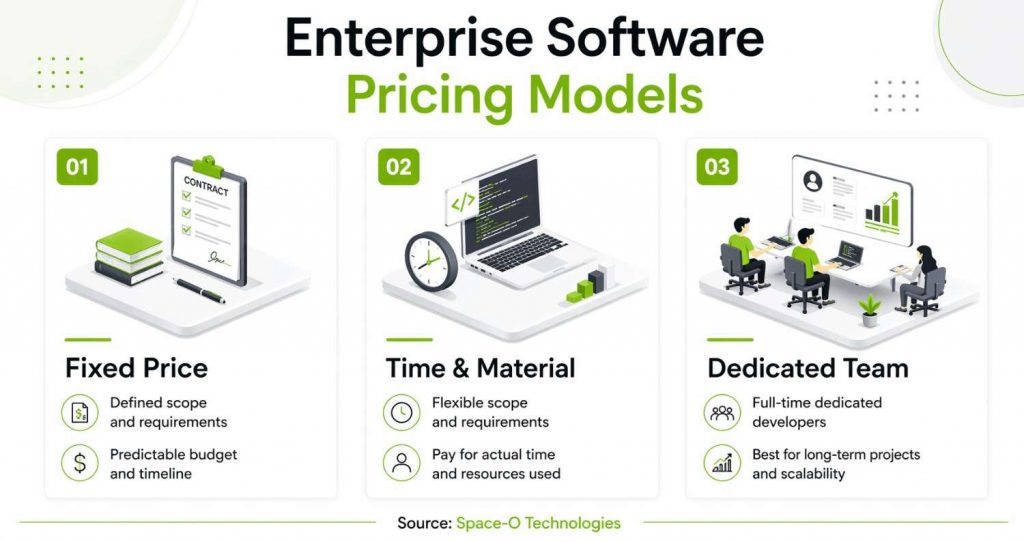
Different engagement models create different financial relationships and cost structures. Choosing the right model aligns with your budget, timeline, and flexibility needs. Each model carries distinct advantages and limitations.
Fixed price model
Fixed price software development models define the total project cost upfront before development begins. The vendor assumes financial risk if costs exceed the estimate. The scope must be extremely clear and detailed before contract signing. Changes to the scope become expensive modifications or costly renegotiations.
Advantages of fixed price engagement:
- Predictable budgets without surprise cost increases or overruns.
- Clear financial accountability and risk assignment.
- Vendor incentive to work efficiently and complete quickly.
- Easier budget approval from finance and leadership teams.
Disadvantages of fixed price models:
- A rigid scope prevents adaptation to changing business needs.
- Quality may suffer if vendors cut corners to protect margins.
- Change requests trigger disputes and additional costs.
- Less vendor collaboration on creative solutions.
Typical fixed price projects cost 10 to 20 % more due to risk premiums. However, cost certainty makes budgeting and financial planning much simpler. Fixed price works best for clearly defined projects with stable requirements.
Time and materials model
Time and materials (T&M) billing charges for actual hours worked and expenses incurred. Developers are billed at their hourly rate multiplied by the hours recorded. Material costs like software licenses and infrastructure pass through directly.
Advantages of time and materials engagement:
- Flexibility to modify scope and features during development.
- Better collaboration between your team and the vendor.
- Quality improvements occur without additional cost pressure.
- Adaptation to discovered requirements happens naturally.
Disadvantages of time and materials models:
- Unpredictable final costs without strict controls.
- Potential for budget overruns if the scope expands continuously.
- Requires strong project management to prevent waste.
- Less vendor accountability for efficiency and timelines.
T&M projects typically cost 20 to 30 % less than fixed price contracts. However, final expenses depend on actual effort and discovered complexity. Strict scope management and change controls become essential.
Dedicated team model
Dedicated team models hire developers for a specific duration, monthly or annually. Your organization receives focused attention from committed team members. Team members become an extension of your internal workforce effectively.
Advantages of dedicated team engagement:
- Cost efficiency compared to hiring full-time employees internally.
- Flexibility to scale team size up or down monthly.
- Deep knowledge of your project and business requirements.
- Easier to pivot direction and add features flexibly.
Disadvantages of dedicated team models:
- Less predictable costs if team size changes frequently.
- The vendor may not prioritize your project if their workload is high.
- Communication overhead increases with remote teams.
- Knowledge retention risks when team members change.
Monthly team costs range from US $8,000 to US $80,000, depending on location and seniority. Annual commitment reduces per-month rates by 10 to 15 % typically. This software development team extension model works best for ongoing projects requiring continuous development.
Hybrid and staff augmentation models
Hybrid models combine fixed price and T&M elements for balanced risk sharing. Staff augmentation hires individual developers to supplement internal teams. These flexible arrangements adapt to changing project needs.
Hybrid models typically charge fixed base fees plus hourly overages for changes. Staff augmentation costs match market rates for individual developer positions. Blended approaches offer flexibility with partial cost predictability.
The right engagement model isn’t always obvious at the start of a project. The best choice depends on how well-defined your requirements are today and how much flexibility you’ll need as the product evolves.
Get a Free Estimate for Your Software Project Today
Tell us about your requirements and receive a detailed cost breakdown from our enterprise software development team within 48 hours.
Regional Cost Comparison: Where to Build Your Software
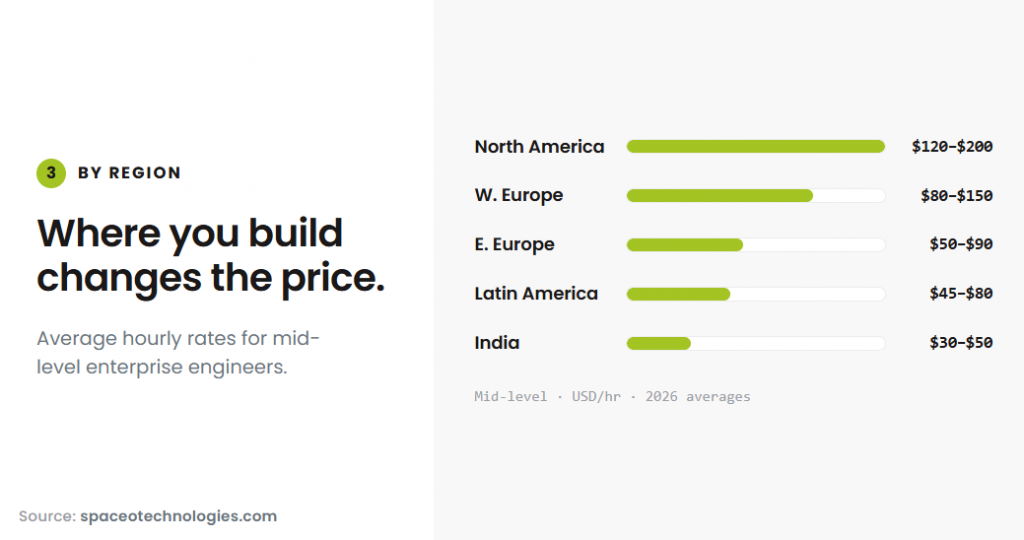
Geographic location dramatically influences enterprise software development costs. Understanding regional pricing helps optimize spending decisions strategically. Each region offers distinct advantages beyond cost considerations.
1. United States and Canada
Onshore software development in North America offers several important advantages. Your team operates in the same time zone for seamless communication. Cultural alignment and regulatory understanding minimize misunderstandings. Intellectual property protections are strong and well-established legally.
Hourly rates in the United States range from US $100 to US $200 per hour. Senior architects and specialized roles cost toward the higher end. Canadian rates fall slightly below United States rates, averaging US $80 to US $150. These high rates reflect experienced developers and established infrastructure.
Monthly team costs in North America typically range from US $30,000 to US $80,000. Small companies may have difficulty competing with large established firms. Talent shortages in specific technologies increase costs significantly. Cost-of-living differences between regions create some internal variation.
2. Western Europe
Western European development offers good quality with moderate cost increases. Developers understand complex regulatory environments across Europe well. Time zone overlap with North America enables real-time collaboration. English language proficiency is generally high among developers.
Hourly rates in Western Europe average US $80 to US $150 per hour, typically. Senior resources command higher rates of US $150 to US $200. Monthly team costs range from US $15,000 to US $50,000, depending on location. Scandinavia and Switzerland cost more than Spain and Portugal.
Switzerland and the Nordic countries rank among the most expensive regions. Eastern European countries offer lower rates than Western European nations. Legal frameworks and data protection standards are robust across Europe.
3. Eastern Europe
Eastern European development offers significant cost savings with quality maintained. Poland, Ukraine, Romania, and the Czech Republic provide strong talent pools. Time zone overlap with Western Europe enables efficient collaboration. English proficiency among developers is generally strong.
Hourly rates in Eastern Europe range from US $50 to US $90 per hour. Monthly team costs average US $15,000 to US $40,000 for experienced teams. Savings of 40 to 60 % compared to United States rates are typical. Quality remains high despite significant cost reductions.
Ukraine and Romania offer excellent value after recent cost increases. Poland provides reliable services with established infrastructure and processes. The Czech Republic delivers quality work with competitive pricing.
4. India and South Asia
India dominates the offshore software development market globally. Massive talent pools provide access to experienced developers readily. Significant cost savings of 50 to 70 % are common. Timezone differences allow 24-hour development cycles when managed well.
Hourly rates in India range from US $30 to US $50 per hour. Monthly team costs average US $8,000 to US $25,000 for quality developers. Savings of 70 to 75 % compared to the United States rates are possible. Entry-level developers cost less but may require more supervision.
English proficiency varies but is generally good among professionals. India has established software development infrastructure and processes. Quality concerns emerge primarily with very low-cost providers lacking expertise.
5. Latin America
Latin America offers nearshore advantages for North American companies. Time zone alignment enables easy same-day communication. Cultural similarities reduce communication barriers significantly. Cost savings of 30 to 50 % are typical for the region.
Hourly rates in Latin America range from US $45 to US $78 per hour. Monthly team costs average US $12,000 to US $35,000 for quality teams. Brazil and Mexico provide larger talent pools than smaller countries. Argentina and Colombia offer competitive pricing and strong technical skills.
Quality standards are generally high in established development hubs. Government support for technology sectors strengthens the ecosystem. English proficiency is growing among younger developers, notably.
Regional selection isn’t just a cost decision; it’s a communication, risk, and quality decision simultaneously. The lowest hourly rate rarely delivers the lowest total cost when time zone friction and quality gaps are factored in.
Team Composition, Roles, and What Each One Actually Costs
Understanding the typical software development team structure helps estimate total project costs accurately. Different project types require different skill combinations and expertise levels. Team size scales based on complexity and timeline requirements significantly.
Essential roles and their contributions
| Role | Primary Responsibility | Monthly Cost (Offshore) |
| Project Manager | Oversees timelines, budgets, and stakeholder communication | US $5,000 – US $10,000 |
| Solution Architect | Designs system structure and technology decisions | US $8,000 – US $15,000 |
| Backend Developer | Creates core business logic and server infrastructure | US $5,000 – US $12,000 |
| Frontend Developer | Builds user interfaces and user experience implementations | US $4,000 – US $10,000 |
| DevOps Engineer | Handles infrastructure and deployment processes | US $6,000 – US $12,000 |
| QA Engineer | Ensures functionality, security, and compliance standards | US $3,000 – US $8,000 |
| UI/UX Designer | Creates interface designs and user experience flows | US $4,000 – US $9,000 |
| Business Analyst | Gathers requirements and ensures business-technical alignment | US $3,000 – US $8,000 |
Sample team composition by project scale
| Project Scale | Team Size | Key Characteristics | Monthly Cost (Offshore) |
| MVP / Simple build | 3 – 5 members | Developers handle multiple roles: part-time PM, manual QA | US $15,000 – US $25,000 |
| Standard project | 6 – 10 members | Dedicated PM; clear role separation; automated testing | US $30,000 – US $60,000 |
| Complex enterprise platform | 15 – 25 members | Specialized roles; multiple team leads; full automated and manual QA | US $80,000 – US $150,000+ |
Team composition is as important as team size. Overstaffing a project wastes budget. Understaffing creates bottlenecks that cost more to fix than they save upfront. Getting the right mix of roles for your specific build is where experienced development partners earn their value.
Hidden Costs in Enterprise Software Development
Most organizations build a development budget and stop there. The expenses that actually derail enterprise projects rarely come from development itself. QA, infrastructure, maintenance, third-party tools, and unplanned scope changes quietly stack up and push final costs well beyond original estimates.
Here’s what you need to account for before finalizing any budget.
1. Quality assurance and testing
Testing is consistently the most underbudgeted line item in enterprise projects. Manual testing costs grow with application complexity. Automated testing requires a higher upfront investment but reduces long-term QA spend. Performance, security, penetration, compliance, and user acceptance testing all add to the total.
Budget 15 to 25 % of your development cost for QA. Projects that skip this don’t save money. They pay more to fix production failures after launch.
2. Infrastructure and hosting
Your software needs somewhere to live, and that cost scales with growth. Separate environments for development, staging, and production each carry their own costs. Cloud infrastructure, database hosting, content delivery networks, load balancing, auto-scaling, and backup systems all contribute to ongoing operational spend. Security infrastructure adds further to the monthly bill.
Monthly hosting costs typically range from US $500 to US $10,000, depending on traffic volume and security requirements.
3. Maintenance and support
Launch is where the ongoing investment begins, not ends. Post-launch maintenance typically costs 15 to 20 percent of your original development spend annually. Bug fixes, security patches, performance optimization, and system monitoring are continuous needs. Feature enhancements and user support require dedicated resources beyond the initial build.
Plan for year-one maintenance to exceed 20 % of your development investment.
4. Third-party services and licenses
Software development tools, code repositories, testing platforms, and deployment pipelines all carry recurring fees. API costs scale with usage. Monitoring tools, support platforms, and payment gateways add monthly or per-transaction costs. For regulated industries, compliance tooling is mandatory.
These costs are individually small but collectively can add US $2,000 to US $15,000+ monthly, depending on your integration footprint.
5. Change orders and scope additions
No enterprise project finishes exactly as scoped. Feature requests, technical discoveries, and mid-build requirement changes all generate additional cost.
Set aside a contingency budget of 10 to 20 percent from the start. Treating it as a reserve rather than a spending buffer keeps projects on track when requirements shift.
The gap between estimated and actual cost on enterprise projects is almost always explained by these five categories. Building them into your initial budget is the difference between a project that finishes and one that stalls mid-build.
Get a Budget That Accounts for the Full Picture
Development is just one line item. Testing, infrastructure, maintenance, and change orders are where budgets break down. Work with a team that plans for all of it upfront — not after the fact.
How to Reduce Enterprise Software Development Costs
Significant cost savings are possible through smart strategies and careful planning. Reducing software development expenses does not require sacrificing quality or functionality. Strategic approaches maintain value while optimizing spending efficiency.
1. Define clear requirements upfront
Vague requirements lead to scope creep and endless revisions. Clear specifications prevent misunderstandings and rework substantially. Written requirements reduce back-and-forth discussions significantly. Detailed requirements help developers estimate more accurately.
Requirements clarity prevents discovery-phase mistakes that cost thousands. Organized specification documents guide development effectively. Sign-off from stakeholders confirms alignment before development begins. Clear requirements typically save 20 to 30 % of development time.
2. Start with the MVP approach
Building minimum viable products first reduces initial costs dramatically. Core features launch first with full functionality. Additional features launch in subsequent phases after user feedback. MVP approach reduces initial risk and accelerates learning.
MVP timelines are typically 30 to 50 % shorter than full platforms. Smaller initial teams cost less and stay more coordinated. Earlier revenue sometimes offsets some development costs. Market learning informs future development priorities effectively.
3. Leverage existing frameworks and libraries
Building from scratch is more expensive than using proven frameworks. Open-source solutions provide starting points for rapid development. Third-party libraries implement common functionality without rebuilding. Established frameworks reduce development time by 30 to 50 %, typically.
Choosing popular software development frameworks increases developer availability and reduces costs. Mature frameworks have better documentation and community support. Framework knowledge transfers more easily between developers. Avoiding proprietary solutions prevents vendor lock-in risks.
4. Optimize team composition and location
Offshore and nearshore teams reduce costs significantly compared to onshore. Blending senior and junior developers balances expertise and cost. Hiring for specific skills prevents paying for unused expertise. Part-time resources reduce costs for non-critical roles.
Experienced teams work more efficiently and produce better code. Reducing team size through efficiency improves communication. Specialized expertise prevents time wasted on unfamiliar technologies. Right-sized teams maintain productivity better than oversized ones.
5. Implement agile development practices
Agile methodology enables efficient development and course correction. Iterative development catches issues early before they cost more. Sprint-based work focuses effort on the highest-value items. Regular feedback prevents building the wrong functionality.
Agile timelines are typically 15 to 25 % shorter than waterfall. Early deployment of core features provides value faster. Course corrections during development cost less than after launch. Agile collaboration reduces miscommunication and rework.
6. Use cloud and SaaS solutions
Cloud services eliminate infrastructure capital expenses initially. SaaS solutions replace custom development for commodity functions. Platform-as-a-Service reduces infrastructure management overhead. Infrastructure scales with usage, avoiding upfront overprovisioning.
Pay-as-you-go models reduce upfront capital requirements. Cloud services scale automatically with demand, eliminating overprovisioning. Managed services reduce operational overhead and support costs. Cloud providers handle security and compliance updates automatically.
Cost reduction isn’t about cutting corners; it’s about making smarter choices at each stage of the software development plan. The teams that consistently come in on budget are the ones who apply these strategies from the first week of scoping, not after costs have already spiraled.
Build Your Enterprise Software With a Team That Gets It Right the First Time
Enterprise software development is too expensive and too strategically important to navigate with guesswork. You need a software development partner who brings both technical depth and genuine cost transparency, one that plans for hidden expenses, right-sizes the team, and estimates with accountability.
At Space-O Technologies, we’ve spent 15+ years delivering custom enterprise software across ERP, CRM, HRMS, analytics, and supply chain verticals. With 180+ engineers and a 98% client retention rate, we combine the technical breadth to handle complex builds with the startup-minded efficiency that keeps costs under control.
Whether you’re scoping a first-phase MVP or planning a full-scale enterprise platform, we work with your budget constraints to define what’s buildable, what’s optional, and what the realistic cost will be before a single line of code is written.
Frequently Asked Questions About Enterprise Software Development Cost
How much does enterprise software development cost on average?
Enterprise software development costs vary based on complexity. Small applications typically cost between $50,000 and $100,000, medium-complexity systems range from $100,000 to $500,000, and large enterprise platforms can cost $500,000 to $5 million or more. Final costs depend on team size, technology choices, and project timeline.
What factors influence enterprise software development pricing most?
Key factors include project complexity, team composition, and geographic location. Technology stack selection, timeline constraints, compliance requirements, and integration needs also significantly impact pricing. Clear scope definition and stable requirements help control costs.
Is it cheaper to outsource enterprise software development?
Outsourcing can reduce costs by 30% to 70% compared to onshore development. Regions like India and Eastern Europe offer significant savings, while nearshore options provide a balance between cost and communication. However, time zone differences and collaboration challenges should be considered.
What engagement model saves the most money?
Time and materials models are often 20% to 30% more cost-efficient due to flexibility. Fixed-price models provide budget certainty but may cost more, while dedicated team models offer a balance between cost and scalability. Hybrid models combine predictability with flexibility.
How can I estimate my enterprise software development costs?
Estimation methods include function point analysis, use case estimation, and analogy-based approaches. Bottom-up estimation breaks work into tasks, while three-point estimation accounts for risk. Consulting experienced developers also helps create realistic cost projections.
What are typical hidden costs in enterprise software projects?
Hidden costs include QA and testing, which can add 15% to 25%, infrastructure and hosting expenses, and ongoing maintenance. Third-party tools, licenses, and scope changes can also increase overall costs unexpectedly.
How much should I budget for post-launch maintenance?
Post-launch maintenance typically costs 15% to 20% of the initial development cost annually. Complex systems require higher maintenance, while cloud-based solutions may reduce long-term operational overhead compared to on-premise setups.
What is the cost difference between custom and off-the-shelf software?
Custom software requires higher upfront investment but aligns perfectly with business processes. Off-the-shelf solutions cost less initially but may require process adjustments. Over time, total cost of ownership depends on customization needs and business requirements.



 All our projects are secured by NDA




 4.8
4.8