---
title: "7 Best AI Frameworks and Tools [Artificial Intelligence Frameworks]"
url: "https://www.spaceotechnologies.com/blog/top-ai-frameworks-tools/"
date: "2021-12-09T03:00:59+00:00"
modified: "2026-06-09T07:55:43+00:00"
author:
name: "Bhaval Patel"
categories:
- "Artificial intelligence"
word_count: 2055
reading_time: "11 min read"
summary: "Looking for some of the best AI frameworks and tools to develop artificial intelligence apps? Herein in this blog, we have listed 7 best artificial intelligence frameworks and tools that we have se..."
description: "Looking for the best AI frameworks and tools to use for AI-based apps? Herein we have listed 7 top AI frameworks that you can check and use for apps."
keywords: "AI frameworks, Artificial intelligence"
language: "en"
schema_type: "Article"
related_posts:
- title: "Top 10 Generative AI Consulting Companies for Strategy and Implementation"
url: "https://www.spaceotechnologies.com/blog/generative-ai-consulting-companies/"
- title: "Top 10 Generative AI Development Companies in 2026"
url: "https://www.spaceotechnologies.com/blog/generative-ai-development-companies/"
- title: "Top 10 AI Development Companies to Build Scalable AI Solutions"
url: "https://www.spaceotechnologies.com/blog/ai-development-companies/"
---
# 7 Best AI Frameworks and Tools [Artificial Intelligence Frameworks]
_Published: December 9, 2021_
_Author: Bhaval Patel_
*Looking for some of the **best AI frameworks and tools** to develop artificial intelligence apps? Herein in this blog, we have listed 7 best artificial intelligence frameworks and tools that we have selected on the basis of usage, popularity, features, and functionalities.*
Table of Contents
1. [7 Best AI Frameworks And Tools To Choose From](#one)
1. [Tensorflow](#one-1)
2. [Microsoft CNTK](#one-2)
3. [Keras](#one-3)
4. [Theano](#one-4)
5. [Sci-kit Learn](#one-5)
6. [Caffe](#one-6)
7. [Torch](#one-7)
3. **[Summing Up](#two)**
Artificial intelligence has been around for a very long time, but it was once considered extremely difficult to implement in practice. Today, [AI development](https://www.spaceotechnologies.com/blog/ai-development/) is far more accessible thanks to evolving tools and frameworks. So, what is a software framework for AI? An AI framework is a pre-built library or platform that provides developers with tools, APIs, and reusable code to build machine learning and deep learning applications without starting from scratch. In recent years, AI frameworks and tools have made AI development much more approachable for the IT sector.
Fortunately, this all this changing. In recent years, AI frameworks and tools for AI have made it much friendlier for the IT sector. This is why we found it the right time to tell you AI enthusiasts about the best AI libraries, sourcing tools, and frameworks.
Being a [AI development services provider](https://www.spaceotechnologies.com/ai-development-services/), we have made sort of an AI framework comparison of the best AI tools in the list below. We have talked about the best frameworks as per our experience in the field.
We do understand that every data scientist and app development team has a unique requirement for his project and this is why this list will be helpful for you. You can choose the **Artificial Intelligence software tools** that work best for you.
***Note:*** *The list below covers the most popular AI frameworks used by developers worldwide. These popular AI frameworks are not listed in chronological order of efficiency.*
## 7 Best AI Frameworks And Tools To Choose From
While many AI framework lists feature the top 10 AI frameworks, we’ve narrowed down this comprehensive AI framework list to the 7 most impactful options for developers in 2025. Here are the frameworks that deliver the best results:
| **AI Frameworks** | **Release Year** | **Repository** | **Platforms** | **Language Used** |
|---|---|---|---|---|
| [Tensorflow](#one-1) | 2015 | [](https://github.com/tensorflow/tensorflow) | macOS, Microsoft Windows, Android, JavaScript | Python |
| [ Microsoft CNTK](#one-2) | 2016 | [](https://github.com/microsoft/CNTK) | Microsoft Windows | Python, C++ |
| [ Keras](#one-3) | 2015 | [](https://github.com/keras-team/keras) | Cross-platform | Python |
| [ Theano](#one-4) | 2007 | [](https://github.com/Theano/Theano) | macOS, Microsoft Windows | Python, CUDA |
| [Sci-kit Learn](#one-5) | 2007 | [](https://github.com/scikit-learn/scikit-learn) | Linux, macOS, Windows | Python, C, C++, Cython |
| [ Caffe](#one-6) | 2017 | [](https://github.com/BVLC/caffe) | Linux, macOS, Windows | C, C++, Python |
| [ Torch](#one-7) | 2002 | [](https://github.com/torch/torch7) | Linux, Android, Mac OS X, iOS | Lua |
1.
### Tensorflow
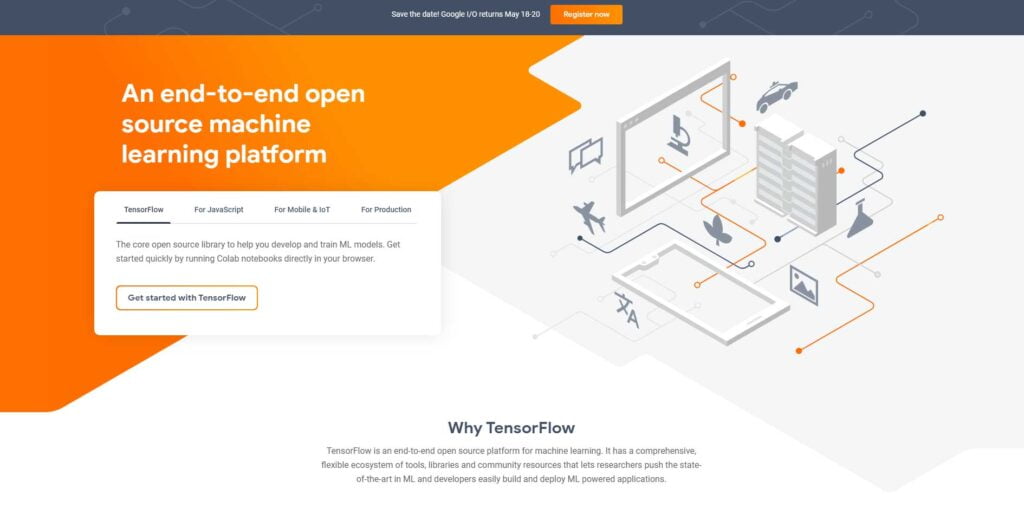
Even if you’re someone who just started to learn about developing apps and software using AI, you must have heard this name. TensorFlow is one of the **most popular frameworks** or machine learning library, and the best part is that it is open source.
Source: Tensorflow
Being backed by Google doesn’t hurt and has a client-base that includes the likes of Airbnb, eBay, Dropbox, and Coca-Cola. In fact, it was developed by **Google’s AI department** and now has become a favorite AI tool of the top tech giants such as **AMD, SAP, Google, Intel, Nvidia** and others.
It is perfectly suited for complex numerical computations of high volumes using data-flow graphs and machine learning for your machine learning projects. This framework has an architecture that allows computation on any CPU or GPU. it is compatible with a desktop, server, or even mobile device.
It supports many classification and regression algorithms and deep learning, neural networks, and natural language processing solutions.
| **Programming languages** | Uses an easy-to-learn language Python, C++, CUDA |
|---|---|
| **Pros** | Keeps code lean and development efficient due to simplifications and abstractions |
| **Cons** | It’s slow, as Python is not the fastest of languages and lacks pre-trained machine learning models |
2.
### Microsoft CNTK
How could Microsoft stay behind Google? CNTK is how Microsoft responded to SensorTower.
Microsoft Cognitive Toolkit or **CNTK is an open-source** and deep learning toolkit. It uses a directed graph to describe neural networks as a series of computational steps. It designed to support robust, commercial-grade datasets and algorithms.
This library that enhances the maintenance of separating computation networks, providing machine learning algorithms and model descriptions. It can also build, train, and run many types of deep neural networks.
It has its own model description language called BrainScript and can be used as a **standalone machine-learning tool**. Not only that, but CNTK can also be included with Python, C++ any .NET language including C#, or Java (**model evaluation functionality**).
This library can be used in AI applications like the ones that can predict house prices or such. Without sacrificing a quality degree of speed and accuracy, it offers efficient scalability from a single CPU to GPUs to multiple machines. It serves big clients like Skype, Cortana, and Bing.
| **Programming languages** | C++, C#, Java, and Python |
|---|---|
| **Pros** | It is very flexible and allows for distributed training |
| **Cons** | Implemented in Network Description Language and lacks visualization |
3.
### Keras
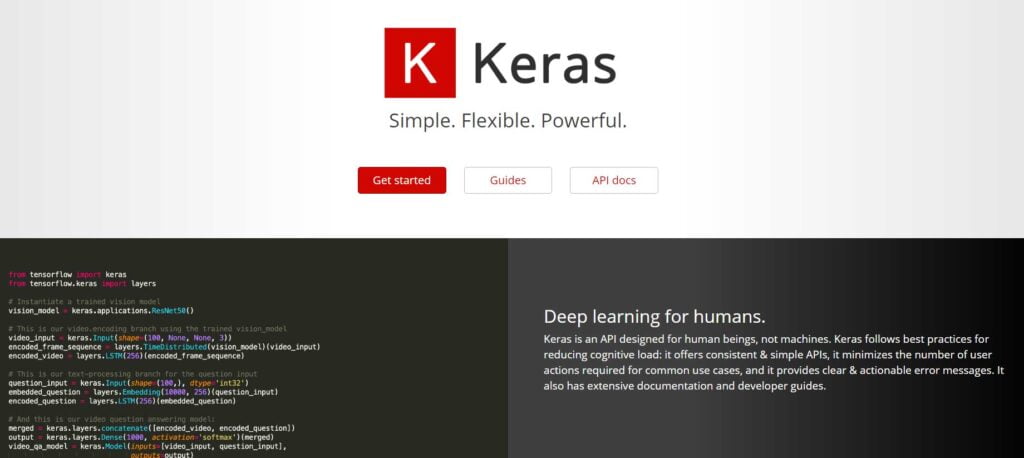
Keras is one of the **most popular AI frameworks**, a neural network library that is written in Python just like TensorFlow, CNTK but unlike them, it is not meant to be an end-to-end machine learning framework. Keras is an API which exclusively designed for humans and not machines.
Source: Keras
Instead, it operates as a user-friendly, easily extensible interface. This provides a high level of abstraction, making the configuration of neural networks easy regardless of the framework it is sitting on.
New modules are easy to add while neural layers, cost functions, and other standalone modules can be combined with few restrictions.
This Python deep learning library is a **high-level neural network API** that can run on top of TensorFlow, Microsoft Cognitive Toolkit, or Theano and supports modularity and total expressiveness.
| **Programming language** | Python |
|---|---|
| **Pros** | Runs seamlessly on both CPU and GPU |
| **Cons** | It can’t be efficiently used as an independent framework |
4.
### Theano
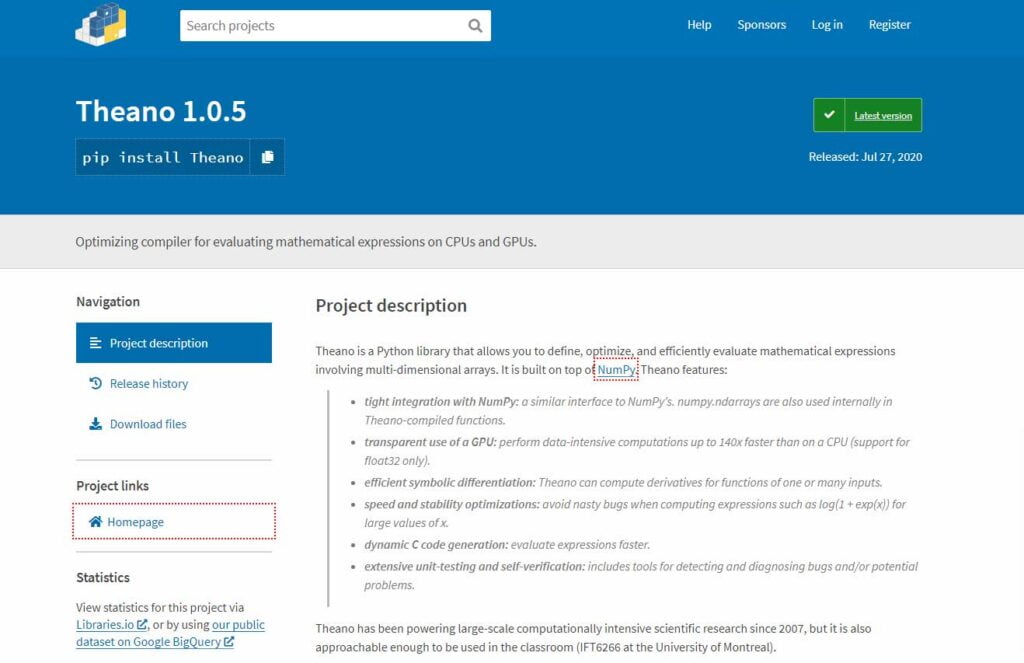
Theano gives strong competition to TensorFlow. This artificial intelligence tool is a Python library that allows defining, optimizing and evaluating mathematical expressions, that involves multi-dimensional arrays efficiently. It particularly evaluates **matrix-valued expressions**.
Source: Theano
This is one of the best AI development frameworks which uses GPU transparently for carrying out data-intensive computations instead of a CPU which results in high efficiency in its operations. In fact, Theano has also been able to top C on a CPU by a significant degree.
Large-scale computationally intensive operations have been powered by Theano for the same reason.
For this reason, Theano has been used in powering large-scale computationally intensive operations for about a decade.
Theano pairs elements of a **computer algebra system (CAS)** with elements of an optimizing compiler. This is how complicated mathematical expressions that require repeated and fast evaluation get an ideal environment.
| **Programming language** | Python |
|---|---|
| **Pros** | Properly optimized for CPU and GPU and efficient for numerical tasks |
| **Cons** | A bit buggy on AWS (Amazon Web Services) and needs to be used with other libraries to gain a high level of abstraction |
5.
### Sci-kit Learn
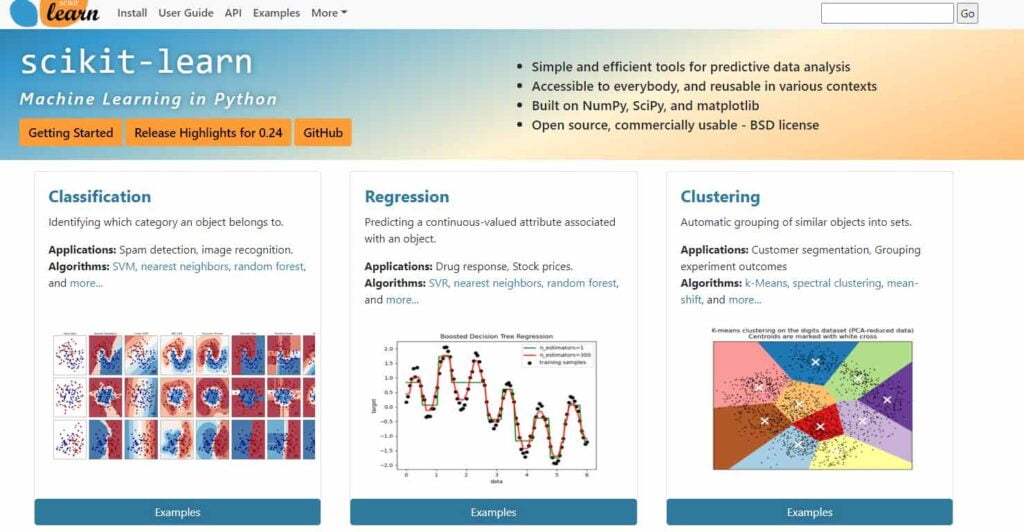
Sci-kit learn is for Machine learning in Python.
Scikit-learn is one of the Artificial Intelligence open-source tools, a commercially usable AI framework. It is a Python library that supports both supervised and unsupervised machine learning.
Source: Sci-kit Learn
This is one of the **multipurpose AI development tools**, it supports classification, regression, and clustering algorithms, and also, dimensionality reduction, model selection, and preprocessing.
Data scientists can quickly access resources on anything from multiclass and multilabel algorithms to covariance estimation using the extensive user guide offered by sci-kit learn.
Sci-kit learn comes with features such as cross-validation, supervised and unsupervised learning algorithms and helps in building models.
| **Programming languages** | Python, CUDA, C, C++ |
|---|---|
| **Pros** | Many main algorithms are available |
| **Cons** | Not very efficient with GPU |
6.
### Caffe
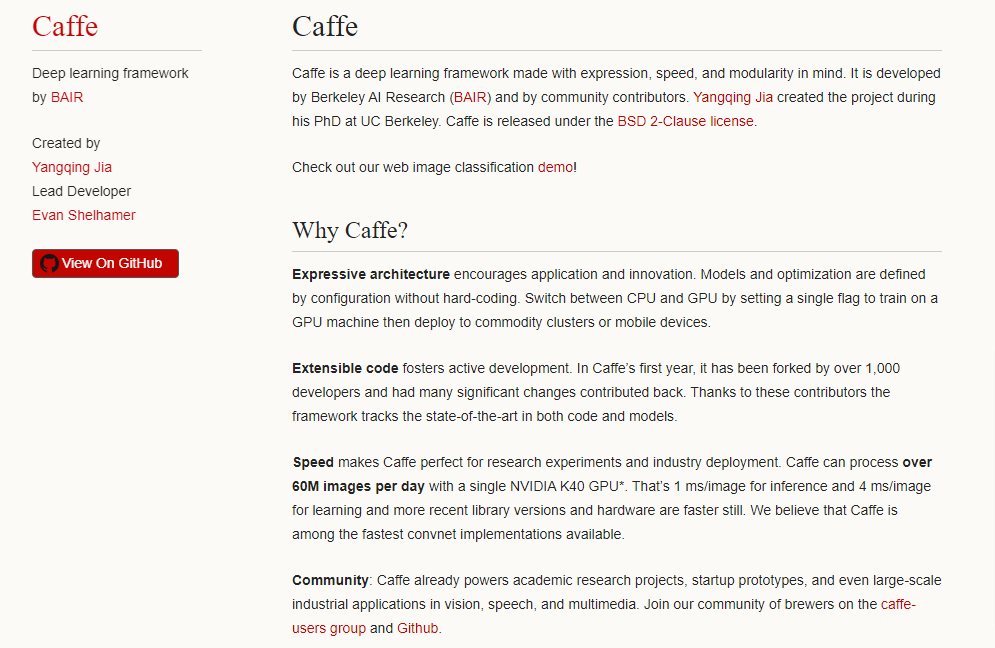
Berkeley AI developed Research Caffe is a deep learning framework in collaboration with community contributors.
Source: Caffe
Expression, speed, and modularity are prioritized in its framework. It has a strong architecture that supports configuration-defined models and optimization without hard coding. It is also capable of switching between CPU and GPU.
Caffe is suitable for research experiments and industry deployments because it can process over 60M images per day with a single NVIDIA K40 GPU.
This AI framework is adaptable with C++, CUDA with Command line, Python, and MATLAB interfaces. Building a **convolutional neural network (CNN)** for image classification with Caffe is very easy.
| **Programming language** | C++ |
|---|---|
| **Pros** | Allows for the training of models without writing code |
| **Cons** | Bad for recurrent networks and not great with new architectures |
7.
### Torch
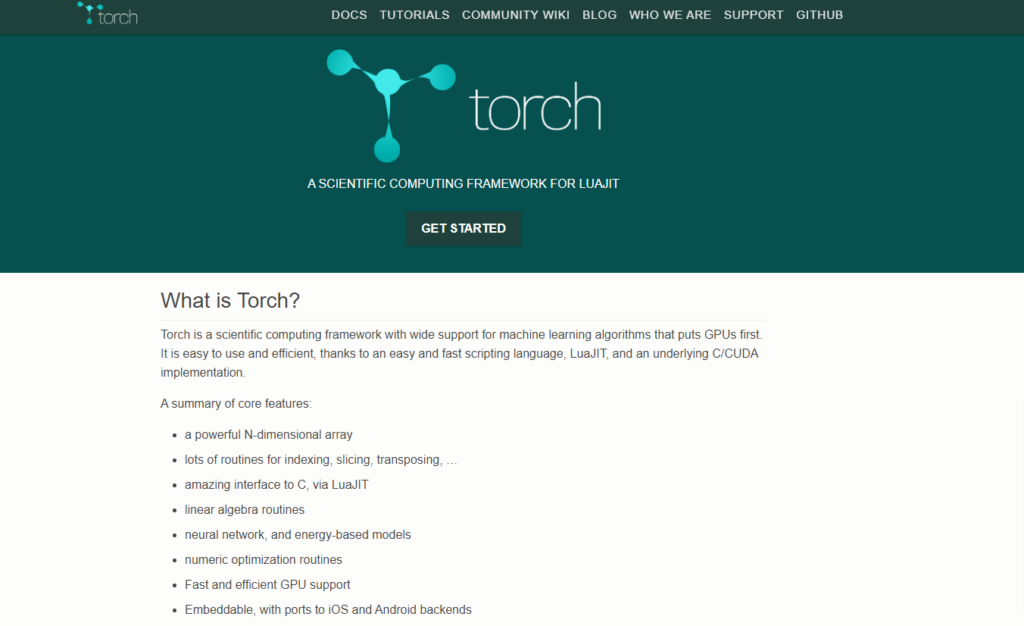
Torch is a scientific computing framework for scientific and numerical operations. It builds algorithms with speed, flexibility, and simplicity.
Source: Torch
Torch claims to put GPUs first and is a Tensor Library that’s similar to NumPy. It is wrapped in LuaJIT and has an underlying implementation of C/CUDA.
It has improved efficiency and makes for easier deep learning research by providing a large number of algorithms. Torch users are provided with easy to use libraries while enabling the flexible implementation of complex neural network topologies.
With a powerful N-dimensional array, it helps with operations such as slicing and indexing. It also offers linear algebra routines and neural network models.
| **Programming languages** | Lua, LuaJIT, C, CUDA and C++ |
|---|---|
| **Pros** | Lots of pre-trained models available and very flexible |
| **Cons** | Documentation is quite unclear and Lua is not a very popular language |
These are some of the best AI frameworks available. If you’re looking for a more comprehensive solution that not only includes the framework but also offers a range of tools and services for building, deploying, and managing ML models, then you should consider [popular machine learning platforms](https://www.spaceotechnologies.com/blog/machine-learning-platforms/).
Typically, a machine learning platform includes features such as data management, model training, and testing, model deployment and monitoring, collaboration, and version control. Of course, the choice between a framework or platform depends on the specific needs and scale of your AI project.
## Summing Up
According to us, these are just 7 of the best AI frameworks useful for [AI app development](https://www.spaceotechnologies.com/blog/artificial-intelligence-in-mobile-app-development/), and we understand that your choice and preferences may differ from ours. You might use other artificial intelligence development tools altogether.
We will keep updating the list with our experience and research in this segment. If you to learn more you can also go through our post on [AI application ideas using OpenAI API](https://www.spaceotechnologies.com/blog/ai-app-ideas-using-openai/).
Choosing the right framework is only one piece of the puzzle. Without the right expertise, even the most powerful tools can fail to deliver meaningful results. Working with [experienced AI development companies](https://www.spaceotechnologies.com/blog/ai-development-companies/) ensures these tools are implemented correctly within a scalable, production-ready architecture that aligns with your business goals. From selecting the right models and data pipelines to handling deployment, monitoring, and continuous improvement, expert teams help you avoid costly mistakes and accelerate time to value.
We serve a multitude of clients all around the world with our expertise in Artificial Intelligence and Machine Learning. We have also developed apps with advanced features using AI frameworks, libraries and APIs. Here are some of the AI-based apps developed by us:
AI-powered Apps Developed by Space-O Technologies
AI Recruitment Software
GPT Vix is an AI recruitment software like Zoho Recruit built for a recruiting agency in the USA. We developed it using technologies like OpenAI’s ChatGPT for natural language processing, OpenAI’s Whisper for video-to-text conversion, and Synthesia for text-to-video generation.
[Learn More](https://www.spaceotechnologies.com/project/gptvix-ai-recruitment-software/)
AI-powered eCommerce Search Bot
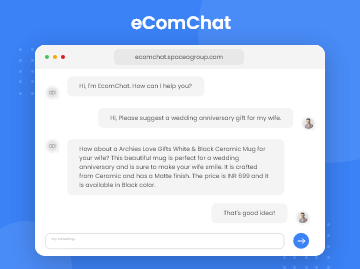
eComChat is an eCommerce search bot like ChatGPT that utilizes OpenAI libraries and NLP algorithms to process user queries from a database of 20,000 eCommerce products. It eliminates zero search result queries and enhances product discovery, boosting the online store’s speed by 23%.
[Learn More](https://www.spaceotechnologies.com/case-study/ecomchat/)
OpenAI-based
Image to Text App
ReadGenie is a reading assistant app that uses technologies like OCR and GPT 3.5 model to convert/extract images to text, summarize the main points, generate new content, and translate content to multiple languages.
[Learn More](https://www.spaceotechnologies.com/project/readgenie-ai-based-image-to-text-app/)
If you have an app idea that requires integration AI-based features then get in touch with us. As an experienced [mobile app development company](https://www.spaceotechnologies.com/mobile-app-development/) we can solve your queries in regards to using AI in your mobile app. All you need to do is to fill up the form in the footer. One of our sales representatives will reach out to you within 2 working days.
To ensure your idea is built on the right foundation, our [strategic AI consulting](https://www.spaceotechnologies.com/ai-consulting-services/) helps you validate use cases, assess feasibility, and define a clear roadmap before development begins, aligning your app vision with real business outcomes.
---
_View the original post at: [https://www.spaceotechnologies.com/blog/top-ai-frameworks-tools/](https://www.spaceotechnologies.com/blog/top-ai-frameworks-tools/)_
_Served as markdown by [Third Audience](https://github.com/third-audience) v3.5.5_
_Generated: 2026-06-09 07:55:45 UTC_